




- Beauty & Personal Care
- Hair Bond Multiplier Market
Hair Bond Multiplier Market Size, Share, and Growth Forecast 2026 - 2033
Hair Bond Multiplier Market by Product Type (Kit, Loose), by Application (Hair Colouring, Hair Treatment), End-user (Salons, Spa, Personal Use), by Distribution Channel (Direct Sales, Retail Sales, Modern Trade Distributors and Wholesalers, Health & Beauty Stores, Online Retailers), and Regional Analysis, 2026 - 2033

Hair Bond Multiplier Market Size and Trend Analysis
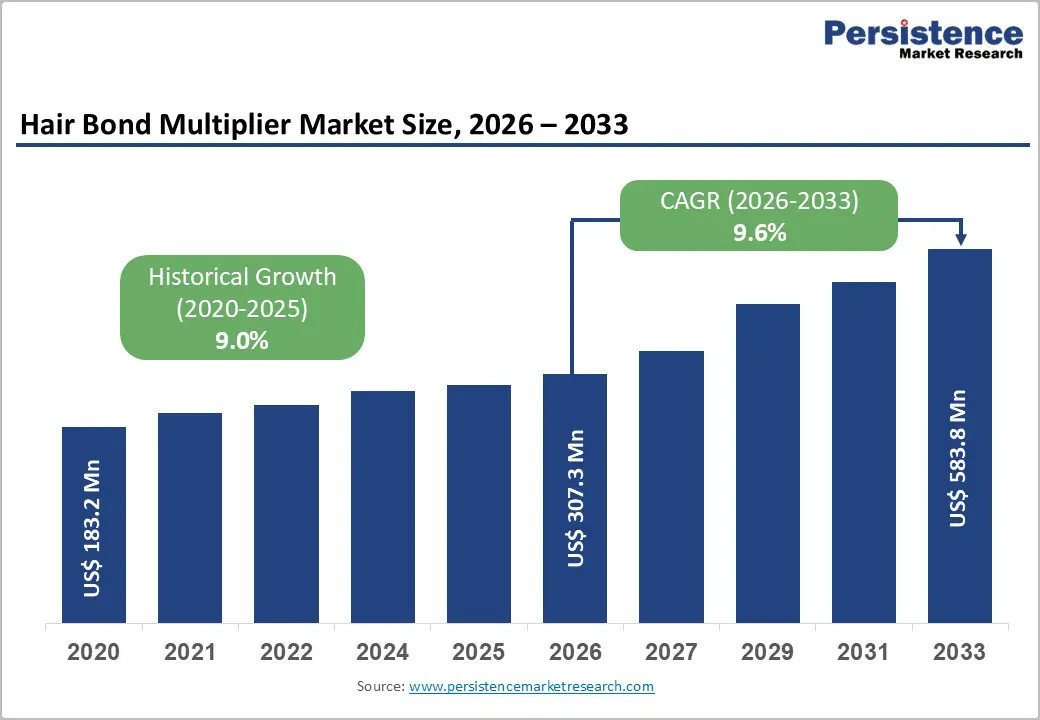
The global hair bond multiplier market size is expected to be valued at US$ 307.3 million in 2026 and projected to reach US$ 583.8 million by 2033, growing at a CAGR of 9.6% between 2026 and 2033.
Rising consumer demand for protective and restorative hair care products, particularly amid frequent coloring, bleaching, and heat styling, is driving market growth. With over 90% of women regularly coloring their hair, structural bond damage has become a key concern, accelerating product adoption. Technological advancements, including patented peptides and cross-linking agents, are enhancing repair performance, driving increased usage across professional salons and at-home treatment segments worldwide.
Key Industry Highlight:
- Leading Region: North America dominates Hair Bond Multiplier with 38% share in 2025, supported by innovation hubs and strong salon culture.
- Fastest-Growing Region: Asia Pacific is the fastest-growing market with 32% share in 2025, driven by urbanization, rising middle-class populations, and growing beauty consciousness.
- Leading Product Category: Kits lead the market with 65% share in 2025, offering convenient and structured sequential applications for professional and at-home use.
- Fastest-Growing Application Category: Hair Colouring accounts for 62% share in 2025, driven by demand for bond protection during chemical treatments.
- Key Market Opportunity: The men’s grooming segment presents growth potential, fueled by rising adoption of unisex hair bond products.
| Key Insights | Details |
|---|---|
|
Hair Bond Multiplier Size (2026E) |
US$ 307.3 million |
|
Market Value Forecast (2033F) |
US$ 583.8 million |
|
Projected Growth CAGR(2026-2033) |
9.6% |
|
Historical Market Growth (2020-2025) |
9.0% |
Market Dynamics
Drivers - Rising Consumer Demand for Protection Against Damage from Frequent Chemical Hair Treatments
Frequent hair coloring, bleaching, and chemical styling significantly weaken hair structure by breaking disulfide bonds within the cortex. Clinical findings published in the Journal of Cosmetic Dermatology indicate that hair dyed more than five times can lose up to 52% of its water content, reflecting severe structural deterioration. Such damage has heightened awareness about protective and restorative solutions among consumers and professionals.
Bond multipliers, particularly when blended with color formulations, help minimize structural degradation and reduce breakage by reinforcing internal bonds. Manufacturer performance tests suggest breakage reduction of up to 94% during chemical processing. As global beauty routines become more intensive and experimental, demand for bond-protecting technologies continues to strengthen across professional salon environments and advanced treatment services.
Expanding Adoption of At-Home Bond Repair Solutions Driven by DIY Hair Care Trends
The shift toward at-home hair care routines has accelerated demand for user-friendly bond multiplier products. Post-pandemic behavioral changes, combined with the influence of social media tutorials and beauty influencers, have normalized DIY chemical treatments and repair regimens. Consumers increasingly seek salon-like outcomes without frequent professional visits, expanding the addressable market base.
Advanced formulations designed for home application penetrate the hair cortex to rebuild weakened bonds effectively. Brands report rising repeat purchases as users experience visible strength, smoothness, and reduced breakage. Millennials and Gen Z consumers, in particular, prioritize preventive hair health, fueling sustained growth in at-home bond repair kits and maintenance treatments globally.
Restraints - Premium Pricing and Ingredient Costs Restrict Wider Accessibility Across Price-Sensitive Markets
The relatively high cost of hair bond multiplier products limits broader consumer adoption, particularly in emerging and price-sensitive regions. Retail prices ranging between US$20–50 per kit position these products within the premium hair care segment, restricting access for budget-conscious users. Additionally, fluctuations in raw material prices, especially specialized peptides and amino acid complexes, further elevate manufacturing expenses.
Ingredient sensitivities also pose a barrier, with dermatological observations indicating that 10–15% of users may experience mild irritation or scalp sensitivity. Such concerns reduce willingness to experiment with premium formulations despite proven efficacy. Collectively, pricing pressures and formulation sensitivities slow market penetration and restrict adoption beyond affluent urban consumer groups.
Growing Consumer Skepticism Regarding Long-Term Effectiveness of Bond Repair Claims
Aggressive marketing campaigns promoting dramatic “bond rebuilding” results have generated skepticism among a segment of consumers. While clinical studies confirm that bond-repair technologies can reinforce damaged hair structures, outcomes often vary depending on hair type, previous chemical exposure, and severity of damage. This variability sometimes leads to unmet expectations among users.
The absence of standardized global testing benchmarks for bond repair efficacy further complicates trust-building efforts. Approximately 20% of potential buyers reportedly remain cautious, comparing these products to traditional conditioners or protein treatments. Doubts surrounding long-term effectiveness and sustainability of results continue to restrain adoption among skeptical consumer groups.
Opportunity - Growing Penetration of Bond Repair Solutions Within the Expanding Men’s Grooming Market
The rapid expansion of the men’s grooming industry presents a significant growth avenue for hair bond multiplier brands. With the segment projected to grow at a CAGR of 13.1%, rising awareness of hair health among male consumers is creating new demand. Frequent styling, chemical treatments, and product buildup contribute to structural hair damage, encouraging adoption of strengthening solutions.
Unisex and male-targeted bond repair formulations are gaining traction, particularly in urban markets. Increasing disposable incomes across Asia-Pacific further support premium product uptake. As men invest more in specialized grooming routines, manufacturers have opportunities to diversify product lines and marketing strategies tailored to this expanding consumer base.
Development of Sustainable and Clean-Label Bond Repair Technologies Driving Future Growth
Sustainability-focused innovation is opening new opportunities within the hair bond multiplier market. Clean beauty trends are influencing purchasing decisions, with eco-friendly and peptide-based formulations projected to capture significantly higher demand. Consumers increasingly prefer plant-derived, low-toxicity ingredients that align with environmental consciousness and scalp safety.
Regulatory initiatives such as the EU Green Deal are encouraging reduced chemical intensity and sustainable sourcing practices. In response, companies are investing in R&D to develop biodegradable, pollution-resistant bond repair technologies. These advancements position sustainable formulations as a competitive differentiator, enhancing brand value and long-term market expansion.
Category-wise Analysis
Product Type Insights
The kit segment leads the Hair Bond Multiplier market, accounting for 65% share in 2025, primarily due to its structured and convenient sequential application format. Pre-measured components ensure consistent and professional-grade results, making kits highly preferred in salon environments as well as for guided at-home treatments. Their integration into color protection routines reduces application errors and enhances bond-repair efficacy, strengthening their dominant market position.
The individual or standalone bond treatments segment is emerging as the fastest-growing category. Consumers increasingly favor flexible, single-step solutions such as leave-in bond builders and concentrated serums that fit simplified routines. Demand is rising particularly among experienced home users seeking customizable applications beyond structured kit formats.
Application Insights
Hair colouring applications dominate the market with a 62% share in 2025, as chemical dyes and bleaching processes cause the most severe disulfide bond disruption. Bond boosters integrated directly into color formulations help minimize up to 94% breakage during lightening procedures. With over 70% of women coloring their hair annually, protective bond technologies remain essential in professional and DIY coloring routines.
The hair repair and maintenance application segment is the fastest-growing, driven by preventive care awareness. Consumers are increasingly using bond multipliers beyond coloring sessions to address heat damage, environmental stress, and long-term structural weakening, expanding routine usage frequency.
End-user Insights
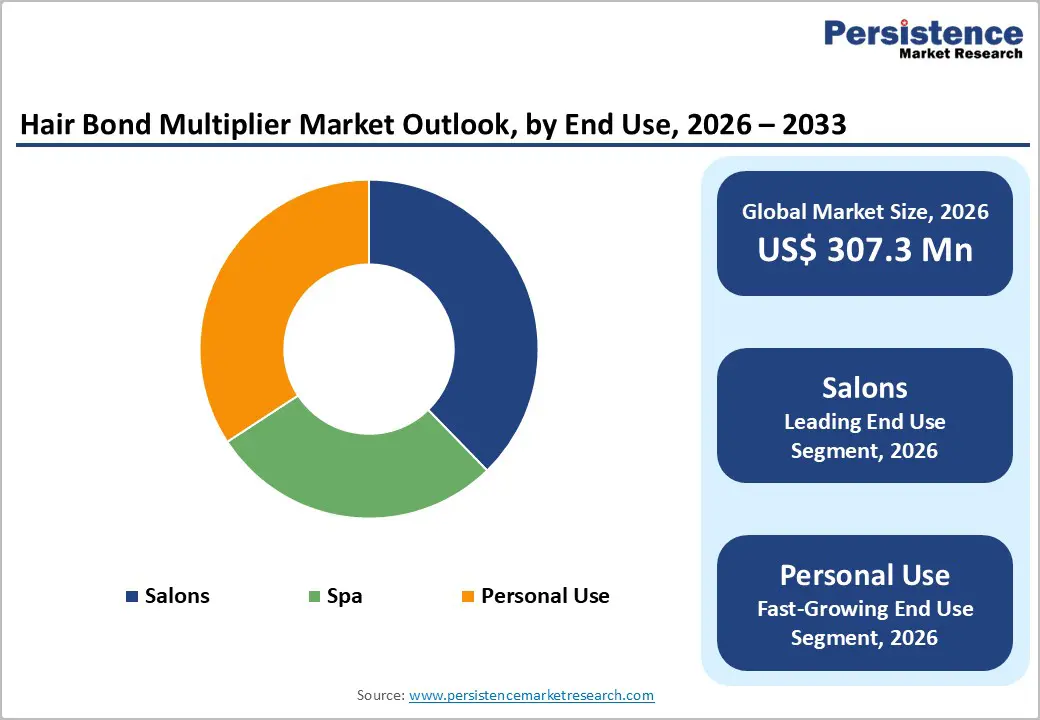
Salons accounted for 43% of the market share in 2025, supported by professional expertise and customized bond repair applications. Advanced in-salon systems significantly reduce breakage during chemical services, reinforcing consumer trust and client retention. The expansion of premium hair treatment services and structured professional protocols continues to sustain salon dominance within the market landscape.
The at-home user segment is witnessing the fastest growth as consumers adopt DIY treatments. Influenced by digital tutorials and greater product accessibility, home users increasingly seek salon-quality bond repair solutions, broadening market penetration beyond traditional professional settings.
Distribution Channel Insights
Retail sales hold 40% share in 2025, making it the leading distribution channel for hair bond multipliers. Health and beauty stores provide physical product visibility, demonstrations, and in-store consultations that build consumer trust. The expansion of organized retail chains and specialty beauty outlets further strengthens this channel’s established market position.
The online distribution channel is growing rapidly as consumers shift toward digital purchasing convenience. E-commerce platforms enable wider product comparisons, influencer-driven marketing, and subscription-based repurchase models, supporting expanding adoption across diverse geographic markets.
Regional Insights
North America Hair Bond Multiplier Market Trends
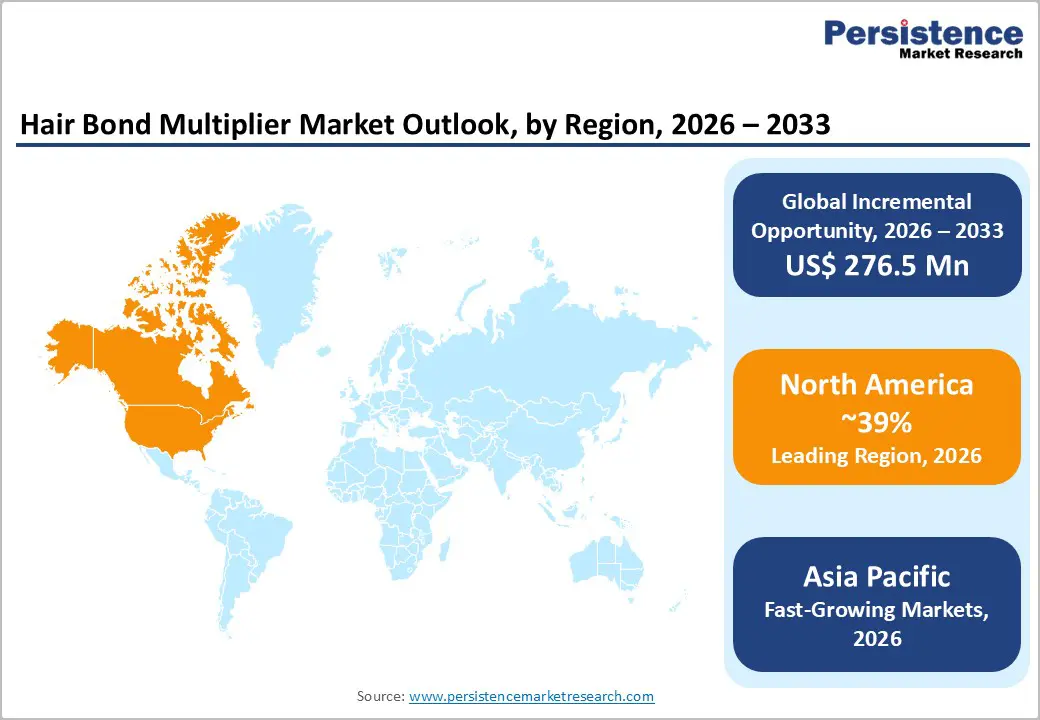
North America leads the global Hair Bond Multiplier market, accounting for 38% share in 2025, supported by strong innovation ecosystems in the United States. Advanced R&D capabilities and stringent regulatory oversight from authorities such as the FDA enhance consumer confidence in bond-repair technologies. Established salon networks and premium hair care spending further reinforce regional dominance.
Influencer-driven marketing and social media trends significantly accelerate product adoption, particularly among younger consumers. Professional salon systems continue to set performance benchmarks, while post-pandemic behavioral shifts have strengthened the at-home treatment segment. The region maintains leadership through technological advancements and strong brand presence.
Europe Hair Bond Multiplier Market Trends
Europe represents a mature yet steadily expanding market, projected to grow at a CAGR of 8.9% during the forecast period. Regulatory harmonization under the EU Cosmetics Regulation ensures strict safety and ingredient standards, fostering consumer trust. Key markets including Germany, the U.K., France, and Spain drive demand through strong professional salon infrastructures.
The region places high emphasis on clean beauty and sustainable formulations, encouraging innovation in peptide-based bond repair solutions. Professional coloring services remain a major application area, with established brands strengthening salon partnerships and reinforcing market growth across Western Europe.
Asia Pacific Hair Bond Multiplier Market Trends
Asia Pacific holds a significant 32% market share in 2025 and is emerging as the fastest-growing regional market. Rapid urbanization, expanding middle-class populations, and increasing beauty consciousness across China, Japan, India, and ASEAN countries are driving demand. Cost-effective manufacturing capabilities also provide competitive pricing advantages within the region.
A young demographic profile and rising adoption of Western hair coloring trends contribute to sustained market expansion. In India, the men’s grooming segment is growing at approximately 13%, while increasing exposure to pollution and heat styling encourages preventive bond repair usage across urban centers.
Competitive Landscape
The global hair bond multiplier market is moderately consolidated, characterized by the presence of established global beauty manufacturers and specialized bond-repair innovators. Competition is largely driven by continuous research and development focused on advanced peptide technologies, cross-linking agents, and improved molecular repair mechanisms. Companies are strengthening distribution networks through salon partnerships and expanding professional-to-consumer product ecosystems to enhance brand loyalty and recurring demand.
Key competitive differentiators include patented bond-building technologies, integrated salon and at-home treatment systems, and clean-label formulations aligned with sustainability trends. Emerging business models increasingly emphasize direct-to-consumer channels, particularly e-commerce platforms and subscription-based replenishment programs, supporting long-term customer engagement and retention.
Key Market Developments
- In January 2025, Olaplex Holdings Inc. launched an enhanced version of its No.1 Bond Multiplier designed for professional use, featuring improved penetration technology to strengthen internal hair bonds more effectively during chemical services, reinforcing its position in advanced salon-grade bond repair solutions.
- In September 2025, Schwarzkopf Professional expanded its FIBREPLEX range with sustainable booster formulations aligned with evolving EU cosmetic regulations, focusing on environmentally responsible ingredients while maintaining high-performance bond protection standards for professional coloring and lightening treatments.
- In March 2024, K18 Hair introduced an advanced molecular repair mask targeting at-home users, leveraging biomimetic peptide technology to improve long-term bond restoration and significantly strengthen its presence within the growing consumer DIY hair repair segment.
Companies Covered in Hair Bond Multiplier Market
- Olaplex LLC
- L’Oréal S.A.
- Henkel AG & Co. KGaA
- Wella Company
- Redken
- Joico
- Keune Haircosmetics
- Unilever PLC
- The Procter & Gamble Company
- The Estée Lauder Companies Inc.
- K18 Hair
- Amika LLC
- Bumble and bumble
- ALTERNA Haircare
- Croda International Plc
Frequently Asked Questions
The global Hair Bond Multiplier market is expected to reach US$ 307.3 million in 2026.
Frequent hair coloring breaks bonds, boosting demand for protective multipliers that reduce breakage during chemical treatments.
North America leads with 38% share in 2025, driven by innovation hubs, salons, and regulatory trust.
Men’s grooming segment grows, offering potential for unisex and male-targeted bond repair products.
Leaders include Olaplex LLC, L’Oréal S.A.Henkel AG & Co. KGaA, Wella Company, Redken, and K18hair.


