




- Automotive Components & Materials
- Steering Stabilizers Market
Steering Stabilizers Market Size, Share, and Growth Forecast, 2026 - 2033
Steering stabilizers market By Product Type (Linear, Rotary), Vehicle Type (Passenger Vehicle, Light Commercial Vehicle, Heavy Commercial Vehicle), Sales Channel (Original Equipment Manufacturing [OEM], Aftermarket), and Regional Analysis for 2026 - 2033

Steering Stabilizers Market Size and Trends Analysis
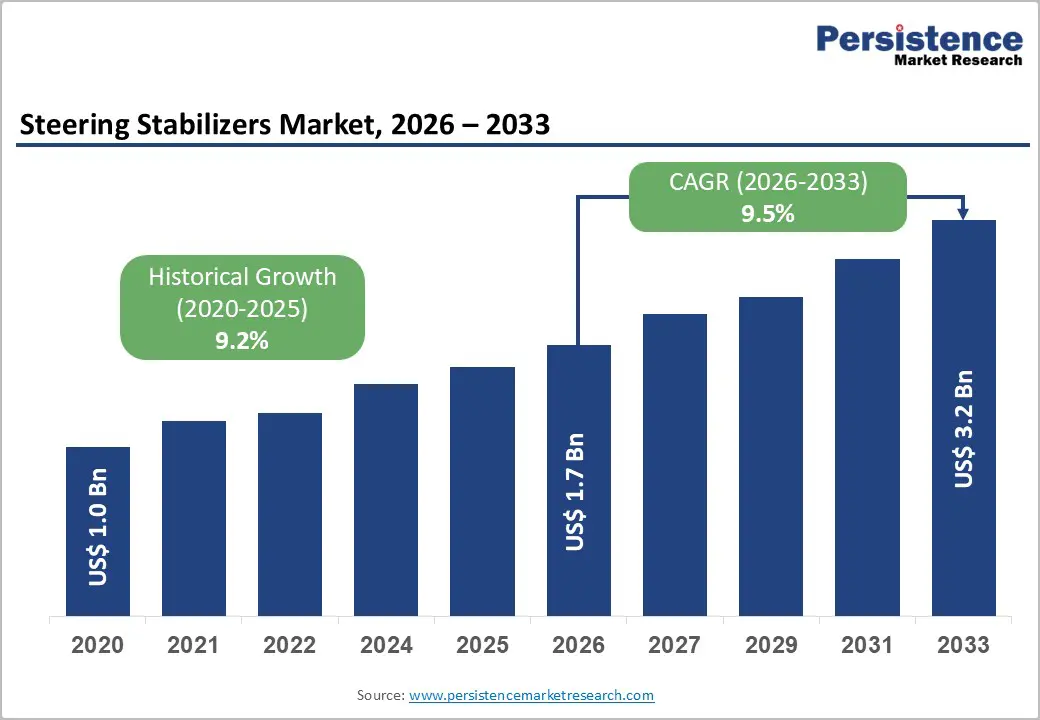
The global steering stabilizers market size is likely to be valued at US$1.7 billion in 2026, and is expected to reach US$3.2 billion by 2033, growing at a CAGR of 9.5% during the forecast period from 2026 to 2033, driven by the increasing prevalence of off-road and adventure vehicle ownership, rising demand for improved steering control and vibration damping, and growing aftermarket upgrades in light trucks and SUVs. Rising demand for high-performance linear steering stabilizers in passenger vehicles and aftermarket channels is driving market growth.
Advancements in hydraulic damping, adjustable valving, and corrosion-resistant materials improve ride stability and durability. Steering stabilizers are increasingly seen as essential for reducing shimmy, enhancing safety, and boosting handling, particularly in off-road and heavy-duty markets.
Key Industry Highlights:
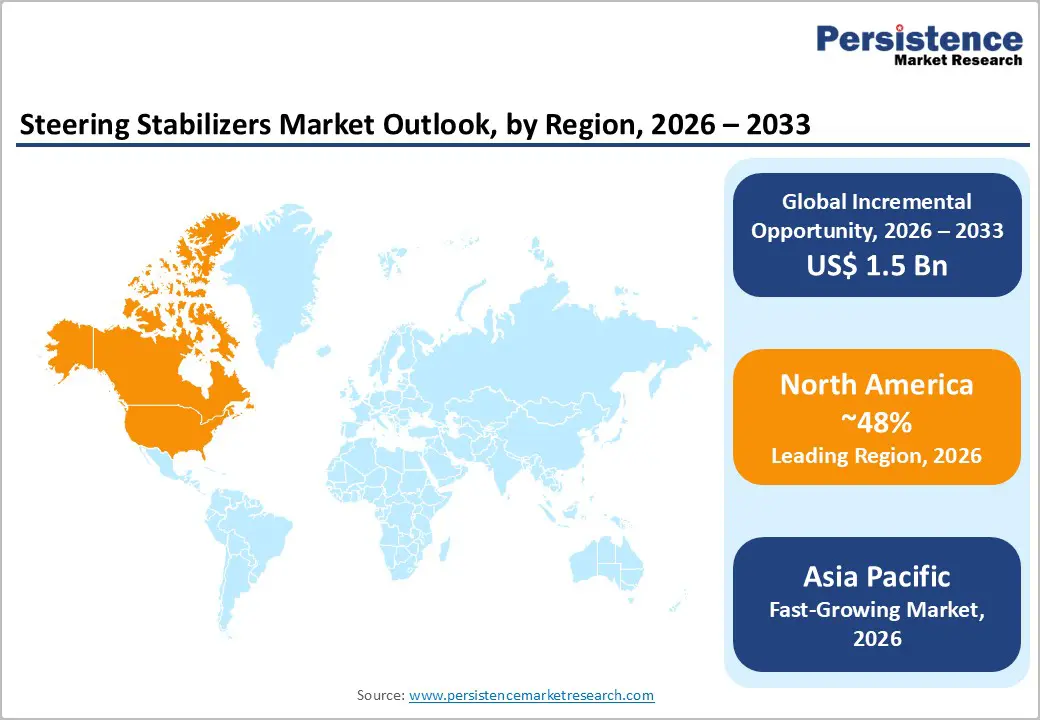
- Leading Region: North America, anticipated to account for a 48% market share in 2026, driven by high off-road vehicle penetration, strong aftermarket culture, and premium demand in the U.S.
- Fastest-growing Region: Asia Pacific, to be fueled by rising SUV and pickup sales, expanding adventure tourism, and growing aftermarket modification trends in Australia and India.
- Dominant Product Type: Linear, to hold approximately 68% of the market share, as it remains the standard solution for most applications.
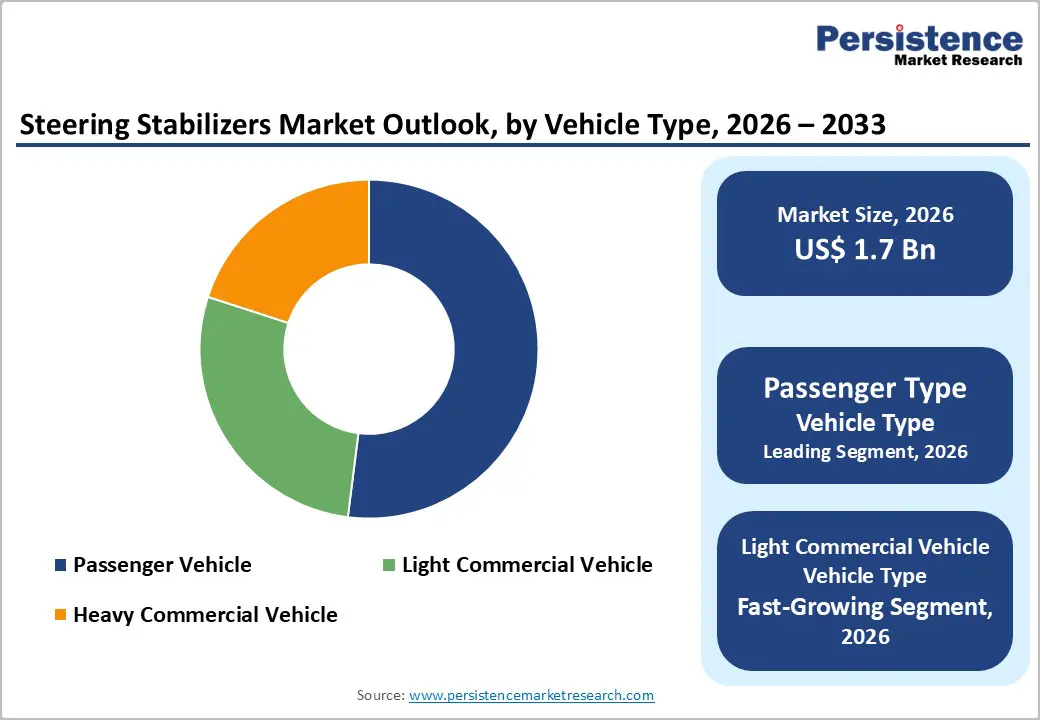
- Leading Vehicle Type: Passenger vehicles, to contribute nearly 52% of the market revenue, due to the highest volume of light trucks and SUVs.
| Key Insights | Details |
|---|---|
|
Steering Stabilizers Market Size (2026E) |
US$1.7 Bn |
|
Market Value Forecast (2033F) |
US$3.2 Bn |
|
Projected Growth CAGR (2026-2033) |
9.5% |
|
Historical Market Growth (2020-2025) |
9.2% |
Market Factors - Growth, Barriers, and Opportunity Analysis
Growth Analysis - Surge in Off-Road and Adventure Vehicle Ownership
Ownership of off-road and adventure vehicles has been rising sharply as consumers increasingly seek outdoor, recreational, and lifestyle-oriented transportation. This trend is reflected in the broader powersports and off-road vehicle segment, where utility terrain vehicles (UTVs) and all-terrain vehicles (ATVs) contribute significantly to outdoor recreation economies. In the U.S., activities related to these vehicles contribute to the expanding outdoor recreation sector, which accounted for US$639.5 billion in GDP in 2023, showing the economic weight of outdoor vehicle use and participation.
Consumer preference for vehicles that support adventure travel, trail riding, and exploration has also driven strong unit production and registrations. Official data from the Motorcycle Industry Council and transportation departments indicate that categories of off-road capable vehicles, such as side-by-side UTVs and light off-highway vehicles, form a substantial portion of the outdoor powersports fleet, supported by growing trail networks and recreational facilities. These patterns illustrate how growing ownership and use of off-road vehicles reflect shifting lifestyle choices. They also sustain demand for aftermarket parts, accessories, upgrades, and related services across the adventure vehicle ecosystem.
Increasing Aftermarket Upgrades and Lift-Kit Installations
Rising interest in personalizing and enhancing off-road vehicles has significantly boosted aftermarket upgrades and lift-kit installations. Owners of trucks, Jeeps, and other adventure vehicles are investing in modifications that improve ground clearance, suspension articulation, tire fitment, and overall performance on challenging terrain. Enthusiasts view these enhancements not only as functional upgrades for navigating trails, rocks, and mud, but also as expressions of personal style and capability. This has led to a vibrant ecosystem of parts manufacturers, installers, and specialty shops offering everything from lift kits and heavy-duty shocks to oversized tires, bumpers, and skid plates, making customization more accessible to a broader audience.
Lift kits have become a cornerstone of off-road modification culture. By raising a vehicle’s ride height, they allow users to install larger tires and achieve better approach, break-over, and departure angles. Independent garages and national chains are reporting higher demand for professional lift-kit installation services, as some modifications require expert alignment, brake adjustments, and suspension tuning to maintain safety and ride quality. The trend toward upgrades is further supported by off-road clubs, social media groups, and trail events, where modified rigs are showcased, and knowledge is shared.
Barrier Analysis - Compatibility Challenges Across Vehicle Models
The wide diversity of vehicle makes, models, and variants on the road creates a significant challenge for steering stabilizer manufacturers and installers. Modern national vehicle registries, such as those maintained by the U.S. Federal Highway Administration, show that there are over 270 million registered motor vehicles across multiple classes, including passenger cars, SUVs, pickup trucks, and motorcycles, each with distinct chassis, suspension, and steering geometries. Within these broad categories, even a single model may have multiple trims and configurations that affect dimensions such as wheelbase, track width, and suspension setup, which in turn influence how a steering stabilizer fits and performs on that specific vehicle.
Steering stabilizers must be matched precisely to a vehicle’s steering linkage, suspension type, and weight distribution. This variability means a stabilizer designed for one model or trim may not be compatible with another, leading to costly returns, custom engineering, or installation adjustments. In markets with extensive model lineups and frequent updates to vehicle generations, aftermarket suppliers face increased design complexity and inventory management costs, as they must develop and stock multiple part numbers to serve different variants.
Vehicle-Specific Fitment and Installation Complexity
Steering stabilizers must be precisely matched to a vehicle’s steering system, suspension setup, and chassis layout, which leads to significant fitment and installation complexity. Unlike universal parts, a steering stabilizer interacts directly with the tie rods, drag links, and suspension geometry; even small variations in vehicle design can change how forces are distributed through these components. This means manufacturers need to design stabilizers that account for differences in wheelbase, track width, steering arm length, and the presence of lift kits or other aftermarket modifications. Without exact specifications, a stabilizer may not align correctly, leading to poor performance or accelerated wear.
For owners, installation complexity becomes an additional barrier. Many vehicles require the removal of factory components, precise torque sequencing, and alignment adjustments during steering stabilizer installation. Trucks or jeeps with modified suspensions often need custom brackets or spacers, which add time, skill, and cost. Some stabilizers require professional installation tools or expertise beyond typical garage capabilities. Consumers may delay or avoid purchasing stabilizers due to perceived difficulty, and retailers may face increased return rates from incorrect fitment.
Opportunity Analysis - Expansion in Adjustable and Dual Steering Stabilizers for Lifted Vehicles
As lifted vehicles and off-road modifications become more common, the development of adjustable and dual steering stabilizers presents a tangible growth opportunity for the steering stabilizers market. Lifted trucks and SUVs often have increased ride height and altered suspension geometry, which can intensify steering feedback and vibration at higher speeds or rough terrain. Adjustable stabilizers allow owners to fine-tune damping force for different load conditions and terrains, while dual stabilizers offer enhanced control for vehicles with heavy accessories or extreme lift setups. These advanced solutions address performance gaps that stock components cannot handle, making them attractive to enthusiasts and professionals who demand both capability and safety.
The opportunity is reinforced by the large number of compatible vehicles on the road. According to the Federal Highway Administration, there are over 47.8 million pickup trucks registered in the U.S. and 73.6 million sport utility vehicles (SUVs), where lift kits and off-road enhancements are most popular. As vehicle personalization continues and owners seek improved handling for modified suspensions, manufacturers and aftermarket brands that innovate in adjustable and dual stabilizer technologies are positioned to capture increased demand for tailored steering solutions that enhance performance and vehicle stability.
Expansion in Electric Off-Road Vehicles
The rise of electric off-road vehicles (EORVs) is creating a fresh growth avenue for the steering stabilizers market as automakers and specialty builders bring battery-powered adventure vehicles into mainstream awareness. EORVs blend rugged capability with quiet, emissions-free powertrains, attracting both traditional off-road enthusiasts and new adopters drawn to sustainability and advanced technology. Many electric platforms, whether purpose-built off-road trucks, electric UTVs, or converted 4×4 rigs, retain or amplify the suspension and steering loads seen in conventional vehicles, often amplifying torque delivery and weight distribution differences caused by heavy battery packs. These factors can increase steering feedback and vibration during dynamic driving, making effective stabilizing solutions even more important for ride comfort, driver control, and component longevity.
Steering stabilizers for electric off-road platforms must accommodate unique vehicle characteristics such as instant torque, regenerative braking forces, and altered mass balance. Aftermarket engineers have opportunities to design stabilizers with tailored damping curves and lightweight materials to offset the added battery weight and to ensure compatibility with electronic steering assist systems found on many EORVs. Brands that innovate in this space can support both OEM partnerships and direct aftermarket sales. Given the expanding interest in electric adventure vehicles from electric pickup launches to electric trail rigs, steering stabilizers that enhance handling and driver confidence on rough terrain can become a key accessory for this emerging segment.
Category-wise Analysis
Product Type Insights
The linear segment is anticipated to dominate the market, accounting for approximately 68% of the market share in 2026, propelled by its simple design, durability, and cost efficiency. Linear steering stabilizers use a straightforward shock-absorber-style mechanism that effectively dampens side-to-side steering vibrations, making them suitable for a wide range of trucks, SUVs, and off-road vehicles. Their ease of installation and compatibility with both stock and moderately lifted suspensions support widespread adoption. KYB SHOCKS SS11318 Steering Stabilizer, manufactured by KYB Corporation, a global automotive components maker known for suspension and steering products. This linear stabilizer is designed to reduce steering shimmy and vibration in vehicles such as the Jeep Wrangler, improving handling and driver control on- and off-road.
The rotary segment is the fastest-growing, driven by its superior performance in handling harsh off-road conditions and heavy steering loads. Unlike linear units, rotary stabilizers use a rotary valve and piston design that provides stronger, more consistent damping across a wide range of motion. This makes them especially effective for lifted trucks, large SUVs, and vehicles with heavy front-end accessories where steering forces are higher. Their enhanced control minimizes steering flutter, improves tracking at speed, and absorbs impacts more efficiently. Hyperpro RSC steering damper, which uses a rotary damping design preferred in high-performance and off-road applications. Rotary stabilizers such as this provide more consistent resistance throughout the steering range compared with conventional linear units, helping absorb lateral forces and reduce wheel flutter on rough terrain and at speed.
Vehicle Type Insights
Passenger vehicles are expected to dominate the market, accounting for nearly 52% of revenue in 2026, driven by a large global fleet and rising customization trends. SUVs, pickup trucks, and crossovers are widely used for both daily commuting and recreational off-road driving, increasing demand for enhanced steering control and ride stability. Many passenger vehicle owners invest in suspension upgrades, lift kits, and larger tires, which heighten the need for steering stabilization. Toyota Motor Corporation regularly equips many of its passenger SUVs and crossovers, such as the Toyota Fortuner and Toyota Innova Crysta, with enhanced suspension and steering systems that are compatible with aftermarket steering stabilizers, improving stability and comfort on varied road surfaces.
The heavy commercial vehicles segment represents the fastest-growing vehicle type, driven by freight demand and the expansion of long-haul transportation globally. HCVs, such as large trucks and buses, carry heavier loads and often operate on challenging road conditions, which increases lateral forces and steering vibration during travel. Steering stabilizers help absorb these forces, improving driver control, reducing fatigue, and extending component life under sustained stress. Volvo Group is a leading global manufacturer of heavy trucks and buses. Volvo’s heavy-duty trucks are widely used in freight transportation, long-haul logistics, and construction sectors that require robust steering and stability components, which are typically supported by aftermarket parts such as steering stabilizers.
Regional Insights
North America Steering Stabilizers Market Trends
North America is projected to dominate, accounting for nearly 48% of the share in 2026, driven by the region’s high off-road vehicle penetration, strong aftermarket culture, and high public awareness of stability benefits. Distribution systems in the U.S. and Canada provide extensive support for steering stabilizer programs, ensuring wide accessibility across linear, adventure, and aftermarket markets. The increasing demand for adjustable, convenient, and easy-to-install forms is further accelerating adoption, as these formats improve control and reduce the barriers associated with death wobble.
Innovation in steering stabilizer technology, including stable rotary, improved dual delivery, and targeted lift-kit enhancement, is attracting significant investment from both public and private sectors. Government initiatives and NHTSA campaigns continue to promote the use of handling risks, safety concerns, and emerging off-road threats, creating sustained market demand. The growing focus on heavy-duty grades and specialty uses, particularly in passenger vehicles and other applications, is expanding the target applications for steering stabilizers.
Europe Steering Stabilizers Market Trends
Europe's growth is propelled by rising awareness of rider safety and performance benefits, robust regulatory frameworks, and government-led adventure-vehicle programs. Countries such as Germany, France, the U.K., and Spain have well-established off-road and touring frameworks that support routine steering stabilizer use and encourage adoption of innovative stabilizer delivery methods, including rotary and adjustable solutions. These high-performance formulations are particularly appealing for adventure populations, regulation-conscious modifiers, and touring users, improving control and coverage rates.
Technological advancements in steering stabilizer development, such as enhanced rotary damping, targeted application delivery, and improved dual-grade offerings, are further boosting market potential. European authorities are increasingly supporting research and trials for stabilizers against both routine and specialized needs, strengthening market confidence. The growing emphasis on convenient, protective options is aligned with the region’s focus on preventive injury reduction and adventure tourism. Public awareness campaigns and promotion drives are expanding reach in both touring and off-road segments, while suppliers are investing in production and novel variants to increase efficacy.
Asia Pacific Steering Stabilizers Market Trends
Asia Pacific is likely to be the fastest-growing market for steering stabilizers in 2026, driven by rising SUV and pickup ownership awareness, increasing government initiatives, and expanding application programs across the region. Countries such as Australia, India, Thailand, and Indonesia are actively promoting stabilizer campaigns to address off-road growth and emerging safety needs. Steering stabilizers are particularly attractive in these regions due to their cost-effective installation, ease of use, and suitability for large-scale adventure and commuting in both urban and rural populations.
Technological advancements are enabling the development of stable, effective, and easy-to-install steering stabilizers that can withstand challenging terrain and minimize shimmy dependence. These innovations are critical for reaching domestic modifiers and improving overall vehicle stability coverage. The growing demand for adventure boots, leather, and aftermarket applications is driving market expansion. Public-private partnerships, increased safety expenditure, and rising investment in stabilizer research and distribution capacity are further accelerating growth. The convenience of stabilizer delivery, combined with improved handling and reduced risk of accidents, positions it as a preferred choice.
Competitive Landscape
The global steering stabilizers market is characterized by strong competition between well-established suspension technology leaders and emerging high-performance aftermarket brands. In North America, companies such as Bilstein and FOX Factory maintain leadership positions through continuous research and development, broad distribution networks, and deep connections with off-road and motorsports communities. Their product portfolios include advanced linear and rotary stabilizers engineered for lifted trucks, SUVs, and performance vehicles, helping reinforce brand loyalty among enthusiasts and professional installers.
In Asia Pacific and Australia, regional manufacturers are gaining traction by offering cost-competitive solutions tailored to local vehicle platforms, improving product accessibility for a wider customer base. Linear stabilizers remain widely adopted for mass-market applications due to their reliability in reducing steering shimmy and enhancing baseline stability. Rotary stabilizers address high-speed vibration and heavy-duty demands, supporting growth in adventure and performance segments. Strategic partnerships, acquisitions, and collaborations across the supply chain are accelerating innovation, broadening product portfolios, and strengthening global market penetration.
Key Industry Developments:
- In February 2026, Öhlins Asia Co., Ltd. announced that the all-new Öhlins SD20 Steering Damper had been officially made available across Asia. Following its recent global launch, the SD20 was made purchasable through authorized Öhlins retailers throughout the region.
- In January 2026, Autoliv, Inc., a global leader in automotive safety systems, and Tensor, a leading innovator in personal autonomous vehicles, announced that the world’s first foldable steering wheel had been co-developed for the Tensor Robocar. The steering wheel was designed with dual functionality, allowing it to be used for conventional manual control or retracted for autonomous operation. This technology was introduced to advance adaptive safety and flexible design within the evolving landscape of automated mobility.
Companies Covered in Steering Stabilizers Market
- Bilstein
- FOX Factory
- Rancho
- Skyjacker
- Pro Comp
- Rubicon Express
- TeraFlex
- Zone Offroad
- Rough Country
- Daysta
- Others
Frequently Asked Questions
The global steering stabilizers market expects a valuation of US$1.4 billion as of the end of 2024.
Increasing demand for off-road vehicles, growth in the automotive aftermarket sector, and emphasis on vehicle stability and control are driving growth in the steering stabilizers market.
North America, and Europe are expected to witness significant growth in the steering stabilizers market due to the popularity of recreational and off-road vehicles.
Trucks, SUVs, and off-road vehicles are major consumers of steering stabilizers due to their higher susceptibility to steering vibrations and instability.
Steering stabilizers help reduce steering vibrations, enhance vehicle stability, and improve handling, especially during off-road driving conditions, thereby enhancing overall safety and performance.


