




- Marine
- Boat Steering System Market
Boat Steering System Market Size, Share, and Growth Forecast 2026 - 2033
Boat Steering System Market by Propulsion System (Inboard, Outboard, Sterndrive), Installation Type (OEMs, Aftermarket), Steering Type (Manual Steering, Hydraulic Steering, Electric Power Steering, Electro-Hydraulic Steering), Application (Leisure & Pleasure Boats, Fishing Boats, Commercial Transport, Offshore Support, Defense & Patrol, Sports & Racing), End-user, and Regional Analysis 2026 - 2033

Boat Steering System Market Size and Trend Analysis
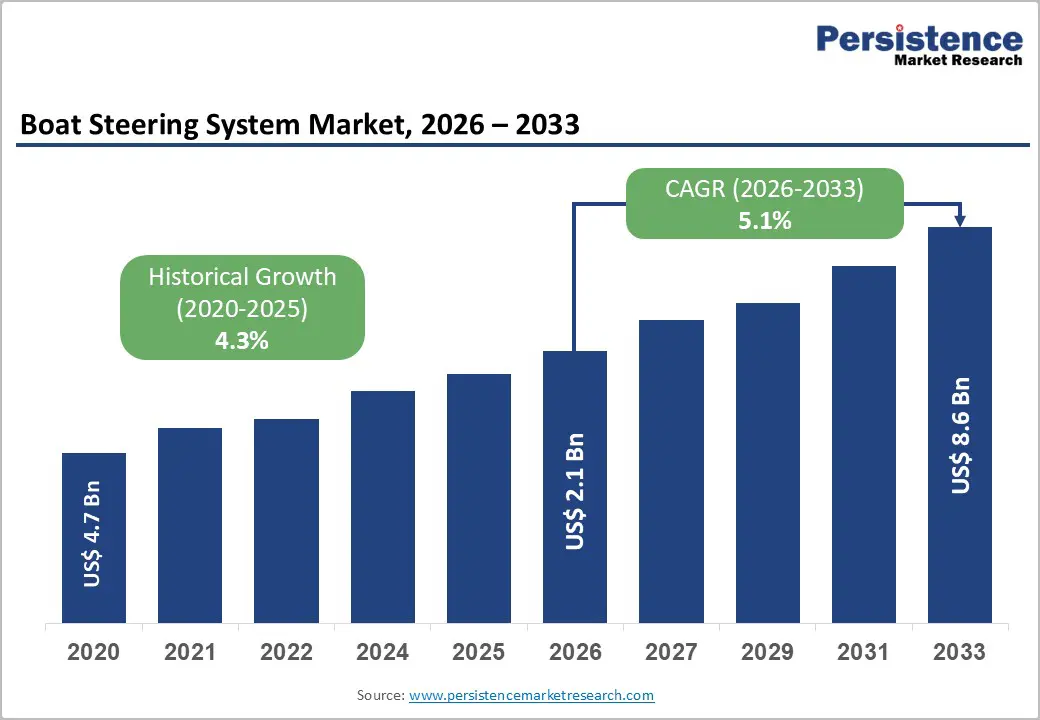
The global boat steering system market size is likely to be valued at US$ 2.1 billion in 2026 and is expected to reach US$ 8.6 billion by 2033, growing at a CAGR of 5.1% during the forecast period from 2026 to 2033. Rising recreational boating participation, stricter marine safety regulations, and the rapid adoption of hydraulic and electric power-steering solutions are underpinning this expansion.
Key Industry Highlights:
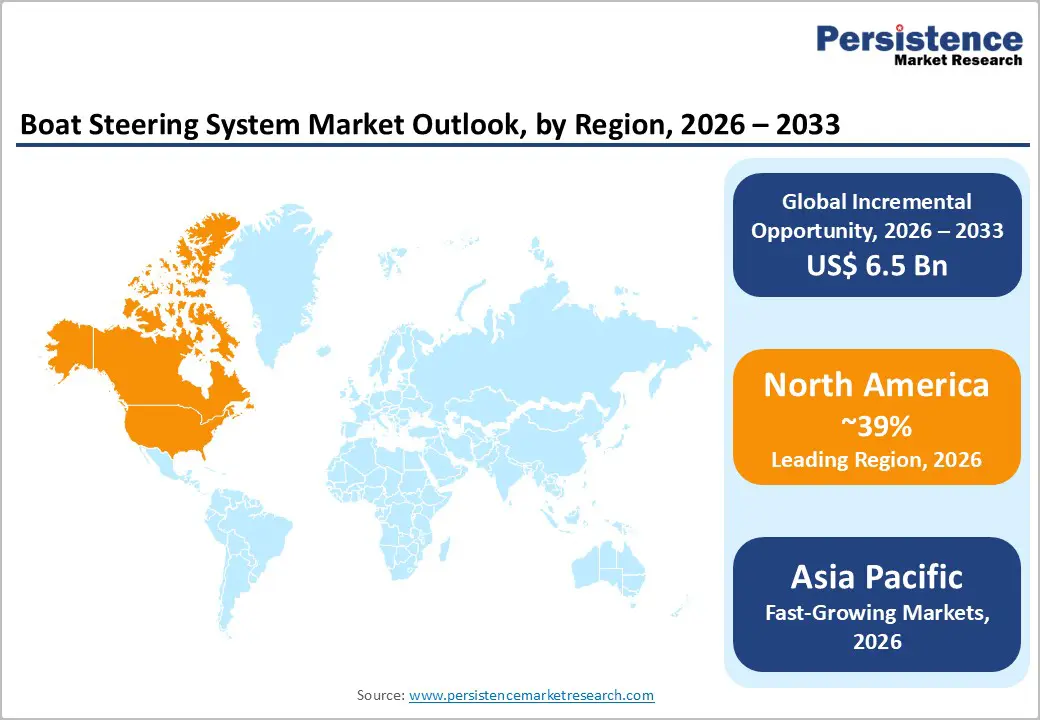
- Leading region: North America remains the largest regional market for the boat steering system market with 39% share, supported by high recreational boating participation, robust marina infrastructure, and a strong OEM and aftermarket ecosystem centered in the United States, Canada, and coastal tourism hubs.
- Fastest-growing region: Asia Pacific is expected to post the 7.8% CAGR, as rising incomes, expanding marine tourism in China, Japan, and ASEAN, and localized manufacturing drive rapid adoption of hydraulic and electro-hydraulic steering systems across recreational and commercial fleets.
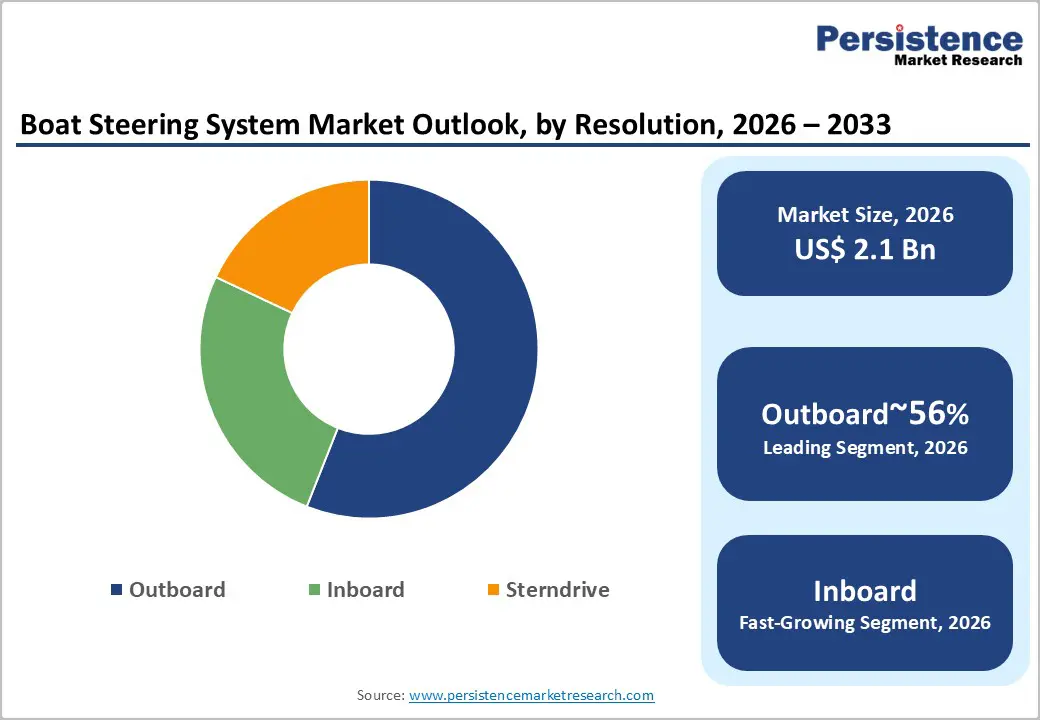
- Dominant segment: Within the Propulsion System category, Outboard steering solutions hold the largest share of 56%, benefiting from their prevalence in Leisure & Pleasure Boats, Fishing Boats, and small commercial craft, as well as ongoing transitions to higher-power four-stroke and electric outboard engines that demand advanced steering.
- Fastest-growing segment: By Steering Type, Electric Power Steering and hybrid electro-hydraulic steering architectures are the fastest-growing segments of approximately
- 6%, buoyed by demand for joystick docking, integrated autopilots, and connected helm solutions that deliver car-like handling and lower operating effort.
- Key market opportunity: Vendors that combine smart steering technologies with localized manufacturing and strong aftermarket support in emerging coastal tourism markets, particularly in Asia Pacific and selected Latin American and Middle Eastern countries, stand to capture significant new demand from Marine Tourism & Rental, Recreational, and Commercial fleets.
| Key Insights | Details |
|---|---|
| Boat Steering System Market Size (2026E) | US$ 2.1 Billion |
| Market Value Forecast (2033F) | US$ 8.6 Billion |
| Projected Growth CAGR (2026 - 2033) | 5.1% |
| Historical Market Growth (2020 - 2025) | 4.3% |
Market Dynamics
Drivers - Rising Global Leisure Boating and Marine Tourism Activities Are Expanding Long-Term Demand for Advanced Boat Steering Systems
The rising popularity of recreational boating and marine tourism is a major growth driver for the global boat steering system market. Increased participation in leisure boating, yachting, and coastal tourism has significantly expanded the global recreational vessel fleet, directly supporting demand for reliable steering systems. In the United States, the recreational boating industry generated an economic impact of approximately US$230 billion in 2023, supporting nearly 813,000 jobs and over 36,100 businesses. This underscores the importance of the broader marine ecosystem, which depends on efficient steering technologies. At a global level, the recreational boat market was valued at approximately US$19.3 billion in 2023 and is projected to grow at a CAGR of about 6.3% through 2030. Growing interest in watersports, cruising, and charter activities continues to stimulate vessel sales. As new boats enter service, demand for inboard, outboard, and sterndrive steering systems increases across both OEM installations and aftermarket replacements, particularly in the Leisure & Pleasure Boats and Sports & Racing segments.
Transition From Mechanical to Hydraulic and Electric Steering Technologies Is Increasing Steering System Value per Vessel
The ongoing shift from traditional mechanical steering to advanced hydraulic, electric, and electro-hydraulic steering systems is another key growth driver for the boat steering system market. Modern steering technologies offer smoother handling, reduced physical effort, improved safety, and better integration with digital navigation and control systems. Industry studies indicate that hydraulic steering accounts for more than 50% of current marine steering installations, while electric steering systems are recording double-digit annual growth due to their energy efficiency and low maintenance requirements.
Hydraulic steering alone accounts for about 35% of the market, driven by its superior performance in higher-horsepower vessels. In developed boatbuilding markets, more than 70% of newly built vessels are now equipped with electronic or hydraulic steering, reflecting growing acceptance of digital helms, joystick docking, and autopilot compatibility. This transition significantly increases the average value of the steering system per vessel compared with mechanical systems, supporting revenue growth for technologically advanced steering solution providers.
Restraints - High Initial Investment and Complex Retrofit Requirements Continue to Limit Adoption of Advanced Boat Steering Technologies
Despite their performance advantages, advanced steering systems face adoption challenges due to high upfront costs and retrofit complexity. Electric power steering and electro-hydraulic systems often require significant investment in electronic control units, hydraulic plumbing, and vessel rewiring, making them less attractive for small operators and owners of older boats. Many commercial operators operate under tight margins and are cautious about capital-intensive upgrades, even when long-term benefits such as fuel efficiency and reduced maintenance are evident.
For aging vessels, steering upgrades can also trigger additional structural and electrical modifications, further increasing overall costs. These challenges slow the replacement of traditional mechanical systems and extend upgrade cycles, particularly in commercial transport and offshore support fleets. While new boat sales increasingly include advanced steering as standard equipment, retrofit hesitancy remains a restraint on market penetration, especially in cost-sensitive and legacy vessel segments.
Economic Volatility and Discretionary Spending Cycles Create Short-Term Demand Fluctuations in the Boat Steering System Market
The boat steering system market is sensitive to macroeconomic fluctuations because it is closely linked to discretionary spending and capital investment cycles. End-use segments such as recreational boating, marine tourism, and rental services are particularly vulnerable during economic downturns. During the global disruptions of 2020, vessel activity and leisure marine demand declined sharply, with some tourism-related categories experiencing declines of 20%-40%.
In such periods, boat manufacturers delay new launches, dealers reduce inventory levels, and vessel owners postpone non-essential upgrades, including steering replacements. Commercial, defense, and government segments may also face procurement delays as budgets are reallocated or tightened. Although long-term market fundamentals remain strong, short-term economic pressures can temporarily slow demand for steering systems and affect near-term revenue growth across OEM and aftermarket channels.
Opportunity - Growing Demand for Smart, Connected, and Electrified Steering Systems Creates High-Value Growth Opportunities for Market Participants
The growing adoption of smart, connected, and electrified steering platforms presents a strong opportunity for market expansion. Electric power steering and software-enabled electro-hydraulic systems are among the fastest-growing segments, with annual growth rates exceeding 9% in some studies. These systems support advanced features such as joystick maneuvering, integrated autopilot functionality, and real-time diagnostics, offering a more intuitive and car-like boating experience.
New generations of boat owners increasingly value ease of operation, safety, and digital integration, driving demand for intelligent steering solutions. For OEMs, this trend enables higher content value per vessel through bundled digital helm packages. For aftermarket players, retrofit kits, modular controllers, and software upgrades create recurring, high-margin revenue opportunities. As connectivity and predictive maintenance gain traction, steering suppliers can also expand into digital services, data analytics, and firmware updates, strengthening long-term customer relationships.
Expanding Marine Tourism and Coastal Infrastructure Development in Emerging Economies Is Driving Global Steering System Demand
Expanding marine tourism and coastal infrastructure development in emerging markets represent a significant growth opportunity for the boat steering system industry. Regions such as Asia Pacific, Latin America, and parts of the Middle East & Africa are investing heavily in marinas, coastal resorts, and nautical tourism facilities. Global trade data show that recreational boat exports reached approximately US$ 17.6 billion in 2023, reflecting strong international demand. In China, the boat steering system market is growing at double-digit rates, supported by a long coastline, rising leisure boating participation, and favorable tourism policies.
Similar trends are evident across Southeast Asia and the Middle East, where governments are promoting marine tourism as part of broader economic diversification strategies. Vendors that localize production, comply with regional certification requirements, and collaborate with charter operators and marinas are well-positioned to capture this rising demand across recreational and tourism-focused vessel segments.
Category-wise Analysis
Propulsion System Insights
Within the propulsion system category, outboard steering systems dominate the global boat steering system market, accounting for an estimated 56% of total revenue in the mid-2020s. This leadership is supported by strong demand for outboard engines across leisure boats, fishing vessels, and smaller commercial craft.
Outboard engines are preferred for their ease of installation, space efficiency, and flexibility for repowering, which directly supports demand for steering systems. Additionally, increasing the adoption of four-stroke and electric outboards to improve fuel efficiency and reduce emissions requires more precise and responsive steering solutions. As a result, hydraulic and electric outboard steering systems are expected to remain dominant across both OEM installations and aftermarket upgrades.
Installation Type Insights
By installation type, OEM installations account for the largest share of the boat steering system market, at roughly 60% of total value. This reflects the growing trend of integrating advanced steering technologies directly into new boat designs. In developed markets such as North America, OEMs increasingly bundle hydraulic and electric steering systems with digital helms, joystick controls, and integrated propulsion packages. However, the aftermarket segment is becoming strategically important as the global vessel fleet ages.
Many boat owners are upgrading from manual or mechanical steering to hydraulic or electric systems to improve safety and handling. With recreational boats often remaining in service for more than 20 years, aftermarket retrofits offer steering suppliers a long-term revenue stream. Retrofit kits, autopilot integration, and station-keeping features are particularly attractive to both recreational and light-commercial vessel segments, supporting sustained aftermarket growth.
Steering Type Insights
Hydraulic steering currently leads the global steering type mix, accounting for approximately 35% of total boat steering system revenues and an even higher share in mid- and high-horsepower vessels. Hydraulic systems are widely valued for their smooth performance, reduced helm effort, and reliability under demanding marine conditions. They are commonly used across leisure boats, fishing vessels, and light commercial craft. At the same time, electric power steering and hybrid electro-hydraulic systems are emerging as the fastest-growing sub-segments.
These technologies offer benefits such as energy efficiency, digital integration, and compatibility with advanced navigation and control systems. Some electric and electromechanical steering architectures are growing at annual rates exceeding 9%, indicating a gradual shift in technology preference. While hydraulic steering remains the current market anchor, ongoing innovation is expected to drive a steady transition toward software-driven and electronically assisted steering solutions over the next decade.
Application Analysis
Leisure & Pleasure Boats represent the largest application segment in the boat steering system market, accounting for an estimated 45% of total demand. Growth in recreational boating activities such as yachting, cruising, and watersports continues to drive this dominance.
In the United States, watersports and fishing boats together account for a significant share of new vessel registrations, reinforcing the importance of leisure-oriented craft.
These vessels increasingly require modern steering solutions, ranging from basic manual systems for small engines to advanced hydraulic and electric steering for larger and performance-focused boats. Ongoing investments in marinas, coastal tourism, and waterfront infrastructure across Europe and the Asia Pacific are expected to further support long-term demand in this application segment.
End-user Insights
By end user, the recreational segment accounts for the largest share of the boat steering system market, estimated at approximately 50%. This dominance is driven by high vessel volumes, shorter replacement cycles for smaller boats, and growing adoption of premium steering features such as digital helms and joystick docking. Recreational boat owners increasingly prioritize comfort, ease of handling, and safety, which supports demand for advanced steering technologies.
Commercial and Defense & Government segments, while smaller in volume, provide stable and specification-driven demand. These segments rely heavily on robust hydraulic and electro-hydraulic steering systems for workboats, patrol vessels, and offshore support craft, where reliability is critical. Investments in coastal security, naval modernization, and port infrastructure, particularly in the Asia Pacific and the Middle East, are expected to gradually increase the share of institutional end-users, creating opportunities for suppliers with certified and ruggedized steering solutions.
Regional Insights
North America Boat Steering System Market Trends
North America is the largest regional market for boat steering systems, led by the United States, which accounted for approximately 57.8% of global revenues in 2024. The region benefits from a strong recreational boating culture, extensive waterways, and well-developed marina infrastructure. According to the National Marine Manufacturers Association, the U.S. recreational boating industry generated about US$ 230 billion in economic impact in 2023. This large installed base supports both OEM steering system installations and a thriving aftermarket.
Regulatory standards set by organizations such as the U.S. Coast Guard and ABYC encourage the adoption of reliable and advanced steering solutions. More than 70% of newly manufactured vessels in the U.S. now feature hydraulic or electronic steering. Rising demand for joystick docking, integrated navigation, and autopilot systems continues to increase the value of steering packages per vessel, reinforcing North America’s leadership in both volume and technology adoption.
Europe Boat Steering System Market Trends
Europe remains a key market for boat steering systems, supported by a mature yacht-building industry, strong marine tourism, and harmonized safety regulations. Countries such as Germany, France, Italy, Spain, and the U.K. have high boating participation and established manufacturing capabilities. Marine and coastal tourism is a core pillar of the European Union’s Blue Growth strategy, which encourages investment in marinas, charter fleets, and nautical tourism routes. Regulatory frameworks such as the EU Recreational Craft Directive drive demand for certified and high-quality steering components.
European boatbuilders increasingly adopt hydraulic and electric steering systems, particularly in premium yachts where silent operation and energy efficiency are important. Continued development of Mediterranean and Baltic coastal infrastructure supports steady demand for leisure and charter vessels. As a result, Europe maintains a significant share of the global market with stable growth prospects across recreational, commercial, and specialized marine applications.
Asia Pacific Boat Steering System Market Trends
Asia-Pacific is the fastest-growing regional market for boat steering systems, driven by rising incomes, expanding marine tourism, and increasing shipbuilding capacity. China is a key growth engine, with its boat steering system market exceeding US$120 million in 2024 and projected to grow at an over 10% CAGR through 2034. Japan and Southeast Asian countries such as Thailand, Indonesia, and Vietnam are also investing in marina infrastructure and nautical tourism.
The region benefits from cost-efficient manufacturing, integrated supply chains, and supportive government policies that encourage localization and exports. Demand is increasing across recreational, commercial, and defense vessels, with rising adoption of hydraulic and electro-hydraulic steering in workboats and patrol craft. As domestic recreational boating markets mature and governments invest in coastal security and tourism infrastructure, Asia Pacific is expected to sustain strong double-digit growth in steering system installations.
Competitive Landscape
The boat steering system market is moderately concentrated, featuring a mix of global engineering firms and specialized marine steering manufacturers. Leading players such as Vetus B.V., Lecomble & Schmitt, Kobelt Manufacturing, Twin Disc, Northrop Grumman Sperry Marine, ZF Friedrichshafen, and SeaStar Solutions benefit from broad product portfolios and strong OEM relationships. Competition is based on reliability, corrosion resistance, compact design, and system integration capabilities. Suppliers are increasingly offering complete helm-to-rudder solutions that combine steering, propulsion control, and digital navigation.
Innovation focuses on electric power steering, low-leakage hydraulic systems, and smart sensors that improve efficiency and simplify installation. Regional players compete through localized manufacturing, cost advantages, and tailored solutions for specific vessel types. Overall, technology advancement, certification, and lifecycle support are becoming key differentiators in this evolving competitive landscape.
Key Market Developments
- April, 2024: Dometic’s SeaStar Solutions expanded its electric steering portfolio by launching an integrated joystick and digital helm system for high-horsepower outboards, enhancing precision control, docking ease, and premium boating experiences in offshore and center-console fishing vessels.
- January, 2024: ZF Friedrichshafen introduced an advanced electro-hydraulic steering solution for commercial and workboats, featuring improved control algorithms that enhance maneuverability, reduce energy consumption, and support hybrid propulsion systems across demanding marine operating conditions.
- September, 2023: Vetus B.V. partnered with Hypro Marine to co-develop compact hydraulic steering systems tailored for small recreational boats and RIBs, enabling OEMs to offer space-efficient, reliable steering solutions across European and Asia Pacific leisure marine markets.
Companies Covered in Boat Steering System Market
- Vetus B.V.
- Lecomble & Schmitt
- Kobelt Manufacturing Co. Ltd.
- Twin Disc, Incorporated
- Northrop Grumman Sperry Marine B.V.
- Uflex USA
- HyDrive Engineering Pty Ltd.
- Hypro Marine
- ZF Friedrichshafen AG
- Techno Italia Kft.
- Excel Controlinkage Pvt. Ltd.
- SeaStar Solutions
- Lewmar Limited
- Dometic Group
- Brunswick Corporation
- Kongsberg Maritime
- Bosch Rexroth AG
- Wärtsilä Corporation
- Jastram Engineering Ltd.
Frequently Asked Questions
The global Boat Steering System Market is projected to be valued at around US$ 2.1 Billion in 2026 and reach approximately US$ 8.6 Billion by 2033, reflecting a forecast CAGR of about 5.1% during 2026 - 2033 based on the provided market scope.
Demand is driven by rising recreational boating and marine tourism; growing recreational boat sales valued at about US$ 19.3 Billion in 2023; significant economic contribution of boating in the U.S. at roughly US$ 230 Billion; and a technology shift from mechanical systems to hydraulic steering, electric power steering, and electro-hydraulic steering that offer better maneuverability, integration, and safety.
By application, Leisure & Pleasure Boats constitute the leading segment, accounting for an estimated 40% share of global steering demand, supported by strong growth in yachting, cruising, and watersports activities and the expanding recreational boat market, which is expected to approach US$ 29.1 Billion by 2030.
North America, and particularly the United States, dominates the global boat steering system market, with estimates indicating that the region accounts for well over half of global revenues in recent years, underpinned by a highly developed recreational boating industry, strong regulatory frameworks, and rapid uptake of electronic and hydraulic steering technologies.
A key opportunity lies in the development and deployment of smart, connected electric power steering and electro-hydraulic steering solutions tailored for high‑growth coastal tourism markets in Asia Pacific, Latin America, and parts of the Middle East & Africa, where rising marine tourism, expanding marinas, and growing Marine Tourism & Rental and Recreational fleets are expected to drive double‑digit growth in steering system adoption.
Major players include Vetus B.V., Lecomble & Schmitt, Kobelt Manufacturing Co. Ltd., Twin Disc, Incorporated, Northrop Grumman Sperry Marine B.V., Uflex USA.


