




- Media & Entertainment
- Consumer Network Attached Storage Market
Consumer Network Attached Storage Market Size, Share, and Growth Forecast 2026 - 2033
Consumer Network Attached Storage (NAS) Market by Product Configuration (Single-Bay NAS, Dual-Bay NAS, Multi-Bay NAS), by Storage Type (HDD-Based NAS, SSD-Based NAS, Hybrid NAS), by Application (Data Backup & Recovery, Media Storage & Streaming, File Sharing & Sync, Personal Private Cloud, Home Surveillance Storage), by End User (Residential, Small & Medium Enterprises, Large Enterprises), by Regional Analysis, 2026 - 2033

Consumer Network Attached Storage Market Size and Trend Analysis
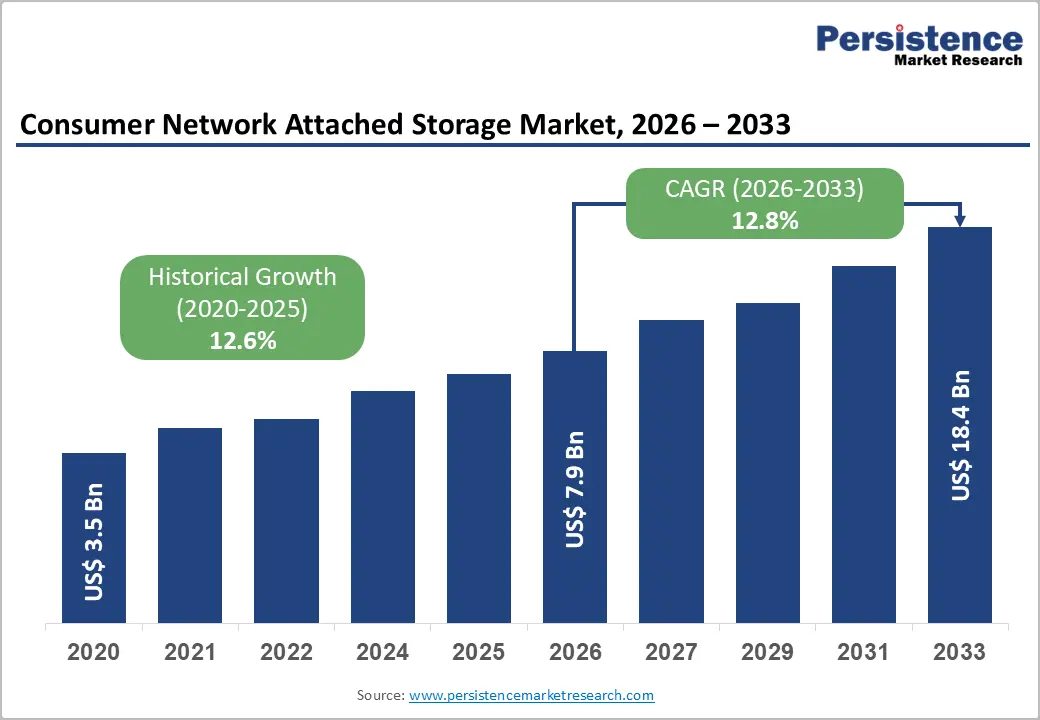
The global Consumer Network Attached Storage (NAS) market size is expected to be valued at US$ 7.9 billion in 2026 and projected to reach US$ 18.4 billion by 2033, growing at a CAGR of 12.8% between 2026 and 2033.
The market is witnessing strong growth as consumers and small businesses increasingly prioritize local data control and secure storage solutions. Rising concerns over cloud data privacy, coupled with the surge in multimedia content creation in households, are driving adoption. NAS devices offer redundancy, backup capabilities, and seamless accessibility, making them a cost-effective choice for reliable, centralized data management across diverse user segments.
Key Market Highlights
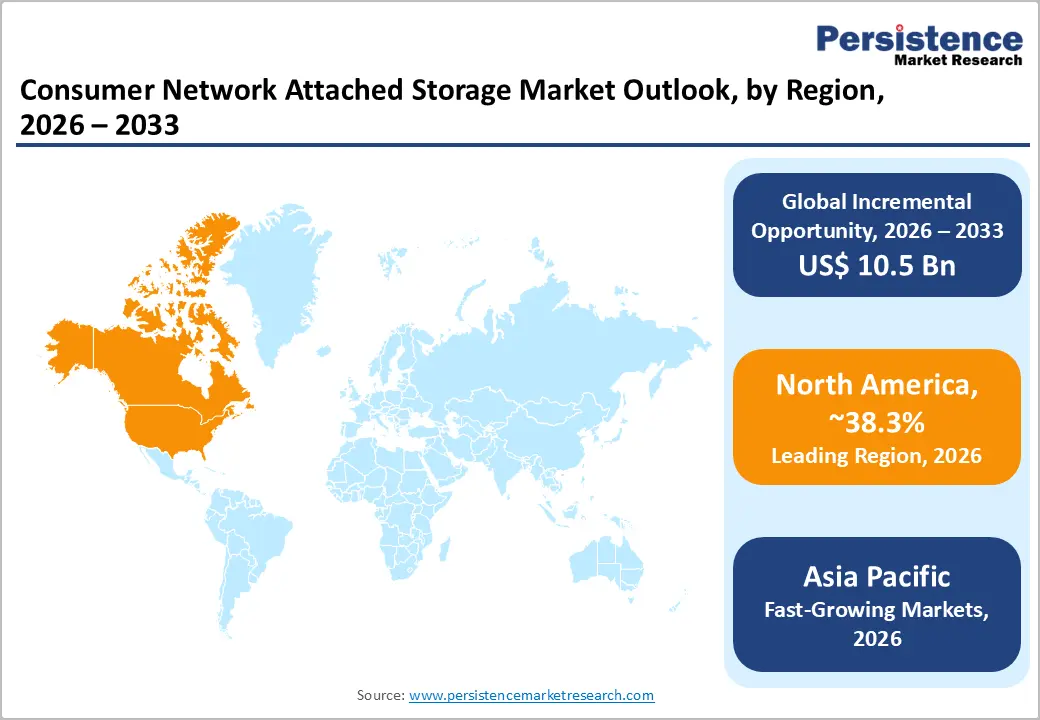
- Leading Region: North America leads the Consumer NAS market with 38.3% global market share in 2025, driven by mature digital infrastructure, strong enterprise adoption, and strict data protection regulations.
- Fastest-Growing Region: Asia Pacific holds 31.1% market share in 2025 and is the fastest-growing, supported by rapid digitization, expanding SME adoption, and rising demand for surveillance and media storage.
- Leading Product Configuration: Multi-Bay NAS (3–4 drive bays) dominates the market with approximately 48% share in 2025, reflecting its optimal balance of capacity, redundancy, and cost efficiency.
- Leading Storage Type: HDD-Based NAS accounts for around 64% market share in 2025, sustained by superior cost-per-terabyte economics for backup and archival workloads.
- Key Market Opportunity: AI-enhanced surveillance storage and Personal Private Cloud integration create transformational market opportunities through intelligent video analytics, ransomware protection, and privacy-preserving data management.
| Key Insights | Details |
|---|---|
|
Consumer NAS Market Size (2026E) |
US$ 7.9 billion |
|
Market Value Forecast (2033F) |
US$ 18.4 billion |
|
Projected Growth CAGR (2026-2033) |
12.8% |
|
Historical Market Growth (2020-2025) |
12.3% |
Market Dynamics
Market Growth Drivers
Rising Adoption of Remote Work and Hybrid Storage Solutions
The global shift toward remote and hybrid work models has significantly transformed data storage needs for consumers and small businesses. With employees accessing sensitive files from home offices and multiple locations, the demand for secure, locally controlled storage solutions has surged. Consumer NAS devices provide centralized repositories with encrypted access, ensuring privacy and eliminating reliance on public cloud services.
These systems also integrate automatic backup capabilities, allowing users to safeguard critical business files without recurring subscription costs. For budget-conscious home offices and small teams, NAS devices deliver a cost-effective solution for collaborative file sharing and data management. The ability to combine security, accessibility, and redundancy has made NAS adoption essential for remote professionals prioritizing privacy and operational efficiency.
Explosion of Multimedia Content and Advanced Video Requirements
The rapid rise in digital content consumption, especially high-resolution 4K and 8K videos, has fueled the need for scalable, reliable storage. Consumers and content creators generate massive amounts of data daily through smartphones, cameras, and professional equipment, making NAS essential for local storage with redundancy.
Modern NAS devices support media streaming, simultaneous video transcoding, and multi-device access, outperforming traditional external drives. For households and prosumers, hybrid NAS solutions combining SSDs and HDDs strike a balance between performance and capacity at competitive prices. These capabilities enable efficient management of large media libraries while meeting the growing demand for fast, high-quality content access and secure backup for multimedia-heavy lifestyles.
Market Restraints
Compatibility and Integration Challenges with Diverse Operating Systems
A major restraint for the Consumer NAS market is ensuring smooth compatibility across diverse technology ecosystems. Users with mixed environments, Windows, macOS, Linux, iOS, and Android, often face challenges configuring NAS file-sharing protocols like SMB, NFS, and AFP. Non-technical consumers can find setup frustrating, as variations across manufacturers prevent a unified, standardized experience.
Legacy software and proprietary systems sometimes fail to recognize NAS storage, requiring alternative solutions. This reliance on professional IT support increases the total cost of ownership, discouraging small and medium-sized enterprises from adopting. The complexity of integration and maintenance limits market expansion, as organizations with constrained IT resources hesitate to implement NAS solutions across heterogeneous networks, slowing overall growth potential.
Performance Limitations and Network Bandwidth Constraints
Consumer-grade NAS devices often experience performance bottlenecks due to limited network bandwidth, especially when handling large video files or performing intensive backups. Standard Gigabit Ethernet connections cap throughput at roughly 125 MB/s, which can frustrate creative professionals or enterprises managing terabytes of data. These limitations reduce the efficiency of local storage for demanding applications.
Bandwidth restrictions in residential areas, particularly in developing regions, constrain hybrid cloud NAS adoption. Mechanical latency in HDDs further affects performance-sensitive tasks, while SSD-based NAS solutions remain costly for budget-conscious users. These constraints can lead to dissatisfaction, abandoned deployments, and slower adoption, particularly when users’ real-world expectations exceed device capabilities.
Market Opportunities
Personal Private Cloud Integration Driving Consumer Segment Expansion
The Personal Private Cloud segment is the fastest-growing opportunity in the Consumer NAS market, fueled by rising privacy concerns and the demand for data autonomy among residential users. NAS-based personal cloud solutions provide complete control over sensitive files such as photos, documents, and financial records, eliminating dependence on subscription-based cloud services that pose privacy risks.
Modern NAS systems incorporate advanced encryption, two-factor authentication, and WORM (Write Once Read Many) technology, providing enterprise-grade security for home users. Awareness of data breaches and unauthorized cloud access drives consumer adoption of on-premises storage. Integration of AI-powered photo management automatically organizes images by facial recognition, location, and content, enhancing user convenience. This combination of privacy, local storage, and intelligent features positions Personal Private Cloud NAS for substantial market growth through 2033.
AI-Enhanced Home Surveillance Storage and Video Analytics Capabilities
The rise of IP-based surveillance cameras in homes and businesses is driving demand for advanced video storage and analytics. NAS devices for surveillance now integrate AI-powered analytics, enabling real-time threat detection, facial recognition, and motion-triggered alerts without cloud processing, ensuring faster response and local control.
Advanced NAS platforms support hardware-accelerated H.265 video transcoding and simultaneous streaming to multiple devices, while cloud backup safeguards against storage failures. Regulatory requirements such as GDPR and government surveillance mandates further promote secure on-premises NAS adoption. The integration of edge computing enables video analysis directly on the NAS, reducing bandwidth usage and ensuring efficient local processing. These capabilities position AI-enabled surveillance NAS solutions as a high-growth opportunity.
Category-wise Insights
Product Configuration Analysis
The Multi-Bay NAS segment, comprising systems with three to four drive bays, leads the market with approximately a 48% share in 2025, driven by strong adoption among enterprises and growing small-business deployments. These configurations deliver optimal capacity, performance, and redundancy for mission-critical applications while remaining cost-effective compared to larger enterprise-grade solutions. Their versatility in branch offices, media production, and corporate environments underscores their dominance.
Meanwhile, the fastest-growing configuration includes hybrid and modular Multi-Bay systems that combine scalable storage with enhanced RAID-based redundancy. These solutions provide enterprises and prosumers with flexible on-premises data protection, efficient power consumption, and a manageable physical footprint, positioning them as ideal alternatives to cloud-only storage and supporting growing adoption among small businesses and advanced home office setups.
Storage Type Analysis
HDD-Based NAS continues to dominate with roughly 64% market share in 2025, reflecting the cost advantage and superior capacity of mechanical hard drives. Enterprises favor these configurations for backup, archival, and capacity-intensive workloads. Innovations like Seagate HAMR and Western Digital ePMR drives enhance density and cost efficiency, while SSDs remain limited to specialized applications. HDDs provide the best price-per-terabyte solution, sustaining strong demand for large-scale storage requirements.
The fastest-growing segment is Hybrid NAS, which combines SSD caching with HDD bulk storage. Hybrid configurations deliver a balanced mix of speed, capacity, and affordability, appealing to prosumers and small businesses seeking efficient storage without high costs. These systems optimize multimedia access, backups, and business continuity applications, driving rapid adoption in emerging and mid-tier markets.
Application Analysis
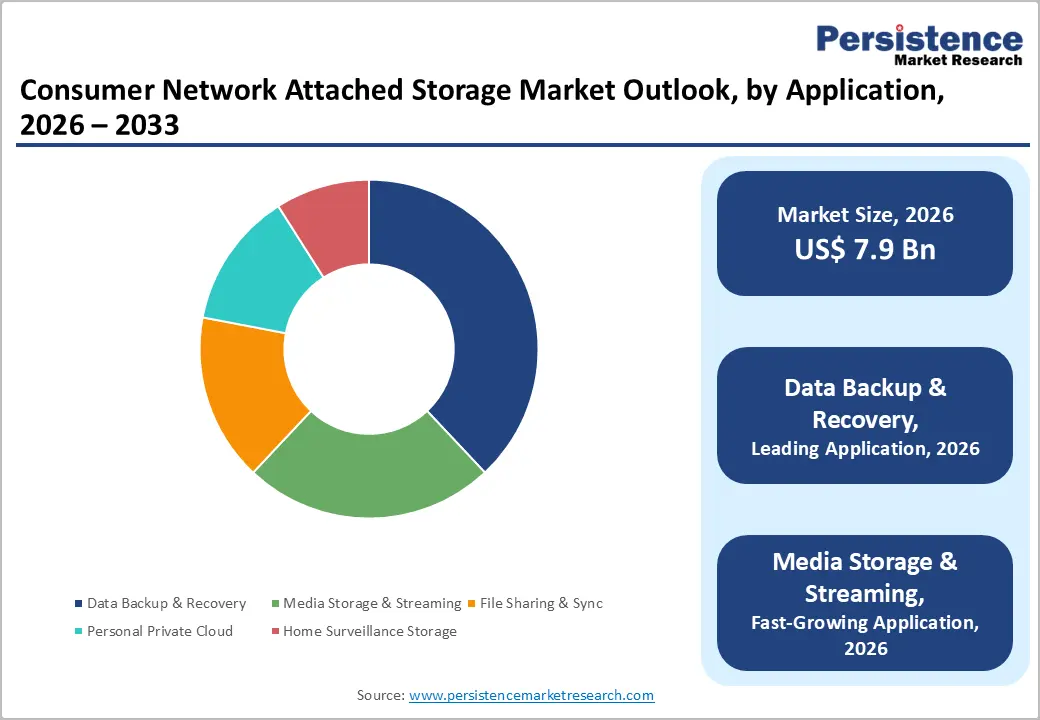
Data Backup & Recovery leads NAS applications with around 38% market share in 2025, reflecting its central role in business continuity. Organizations deploy NAS-based backup solutions featuring automated scheduling, deduplication, and ransomware protection to secure critical files. Rising cyber threats and cloud vulnerabilities drive the adoption of on-premises solutions. SMEs benefit from cost savings by replacing cloud subscriptions with NAS backup, while NDMP and replication protocols enable efficient cross-location data synchronization.
The fastest-growing application is Media Storage & Streaming, fueled by households and prosumers managing large multimedia libraries. NAS platforms now support real-time transcoding, multi-device streaming, and AI-enabled content management. This application leverages SSD/HDD hybrid setups to provide high-performance, reliable storage solutions for video, photos, and music, meeting rising consumer and professional content demands.
End User Analysis
Large Enterprises dominate the market with approximately 53.6% share in 2025, using NAS for departmental storage, file collaboration, and branch consolidation. Enterprises increasingly adopt NAS for secondary workloads to reduce infrastructure costs while maintaining operational flexibility. SMEs and residential users are gradually expanding their adoption of NASs due to cost and convenience advantages.
The fastest-growing end-user segment is SMEs and Residential users, driven by affordability, ease of deployment, and the desire for personal cloud alternatives. SMEs leverage NAS for cost-effective file sharing, backup, and small-scale collaboration, while residential users prioritize privacy, local control, and scalable storage for multimedia and personal data. Adoption is rising rapidly in the Asia Pacific due to digital transformation initiatives and budget-conscious IT strategies.
Regional Insights
North America Consumer NAS Market Trends and Insights
North America leads the global Consumer NAS market, accounting for approximately 38.3% of global market share in 2025, supported by mature IT infrastructure, high consumer purchasing power, and advanced enterprise digitalization. The United States dominates regional demand, driven by widespread hybrid cloud adoption that integrates on-premises NAS with public cloud platforms for backup and disaster recovery.
The region benefits from stringent regulatory requirements, including HIPAA, PCI DSS, and NIST cybersecurity frameworks, which mandate secure local data storage. High-speed broadband and early 5G deployment further support remote access and synchronization. Rising consumer awareness of data privacy and cloud breaches is accelerating the adoption of personal private cloud NAS solutions among residential users.
Europe Consumer NAS Market Trends and Insights
Europe represents a steadily expanding Consumer NAS market, growing at a CAGR of 11.9% through 2033, driven by strict data protection and cybersecurity regulations. Frameworks such as GDPR, DORA, and the NIS2 Directive compel organizations to implement secure, compliant data storage solutions, supporting strong NAS demand across regulated industries.
Germany, the UK, and France lead adoption through government and enterprise digital transformation initiatives. Financial services, healthcare, and manufacturing sectors increasingly deploy NAS for GDPR-compliant backup and operational resilience. Growing emphasis on data sovereignty and local data control further accelerates the adoption of hybrid NAS architectures over fully cloud-dependent storage models.
Asia Pacific Consumer NAS Market Trends and Insights
Asia Pacific emerges as the fastest-growing region, capturing approximately 31.1% of global market share in 2025, driven by rapid digitization across China, India, and Southeast Asia. China dominates regional manufacturing and consumption, supported by large-scale deployment across SMEs, surveillance infrastructure, and media production environments.
The region’s growth is fueled by expanding SME adoption, smart city initiatives, and rising video content generation. India, South Korea, and Taiwan show strong uptake due to fintech expansion and 4K/8K media creation. Government-backed digital infrastructure programs and manufacturing relocation initiatives further accelerate the adoption of NAS across ASEAN economies.
Competitive Landscape
The global Consumer NAS market displays a moderately consolidated competitive structure, with a small group of leading vendors controlling a significant share through strong software ecosystems, extensive application libraries, and continuous product innovation. These players benefit from proprietary operating systems, seamless third-party integrations, and intuitive user interfaces that foster high customer retention across consumer and SME segments.
At the same time, the market remains competitively dynamic, with emerging vendors targeting niche segments through differentiated features and value-based pricing. Larger technology groups participate through broader storage portfolios and enterprise relationships. Ongoing competition centers on AI-driven data management, advanced security, and hybrid cloud integration, reinforcing ecosystem-led differentiation and sustained innovation.
Key Market Developments
- In October 2025, TerraMaster Technology unveiled the F4-425 Plus and F2-425 Plus hybrid NAS models featuring dual 5GbE Ethernet ports, M.2 NVMe support, and AI-enhanced privacy protection, establishing new performance standards for consumer-focused hybrid storage with storage capacities reaching 144TB and 84TB, respectively.
- In March 2025, Western Digital Corporation introduced the 26TB WD Red Pro HDD specifically engineered for NAS environments, delivering 550TB/year workload ratings, 2.5M hours MTBF, and OptiNAND technology, directly addressing escalating storage capacity demands in multi-bay, RAID-optimized consumer and small business systems.
- In September 2024, TerraMaster Technology launched nine new NAS models, including the F8 SSD Plus all-flash storage system and high-performance T-series rack-mount solutions integrated with the proprietary TOS 6 operating system, incorporating advanced TRAID+ technology, WORM data protection, and comprehensive business backup suite features.
Companies Covered in Consumer Network Attached Storage Market
- Synology Inc.
- QNAP Systems Inc.
- Western Digital Corporation
- Seagate Technology
- NETGEAR Inc.
- ASUSTOR Inc.
- Buffalo Technology
- TerraMaster Technology Co., Ltd.
- Drobo Inc.
- Zyxel Communications Corp.
- Thecus Technology Corp.
- D-Link Corporation
- Lenovo
- ASUS
- Toshiba Corporation
- NetApp Inc.
- Dell Technologies Inc.
- Hewlett Packard Enterprise
- Fujitsu Limited
- Hitachi Ltd.
Frequently Asked Questions
The global Consumer NAS market is expected to reach a valuation of US$ 7.9 billion in 2026, supported by rising adoption of personal cloud, local data storage, and cost-effective backup solutions.
Market growth is driven by remote work adoption, cloud data privacy concerns, rapid 4K/8K content generation, rising cyber threats, and regulatory mandates favoring locally controlled storage solutions.
North America is expected to lead with approximately 38.3% global market share, supported by advanced digital infrastructure, strong regulatory compliance requirements, and mature hybrid cloud adoption.
AI-enabled Personal Private Cloud integration represents the most significant opportunity, driven by demand for privacy-focused storage, advanced security features, and intelligent data management.
The Consumer NAS market includes comprehensive coverage of leading global competitors, including Synology Inc., QNAP Systems Inc., Western Digital Corporation, Seagate Technology, and NETGEAR Inc.


