




- Automotive Components & Materials
- Piston Ring Market
Piston Ring Market Size, Share, Trends, Growth, Regional Forecasts 2026 - 2033
Piston Ring Market by Product Type (Compression Ring, Oil Ring), Material Type (Grey Cast Iron, Chromium Steel, Misc. Material), Vehicle Type (Two Wheelers, Passenger Vehicle, Light Commercial Vehicle, Heavy Commercial Vehicle, Off Road Vehicles), Sales Channel (OEM, Aftermarket), and Region Analysis 2026 - 2033

Piston Ring Market Share and Trends Analysis
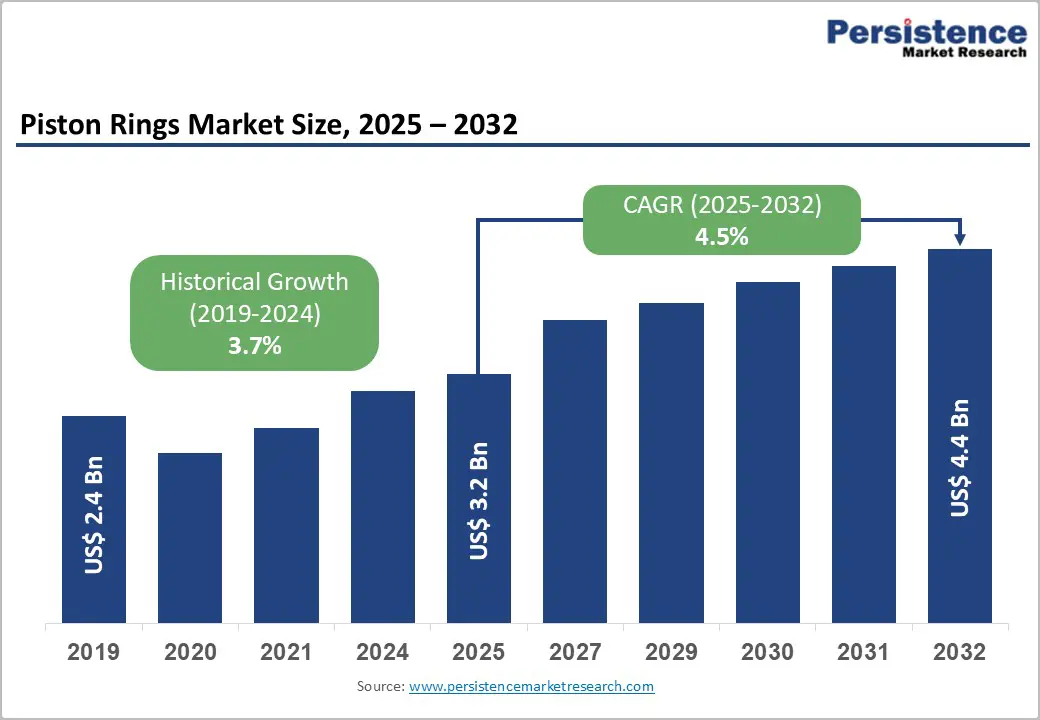
The global piston ring market size is projected to be valued at US$44.0 billion in 2026 and is anticipated to reach US$64.3 billion by 2033, growing at a CAGR of 5.6% between 2026 and 2033.
Market expansion is fundamentally driven by robust global automotive production growth, increasing vehicle electrification that requires specialized hybrid-engine components, and the expansion of two-wheeler manufacturing across Asian economies. Rising demand from original equipment manufacturers in emerging automotive hubs, coupled with stringent emission standards that require advanced sealing technologies, reinforces sustained market momentum and revenue growth.
Key Industry Highlights:
- Compression rings dominate by volume and revenue, with a 67% share; chromium steel is the fastest-growing material, growing at a 7.3% CAGR, reflecting advanced engine technology requirements and premium specification adoption.
- Passenger vehicles maintain 43% segment leadership; two-wheelers demonstrate the highest growth at 5.9% CAGR, propelled by 58 million annual unit production across Asian markets.
- OEM channel commands 61% market share; aftermarket grows fastest at 4.8% CAGR driven by aging global vehicle fleet and increasing replacement demand patterns.
- Asia Pacific holds a dominant 56% global share as a manufacturing hub with 48 million two-wheeler and 50+ million light vehicle production; Europe maintains 26% share with premium positioning.
- Strategic consolidation features 6 major capacity expansions, technology acquisitions, and digital initiatives since late 2023, focusing on Asian manufacturing, hybrid powertrain solutions, and aftermarket channel transformation.
- North America grows at a 4.7% CAGR, driven by stable production and robust aftermarket demand; hybrid vehicle proliferation represents a significant incremental opportunity through transitional powertrain adoption.
| Key Insights | Details |
|---|---|
|
Piston Ring Market Size (2026E) |
US$ 44.0 Billion |
|
Market Value Forecast (2033F) |
US$ 64.3 Billion |
|
Projected Growth CAGR (2026-2033) |
5.6% |
|
Historical Market Growth (2020-2025) |
5.0% |
Market Dynamics Analysis
Drivers - Global Automotive Production Expansion and Manufacturing Hub Development
Global light vehicle production reached 85.4 million units in 2023 according to the International Organization of Motor Vehicle Manufacturers, with projections indicating 92-95 million units annually by 2028. China remains the largest production hub, with 30.2 million units, while India shows the fastest growth, adding 5.8 million units and expanding 8.2% year over year. The Society of Indian Automobile Manufacturers reports that two-wheeler production exceeds 21.2 million units annually, creating substantial demand for OEM piston rings. Southeast Asian manufacturing development, particularly Thailand's 2.1 million-unit capacity and Indonesia's expanding automotive sector, diversifies the production geography. Each vehicle requires 12-24 piston rings depending on engine configuration and cylinder count, translating production volumes directly into component demand. Regional manufacturing incentives, including India's Production Linked Incentive scheme and Thailand Board of Investment tax benefits, accelerate facility investments.
Two-Wheeler Market Expansion and Urbanization in Emerging Economies
Global two-wheeler production exceeded 58 million units annually, with India contributing 21.2 million units and ASEAN nations collectively contributing 16.8 million units, according to the respective automotive manufacturers' associations. Urbanization rates in developing economies reach 55-62%, creating transportation infrastructure gaps addressed through affordable two-wheeler mobility solutions. The Asian Development Bank documents 450 million new urban residents projected across Asia by 2030, driving motorcycle and scooter adoption.
Two-wheeler engines typically utilize 3-6 piston rings per unit, generating substantial component volumes despite smaller engine displacements. Economic accessibility with average vehicle costs ranging from US$800 to US$2,500 enables mass-market penetration. Electric two-wheeler transition remains gradual at 4-7% market share, sustaining internal combustion engine demand through 2030. Statistical correlation indicates that a 1-million-unit increase in two-wheeler production is associated with a substantial increase in piston ring demand.
Restraint - Electric Vehicle Acceleration and Internal Combustion Engine Displacement
The rapid adoption of electric vehicles fundamentally challenges long-term market growth, with global BEV and PHEV sales reaching 14.2 million units in 2023, representing 18% of total light-vehicle sales, according to the International Energy Agency. Major automotive markets are implementing combustion-engine phase-out timelines, including the European Union's 2035 ban, Norway's 2025 target, and multiple U.S. states adopting California's Advanced Clean Cars II regulation. China's new energy vehicle mandate requires that 40% of vehicle sales be electrified by 2030. Battery cost reductions, achieving US$139/kWh in 2023 improve EV affordability, accelerating adoption curves. A complete powertrain transition eliminates piston ring requirements entirely, whereas hybrid configurations reduce cylinder counts and engine utilization, thereby constraining demand growth despite overall vehicle production increases.
Raw Material Price Volatility and Supply Chain Vulnerabilities
Piston ring manufacturing relies on specialized steel alloys, chromium, molybdenum, and other strategic materials, all of which are subject to price volatility and geopolitical supply risks. Chromium prices fluctuated 28-42% annually over 2022-2024 according to London Metal Exchange data, compressing manufacturer margins. The U.S. Geological Survey identifies chromium import dependency exceeding 75% for major consuming nations, creating supply vulnerabilities. Molybdenum pricing volatility reaching 35% annual variation impacts premium coating production costs. Additionally, energy-intensive manufacturing processes face margin pressure from fluctuating industrial electricity and natural gas costs. Global supply chain disruptions demonstrated through 2021-2023 semiconductor shortages and logistics constraints reveal structural vulnerabilities impacting production continuity and working capital requirements.
Opportunity - Hybrid Powertrain Proliferation and Specialized Component Requirements
Hybrid electric vehicles reached 16.8% of global light vehicle sales in 2023, projected to achieve 28-32% penetration by 2030 before full electrification transitions mature. The International Council on Clean Transportation documents hybrid adoption as a transitional technology enabling emission compliance while addressing range anxiety and charging infrastructure limitations. Hybrid engines require specialized piston ring designs accommodating frequent start-stop cycles, varied thermal loading, and extended idle periods creating unique operating conditions. Premium hybrid-specific rings command 40-65% price premiums through advanced materials and optimized geometries. Market sizing estimates indicate hybrid vehicle segment represents US$8.2-10.6 billion incremental opportunity through 2033, with manufacturers adapting portfolios to capture transitional demand before full electrification. Toyota's hybrid fleet exceeding 20 million units and expanding model ranges exemplify market scale.
Aftermarket Channel Digital Transformation and Direct-to-Consumer Models
E-commerce penetration in automotive aftermarket reaches 18-22% of total channel sales, projected at 32-38% by 2028 according to the Specialty Equipment Market Association. Digital marketplace expansion enables manufacturers to establish direct relationships with repair facilities and consumers, capturing margin traditionally absorbed by distribution layers. Online parts sales in North America exceeded US$28 billion in 2023, growing at 12-15% annually. Digital platforms facilitate premium product education, application-specific recommendations, and enhanced differentiation in customer service. Subscription-based maintenance programs and predictive maintenance analytics create recurring revenue models beyond transactional sales. Market analysis indicates direct-to-consumer channels achieve 8-12 percentage point higher gross margins while enhancing brand equity and customer lifetime value, representing a US$2.8-3.6 billion addressable opportunity.
Category-wise Analysis
Product Type Insights
Compression ring maintains a dominant market position with approximately 67% share by volume and revenue, driven by fundamental engine architecture requiring multiple compression rings per cylinder in both OEM and aftermarket applications. Standard piston assemblies incorporate two compression rings versus one oil control ring, creating inherently higher unit volumes across all vehicle categories. Complete ring sets sold as matched components for specific piston specifications ensure compatibility and optimal sealing performance, reinforcing segment leadership. The compression ring segment serves critical functions, including combustion gas sealing, heat transfer from piston to cylinder wall, and preventing pressure loss.
Oil Ring demonstrates identical 5.6% CAGR growth as compression rings, reflecting the integrated nature of ring set sales in both OEM and aftermarket channels, where components are sold together as complete assemblies. While oil rings generate primary replacement demand in aftermarket applications due to oil consumption issues prompting service interventions, OEM production volumes mirror compression ring requirements as engines are assembled with complete ring sets.
Material Type Insights
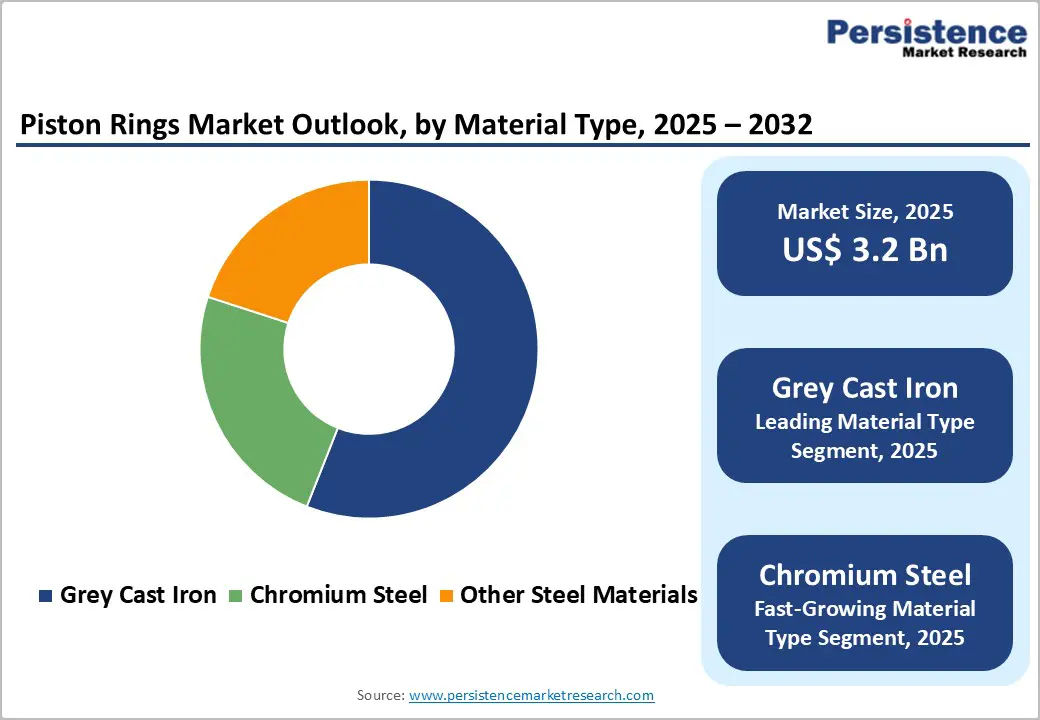
Grey Cast Iron commands market leadership with approximately 57% share, attributed to an optimal balance of cost-effectiveness, proven performance characteristics, and extensive manufacturing infrastructure supporting high-volume production requirements. Grey cast iron stays dominant by delivering reliable performance at low cost, supported by strong thermal control, vibration damping, and a well-established global supply chain. Material characteristics, including machinability, dimensional stability, and resistance to thermal expansion, support efficient manufacturing processes. The segment serves base-specification engines across all vehicle categories, with particular strength in emerging market production where cost optimization drives material selection.
Chromium Steel emerges as the fastest-growing material segment with 7.3% CAGR, propelled by superior mechanical properties, enhanced wear resistance, and performance requirements of modern high-efficiency powertrains. Turbocharged, high compression engines require chromium steel rings with PVD, plasma, and nitrided coatings delivering multi-fold durability, reduced friction, and thermal resistance, driving premium adoption across luxury vehicles and developed automotive markets.
Vehicle Type Insights
Passenger Vehicle segment maintains market leadership with approximately 43% share, representing the largest volume category despite intense electric vehicle competition and market share erosion to expanding two-wheeler production. Global passenger vehicle production of 66-68 million units annually generates substantial piston ring demand across diverse powertrain configurations from compact three-cylinder engines to large-displacement V8 applications. The segment encompasses sedans, hatchbacks, SUVs, and crossovers spanning economy to luxury price points with corresponding specification variations. Regional production concentration in China (24 million units), Europe (15 million units), and North America (12 million units) drives geographic market distribution.
Two Wheelers represents the fastest-growing vehicle segment at 5.9% CAGR, driven by explosive production growth across Asian manufacturing hubs and urbanization-fueled demand for affordable personal mobility. Annual two-wheeler production exceeding 58 million units, concentrated in India (21.2 million), China (16.5 million), Indonesia (6.4 million), and Vietnam (3.8 million), creates robust component demand. Two-wheeler growth outpaces passenger vehicles due to affordability, urban congestion advantages, rising middle-class demand, and higher ring counts per engine that drive strong component volumes.
Sales Channel Insights
OEM Channel dominates with approximately 61% market share, reflecting direct supply relationships with vehicle manufacturers, accounting for the majority of total piston ring production volumes globally. Original equipment applications ensure guaranteed volumes through multi-year supply contracts, platform-specific designs, and integrated product development processes with automotive manufacturers. The OEM segment benefits from Asia Pacific's position as a global manufacturing hub, with China, India, Japan, South Korea, and ASEAN nations collectively producing ~62% of global vehicles. Just-in-time delivery requirements, stringent quality specifications, and long-term partnerships characterize OEM relationships.
The global piston ring aftermarket is growing at 4.8% CAGR, driven by expanding global vehicle fleet, aging vehicle demographics, and increasing vehicle utilization, generating replacement component demand. The aftermarket benefits from higher per-unit margins versus OEM supply, brand preference opportunities, and diverse distribution channels, including wholesale networks, retail chains, and digital marketplaces. A growing fleet age, averaging 11-13 years in developed economies, creates sustained replacement cycles, while emerging markets demonstrate increasing replacement culture adoption.
Regional Market Insights
North America Piston Ring Market Trends
North America records 4.7% CAGR, supported by stable light vehicle production averaging 15.5–16.2 million units and strong aftermarket demand from aging fleets. The United States leads with 10.6 million light vehicles and 780,000 heavy trucks, while Canada contributes 1.4 million units from Ontario. The region delivers the world’s highest OEM content value per vehicle, reflecting large engines, performance models, and premium specifications. Regulatory pressure from CAFE and CARB standards accelerates advanced piston ring adoption, while pickup trucks and SUVs dominate sales.
Key strengths include concentrated Tier-1 suppliers, vertical integration strategies, Great Lakes manufacturing hubs, advanced materials innovation, coating technologies, optimized production processes, and a mature aftermarket ecosystem sustaining long-term replacement demand.
Europe Piston Ring Market Trends
Europe accounts for 26% of the global piston ring market, driven by premium vehicle output, strict regulations, and a mature automotive ecosystem. Germany, the United Kingdom, France, Spain, and Italy produce about 14.8 million vehicles annually, led by Germany’s premium OEMs requiring advanced ring technologies. The region features the highest turbocharged engine share, strong diesel presence, and rapidly growing hybrid penetration. Euro emission norms and CO2 targets enforce high performance standards, accelerating demand for specialized, low-friction, durable ring solutions.
The United Kingdom, France, and Spain sustain strong production levels, while supplier consolidation, long-term OEM alliances, electrification strategies, and circular economy investments strengthen remanufacturing and future market resilience.
Asia Pacific Piston Ring Market Trends
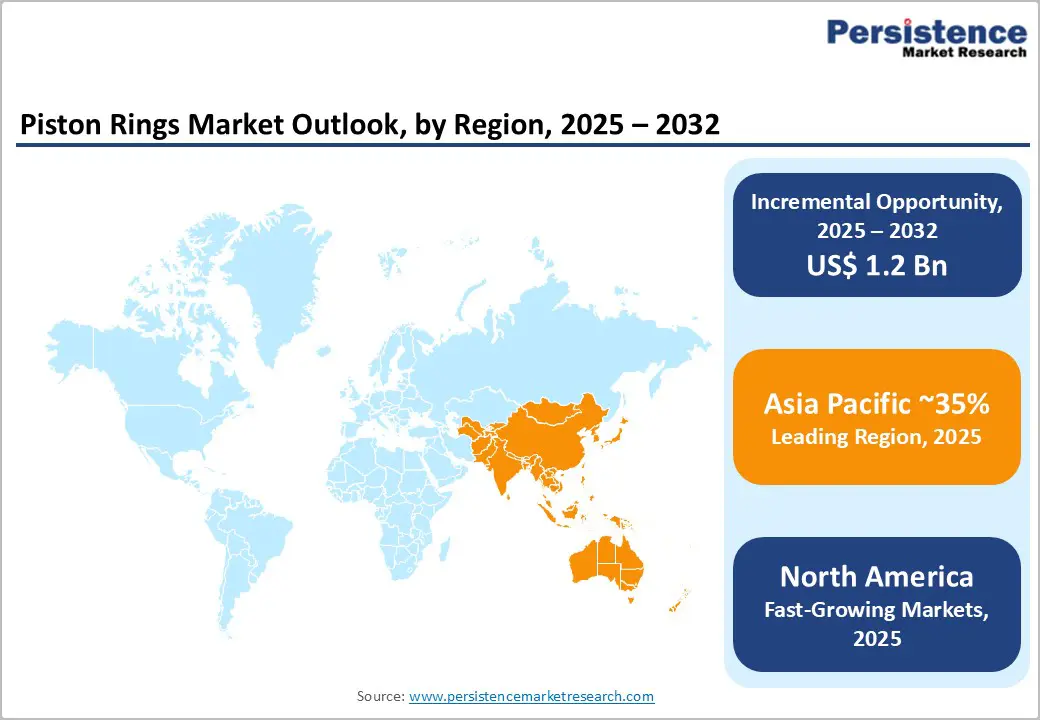
Asia Pacific commands nearly 56% of the global market, powered by massive two-wheeler production exceeding 48 million units and its role as the world’s manufacturing hub. China leads with 30.2 million light vehicles and 16.5 million two-wheelers, while India adds 5.8 million light vehicles and dominates two-wheelers. Japan contributes technologically advanced production, and ASEAN strengthens regional output. Competitive labor, strong supply chains, raw material access, and supportive government policies position Asia Pacific as the fastest-growing regional market.
Two-wheelers represent a uniquely high share of piston ring demand, far exceeding global averages. China’s electric vehicle leadership creates transition pressure, yet hybrid growth and sustained internal combustion production across other segments continue supporting long-term market expansion.
Competitive Landscape
Market leaders differentiate through advanced coatings, low-friction, hybrid-ready designs, expand into Asian hubs, integrate surface treatment capabilities, partner early with OEMs, and balance OEM volumes with high-margin aftermarket channels, using branding and digital platforms to maximize long-term profitability and competitive positioning.
Strategic Developments
- In October 2023, Nippon Piston Ring Co., Ltd. and Riken Corporation merged to establish NPR-RIKEN CORPORATION, combining their piston ring technologies and capacities to enhance product offerings and innovation in critical internal combustion engine components.
- In October 2024, major OEMs and lubricant developers accelerated H2ICE internal combustion engine initiatives, highlighting the need for advanced piston ring and lubricant systems capable of handling higher combustion temperatures, water byproduct effects, and hydrogen-induced wear for future hydrogen engines.
Companies Covered in Piston Ring Market
- Mahle GmbH
- Tenneco Inc.
- Nippon Piston Ring Co., Ltd.
- Riken Corporation
- TPR Co., Ltd.
- Federal-Mogul Motorparts (Tenneco)
- ASIMCO Technologies
- Shriram Pistons & Rings Ltd.
- Art Piston Rings
- Hastings Manufacturing Company
- ZYNP Corporation
- Indian Piston Limited
- Federal-Mogul Powertrain (Tenneco)
- Hitachi Automotive Systems
Frequently Asked Questions
The global piston ring market is projected at US$44.0 billion in 2026, expanding to US$64.3 billion by 2033, encompassing both OEM supply for 85+ million annual vehicle production globally and aftermarket replacement demand globally.
Key drivers include global automotive production of 85-95 million units annually, two-wheeler manufacturing over 58 million units in Asia, and the rise of hybrid powertrains creating specialized component needs and market opportunities.
The piston ring market is projected to grow at a 5.6% CAGR between 2026 and 2033.
Hybrid vehicle growth is creating strong opportunities through specialized components, digital aftermarket channels are unlocking new value via direct-to-consumer models, and Asian manufacturing expansion with two-wheeler growth is driving large volumes despite electric transition pressures.
Market leaders include Mahle GmbH, Tenneco Inc., Nippon Piston Ring Co., Riken Corporation, TPR Co., Federal-Mogul Motorparts, ASIMCO Technologies, Shriram Pistons & Rings, with strong regional positions from Art Piston Rings, Hastings Manufacturing, and expanding Asian manufacturers.


