




- Animal Health
- Bovine Tuberculosis Diagnosis Market
Bovine Tuberculosis Diagnosis Market Size, Share, and Growth Forecast, 2026 - 2033
Bovine Tuberculosis Diagnosis Market by Test Type (Serological Tests, Molecular Diagnostic Tests, Traditional Tests), Sample (Blood, Milk, Tissue/Lesion, Fecal & Environmental Swab), and Regional Analysis for 2026 - 2033

Bovine Tuberculosis Diagnosis Market Size and Trends Analysis
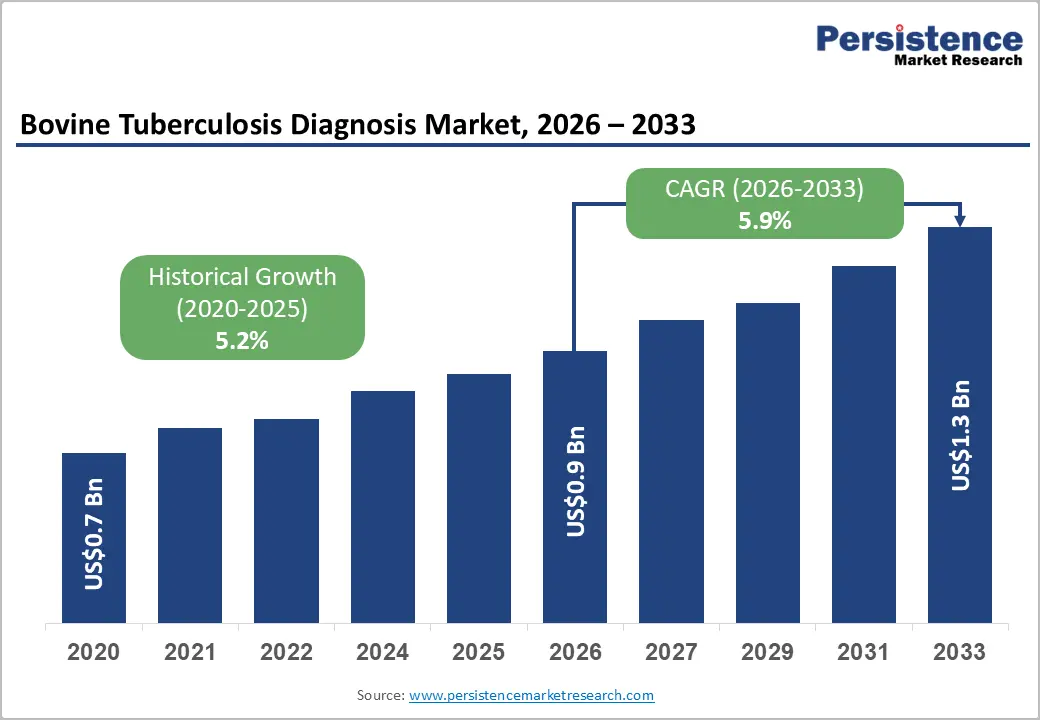
The global bovine tuberculosis diagnosis market size is likely to be valued at US$0.9 billion in 2026 and is expected to reach US$1.3 billion by 2033, growing at a CAGR of 5.9% during the forecast period from 2026 to 2033, driven by expanding livestock disease surveillance programs, rising zoonotic disease concerns, and increasing regulatory focus on animal health monitoring.
According to the World Organization for Animal Health, bovine tuberculosis remains a major animal health challenge across Africa, Asia, Europe, and the Americas, with cattle serving as the primary reservoir of infection. In 2025, France reported 93 confirmed bovine tuberculosis outbreaks, highlighting the continued need for routine testing and herd surveillance programs. The United States Department of Agriculture reported ongoing bovine tuberculosis monitoring under its National Tuberculosis Eradication Program in 2026, supporting demand for advanced diagnostic solutions and large-scale livestock screening.
Key Industry Highlights:
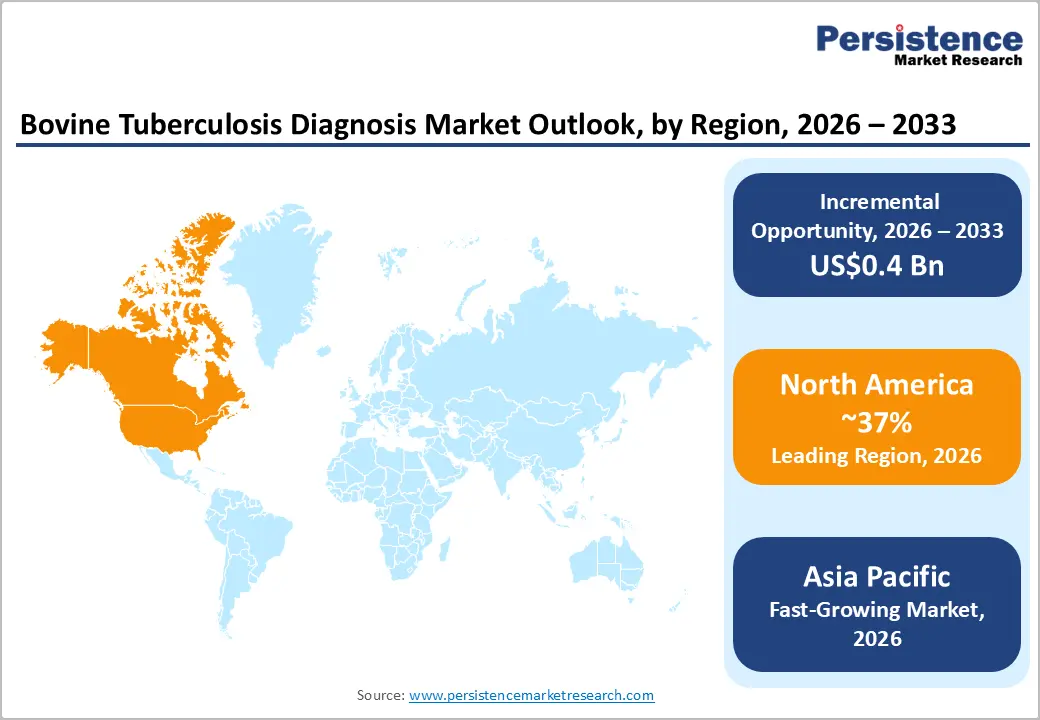
- Leading Region: North America is anticipated to be the leading region, accounting for a market share of 37% in 2026, driven by extensive surveillance programs, advanced veterinary diagnostics infrastructure, and strong regulatory oversight.
- Fastest-growing Region: Asia Pacific is likely to be the fastest-growing region, supported by large cattle populations, expanding veterinary healthcare infrastructure, and increasing disease surveillance initiatives.
- Leading Test Type: Traditional tests are projected to represent the leading test type in 2026, accounting for 52% of the revenue share, due to their widespread regulatory acceptance, cost-effectiveness, and extensive use in national cattle surveillance and eradication programs.
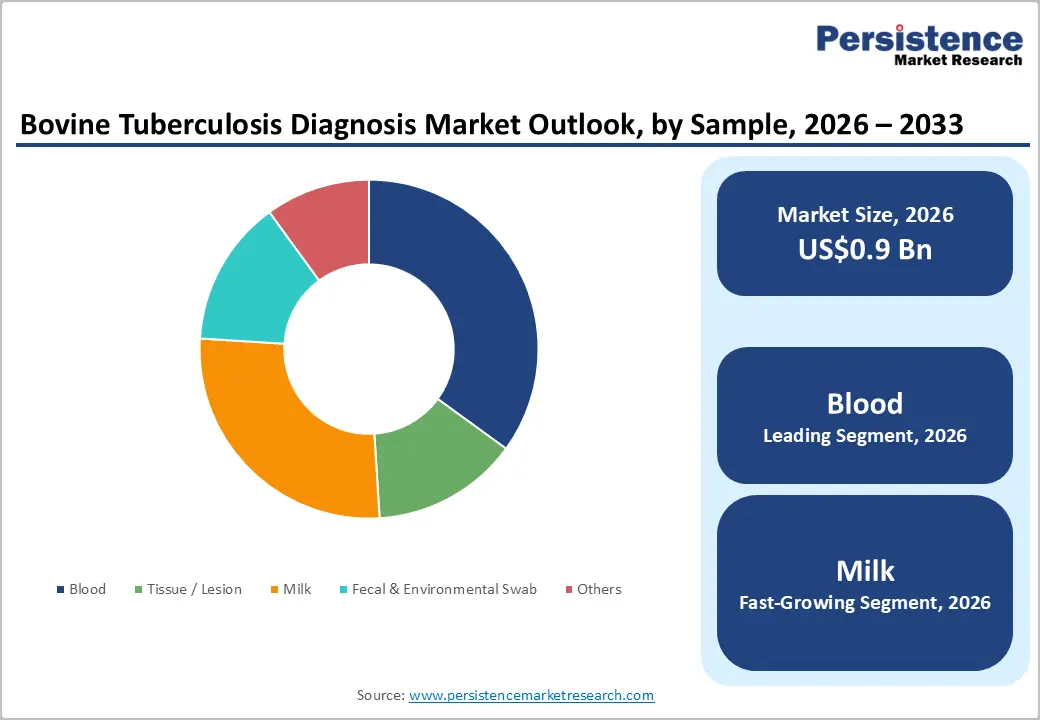
- Leading Sample Type: Blood samples are anticipated to be the leading sample type, accounting for over 55% of the revenue share in 2026, supported by their compatibility with multiple diagnostic methods, ease of collection, and routine use in veterinary disease screening programs.
- Key Opportunity: The growing adoption of rapid molecular diagnostics, point-of-care testing, and integrated livestock disease surveillance platforms presents a significant opportunity to enhance early bovine tuberculosis detection and herd health management.
DRO Analysis
Driver - Rising Prevalence and Zoonotic Risk Awareness
The disease affects livestock productivity, animal welfare, and trade activities, prompting governments and livestock owners to strengthen surveillance efforts. Growing herd sizes and intensified dairy and beef production systems have increased the need for regular disease screening. Veterinary authorities across many countries are implementing monitoring programs to identify infected animals at earlier stages.
This has elevated demand for reliable diagnostic tests, including traditional, serological, and molecular methods. As a result, diagnostic manufacturers continue expanding testing capabilities to support disease-control initiatives. Rising awareness of the zoonotic nature of bovine tuberculosis is accelerating market growth. The disease can be transmitted from infected animals to humans through direct contact or consumption of contaminated animal products, making public health protection a priority.
Regulatory agencies, veterinary organizations, and international animal health bodies continue promoting surveillance and eradication programs. Increasing focus on food safety, biosecurity, and livestock traceability encourages routine testing across dairy and beef sectors. Growing recognition of the economic and health consequences associated with outbreaks has strengthened investment in advanced diagnostic technologies, supporting sustained demand for accurate and efficient disease detection solutions.
Restraint - Limited Veterinary Infrastructure in Emerging Regions
Rural and remote livestock-producing regions often face shortages of veterinary professionals, diagnostic laboratories, and disease-monitoring resources. Inadequate access to testing facilities can delay diagnosis and reduce the effectiveness of surveillance programs. Many livestock owners have limited awareness of disease management practices and may not conduct routine testing. Transportation challenges and insufficient laboratory networks restrict sample collection and processing capabilities.
Financial constraints also contribute to infrastructure-related challenges in bovine tuberculosis diagnosis. Government animal health budgets in some regions prioritize immediate livestock production concerns over long-term disease surveillance investments. Limited funding can restrict procurement of modern diagnostic equipment and training programs for veterinary personnel. Variations in regulatory enforcement and reporting systems complicate disease-control efforts.
Opportunity - Technological Convergence and Point-of-Care Innovations
Advances in molecular biology, biosensors, artificial intelligence, and data analytics are enhancing diagnostic performance across veterinary applications. Modern testing platforms can deliver more reliable results while reducing laboratory dependence and operational complexity. Integration of digital monitoring systems with diagnostic workflows enables better disease tracking and herd management.
These innovations support early intervention strategies and strengthen surveillance programs. As livestock producers seek efficient disease-control solutions, demand for technologically advanced diagnostic tools continues to expand. Point-of-care diagnostic innovations represent a particularly attractive growth opportunity for market participants. Portable and user-friendly testing platforms allow veterinarians and livestock managers to perform disease screening directly on farms, reducing turnaround times and logistical challenges.
Rapid diagnostics can support timely decision-making and improve outbreak management in large cattle populations. These solutions are especially valuable in regions where laboratory infrastructure remains limited. Ongoing research into portable molecular assays, advanced immunodiagnostics, and connected testing devices is expected to enhance field-based disease detection capabilities.
Category-wise Analysis
Test Type Insights
Traditional tests are expected to account for 52% of revenue in 2026, due to long-standing regulatory acceptance, cost-effectiveness, and extensive integration into national bovine tuberculosis surveillance and eradication programs. Veterinary authorities across developed and developing countries continue to rely on tuberculin skin testing and interferon-gamma-based screening because these methods are well validated and suitable for large-scale herd monitoring. For example, AsureQuality which operates New Zealand’s national bovine tuberculosis testing program and performs extensive tuberculin skin testing as part of the country's TB eradication strategy.
Molecular diagnostic tests are likely to represent the fastest-growing segment, supported by their high sensitivity, specificity, and ability to detect infection at earlier stages. Increasing emphasis on accurate disease confirmation and rapid outbreak management is encouraging the adoption of advanced molecular technologies such as PCR-based testing. A notable example includes Qiagen N.V., which provides molecular testing technologies and sample-processing solutions that support veterinary laboratories in detecting infectious diseases.
Sample Type Insights
Blood sample is projected to lead the market, capturing around 55% of the revenue share in 2026. Their leadership position is attributed to broad compatibility with multiple diagnostic techniques, including serological, molecular, and interferon-gamma assays. Blood collection is a routine veterinary procedure that can be integrated efficiently into herd health management programs without significant operational disruption. For example, Bio-Rad Laboratories, whose diagnostic technologies support blood-based testing workflows used in veterinary laboratories for infectious disease detection and surveillance activities.
Milk is likely to be the fastest-growing sample type due to increasing interest in non-invasive and herd-friendly testing approaches. The growing adoption of dairy herd monitoring programs is encouraging the use of milk samples because they can be collected during routine milking operations without causing additional stress to animals. For instance, Neogen Corporation, which develops animal health and diagnostic solutions that support advanced testing applications within livestock production and dairy herd management environments.
Regional Insights
North America Bovine Tuberculosis Diagnosis Market Trends
North America is anticipated to be the leading region, accounting for a market share of 37% in 2026, supported by strong disease surveillance systems, advanced veterinary laboratory infrastructure, and established eradication programs. Demand is increasing for molecular diagnostics, interferon-gamma assays, and digital herd monitoring solutions that improve disease traceability and regulatory compliance. A notable example includes Neogen Corporation, which continues to expand its animal health and diagnostic portfolio.
U.S Bovine Tuberculosis Diagnosis Market Trends
The U.S. is expected to dominate the regional market, accounting for approximately 88% of the market share in 2026, driven by the National Tuberculosis Eradication Program administered by the United States Department of Agriculture. Increased use of risk-based testing and cattle movement monitoring is supporting demand for advanced diagnostics. State animal health agencies are enhancing traceability systems to identify infection sources more rapidly. Investments in veterinary laboratory modernization are improving testing capacity.
Canada Bovine Tuberculosis Diagnosis Market Trends
Canada is likely to be a significant market for bovine tuberculosis diagnosis, holding approximately 12% of the market share in 2026, supported by the Canadian Food Inspection Agency. The country continues implementing risk-based surveillance and wildlife monitoring initiatives to reduce disease transmission risks. Diagnostic testing demand is supported by strict livestock health regulations and export requirements. Enhanced data-sharing systems are improving outbreak response capabilities. Veterinary laboratories are adopting more advanced testing platforms for disease confirmation.
Europe Bovine Tuberculosis Diagnosis Market Trends
Europe is likely to be a significant market for bovine tuberculosis diagnosis in 2026, due to stringent animal health regulations, comprehensive surveillance programs, and continuous investment in disease eradication initiatives. The region is witnessing increased adoption of molecular testing technologies alongside traditional screening methods to improve diagnostic accuracy. For example, bioMérieux SA, which provides advanced molecular diagnostic technologies that support veterinary laboratories and infectious disease testing applications across European markets.
U.K. Bovine Tuberculosis Diagnosis Market Trends
The U.K. is likely to be a significant market for bovine tuberculosis diagnosis, accounting for 15% of Europe market share in 2026, supported by ongoing disease management efforts. Government authorities continue implementing extensive cattle testing programs and surveillance measures. Increased focus on early detection and outbreak prevention supports adoption of advanced diagnostic technologies. Veterinary services are utilizing improved data analytics and herd monitoring systems. Research initiatives aimed at enhancing disease control strategies are creating opportunities for diagnostic innovation.
Germany Bovine Tuberculosis Diagnosis Market Trends
Germany is expected to be the largest country-level market in Europe, accounting for approximately 37% of regional revenue in 2026, due to its favorable bovine tuberculosis status through rigorous surveillance and monitoring activities. Veterinary authorities conduct targeted testing programs to rapidly identify and contain potential cases. Diagnostic laboratories are increasingly utilizing advanced molecular technologies to complement traditional testing methods. The country benefits from a highly developed veterinary healthcare system and strong research capabilities.
Asia Pacific Bovine Tuberculosis Diagnosis Market Trends
The Asia Pacific region is expected to be the fastest-growing market for bovine tuberculosis diagnosis, driven by expanding livestock populations, rising dairy production, and increasing awareness of zoonotic disease threats. Governments across the region are enhancing animal health surveillance programs and investing in veterinary healthcare infrastructure to strengthen disease monitoring and control. The growing adoption of advanced molecular diagnostic technologies is also supporting market expansion.
For instance, solutions offered by Qiagen N.V. are being increasingly utilized by veterinary laboratories across Asia Pacific for the detection and management of bovine tuberculosis.
China Bovine Tuberculosis Diagnosis Market Trends
China is projected to dominate the regional market, holding around a 30% share of the market in 2026, due to increasing dairy and beef production, which is driving demand for reliable bovine tuberculosis testing solutions. Veterinary authorities are investing in laboratory capacity and diagnostic technology upgrades. Improved livestock traceability systems are supporting disease monitoring efforts. Adoption of molecular diagnostics is increasing in provincial veterinary laboratories.
India Bovine Tuberculosis Diagnosis Market Trends
India is expected to emerge as a significant market for bovine tuberculosis diagnosis, accounting for approximately a 20% share in 2026, due to its large cattle population and expanding dairy sector. Veterinary infrastructure is improving through investments in laboratory facilities and training programs. Rising awareness of zoonotic disease risks is promoting adoption of diagnostic testing. Dairy cooperatives and livestock producers are implementing stronger herd health monitoring practices. Advances in veterinary healthcare services are improving access to diagnostic solutions.
Competitive Landscape
The global bovine tuberculosis diagnosis market exhibits a moderately fragmented structure, driven by the presence of established veterinary diagnostic companies, specialized animal health laboratories, and emerging biotechnology firms focused on livestock disease detection. Market competition is influenced by increasing demand for accurate, rapid, and regulatory-compliant diagnostic solutions to support national bovine tuberculosis surveillance and eradication programs. Growing investments in molecular diagnostics, immunoassays, and laboratory automation are reshaping the competitive environment.
With key leaders, including IDEXX Laboratories, Qiagen N.V., BioMérieux SA, Neogen Corporation, Bio-Rad Laboratories, and Abbott Laboratories, the market remains highly innovation-focused. These players compete through technological advancements, product accuracy, test sensitivity, laboratory network expansion, strategic collaborations, and investments in next-generation molecular and immunological testing platforms.
Key Industry Developments:
- In October 2025, the Animal and Plant Health Agency advanced Phase 3 field trials of a bovine tuberculosis cattle vaccine and companion skin test across England and Wales. The development supports next-generation bovine TB detection and disease eradication strategies through improved diagnostic accuracy and surveillance programs.
- In April 2025, Valley Diagnostics and Sona Nanotech signed a licensing agreement to commercialize a rapid bovine tuberculosis lateral flow assay across the U.K. and Ireland. The collaboration aims to accelerate point-of-care bovine TB detection using advanced biomarker and nanotechnology platforms, supporting faster disease diagnosis, improved herd management, and strengthened livestock disease surveillance programs.
Companies Covered in Bovine Tuberculosis Diagnosis Market
- Abbott Laboratories
- AsureQuality
- BioMérieux SA
- Bionote
- Bio-Rad Laboratories
- Creative Diagnostics
- Enfer Group
- Hangzhou Frenovo Biotech Co., Ltd.
- IDEXX Laboratories
- Innovative Diagnostics SAS (IDvet)
- Neogen Corporation
- Qiagen N.V.
Frequently Asked Questions
The global bovine tuberculosis diagnosis market is projected to reach US$0.9 billion in 2026.
Rising bovine tuberculosis prevalence, increasing zoonotic disease awareness, and expanding government-led livestock disease surveillance programs drive market growth.
The bovine tuberculosis diagnosis market is expected to grow at a CAGR of 5.9% from 2026 to 2033.
Technological advancements in molecular diagnostics and point-of-care testing create significant opportunities for faster and more accurate bovine tuberculosis detection.
Abbott Laboratories, AsureQuality, BioMérieux SA, Bionote, Bio-Rad Laboratories, and Creative Diagnostics are the leading players.


