




- Food Ingredients & Additives
- Avocado Powder Market
Avocado Powder Market Size, Share, and Growth Forecast, 2025 - 2032
Avocado Powder Market By Form (Freeze-Dried, Spray-Dried, Others) Application (Food & Beverages, Cosmetics, Others), Distribution Channel, and Regional Analysis for 2025 - 2032

Avocado Powder Market Size and Trends Analysis
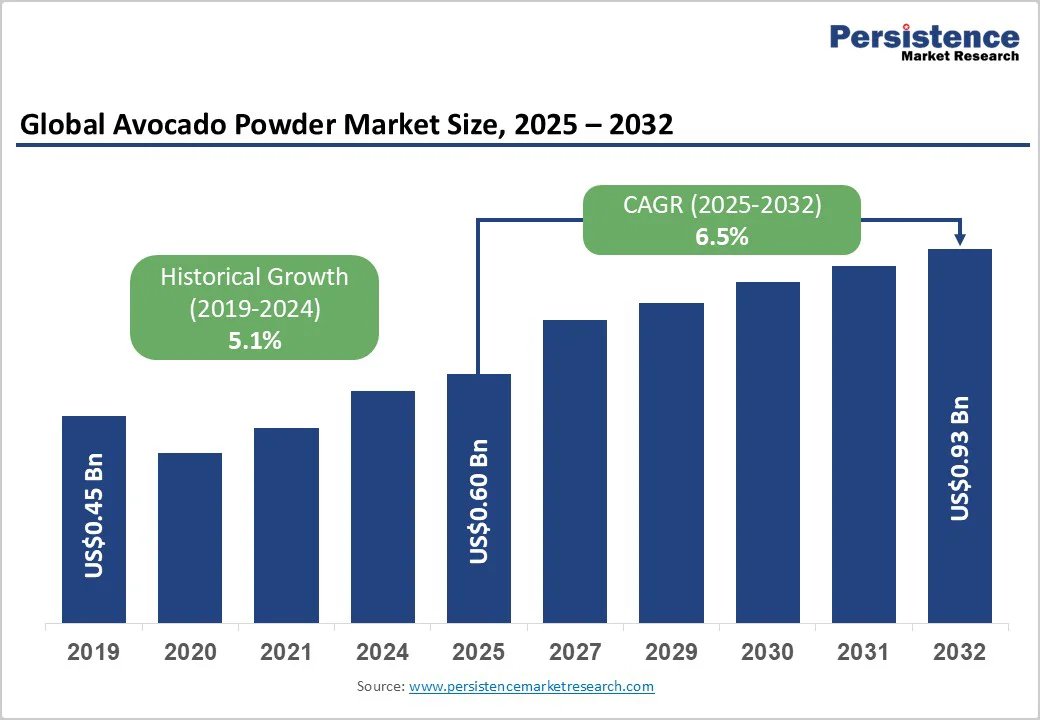
The global avocado powder market size is likely to be valued at US$0.60 Billion in 2025 and is expected to reach US$0.93 Billion by 2032, growing at a CAGR of 6.5% during the forecast period from 2025 to 2032, driven by the rising adoption of natural and functional food ingredients, a growing shift toward plant-based nutrition, and increased demand for long-shelf-life fruit derivatives.
Avocado powder’s versatility across food, beverage, nutraceutical, and cosmetic sectors makes it a high-value, sustainable ingredient. Its rich nutrient profile, potassium, folate, and vitamins E and C, supports use in functional, premium formulations. Rising demand for clean-label and vegan products is driving producers to scale operations and launch organic and freeze-dried variants.
Key Industry Highlights
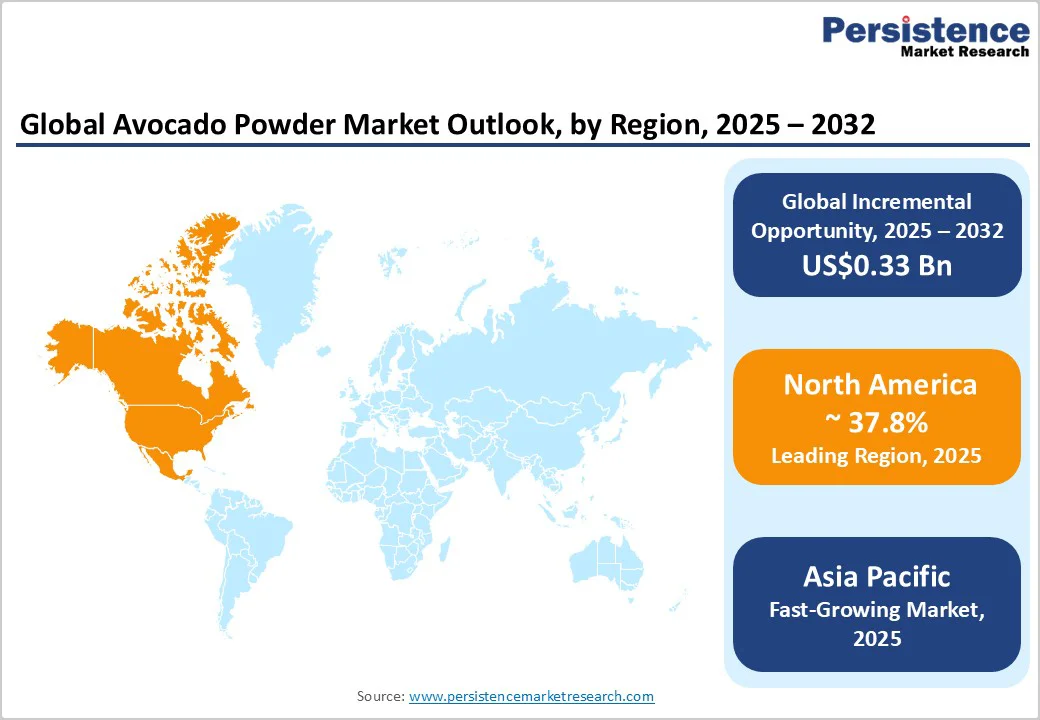
- Leading Region: North America accounted for around 37.8% of global revenue in 2025, driven by strong health-food adoption and established retail infrastructure.
- Fastest-Growing Region: Asia Pacific, supported by expanding e-commerce, rising disposable incomes, and increasing demand for plant-based nutrition.
- Investment Plans: Major players are investing in advanced freeze-drying and encapsulation technologies, with regional processing expansions across Mexico, India, and Thailand to strengthen supply reliability and export capabilities.
- Dominant Form: Freeze-dried avocado powder leads with approximately 46.3% market share in 2025, favored for nutrient retention and premium positioning in beverages and functional foods.
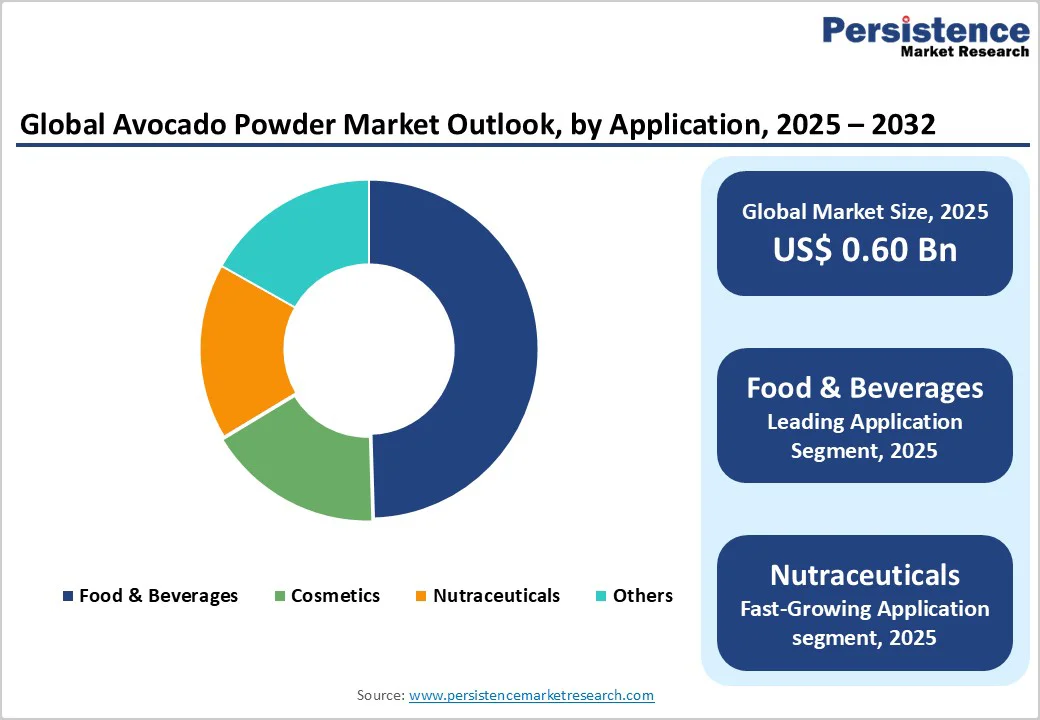
- Leading Application: The food & beverages segment contributes about 53% of total demand, supported by the rising inclusion of avocado powder into smoothies, bakery products, and clean-label formulations.
| Key Insights | Details |
|---|---|
|
Avocado Powder Market Size (2025E) |
US$0.60 Bn |
|
Market Value Forecast (2032F) |
US$0.93 Bn |
|
Projected Growth (CAGR 2025 to 2032) |
6.5% |
|
Historical Market Growth (CAGR 2019 to 2024) |
5.1% |
Market Factors - Growth, Barriers, and Opportunity Analysis
Growth analysis - Rising Demand for Functional and Nutrient-Rich Ingredients
The surge in global health awareness has amplified demand for nutrient-dense foods, positioning avocado powder as a preferred ingredient in smoothies, snacks, and dietary supplements. It offers a balanced composition of healthy fats, fibers, and antioxidants that align with consumer demand for heart-friendly and clean-label formulations. The product’s ability to retain nearly 80–85% of the nutrient value of fresh avocado through controlled dehydration methods strengthens its market potential. Growing consumer inclination toward superfood-based nutrition is expected to drive substantial uptake across both developed and developing regions.
Expanding Application Scope in Food and Beverage Manufacturing
Avocado powder’s adaptability in bakery, confectionery, beverage, and savory applications has made it a valuable input for food processors seeking natural flavoring and functional enrichment. The powder’s longer shelf life compared to fresh avocado reduces wastage and supports logistics optimization for manufacturers. Increasing product incorporation in instant drink mixes, dairy alternatives, and snack coatings is accelerating its industrial adoption. Food producers are capitalizing on the product’s texture-enhancing and nutritional properties to meet evolving consumer expectations for natural taste and quality consistency.
Rising Popularity of Plant-Based and Vegan Lifestyle
A global shift toward plant-based eating habits is reinforcing the adoption of fruit and vegetable powders in mainstream food production. Avocado powder aligns well with vegan preferences while offering high versatility in recipes and cosmetic formulations. Manufacturers are leveraging this demand by promoting powder-based formats that avoid the perishability and handling challenges of fresh produce. Continuous innovation in cold-drying and encapsulation technologies is further improving product stability, creating new commercial pathways for plant-derived ingredient suppliers.
Barrier Analysis - High Production Costs and Seasonal Supply Fluctuations
The cost of producing avocado powder remains relatively high due to raw material seasonality and energy-intensive drying processes. Fluctuations in avocado prices, driven by weather patterns and export demand from producing nations such as Mexico and Peru, directly impact cost structures. These variables contribute to pricing volatility across the supply chain and limit scalability for small processors in developing economies.
Limited Consumer Awareness in Emerging Markets
Despite growing global recognition, consumer awareness of avocado powder remains limited in certain regions, particularly across parts of Africa and the Middle East. The absence of widespread marketing campaigns and low retail penetration restricts demand growth. Consumers often perceive powdered fruit ingredients as niche or premium, leading to slower mainstream adoption compared to traditional fruit derivatives such as pulp or juice concentrates.
Opportunity Analysis - Expansion in Nutraceuticals and Functional Supplements
The rising global demand for functional foods and dietary supplements presents significant opportunities for avocado powder integration. Its rich composition of monounsaturated fats and phytosterols positions it as a natural ingredient for heart-health and anti-aging products. The global nutraceuticals industry’s growth trajectory creates substantial potential for avocado powder to capture value in protein blends, capsule formulations, and functional beverages.
Technological Advancements in Drying and Processing Techniques
Innovations in freeze-drying, spray-drying, and vacuum-drying technologies are enhancing the retention of bioactive compounds and flavor in avocado powder. These advancements are improving shelf life, solubility, and nutrient preservation, enabling manufacturers to target premium product segments. Emerging technologies also reduce energy consumption and processing costs, supporting sustainable production models aligned with environmental goals.
Rising Demand in Cosmetic and Personal Care Formulations
Avocado powder’s antioxidant and moisturizing properties are driving its use in skincare and haircare formulations. Its natural content of vitamins A, E, and K supports anti-aging and skin-repair functions, appealing to consumers who favor botanical ingredients. With the global natural cosmetics market expanding, avocado powder-based formulations represent a growing opportunity for suppliers aiming to diversify their portfolio beyond the food and beverage sectors.
Category-wise Analysis
Form Insights
Freeze-dried avocado powder leads the global market with over 46.3% revenue share in 2025, driven by its exceptional nutrient preservation and premium quality. The freeze-drying process removes moisture through low-temperature sublimation, retaining up to 90% of the vitamins, minerals, and healthy fats found in fresh avocados. This technique ensures vibrant color, natural flavor, and fine texture, making it ideal for high-end applications such as smoothies, baby food, nutritional drink mixes, and dairy alternatives. Producers such as NutraDry (Australia) and AvoLov (U.S.) are investing in advanced freeze-drying systems to meet demand from clean-label and private-label brands. Its extended shelf life of up to two years also enhances export potential across North America and Europe.
Spray-dried avocado powder represents the fastest-growing segment, supported by its cost-effectiveness and scalability for industrial food production. Using hot-air atomization, this method yields a fine, free-flowing powder suited for bakery, seasoning, and instant meal formulations. Food manufacturers prefer spray-dried formats for their easy solubility and compatibility with large-scale processing. Emerging producers in China, India, and Mexico are expanding spray-drying capacity to cater to mainstream food sectors. For instance, Foodchem International (China) and Green Essence Foods (India) are leveraging local sourcing to offer affordable, versatile avocado powder for snacks, beverages, and packaged foods.
Application Insights
The food and beverage segment holds the largest share, representing over 53% of total market revenue in 2025, supported by the increasing integration of avocado powder into mainstream product formulations. Food manufacturers utilize it as a natural emulsifier and nutrient booster in ready-to-drink beverages, bakery fillings, dips, dressings, sauces, and frozen desserts. The powder’s smooth texture and mild flavor enable seamless incorporation into both sweet and savory applications. For instance, several U.S. smoothie brands have begun replacing synthetic flavoring agents with freeze-dried avocado powder to enhance nutrition profiles and product stability. In Latin America, bakery chains are experimenting with avocado-infused bread mixes, leveraging its natural fat content to improve dough softness and shelf life.
The nutraceuticals segment is the fastest-growing, emerging as the most dynamic end-use category. Avocado powder is increasingly used in dietary supplements, functional capsules, and health drinks due to its high concentration of antioxidants, carotenoids, and monounsaturated fats. Its anti-inflammatory and cholesterol-lowering properties align with consumer demand for heart-health and anti-aging products. Nutraceutical companies in Japan and the United States are incorporating avocado powder into superfood blends and protein supplements, targeting both athletes and wellness enthusiasts. For example, wellness brands have launched avocado-based collagen supplements and green superfood powders combining avocado with spirulina and moringa for synergistic health benefits.
Regional Insights
North America Avocado Powder Market Trends - Expanding Functional and Clean-Label Adoption Driven by U.S. Production Strength
North America remains the largest regional market, accounting for over 37.8% of global avocado powder demand in 2025. The U.S. leads regional consumption, supported by the widespread popularity of avocado-based foods, functional beverages, and ready-to-mix nutrition products. The region’s strong processing ecosystem, especially in California and Texas, facilitates large-scale production and distribution of freeze-dried avocado powder. Leading brands such as BetterBody Foods and NutraGreen Biotechnology have expanded their product portfolios to include clean-label avocado-based powders targeted toward vegan and fitness-conscious consumers.
The market benefits from an increasing preference for plant-based and functional ingredients, coupled with transparency-focused regulations under the U.S. Food and Drug Administration (FDA) that reinforce consumer trust. Canada’s nutraceutical industry is also rapidly integrating avocado powder in dietary supplements and fortified foods. In April 2025, SunOpta Inc. announced an expansion of its fruit ingredient processing facility in Ontario to include avocado powder production, aiming to strengthen supply for North American beverage brands. Overall, local production investments are aimed at minimizing import reliance and stabilizing raw material costs amid avocado price volatility.
Europe Avocado Powder Market Trends - Sustainability and Organic Certification Fueling Growth across Food and Cosmetics
Europe ranks as the second-largest regional market, with the region’s growth anchored by rising consumer awareness of sustainably sourced and natural ingredients, with high demand observed across Germany, France, and the U.K. The clean-label and organic movement continues to drive uptake in both the food and cosmetics sectors. European manufacturers, such as AvaGro Europe and Ecoandina GmbH, have introduced non-GMO and organic-certified avocado powders, catering to environmentally conscious consumers and retail partners emphasizing traceable supply chains.
The European Union’s harmonized food safety regulations, including EFSA guidelines for labeling and ingredient purity, support transparent cross-border trade and uniform product quality. In February 2025, Greenyard N.V. announced a research collaboration in Belgium to develop energy-efficient drying technologies aimed at reducing carbon emissions during powder production. The U.K. market stands out for its growing use of avocado powder in plant-based smoothies and anti-aging cosmetics, with brands such as The Body Shop and Neal’s Yard Remedies increasingly sourcing sustainable avocado derivatives for skincare applications.
Asia Pacific Avocado Powder Market Trends - Rapid Urban Demand and Local Manufacturing Powering Market Acceleration
Asia Pacific represents the fastest-growing regional market. The region’s demand surge is driven by urbanization, evolving dietary habits, and rising disposable incomes across China, India, and Japan. Consumers are increasingly drawn to healthy snacking and natural beauty products, where avocado powder serves as a functional additive rich in antioxidants and healthy fats. Local manufacturers benefit from cost-effective processing, abundant raw material access, and growing export demand for freeze-dried ingredients.
In June 2025, Sresta Natural Bioproducts Ltd. of India introduced a line of avocado powder under its 24 Mantra Organic brand, expanding its portfolio into functional food ingredients. Similarly, Chinese companies such as Zhejiang Vegmax Biotech Co., Ltd. have invested in large-scale spray-drying plants to cater to domestic and ASEAN markets. Japan remains a key innovation hub, with brands experimenting with avocado-infused supplements and ready-to-drink blends tailored to wellness-focused consumers. The ongoing expansion of e-commerce and direct-to-consumer platforms, including JD.com and Nykaa, continues to enhance product accessibility across Asia Pacific, reinforcing its position as the most dynamic growth region in the global avocado powder market.
Competitive Landscape
The global avocado powder market is moderately consolidated. Competition is defined by product quality, distribution reach, and technological capability. Established brands leverage vertical integration and strategic sourcing partnerships with avocado growers to ensure a consistent raw material supply. New entrants focus on niche applications such as organic and fortified formulations to differentiate within the competitive landscape.
Market leaders emphasize technological innovation, supply chain resilience, and sustainability-driven sourcing to maintain a competitive advantage. Companies are investing in renewable energy-powered drying systems and recyclable packaging to align with global sustainability standards.
Key Industry Developments
- In July 2025, the World Avocado Organisation launched its “2025 India Campaign” to educate Indian consumers and the food-industry trade about avocado uses, including avocado powder, in regional cuisine, signalling growing demand in South Asia for value-added avocado derivatives.
- In September 2025, OVAVO LTD. introduced a finer-mesh (US 18 mesh) avocado-powder product developed after extensive R&D; the launch positions the company for high-end applications in meal replacements, beverages, and supplements with improved sensory and functional attributes.
Companies Covered in Avocado Powder Market
- AvoLov
- Woodland Foods
- Schilling Ltd.
- The Green Labs LLC
- OVĀVO LTD.
- Unichi
- ORGANICWAY
- Xi’an Sost Biotech Co., Ltd.
- AvoPure
- Avocado Global Pte Ltd.
- ConnOils LLC
- Tradin Organic Agriculture B.V.
- AVOCARE
- NutraGreen Biotechnology Co., Ltd.
- Bella Vado, Inc.
- AvoPacific Plantations
- AVOHASS S.A.
- Calavo Growers, Inc.
- The Avocado Company
- Dalisay World
Frequently Asked Questions
The global avocado powder market size is estimated at US$0.60 Billion in 2025.
By 2032, the avocado powder market is projected to reach a value of US$0.93 Billion.
Key trends include the rising use of freeze-dried powders in functional beverages, increasing adoption in nutraceutical formulations, and expanding e-commerce distribution.
The freeze-dried avocado powder segment leads the market in 2025, accounting for the largest revenue share due to superior nutrient preservation and wide use in premium food and beverage products.
The avocado powder market is expected to grow at a CAGR of 6.5% between 2025 and 2032.
Major players include OVĀVO LTD., Woodland Foods, NutraGreen Biotechnology Co., Ltd., Tradin Organic Agriculture B.V., and The Green Labs LLC.


