




- Automation & Robotics
- Acoustic Emission-based NDT Market
Acoustic Emission-based NDT Market Size, Share, and Growth Forecast 2026 - 2033
Acoustic Emission-based NDT Market by Offering (Equipment (AE sensors & transducers, Data acquisition systems, Preamplifiers & accessories), Software (Signal processing & analysis, Source location & visualization, AI-enabled platforms), Services (Inspection & Testing Services, Calibration, Installation & Training)), Technique, Industry, Regional Analysis, 2026 - 2033

Acoustic Emission-based NDT Market Size and Trend Analysis
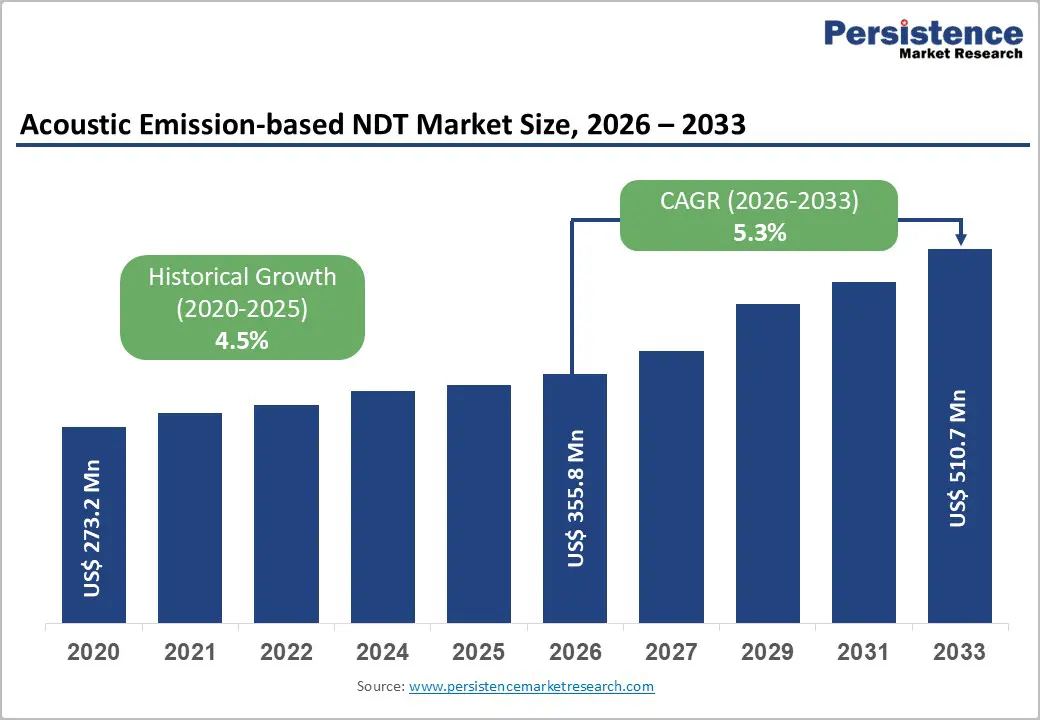
The global acoustic emission-based NDT market size is expected to be valued at US$ 335.8 million in 2026 and projected to reach US$ 482.0 million by 2033, growing at a CAGR of 5.3% between 2026 and 2033. Emergence of stringent safety and regulations across oil & gas, power generation fuels the need for acoustic emission-based NDT techniques across aerospace and infrastructure sectors.
Rising adoption of predictive maintenance practices to reduce unplanned downtime and asset failures further supports market expansion. Continuous advancements in acoustic emission sensors, data acquisition systems, and AI-based signal analysis are improving detection accuracy and reliability. Expanding industrial and infrastructure projects in emerging economies are accelerating demand for dependable, real-time non-destructive testing solutions.
Key Industry Highlights:
- Leading Region: North America dominates the Acoustic Emission-based NDT market, accounting for 35% of the market in 2025, driven by stringent U.S. regulations and aerospace sector leadership.
- Fastest-Growing Region: Asia Pacific is the fastest-growing region with 32% share in 2025, expanding at 6.3% CAGR (2025–2032) due to industrialization and infrastructure development in China, India, and Southeast Asia.
- Leading Offering Category: Equipment is the dominant offering segment with 45% share in 2025, fueled by AE sensors and data acquisition systems in oil & gas inspections.
- Leading Technique: Multiple Channel Source Location holds 40% share in 2025, providing precise monitoring across complex and large-scale assets.
- Key Opportunity: AI-integrated platforms drive adoption of predictive maintenance, improving defect-detection accuracy, particularly in renewable energy applications.
| Key Insights | Details |
|---|---|
|
Acoustic Emission-based NDT Size (2026E) |
US$ 335.8 million |
|
Market Value Forecast (2033F) |
US$ 482.0 million |
|
Projected Growth CAGR(2026-2033) |
5.3% |
|
Historical Market Growth (2020-2025) |
4.5% |
Market Dynamics
Drivers - Stringent Regulatory Compliance and Mandatory Safety Frameworks
Governments and industry bodies worldwide enforce rigorous safety and integrity standards, accelerating adoption of advanced NDT techniques such as acoustic emission testing. Regulations from organizations such as ASTM, ISO, FAA, and ASME mandate periodic inspection of critical assets in the oil & gas, aerospace, and nuclear power sectors. Standards like ISO 12713 and ASTM E1106 define AE sensor performance requirements, ensuring reliable detection of structural defects and degradation. This regulatory push has driven widespread implementation of AE-based NDT as a compliance-critical tool rather than an optional inspection method. By standardizing high-reliability monitoring practices, industries have reported meaningful reductions in inspection-related failures and safety incidents. As regulatory oversight continues to tighten, particularly for aging infrastructure and high-risk assets, compliance-driven adoption remains a core driver of market growth.
Accelerated Shift Toward Predictive and Condition-Based Maintenance
Industries are increasingly shifting from reactive maintenance approaches to predictive and condition-based strategies, significantly boosting demand for acoustic emission-based NDT solutions. AE enables real-time monitoring of active damage mechanisms, helping operators detect early-stage cracks, corrosion, and leak initiation. Sector studies indicate that predictive maintenance supported by AE can reduce unplanned downtime by 20–40%, improving asset availability and operational efficiency.
In power generation and oil & gas sectors, continuous AE monitoring aligns with international safety recommendations and risk-based inspection programs. Integration with digital twins, advanced analytics, and AI-driven diagnostics further enhances decision-making accuracy. This transition toward data-driven maintenance models extends asset life, lowers lifecycle costs, and sustains long-term demand for AE technologies across industrial environments.
Restraints - High Capital Investment Requirements and Shortage of Skilled AE Professionals
Acoustic emission–based NDT systems require substantial upfront investment in specialized hardware, including multi-channel data acquisition units, high-sensitivity sensors, and advanced analysis software. In many cases, total system costs exceed those of conventional NDT methods by 25–50%, creating a significant barrier for small and mid-sized enterprises. Additionally, installation and calibration in harsh industrial environments further increase ownership and maintenance expenses.
The global shortage of trained and certified AE professionals also constrains its adoption. Industry bodies such as the American Society for Non-destructive Testing (ASNT) have highlighted skill gaps in advanced AE signal interpretation and system deployment. Limited availability of experienced personnel raises operational risks, increases training costs, and slows penetration in cost-sensitive regions, despite the long-term economic benefits of predictive monitoring.
Complex Data Interpretation and Limited Standardization in Signal Analysis
Acoustic emission testing generates large volumes of high-frequency data that are highly sensitive to background noise, operational vibrations, and environmental interference. Accurate defect localization and classification require advanced expertise and robust signal processing capabilities. Studies from AE research groups indicate that false-positive rates can reach 15–20% in complex operating environments, reducing user confidence in inspection outcomes.
While AI and machine-learning tools show promise in improving data interpretation, the lack of standardized algorithms and validation frameworks limits widespread adoption. In safety-critical applications such as aerospace and nuclear energy, this uncertainty delays regulatory acceptance and operational deployment. These challenges in data interpretation continue to hinder the broader implementation of AE-based NDT solutions.
Opportunities - Integration of AI-Enabled Acoustic Emission Monitoring Platforms
The integration of artificial intelligence into acoustic emission–based NDT platforms presents a strong growth opportunity for market participants. AI-enabled software enhances signal filtering, source localization, and defect classification, significantly improving inspection accuracy and reducing operator dependency. Industry trials indicate that machine-learning-driven AE systems can improve defect-identification accuracy by nearly 30%, thereby accelerating the adoption of multi-channel monitoring solutions across asset-intensive industries.
This opportunity is particularly pronounced in fast-growing sectors such as renewable energy, where wind turbine blades and towers require continuous structural health monitoring. Alignment with Industry 4.0 initiatives and digitalization policies, including government-backed funding programs for smart inspection technologies, further supports demand. Vendors offering ISO-certified, AI-integrated AE solutions are well-positioned to capitalize on this technology-driven shift.
Rising Infrastructure Development Across Asia Pacific Economies
Rapid industrialization and large-scale infrastructure development across the Asia Pacific create substantial opportunities for the acoustic emission–based NDT market. Countries such as China, India, and ASEAN members are investing heavily in pipelines, power plants, transportation networks, and industrial facilities, all of which require continuous monitoring of structural integrity. AE-based techniques are increasingly adopted for early detection of cracks, corrosion, and leak initiation in these assets.
Government-led infrastructure and energy programs are reinforcing safety compliance requirements and accelerating the adoption of AE in power generation and pipeline monitoring applications. Additionally, the growth of local manufacturing capabilities and service networks is reducing system costs and enabling broader penetration. This combination of regulatory support, infrastructure expansion, and cost advantages positions the Asia Pacific as a key growth engine for the market.
Category-wise Analysis
Offering Insights
Equipment accounted for 45% of the acoustic emission-based NDT market in 2025, driven by strong demand for AE sensors, transducers, and multi-channel data acquisition systems. Oil & gas inspections and pressure vessel monitoring remain key demand centers, where high-sensitivity hardware is critical for real-time defect detection. Regulatory approvals in the aerospace and nuclear sectors further favor durable, certified equipment capable of operating reliably in harsh environments.
Looking ahead, software is emerging as the fastest-growing offering segment as users increasingly prioritize advanced signal processing, visualization, and remote monitoring capabilities. Integration of AI-driven analytics, cloud-based platforms, and digital twin compatibility is accelerating adoption, particularly among asset-intensive industries seeking scalable and intelligent inspection solutions beyond traditional hardware-centric deployments.
Technique Insights
Multiple-channel source location accounted for approximately 40% of the share in 2025, owing to its superior accuracy in complex and large-scale structures. This technique enables precise defect localization by analyzing differences in hit arrival times across multiple sensors, making it well-suited for volumetric inspections in power plants, pressure vessels, and large pipelines. Its endorsement in safety-critical standards has reinforced widespread industrial adoption.
Zonal and linear location techniques are expected to grow more rapidly as industries seek cost-effective monitoring solutions for long-distance assets such as pipelines and storage terminals. These methods offer simpler deployment and lower system complexity, making them attractive for emerging markets and large infrastructure networks where broad-area surveillance is prioritized over pinpoint localization.
Industry Insights
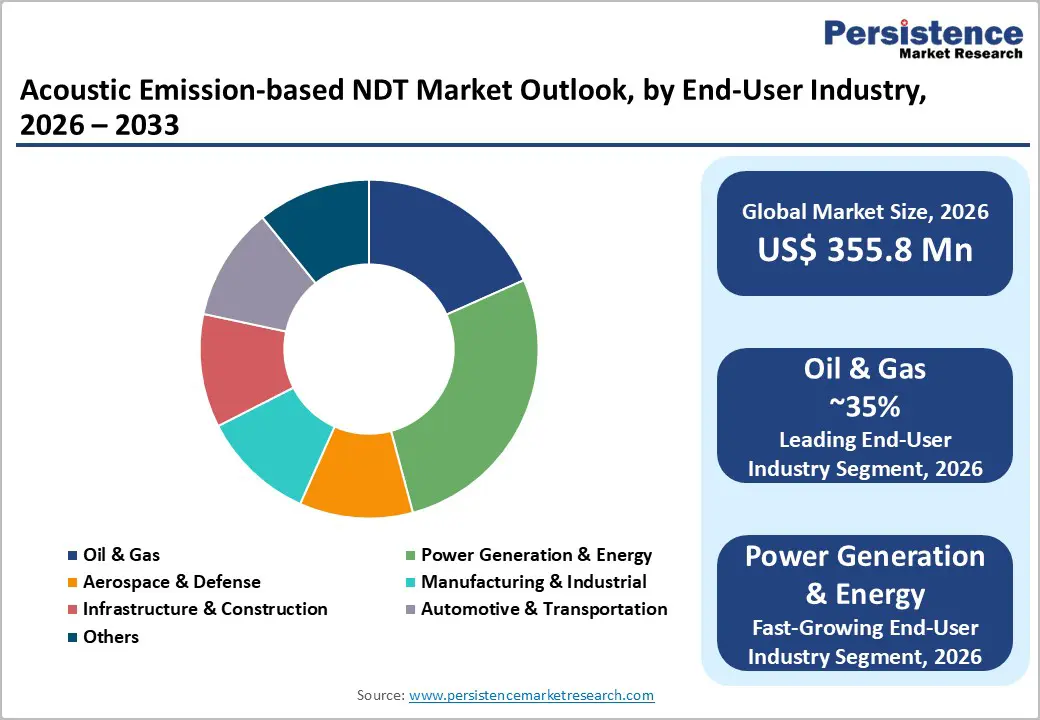
The oil & gas sector, with a 35% share in 2025. It is supported by stringent pipeline-integrity regulations and by high-risk operating environments. AE testing is extensively used for early detection of corrosion, crack propagation, and leak initiation, helping operators avoid costly failures. Aging pipeline infrastructure and offshore exploration activities continue to sustain strong demand across upstream and midstream operations.
The power generation sector is emerging as the fastest-growing end-user segment as utilities focus on proactive monitoring of turbines, boilers, and pressure components. The increasing emphasis on plant life extension, grid reliability, and the integration of renewable energy assets is driving the adoption of continuous AE-based monitoring systems across thermal, nuclear, and renewable power facilities.
Regional Insights
North America Acoustic Emission-based NDT Market Trends
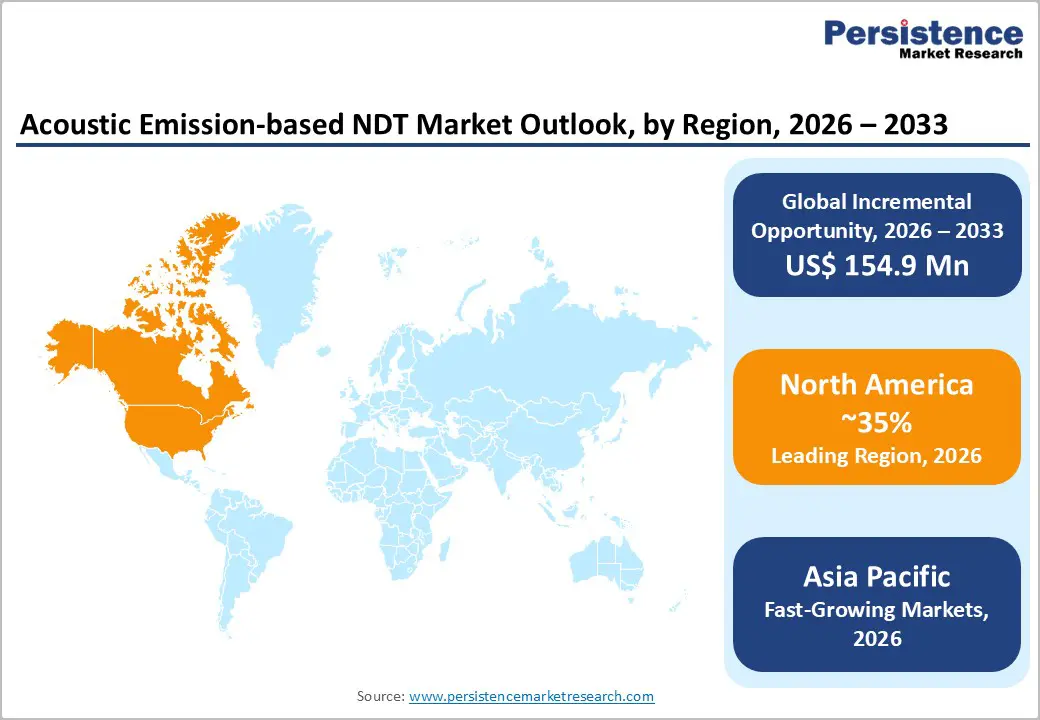
North America dominated the Acoustic Emission-based NDT market with a 35% share in 2025, driven by strong regulatory enforcement and early adoption of advanced inspection technologies. The U.S. remains the core contributor, supported by FAA mandates in aerospace, ASME codes for pressure equipment, and stringent oil & gas safety regulations. Mature industrial infrastructure and high asset criticality continue to sustain demand for AE-based monitoring.
Technological leadership further strengthens the region’s position, with innovation hubs focusing on AI-integrated and online AE monitoring solutions. Aerospace, defense, and oil & gas sectors are rapidly adopting continuous monitoring systems to enhance safety and reduce downtime. The presence of major solution providers and strong spending on predictive maintenance reinforces North America’s long-term market stability.
Europe Acoustic Emission-based NDT Market Trends
Europe demonstrates strong market performance, supported by a robust industrial base and harmonized regulatory frameworks across major economies. Countries such as Germany, France, and the UK drive adoption through advanced manufacturing, nuclear power operations, and renewable energy expansion. Compliance with ISO and EN standards has positioned AE-based NDT as a preferred technique for safety-critical inspections.
The region is projected to achieve a 5.8% CAGR, driven by increasing investments in nuclear plant life extension, offshore wind farms, and hydrogen infrastructure. TÜV-certified inspection practices significantly enhance credibility and adoption across power generation and heavy industries. Europe’s emphasis on sustainability, asset reliability, and digital inspection technologies continues to accelerate market momentum.
Asia Pacific Acoustic Emission-based NDT Market Trends
Asia-Pacific accounted for approximately 32% of the global acoustic emission-based NDT market in 2025 and represents the fastest-growing regional market. Growth is fueled by rapid industrialization in China and Japan, as well as by large-scale infrastructure development in India and Southeast Asia. Expanding oil & gas pipelines, power plants, and transportation networks is a key demand driver.
The region benefits from cost-effective manufacturing, the expansion of local service providers, and the rising adoption of zonal and linear AE techniques. Government-led infrastructure and energy safety initiatives are increasing reliance on non-destructive testing. As industries prioritize preventive monitoring to manage aging assets, the Asia Pacific is expected to remain a critical growth engine for AE-based NDT solutions.
Competitive Landscape
The acoustic Emission-based NDT market is moderately concentrated, characterized by a mix of established technology providers and specialized solution vendors. Market leadership is driven by continuous investment in research and development, particularly in advanced signal processing, AI-enabled analytics, and high-sensitivity sensor technologies. Product differentiation increasingly centers on reliability, certification compliance, and suitability for safety-critical and hazardous operating environments.
Competitive strategies emphasize partnerships and collaborations to expand service capabilities and geographic reach. Vendors are integrating predictive analytics, wireless sensor networks, and remote monitoring platforms to enhance value propositions. At the same time, regional players are gaining traction by offering cost-optimized solutions tailored to local regulatory requirements, intensifying innovation and competitive dynamics.
Key Developments:
- In March 2025, MISTRAS Group reported strong Q4 2024 financial performance, emphasizing expansion of acoustic emission–based online monitoring solutions. The development strengthened its competitive positioning by enhancing real-time asset integrity monitoring capabilities across oil & gas, aerospace, and industrial applications.
- In December 2024, Olympus Corporation completed the acquisition of Physical Acoustics, significantly strengthening its acoustic emission sensor portfolio and data acquisition capabilities. This strategic move expanded Olympus’s presence in advanced AE-based NDT systems and reinforced its focus on high-precision inspection technologies.
- In 2023, Vallen Systeme introduced ISAFE3 intrinsically safe acoustic emission sensors designed for Zone 0 hazardous environments. The launch addressed growing safety requirements in oil & gas and chemical facilities, enabling reliable AE monitoring in high-risk, explosive operating conditions.
Companies Covered in Acoustic Emission-based NDT Market
- MISTRAS Group, Inc.
- Parker Hannifin Corporation (Physical Acoustics / PAC)
- Waygate Technologies (Baker Hughes)
- Olympus Corporation
- Eddyfi Technologies
- Vallen Systeme GmbH
- TÜV Rheinland Group
- Sonatest Ltd.
- Score Group
- KRN Services, Inc.
- Siemens AG
- Acuren
- SGS SA
- Acoustic Emission Technologies, Inc.
- Beijing Softland Times Scientific & Technology Co., Ltd.
Frequently Asked Questions
The market is expected to reach US$ 335.8 million in 2026, driven by regulatory demands and predictive maintenance adoption.
Stringent regulations from ASTM, ISO, and FAA mandate AE testing, boosting demand in oil & gas and aerospace.
North America leads with 35% share in 2025, supported by U.S. innovation, aerospace leadership, and a mature industrial base.
AI-enabled platforms for real-time analysis and predictive maintenance, with Asia Pacific (32% share in 2025) expected to expand rapidly at 6.3% CAGR.
Leaders include MISTRAS Group, Inc., Parker Hannifin Corporation (Physical Acoustics / PAC), Waygate Technologies (Baker Hughes), Olympus Corporation, and Eddyfi Technologies, focusing on sensors and software innovations


