




- Medical Devices
- MRI Systems Market
MRI Systems Market Size, Share, and Growth Forecast 2026 - 2033
MRI Systems Market by Strength (<0.5T, 1.5T, 3T, >3T), by Architecture (Open, Closed), End-user (Hospitals, Ambulatory Surgical Centers, Diagnostic Centers, Academic and Research Institutes, Others), and Regional Analysis, 2026–2033

MRI Systems Market Size and Trend Analysis
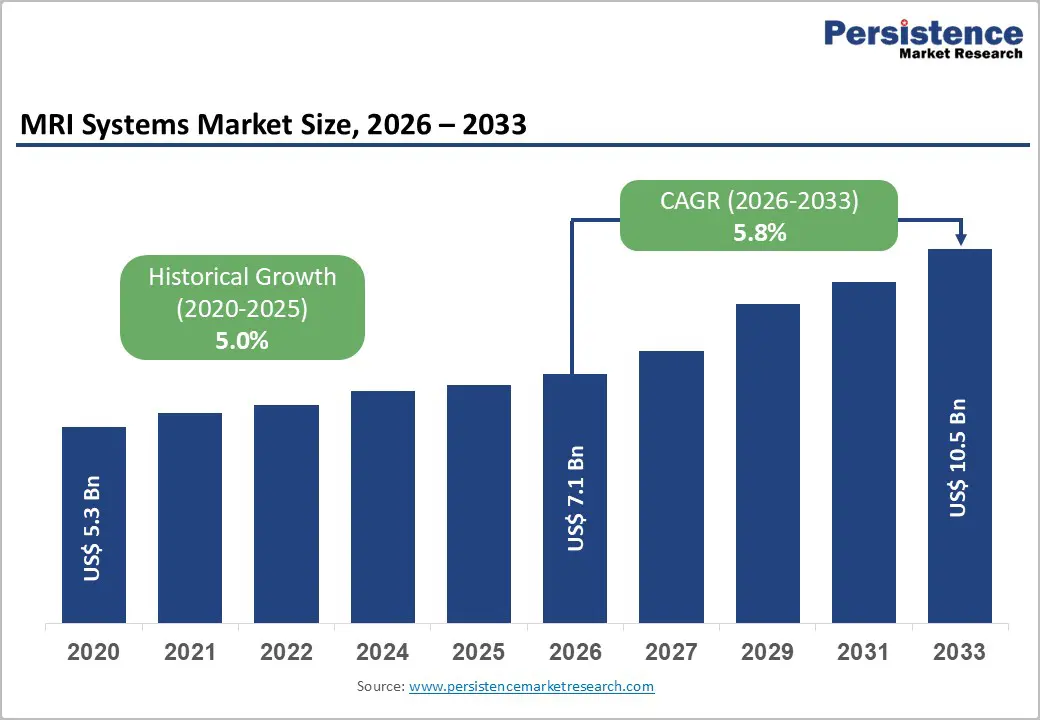
The global MRI systems market size is expected to be valued at US$ 7.1 billion in 2026 and projected to reach US$ 10.5 billion by 2033, growing at a CAGR of 5.8% between 2026 and 2033. The MRI systems market is on a sustained growth trajectory, driven by escalating global demand for non-invasive, radiation-free advanced diagnostic imaging across oncology, neurology, and musculoskeletal medicine.
The World Health Organization (WHO) estimates cancer incidence will rise by 77% by 2050 compared to 2022 levels, with MRI serving as a cornerstone modality for tumor staging and treatment monitoring.
Simultaneously, rapid advances in AI-assisted image reconstruction, 3T and ultra-high-field MRI systems, and the expansion of diagnostic imaging infrastructure across Asia Pacific and Latin America are reinforcing broad-based demand growth. Government-backed healthcare modernization programs and rising per-capita diagnostic spending in emerging economies further strengthen the market's long-term outlook.
Key Industry Highlights
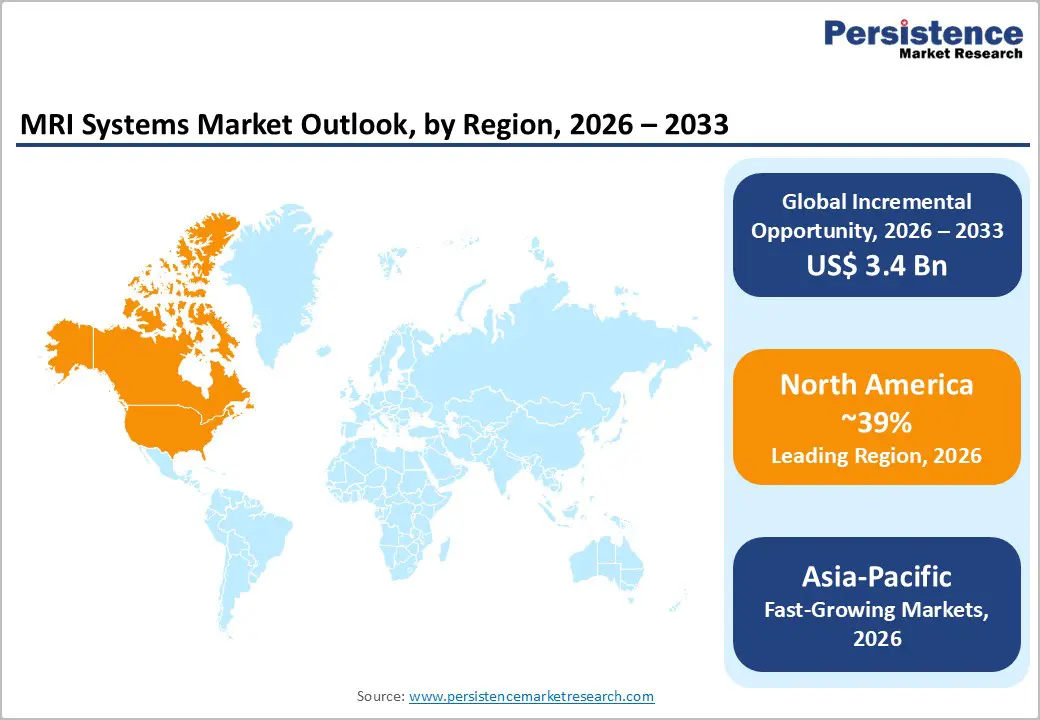
- North America leads the global MRI systems market with approximately 39% share in 2025, anchored by the United States' high MRI utilization rates, FDA-driven innovation, and the headquarters presence of market leaders GE HealthCare and HYPERFINE, Inc
- Asia-Pacific is the fastest-growing MRI systems market region, driven by China's 14th Five-Year Healthcare Plan, India's Ayushman Bharat infrastructure program, and rising per-capita diagnostic imaging investment across Japan and ASEAN emerging markets.
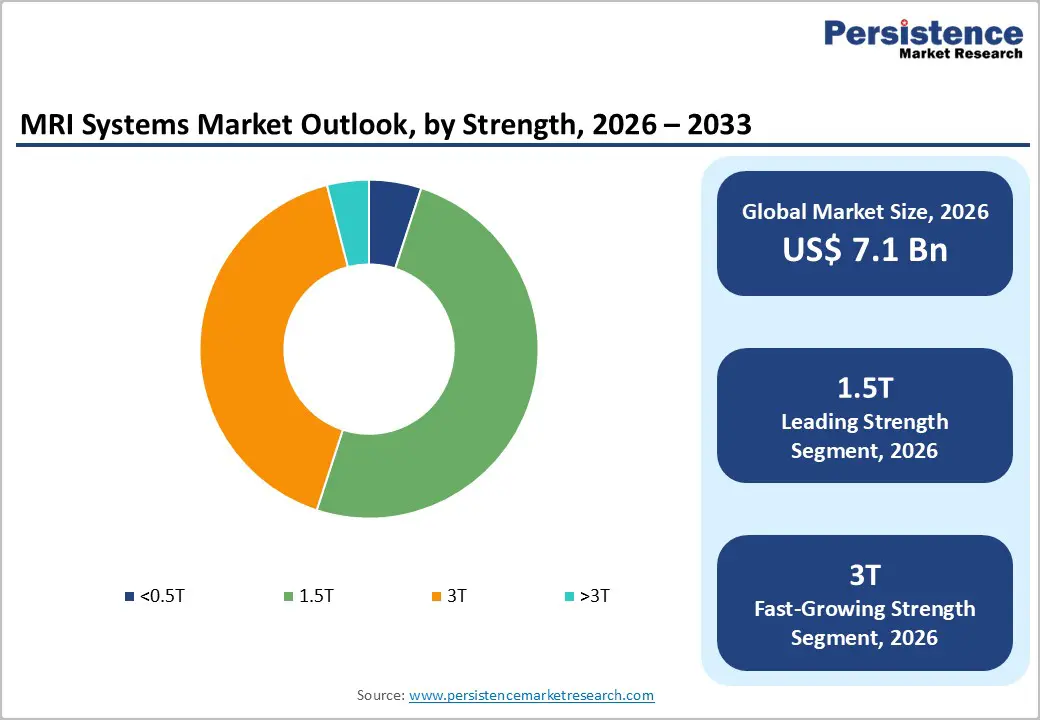
- The 1.5T MRI segment dominates global field strength with approximately 50% market share in 2025, recognized by the American College of Radiology (ACR) as the standard clinical MRI platform and supported by GE HealthCare, Philips, and Siemens comprehensive 1.5T portfolios.
- The 3T MRI segment is the fastest-growing field strength category, driven by superior soft tissue contrast for neuroimaging and oncology, increasing adoption in academic medical centers, and AI-enhanced image reconstruction, reducing historical 3T workflow complexity.
- The key market opportunity lies in portable and low-field MRI expansion into point-of-care settings and LMICs, with HYPERFINE's FDA-cleared Swoop system and permanent magnet technology advances making MRI diagnostics accessible beyond shielded radiology suites for the first time.
Market Dynamics
Drivers - Emergence of Customization and Modular MRI Systems
Modular MRI systems enable healthcare facilities to focus on specific diagnostic areas instead of investing in general-purpose MRI machines. For instance, orthopedic-focused MRI systems are gaining popularity owing to their lower cost and specialized imaging capabilities. Custom-built MRI systems assist in decreasing initial capital investment by avoiding unnecessary features. This flexibility is particularly appealing to small to medium-sized clinics. Cost-efficient diagnostic solutions are predicted to contribute to 40% of modular MRI purchases by 2032. Modular systems provide a scalable approach, enabling facilities to upgrade components such as coils or software without replacing the entire system. This reduces downtime and extends the system's lifecycle. A survey by healthcare equipment vendors showed that 65% of healthcare providers prefer scalable systems, citing operational continuity and long-term cost savings.
Rising Demand for Portable and Point-of-care MRI Systems
Portable MRI systems enable diagnostic imaging in remote or underserved areas with limited access to healthcare infrastructure. According to the World Health Organization (WHO), 45% of the global population lacks access to basic diagnostic imaging. Portable systems aim to bridge this gap. Point-of-Care MRI systems provide immediate imaging in emergency departments and intensive care units (ICUs). This enhances diagnostic accuracy and patient outcomes during critical situations. For instance, the BrainScope portable MRI system, widely used in trauma centers, has reduced diagnostic time for head injuries by 40%, according to clinical trials.
Mobile imaging solutions equipped with portable MRU systems are being deployed for onsite diagnostics in rural clinics and industrial settings. These systems are designed to be compact and lightweight, making them easy to transport and set up in various locations. For instance, the Hyperfine Swoop Portable MRI, weighing just 1,400 pounds, can be transported to different rooms or locations, expanding its usability in diverse clinical environments.
Restraints - Risk of Claustrophobia and Noise Levels
Enclosed designs of conventional MRI systems can induce claustrophobia, anxiety, and panic in patients. For instance, a study published by The British Journal of Radiology revealed that 10% to 15% of patients experience severe claustrophobia during an MRI scan. Claustrophobia-related issues account for 1.2% to 10.5% of incomplete scans annually, depending on the population and healthcare setting. Studies reveal that 25% of patients report moderate anxiety when undergoing a traditional closed MRI scan.
MRI scanners generate loud noises owing to their rapid magnetic field changes and gradient coil vibrations. These sounds can reach an uncomfortable level at some point. Extended exposure to such high noise levels can pose risks, especially for children. Noise generated by an MRI machine can range from 80 to 130 decibels (dB), comparable to the sound of a jackhammer or a low-flying jet. Research shows that 35% of patients report noise-related discomfort during MRI scans.
Opportunities - Increasing Utilization in Neurological and Musculoskeletal Imaging
Rising prevalence of neurological disorders is propelling demand for MRI systems. For example, according to the World Stroke Organization, approximately 12.2 billion new stroke cases are reported each year globally, with MRI being the gold standard for early detection and treatment planning. Musculoskeletal disorders are the leading cause of disability worldwide. These conditions are often diagnosed and managed using MRI. MRI systems offer a non-invasive and radiation-free alternative for detailed imaging of the brain, spinal cord, joints, and soft tissues. This is especially crucial for neurological patients where avoiding radiation exposure is critical for long-term monitoring.
Rising Adoption of AI and ML Integration
AI-driven MRI systems significantly decrease scan times, addressing one of the primary challenges in MRI procedures. Studies showcase that AI algorithms can cut MRI scan times by 50%, making the process more patient-friendly and cost-effective. For instance, Siemens Healthineers' AI-based software, Deep Resolve, accelerates image reconstruction while maintaining high-quality output.
AI and ML enhance the sensitivity and specificity of MRI interpretation by identifying subtle patterns and anomalies that may be missed by radiologists. A research study published in the Journal of the American Medical Association (JAMA) in 2022 found that AI-assisted MRI systems improved diagnostic accuracy for neurological conditions like brain tumors by 30% compared to traditional methods.
AI-powered solutions streamline workflows by automating repetitive tasks such as image segmentation, lesion detection, and volumetric measurements. A 2023 study revealed that radiology departments using AI-enabled MRI systems experienced a 20% to 25% increase in efficiency, enabling radiologists to focus on complex cases.
Category-wise Analysis
Strength Insights
The 1.5T MRI system segment leads the global MRI systems market by field strength, commanding approximately 50% of total market share in 2025. This dominant position reflects 1.5T systems' optimal balance of clinical diagnostic performance, established safety profiles, and cost accessibility relative to higher-field alternatives. The American College of Radiology (ACR) recognizes 1.5T as the workhorse field strength for general clinical MRI, covering the full spectrum of neurological, musculoskeletal, abdominal, cardiac, and vascular imaging applications.
With over three decades of clinical deployment, 1.5T systems benefit from the broadest base of published clinical evidence, validated sequences, and coil ecosystems. Market leaders including GE HealthCare, Siemens Medical Solutions USA, Inc., and Koninklijke Philips N.V. maintain comprehensive 1.5T portfolios that drive the majority of global procurement volumes.
Architecture Insights
Closed-bore MRI systems maintain clear market leadership within the architecture segment, capturing approximately 72% of total architecture-based market share in 2025. Closed systems deliver superior magnetic field homogeneity, higher field strength availability, and greater gradient performance compared to open architectures, enabling faster scan times and higher-resolution imaging across all clinical applications.
The clinical imperative for high-diagnostic-quality imaging in oncology, neurology, and cardiac assessment supported by protocols from the Society for Cardiovascular Magnetic Resonance (SCMR) and European Society of Radiology (ESR) solidly favors closed-bore systems. However, open MRI systems are growing in relevance for claustrophobic and obese patients, with manufacturers such as Esaote SPA and Time Medical Systems innovating in open low-field configurations for weight-bearing musculoskeletal imaging.
Regional Insights
North America MRI Systems Market Trends and Insights
North America dominates the MRI systems market due to high imaging utilization, strong reimbursement systems, and advanced infrastructure. The region performs ~40 million MRI scans annually, reflecting high diagnostic demand. Moreover, MRI availability is significantly higher than global averages, supporting widespread adoption. This strong installed base, combined with early adoption of high-field MRI (1.5T & 3T), ensures continued dominance in a US$ 7.1 Bn market growing at 5.8% CAGR.
U.S. MRI Systems Market Trends and Insights
The U.S. leads due to its high MRI density (~38 units per million population), nearly double the global average. The country conducts millions of scans annually, driven by chronic diseases and preventive diagnostics. Strong private healthcare spending and rapid technology adoption (AI-enabled MRI, 3T systems) further support market leadership. The U.S. is expected to remain dominant, reaching ~US$ 2.6 Bn.
Canada MRI Systems Market Trends and Insights
Canada is witnessing growth due to capacity expansion and reduction of diagnostic wait times. MRI density (~10 units per million) remains lower than the U.S., indicating unmet demand. Government investments in public healthcare imaging infrastructure are increasing scanner installations, driving steady growth at ~6.6% CAGR.
Europe MRI Systems Market Trends and Insights
Europe remains a key region due to well-established public healthcare systems and consistent replacement demand. MRI availability across EU countries averages ~17 units per million population, reflecting mature but uneven access. The region benefits from strong regulatory frameworks and rising chronic disease burden, supporting stable demand in a mature market environment.
Germany MRI Systems Market Trends and Insights
Germany leads Europe with high MRI density (~33–47 units per million population), among the highest in the region. Advanced hospital infrastructure and strong diagnostic imaging demand drive adoption. Continuous upgrades to high-field MRI systems further support growth, with the market expected to reach ~US$ 1.2 Bn.
France MRI Systems Market Trends and Insights
France is growing due to government initiatives to expand imaging access and reduce waiting times. MRI density (~14–16 units per million) is lower than Germany, indicating expansion potential. Increasing investments in hospital modernization and diagnostic capacity are expected to drive growth at ~7.0% CAGR.
Asia Pacific MRI Systems Market Trends and Insights
Asia-Pacific is the fast-growing region due to large patient population, rising healthcare expenditure, and low MRI penetration. Countries such as China and India still have significantly lower MRI density, creating strong growth headroom. For instance, India has ~1–2 MRI units per million population far below developed markets. This gap is driving rapid installations, making APAC the fastest-growing region in the global market.
China MRI Systems Market Trends and Insights
China leads the region with over 12,000 MRI installations, driven by large-scale healthcare infrastructure expansion. Government healthcare reforms and increasing hospital investments are accelerating adoption. The country is expected to reach ~US$ 1.5 Bn, supported by rising diagnostic demand and urban hospital expansion.
India MRI Systems Market Trends and Insights
India is the fastest-growing due to extremely low MRI penetration (~1.2 units per million) and expanding private healthcare sector. Increasing insurance coverage, rising chronic disease burden, and diagnostic awareness are driving installations. The market is expected to grow at ~7.5% CAGR, making it a key high-growth opportunity globally.
Competitive Landscape
The global MRI systems market is moderately consolidated, with four dominant multinational players GE HealthCare, Siemens Medical Solutions USA, Inc., Koninklijke Philips N.V., and CANON MEDICAL SYSTEMS CORPORATION collectively commanding significant global market share through established brand equity, broad clinical validation portfolios, and extensive service networks. Competitive differentiation increasingly centers on AI-assisted imaging software integration, field strength advancement, and portable/low-field innovation. Emerging challengers including United Imaging Healthcare Co., Ltd. and HYPERFINE, INC. are disrupting traditional market dynamics through price competitiveness and novel use-case expansion respectively.
Key Developments:
- May 2026: Esaote S.p.A. announced that it had advanced its intraoperative MRI innovation, moving its I-Genius system closer to entry into the U.S. market. The company focused on expanding the clinical adoption of its dedicated surgical MRI solution, designed to provide real-time imaging support during procedures.
- February 2026: GE HealthCare announced that it had achieved a significant milestone in its MRI portfolio after receiving multiple clearances from the U.S. Food and Drug Administration for its next-generation SIGNA MRI systems. The newly cleared systems were designed to enhance precision imaging, improve workflow efficiency, and support better clinical decision-making across a wide range of applications.
Companies Covered in MRI Systems Market
- GE HealthCare
- Esaote SPA
- Siemens Medical Solutions USA, Inc.
- FUJIFILM
- Bruker
- Koninklijke Philips N.V.
- CANON MEDICAL SYSTEMS CORPORATION
- United Imaging Healthcare Co., Ltd.
- Aspect Imaging Ltd.
- HYPERFINE, INC.
- Shenzhen Anke High-Tech Co., Ltd.
- Time Medical Systems
- Paramed Medical Systems
- Aurora Imaging Technology, Inc.
- Others
Frequently Asked Questions
The global MRI systems market is estimated to be valued at US$ 7.1 billion in 2026.
Rising chronic diseases, aging population, technological advancements, early diagnosis demand, healthcare infrastructure expansion, and increasing imaging use.
North America leads the global MRI systems market with approximately 39% of the total share in 2025.
Expansion of portable MRI, emerging markets growth, AI integration, cost reduction, improved accessibility, and outpatient imaging demand.
The key market players include GE HealthCare, Siemens Medical Solutions USA, Inc., Koninklijke Philips N.V., CANON MEDICAL SYSTEMS CORPORATION, United Imaging Healthcare Co., Ltd.


