




- Medical Devices
- PET MRI Market
PET MRI Market Size, Share, Trends Growth, and Regional Forecast, 2026 to 2033
PET MRI Market by Product Type (Integrated, Separate, Insert, Hybrid), by PET Imaging Technology (Conventional, Time of Flight), by Image Acquisition (Sequential PET MRI Scanners, Simultaneous PET MRI Scanners), Application (Pre-clinical PET MRI Systems, Clinical PET MRI Systems), End-user, and Regional Analysis from 2026 to 2033

PET MRI Market Share and Trends Analysis
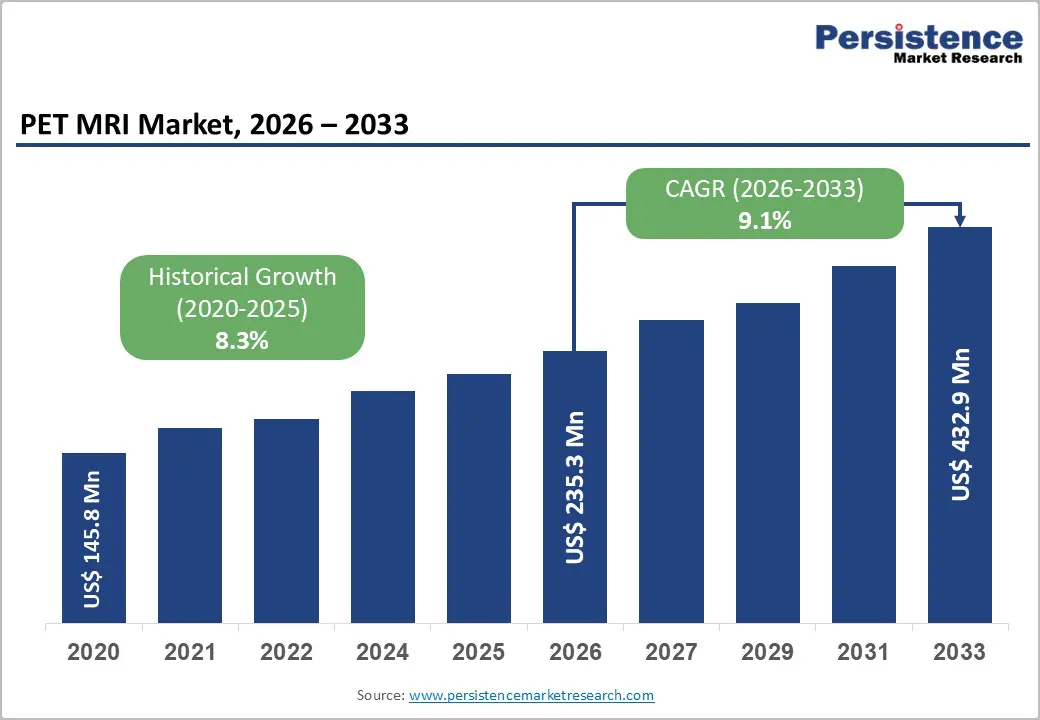
The global pet MRI market is expected to reach US$ 235.3 million in 2026 and US$ 432.9 million by 2033, growing at a CAGR of 9.1% over the forecast period from 2026 to 2033.
Continuous improvements in PET MRI technology reflect broader progress in medical imaging. PET and MRI are established diagnostic tools, each with unique strengths for evaluating physiological and structural changes. Integrating both modalities into a single hybrid system enables the simultaneous capture of anatomical, functional, and molecular data. Advanced system designs ensure accurate alignment of PET and MRI images, improving clinical confidence. This integrated approach eliminates the need for separate scans, reducing overall examination time, minimizing patient discomfort, and limiting motion-related artifacts, ultimately enhancing diagnostic efficiency and care quality.
Key Industry Highlights
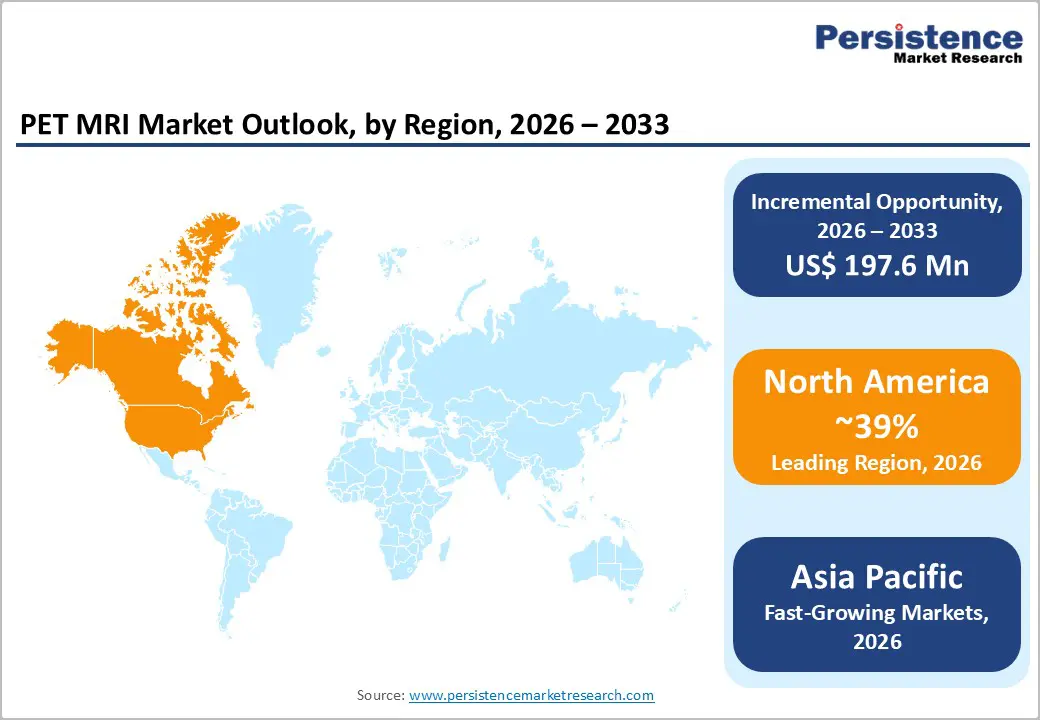
- Leading Region: North America leads the PET MRI market, supported by high healthcare spending, widespread hospital and academic medical center infrastructure, strong adoption of advanced imaging technologies, and a focus on precision diagnostics and research.
- Fastest Growing Region: Asia Pacific is the fastest-growing region, driven by rapid hospital and specialty clinic expansion, rising chronic disease prevalence, government investment in digital healthcare, and cost advantages for domestic and imported PET MRI systems.
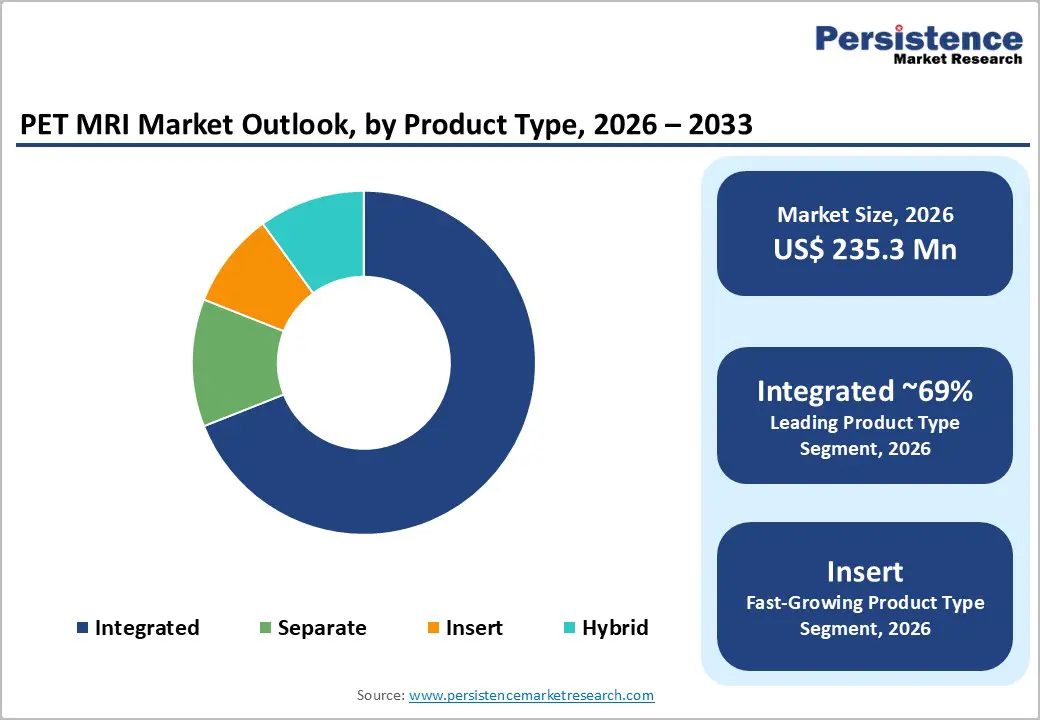
- Dominant Segment: Integrated PET MRI systems dominate the market, owing to their ability to provide simultaneous metabolic and anatomical imaging, improved workflow efficiency, and preference by tertiary hospitals and research centers.
- Fastest Growing Segment: Insert and hybrid PET MRI systems are the fastest-growing product types, fueled by increasing adoption in preclinical research, specialized neuroimaging, pediatric applications, and facilities with space or budget constraints that favor compact or modular designs.
| Key Insights | Details |
|---|---|
| PET MRI Market Size (2026E) | US$ 235.3 Mn |
| Market Value Forecast (2033F) | US$ 432.9 Mn |
| Projected Growth (CAGR 2026 to 2033) | 9.1% |
| Historical Market Growth (CAGR 2020 to 2025) | 8.3% |
Market Dynamics
Driver - Technological Advancements and Helium-Efficient Magnet Designs
Technological progress is a major driver of the PET MRI market's growth. Advances in detector design and time-of-flight capabilities have significantly improved image clarity and accuracy. Modern digital detectors capture signals more efficiently, allowing clearer images even with shorter scan times. Improved reconstruction techniques also help reduce the amount of radiotracer required, lowering patient exposure while maintaining high diagnostic confidence. These improvements make PET MRI more practical for routine clinical use, especially in complex cases requiring detailed anatomical and functional information.
Another important development is progress in magnet engineering. Manufacturers are focusing on helium-efficient and low-helium magnet designs to address rising costs and supply concerns. Traditional MRI systems rely heavily on helium for cooling, which increases operating expenses and maintenance complexity. New designs reduce helium consumption, improving system reliability and lowering long-term ownership costs. Together, these advances make PET MRI systems more appealing to tertiary hospitals and academic centers seeking advanced imaging solutions that balance performance, efficiency, and operational sustainability.
Restraints - High Capital and Operating Costs of PET MRI Systems
High acquisition and operating costs remain a major restraint for the PET MRI market. Integrated PET-MRI systems require a substantial upfront investment, making them significantly more expensive than PET-CT or standalone MRI scanners. This high entry cost limits adoption mainly to large academic hospitals and well-funded specialty centers. Smaller hospitals and diagnostic imaging centers often struggle to justify such investments due to budget constraints.
In addition to purchase costs, ongoing expenses further increase the financial burden. These include system maintenance, magnet cooling, software upgrades, and specialized technical support for both PET and MRI components. In many healthcare systems, reimbursement policies still favor PET CT for standard imaging, reducing the financial incentive to routinely use PET MRI. This imbalance slows adoption in routine clinical practice and affects overall system utilization, making return on investment challenging for many providers.
Opportunity - Expansion of Clinical PET MRI in Neurodegenerative and Pediatric Imaging
Expanding clinical use beyond oncology presents a strong growth opportunity for the PET MRI market. In neurological disorders, PET-MRI provides detailed metabolic and structural insights in a single examination. Conditions such as Alzheimer’s disease, epilepsy, and movement disorders benefit from the precise alignment of functional and anatomical data. This combined approach supports earlier diagnosis, better disease characterization, and more effective monitoring of progression, encouraging broader clinical acceptance in neurology departments.
Pediatric imaging is another promising area for market expansion. PET MRI offers significantly lower radiation exposure compared to PET CT, which is a key consideration when imaging children. Improved soft tissue contrast also enhances diagnostic confidence in complex pediatric cases. Growing awareness of radiation safety and increasing parental preference for safer imaging options are driving interest in PET MRI for pediatric applications. These factors create opportunities for manufacturers to develop child-specific imaging protocols and system accessories, supporting wider adoption across pediatric hospitals and specialty centers.
Category-wise Analysis
By Product Type Insights
Among the product type segment, integrated PET MRI systems hold a dominant position, accounting for approximately 69% of the global market share in 2025. This dominance reflects a strong preference for fully unified hybrid scanners that combine PET and MRI capabilities within a single system. Integrated platforms enable either simultaneous or closely synchronized image acquisition, ensuring precise alignment of metabolic and anatomical data. This improves diagnostic confidence while enhancing patient comfort by eliminating the need for multiple imaging sessions. Compared with separate or insert-based configurations, integrated systems offer smoother workflows, shorter total scan times, and reduced motion-related errors.
Major manufacturers such as GE Healthcare, Siemens AG, and Koninklijke Philips N.V. continue to invest in advanced integrated PET-MRI platforms for high-volume tertiary hospitals and academic medical centers. These systems are frequently equipped with specialized applications for oncology and neurological imaging, making them suitable for complex diagnostic and research use. Integrated PET-MRI scanners are also more likely to be selected for grant-funded research and national imaging programs, thereby strengthening their installed base. As a result, integrated systems are increasingly viewed as the preferred standard for advanced clinical imaging and translational research environments.
By End-user Insights
Hospitals represent the largest end-user segment in the PET MRI market, followed by research institutes and diagnostic laboratories. Hospitals and academic medical centers manage the majority of complex imaging procedures, particularly in oncology and neurology, where advanced hybrid imaging provides significant clinical value. These institutions are more inclined to invest in high-end PET MRI systems that support multidisciplinary care and advanced diagnostic workflows. Strong existing imaging infrastructure further supports adoption, especially in regions such as North America, where thousands of MRI systems are already installed.
Research institutes and university hospitals also play a critical role in the adoption of PET MRI. In addition to providing specialized patient care, these centers act as innovation hubs for developing new imaging protocols and evaluating emerging radiotracers. Their involvement in clinical trials and collaborative research projects drives early adoption of PET MRI technology. Diagnostic laboratories, while representing a smaller share, increasingly participate by offering specialized imaging services for pharmaceutical research and advanced diagnostics. Together, these end users create a balanced ecosystem that supports both clinical utilization and ongoing technological advancement in the PET MRI market.
Region-wise Insights
North America PET MRI Market Trends
North America is the leading regional market for PET MRI, underpinned by high imaging infrastructure density, strong reimbursement for advanced oncology diagnostics, and robust academic-industry collaboration. The region holds the largest share of overall PET installations, with major vendors such as GE Healthcare, Siemens Healthineers, and Philips Healthcare operating extensive installed bases and service networks. The U.S. also leads in research-driven PET/MR deployments, particularly in brain imaging, where large academic centers use hybrid systems to study neurodegenerative diseases, psychiatric conditions, and pediatric epilepsy.
Regulatory frameworks in the U.S. encourage innovation in radiopharmaceuticals and imaging devices, supported by FDA pathways for novel tracers and hybrid modalities, as well as strong funding from agencies such as the NIH for multi-center imaging studies. IMV survey data show that, overall, PET procedure volumes in North America have continued to grow at double-digit rates, indicating robust underlying demand for molecular imaging that can spill over into hybrid PET-MRI usage. As hospitals upgrade older systems and invest in AI-driven workflow and quantification tools, North America is expected to remain at the forefront of clinical and translational PET MRI adoption.
Asia and Pacific PET MRI Market Trends
The Asia Pacific region is poised to be the fastest-growing PET MRI market, driven by rising healthcare expenditures, rapid expansion of imaging capacity, and intensifying focus on oncology and neurology care. Countries such as China, Japan, India, and key ASEAN economies are investing heavily in high-end imaging infrastructure, often supported by government programs to improve cancer diagnosis and treatment. Local and regional manufacturers, including United Imaging, are also emerging as important players, offering competitively priced hybrid systems tailored to regional hospitals' needs.
Manufacturing cost advantages and growing engineering capabilities allow Asia Pacific vendors to experiment with innovative system architectures and integration of AI-based reconstruction and workflow tools. As awareness of the clinical advantages of PET MRI grows and as more tertiary hospitals in China and India seek to differentiate themselves with advanced imaging services, demand for both clinical and preclinical hybrid systems is expected to accelerate. Nevertheless, variability in reimbursement and uneven distribution of radiopharmacy networks across the region will require vendors to develop flexible business models, including managed-service and pay-per-scan arrangements, to unlock full growth potential.
Market Competitive Landscape
The PET MRI market is moderately consolidated, with a small group of global imaging leaders and specialized niche vendors shaping technology development and commercial adoption. Established OEMs such as GE Healthcare, Siemens AG (Siemens Healthineers), and Koninklijke Philips N.V. offer integrated PET MRI systems that sit at the top of their premium product portfolios, often bundled with advanced clinical applications, service contracts, and AI-enabled software suites. Complementing these giants, companies such as United Imaging, Bruker, Mediso Ltd., Aspect Imaging, Cubresa Inc., inviscan SAS, and MR Solutions focus on preclinical or specialized clinical systems, leveraging strengths in small-animal imaging, compact magnet design, or research-grade flexibility. Emerging business models include long-term managed-equipment services, research collaborations with universities and pharmaceutical firms, and modular upgrade paths that allow sites to transition from sequential to integrated hybrid configurations over time.
Key Industry Developments:
- In April 2024, PGI’s Nuclear Medicine Department planned to acquire PET-MRI, unavailable at government hospitals, for brain and pelvic cancer diagnostics.
- In January 2023, Esaote North America launched Magnifico Vet MRI equipment to enable fast, efficient diagnostic imaging in veterinary clinics.
- In June 2023, GE HealthCare will unveil SIGNA PET/MR AIRi at SNMMI 2023, combining AIR technologies to improve diagnostic accuracy, streamline treatment assessment, and enhance patient comfort.
Companies Covered in PET MRI Market
- GE Healthcare
- Siemens AG
- Koninklijke Philips N.V.
- United Imaging
- Bruker
- Mediso Ltd.
- Aspect Imaging
- Cubresa Inc.
- inviscan SAS
- MR Solutions
- Others
Frequently Asked Questions
The global PET MRI market is projected to be valued at US$ 235.3 Mn in 2026.
Rising oncology and neurology imaging demand, superior diagnostic accuracy, multimodal imaging benefits, and growth of advanced imaging centers.
The global market is poised to witness a CAGR of 9.1% between 2026 and 2033.
Research applications expansion, preclinical imaging demand, technological miniaturization, emerging market installations, and growing use in precision medicine.
North America is the leading region in the global healthcare clinical analytics market.


