




- Technology
- Refurbished Laptops and Computers Market
Refurbished Laptops and Computers Market Size, Share, and Growth Forecast 2026 - 2033
Refurbished Laptops and Computers Market by Product Type (Laptop, Computers), Operating Platform (Windows, Mac, Linux), End-user (Corporate Offices, Educational Institutes, Home Users, Other), Distribution Channel (Online, Certified Refurb Stores, Independent Retailers, Other), and Regional Analysis for 2026 - 2033

Refurbished Laptops and Computers Market Size and Trend Analysis
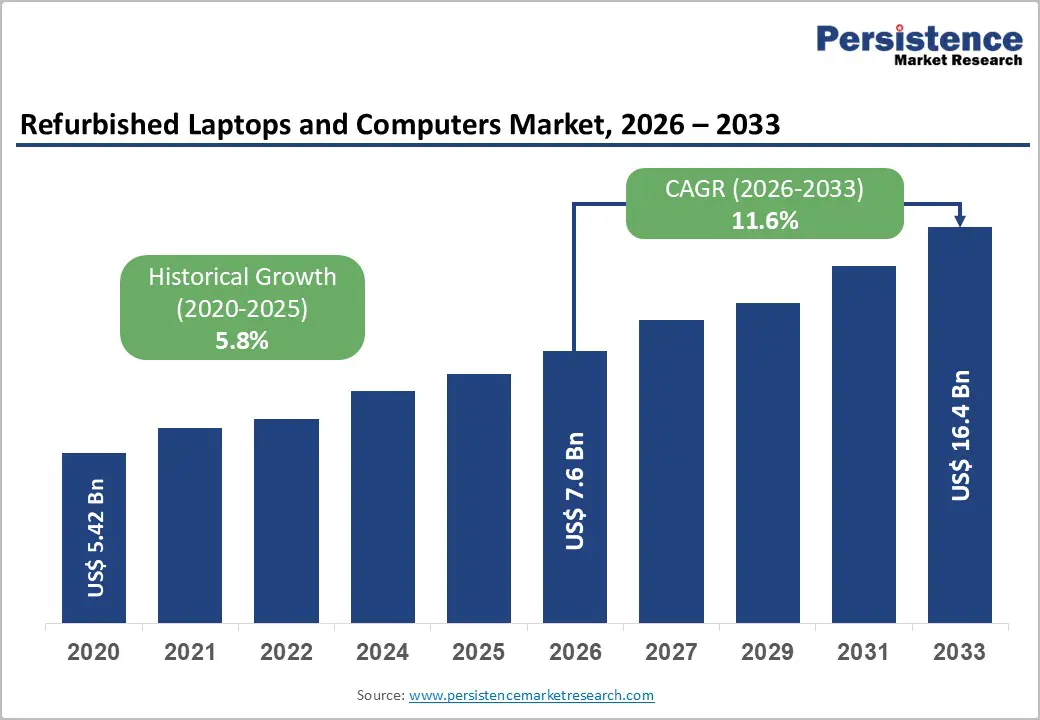
The global refurbished laptops and computers market is valued at US$ 7.6 billion in 2026 and is projected to reach US$ 16.4 billion by 2033, growing at a CAGR of 11.6% between 2026 and 2033.
This robust expansion is principally driven by three reinforcing forces: the persistent cost advantage of refurbished devices over new hardware, escalating institutional sustainability mandates including the EU WEEE Directive (2012/19/EU) and national Extended Producer Responsibility (EPR) frameworks, and the accelerating corporate PC refresh cycle tied to the global Windows 10 end-of-life transition in 2025, which is releasing a large volume of off-lease grade-A inventory into refurbishment pipelines. Educational institutions and small-to-medium enterprises (SMBs) globally continue to bulk-purchase refurbished devices to bridge digital access gaps and reduce capital expenditure, creating a durable and recurring demand base.
Key Industry Highlights
- Leading Region: North America leads the global Refurbished Laptops and Computers market, with 34% market share, with the U.S. generating over US$ 2 billion in refurbished laptop revenues in 2024, anchored by a mature ITAD ecosystem, strong OEM-certified programs, and widespread e-commerce adoption.
- Fastest Growing Region: Asia Pacific is the fastest-growing region, driven by India, China, and ASEAN markets, where cost sensitivity, digital education mandates, and expanding internet infrastructure create sustained high-velocity demand for affordable refurbished computing devices.
- Dominant Product: The Laptop sub-category under Product Type dominates with approximately 74% market share, reflecting the global shift to hybrid work, mobile computing, and portable device preferences among both enterprise and individual buyers.
- Fastest Growing Distribution Channel: The Online distribution channel is the fastest-growing segment, driven by platforms like Back Market (US$ 3.5 Bn GMV in 2025) and Amazon Renewed, which offer scalable, trust-anchored, and geographically unrestricted access to refurbished hardware.
- Key Opportunity: OEM-certified refurbishment program expansion, particularly by HP, Dell, and Lenovo, presents the single largest near-term value creation opportunity, as manufacturer-backed quality assurance and warranty programs directly convert skeptical institutional buyers in under-penetrated international markets.
| Key Insights | Details |
|---|---|
| Refurbished Laptops and Computers Market Size (2026E) | US$ 7.6 Bn |
| Market Value Forecast (2033F) | US$ 16.4 Bn |
| Projected Growth CAGR (2026 - 2033) | 11.6% |
| Historical Market Growth (2020 - 2025) | 5.8% |
Market Dynamics
Drivers - Cost Efficiency and Budget-Constrained Digital Adoption
The primary growth driver for the refurbished laptops and computers market is the substantial price advantage that refurbished devices hold over new systems. Typically priced 30-50% lower, these products have become a preferred choice for cost-conscious segments such as small and medium-sized businesses, educational institutions, and consumers in emerging markets.
Government-led digital inclusion initiatives further strengthen this trend. For instance, the U.S. General Services Administration has distributed more than 4,700 refurbished computers to students nationwide since January 2022, reflecting the role of public programs in accelerating adoption. Additionally, rising inflationary pressures, constrained corporate IT budgets, and expanding internet penetration in developing regions continue to reinforce economically driven procurement behavior, ensuring sustained market demand throughout the forecast period.
Corporate PC Refresh Cycle and IT Asset Disposition (ITAD) Supply Surge
The global transition away from Windows 10 following its end-of-life in October 2025 has initiated a significant corporate PC refresh cycle, markedly increasing the supply of off-lease, enterprise-grade refurbished systems. Dell Technologies anticipates that this refresh momentum will continue to influence market demand through 2026, driven by elevated device turnover across IT Asset Disposition (ITAD) channels.
As organizations retire aging hardware, the volume and quality of refurbished inventory expand proportionately, strengthening the position of certified refurbishers and secondary-market platforms. HP’s 2024 Sustainable Impact Report indicates that over 85% of devices collected via its ITAD program were refurbished and prepared for resale, demonstrating the effectiveness of the enterprise-to-secondary market supply chain. This reinforcing supply-demand cycle represents a durable, multi-year catalyst for market growth.
Restraints - Consumer Trust Deficit and Perceived Quality Risk
A key obstacle to the broader adoption of refurbished devices is persistent consumer skepticism about product reliability, data security, and the adequacy of after-sales support. Unlike new hardware supported by comprehensive manufacturer warranties, many independently refurbished units provide only limited coverage, often 90 days or less, and lack uniform grading standards, making quality assessment difficult for buyers.
Concerns related to data wiping, concealed component degradation, and reduced battery life remain legitimate deterrents, particularly for corporate procurement teams and privacy-conscious home users. These factors collectively restrict market penetration, especially within premium enterprise and high-expectation consumer segments.
Regulatory Compliance Complexity Across Jurisdictions
Refurbishers operating across international markets must contend with an increasingly complex and fragmented regulatory landscape. Since December 13, 2024, the EU General Product Safety Regulation (GPSR) has required full safety and traceability for refurbished products, mandating detailed documentation of product history, modifications, and conformity assessments.
Concurrently, compliance with the WEEE Directive (2012/19/EU) and the Waste Framework Directive (2008/98/EC) introduces substantial operational and financial burdens. Smaller and informal-sector refurbishers, who constitute a significant share of the global market, often lack the technical and financial resources to meet these evolving standards, limiting market formalization and cross-border scalability.
Opportunity - Expanding OEM-Certified Refurbishment Ecosystems
The entry of Original Equipment Manufacturers (OEMs) into certified refurbishment programs represents a highly transformative opportunity for the market. HP expanded its Certified Refurbished PC portfolio in January 2025, introducing new EliteBook and EliteDesk models with standard one-year warranties and extending availability from the U.S. and France to the U.K., Spain, Sweden, and the Netherlands by April 2025. This OEM-certified ecosystem effectively mitigates consumer trust concerns by providing standardized quality grading, manufacturer-backed warranties, and consistent multi-country after-sales support, all of which significantly influence corporate and institutional procurement decisions. As sustainability commitments intensify, including HP’s pledge to achieve 75% circularity by 2030, OEM-led refurbishment initiatives are positioned to become high-volume, credibility-based distribution channels that substantially broaden market reach.
Digital Inclusion Initiatives and Emerging Market Penetration
Governments and non-governmental organizations across South Asia, Southeast Asia, Sub-Saharan Africa, and Latin America are increasingly adopting refurbished computing devices as a cost-effective means to advance universal digital literacy goals. India, which imports a significant share of its laptops from China and continues to face affordability challenges in Tier-2 and Tier-3 cities, represents a particularly strong growth opportunity. Reflecting this potential, HP introduced its first-ever refurbished laptop subscription program in India before expanding it nationwide to retail consumers.
The European Commission, through its Circular Economy Action Plan, has also encouraged Member States to implement take-back and refurbishment initiatives, elevating refurbished electronics as a formally supported product category. As digital connectivity strengthens across emerging economies, refurbished laptops are poised to serve as the preferred, affordable entry-level computing solution for a growing user base.
Category-wise Analysis
Product Type Insights
The laptop segment remains the dominant category in the Refurbished Laptops and Computers market, accounting for nearly 74% of total market share. This leadership is supported by the superior portability, adaptability, and user convenience that laptops offer, making them the preferred choice for remote professionals, students, and mobile enterprise users. The rapid expansion of hybrid work models since 2020 has further strengthened laptop demand relative to desktop systems.
Furthermore, enterprise PC refresh cycles triggered by the Windows 10 end-of-life have significantly increased the availability of refurbished business-class laptops, such as HP EliteBooks, Dell Latitudes, and Lenovo ThinkPads, well-suited for certified secondary-market channels. While desktops hold a smaller share, they continue to gain relevance in corporate and educational environments where mobility is less critical, and cost-efficiency is prioritized.
Operating Platform Insights
Windows remains the dominant operating platform in the refurbished computing market, accounting for approximately 66% of total market share. This leadership is driven by the extensive global installed base of Windows-based enterprise and educational devices, as well as the large volume of off-lease Windows laptops and desktops entering refurbishment streams. Corporate IT environments remain heavily standardized around Microsoft Windows, with compatibility requirements for enterprise software suites and the widespread adoption of Microsoft Authorized Refurbisher (MAR) licensing, reinforcing platform loyalty among institutional buyers.
Refurbished macOS devices, supported by Apple Certified Refurbished programs, command premium pricing and retain strong brand appeal. Although smaller in scale, the Linux-based refurbished segment is expanding, particularly in developer communities, educational deployments, and cost-sensitive emerging markets.
End-user Insights
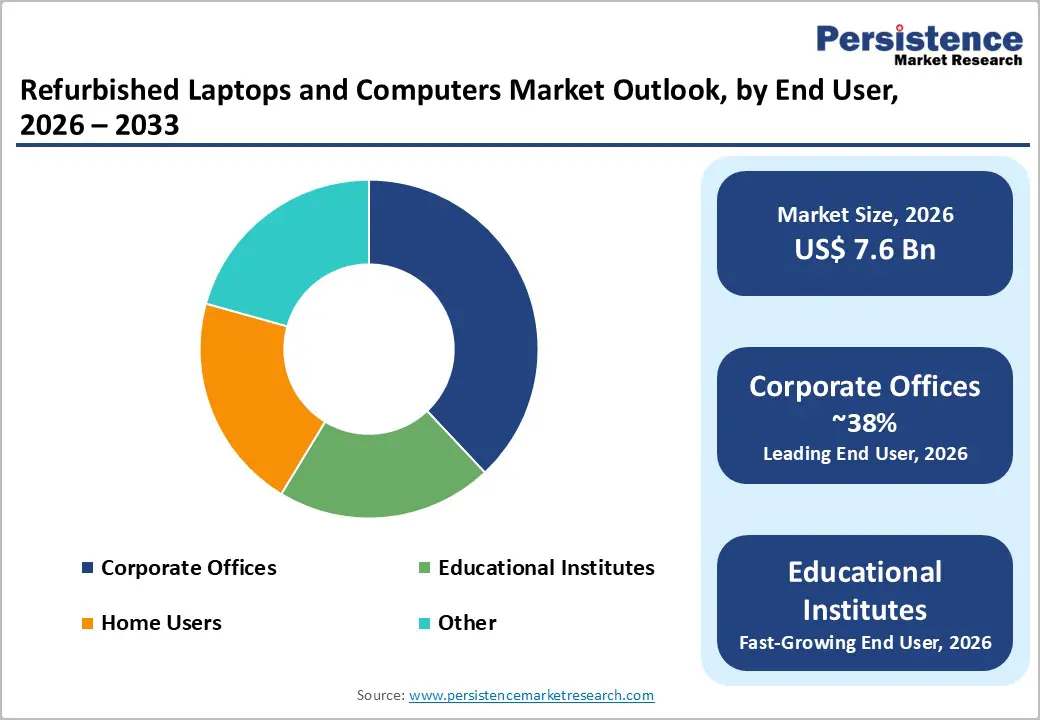
Corporate Offices constitute the largest end-user segment in the Refurbished Laptops and Computers market, accounting for approximately 38% of overall demand. This leadership is driven by structured IT procurement cycles, increasing sustainability reporting requirements, and the economic rationale of adopting refurbished grade-A enterprise hardware at significantly lower costs than new devices.
The ongoing transition from Windows 10 to Windows 11 is further accelerating corporate demand, as enterprises seek certified refurbished units that meet updated hardware standards for fleet modernization. Educational Institutes represent the fastest-growing end-user sub-segment, supported by government-led digital learning initiatives, NGO-backed device distribution programs, and bulk procurement efforts by schools and universities to expand access to reliable computing for underserved student populations.
Distribution Channel Insights
The online distribution channel remains the dominant segment in the Refurbished Laptops and Computers market, accounting for approximately 68% of global sales. This leadership is driven by the rapid growth of dedicated refurbished electronics marketplaces, most notably Back Market, which surpassed US$ 3.5 billion in GMV in 2025, reshaping the channel landscape toward digitally enabled platforms that offer standardized grading, buyer protections, and efficient logistics.
Online channels also gain credibility from established programs such as Amazon Renewed, Dell Refurbished, and Apple Certified Refurbished, which leverage strong consumer trust. Meanwhile, Certified Refurb Stores remain the preferred option for B2B buyers requiring physical inspection, bulk negotiation, and on-site support, particularly across North America and Western Europe.
Regional Insights
North America Refurbished Laptops and Computers Trends
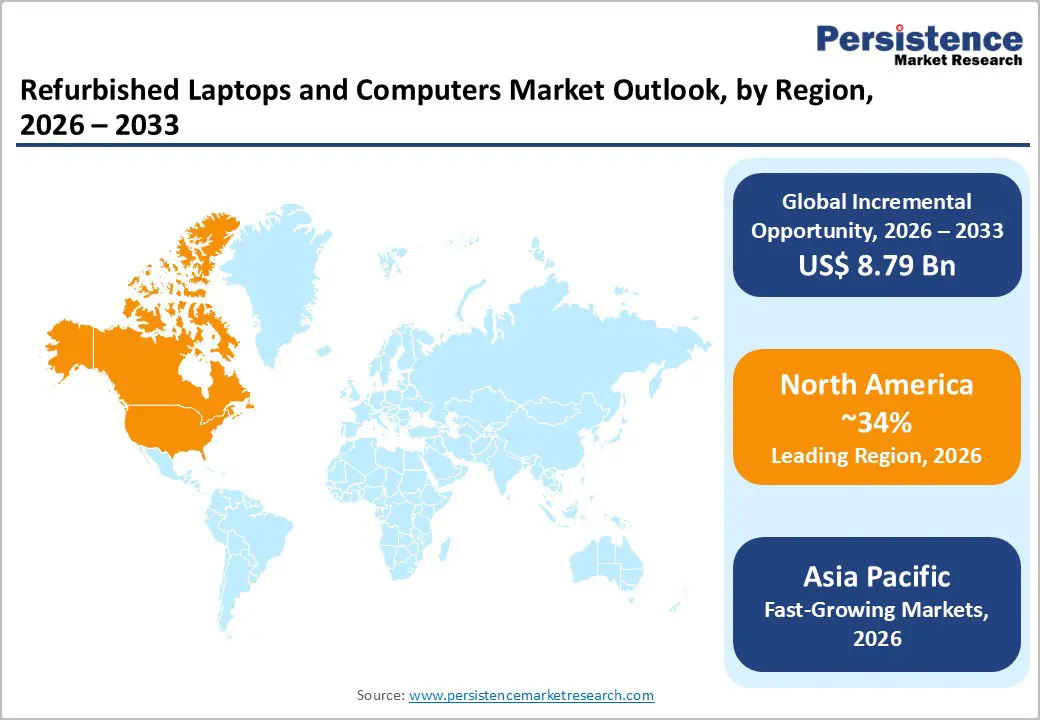
North America represents the largest regional market for refurbished laptops and computers, with 34% market share, supported by a highly mature IT Asset Disposition (ITAD) ecosystem, advanced e-commerce infrastructure, and strong corporate sustainability commitments. The United States alone generated more than US$ 2 billion in refurbished laptop revenues in 2024, driven by an extensive network of certified refurbishers, authorized resellers, and OEM-direct programs.
The U.S. General Services Administration has additionally facilitated the transfer of more than 4,700 refurbished devices to underserved student groups, reinforcing public-sector demand for secondary-market hardware. The region’s innovation landscape is strengthened by rapidly scaling online marketplaces such as Back Market, whose leadership highlights the U.S. as a critical expansion frontier. The Microsoft Authorized Refurbisher (MAR) program further formalizes the channel by ensuring legitimate software licensing for refurbished Windows devices.
Europe Refurbished Laptops and Computers Trends
Europe represents both a mature and rapidly formalizing market for refurbished electronics, supported by regulatory frameworks that are driving structural demand. The EU WEEE Directive (2012/19/EU), Waste Framework Directive (2008/98/EC), and the newly implemented EU General Product Safety Regulation (GPSR), effective December 13, 2024, collectively mandate enhanced product traceability, safety documentation, and collection standards, accelerating the transition of informal refurbishment activities into the regulated economy.
Major markets such as Germany, France, the U.K., and Spain benefit from active circular economy initiatives and an expanding network of certified refurbishers. The European Commission’s Circular Economy Action Plan further encourages national take-back programs, with upcoming revisions to the WEEE Directive emphasizing reuse over recycling. Back Market, headquartered in Paris, remains the region’s leading platform, achieving US$ 3.5 billion in GMV in 2025.
Asia Pacific Refurbished Laptops and Computers Trends
Asia Pacific is the fastest-growing region in the global refurbished laptops and computers market, driven by a rapidly expanding, digitally aspirant middle class, government-mandated digital education initiatives, and a large base of cost-sensitive SMB and student buyers across China, India, ASEAN, and Japan. India stands out as one of the most dynamic markets, where HP launched its first global refurbished laptop subscription program to serve both retail consumers and SMBs in regions with uneven digital access.
The rise of online education has further strengthened demand for affordable refurbished devices. China’s manufacturing and refurbishment infrastructure enables highly competitive pricing, while India’s E-Waste (Management) Rules, 2022, and EPR framework support formal-sector growth. Developed markets such as Japan, Singapore, and Malaysia exhibit strong institutional demand, while emerging Southeast Asian economies present substantial opportunities for volume growth.
Competitive Landscape
The refurbished laptops and computers market remains moderately fragmented, comprising OEM-certified programs from leading brands such as Apple, Dell, HP, Lenovo, and Acer. Market leaders distinguish themselves through rigorous quality certifications, comprehensive warranty offerings, and broad international distribution capabilities. Emerging business models, such as device-as-a-service (DaaS) and subscription-based refurbished laptop programs, exemplified by HP’s initiative in India, are gaining traction. Additionally, AI and blockchain-enabled device-history tracking and expanding OEM-licensee partnerships are driving consolidation and elevating quality standards across global markets.
Key Developments:
- May 2025: HP expanded its HP Certified Refurbished PC portfolio, adding EliteBook and EliteDesk models with 1-year warranties and extending program availability to the U.K., Spain, Sweden, and the Netherlands from April 2025, deepening its global certified refurbishment reach.
- April 2025: Lenovo launched a global Trade-In Program that exchanges old devices for Visa gift cards redeemable for new purchases, strengthening circular material flows.
- March 2024: Dell Refurbished expanded its certified refurbished program to a broader range of laptop and desktop models, responding to rising consumer demand for cost-effective and environmentally responsible computing solutions.
Top Companies in Refurbished Laptops and Computers Market
- Back Market (Paris, France) is the world's largest dedicated marketplace for verified refurbished electronics, surpassing US$ 3.5 billion in global GMV in 2025. The platform connects consumers with vetted sellers across the U.S., Europe, and Asia, offering a 1-year warranty and 30-day return policy that directly addresses consumer trust barriers and has driven mainstream adoption across multiple device categories, including laptops.
- HP (Palo Alto, U.S.) is a pioneering OEM in the certified refurbishment space, with its HP Renew and HP Certified Refurbished programs active in multiple global markets. In 2024, HP diverted more than 85% of collected devices from landfills through its IT Asset Disposition service. Its certified licensee model, with five global licensees distributing certified refurbished devices within the program's first year, offers a scalable, quality-assured supply chain model aligned with HP's 75% circularity target for 2030.
- Dell Refurbished (Round Rock, U.S.) operates one of the most recognized OEM-direct refurbishment programs globally, offering certified pre-owned laptops and desktops with full Dell warranty support. Dell's forecast that the corporate PC refresh cycle driven by Windows 10 end-of-life would extend into 2026 positions its outlet as a primary beneficiary of the resulting off-lease hardware surplus. The program's integration with Dell's Pro-Support services provides enterprise buyers with a credible, risk-mitigated route to certified refurbished IT procurement.
Companies Covered in Refurbished Laptops and Computers Market
- Apple Certified Refurbished
- Dell Refurbished
- Lenovo Renew
- HP Renew
- Amazon Renewed
- Best Buy Outlet
- Microsoft Authorized Refurbishers (MAR)
- Acer Recertified
- Budli.in
- Back Market
- Refurb.io
- PC Liquidations
Frequently Asked Questions
The global Refurbished Laptops and Computers market is valued at US$7.6 billion in 2026 and is projected to reach US$16.4 billion by 2033, expanding at a compound annual growth rate of 11.6% during the 2026 - 2033 forecast period. The market recorded a historical CAGR of 5.8% between 2020 and 2025.
The primary demand drivers include the 30-50% cost advantage over new devices, the large-scale corporate PC refresh cycle triggered by the Windows 10 end-of-life, government-backed digital inclusion programs, and the rising sustainability mandates of both corporations and regulatory bodies such as the European Commission's Circular Economy Action Plan, which collectively sustain structural, multi-year demand for refurbished computing hardware.
The Laptop segment is the dominant product type, accounting for approximately 74% of the total market share. Laptops command this leadership due to their portability advantages, suitability for hybrid work and remote learning, and the high volume of enterprise-class refurbished notebooks entering the secondary market through ITAD channels.
North America is the leading region, with the United States alone generating over US$ 2 billion in refurbished laptop revenues in 2024. The region's leadership is supported by a sophisticated ITAD infrastructure, a dense network of OEM-certified refurbishers, strong e-commerce penetration, and favorable regulatory conditions, including the Microsoft Authorized Refurbisher (MAR) licensing program.
The most significant near-term opportunity lies in the expansion of OEM-certified refurbishment programs, particularly in underpenetrated markets across South Asia, Southeast Asia, and Latin America. HP's certified refurbishment ecosystem, with five global licensees distributing devices with manufacturer-backed 1-year warranties and a public commitment to 75% product circularity by 2030, illustrates the commercial model that market participants can replicate to capture high-trust institutional and enterprise buyers.
The leading companies operating in the global Refurbished Laptops and Computers market include Apple Certified Refurbished, Dell Refurbished, HP Renew, Lenovo Renew, Back Market, Amazon Renewed, Microsoft Authorized Refurbishers (MAR), Acer Recertified, Best Buy Outlet, Budli.in, Refurb.io, and PC Liquidations, among others.


