




- Retail
- Refurbished Sneaker Market
Refurbished Sneaker Market Size, Share, Trends, Growth, Forecasts 2026 - 2033
Refurbished Sneaker Market By Consumer Orientation (Men, Women, Kids), Price Range (Mass Refurbished Sneakers, Premium Refurbished Sneakers), Sales Channel (Online, Offline), and Regional Analysis from 2026 to 2033

Refurbished Sneaker Market Share and Trends Analysis
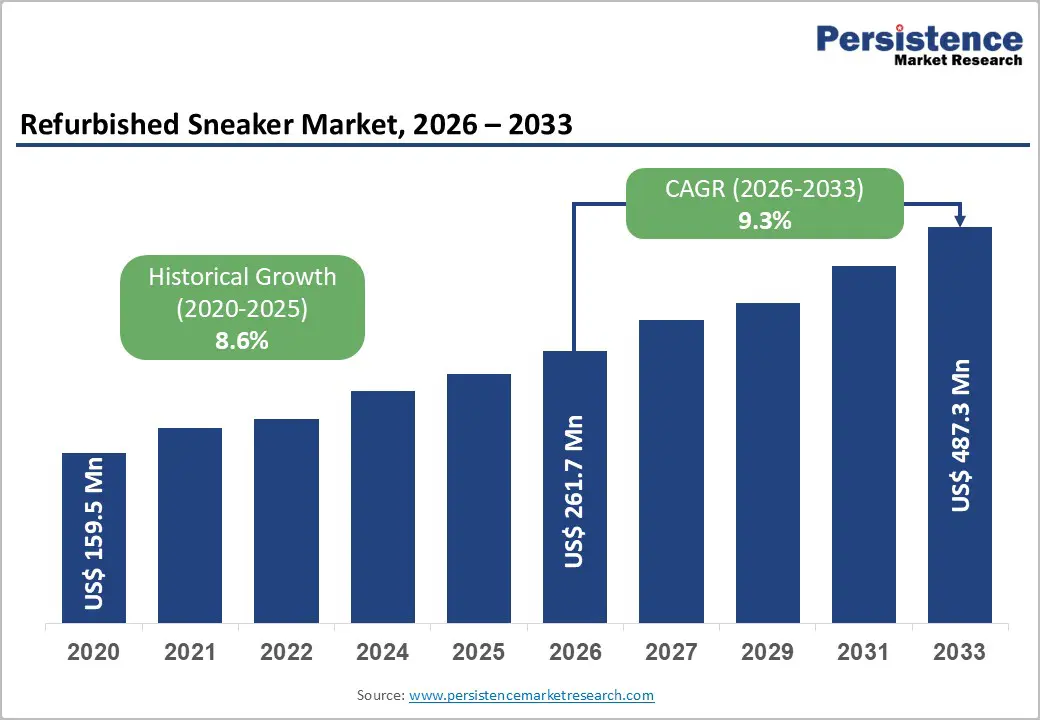
The global refurbished sneaker market size anticipated at US$261.7 Million in 2026 and is projected to reach US$487.3 Million by 2033, growing at a CAGR of 9.3% between 2026 and 2033.
Market expansion is driven by growth in e-commerce resale platforms serving over 30 million active users, rising sustainability focus addressing fashion’s 10% global carbon emissions share, and normalization of sneaker resale via social media and celebrity influence. Advanced authentication using blockchain, RFID, and AI removes trust barriers, positioning refurbished sneakers as resilient, circular-economy infrastructure delivering affordable access to premium brands.
Key Industry Highlights:
- Premium Segment Acceleration: Premium refurbished sneakers expand fastest at 11.3% CAGR versus mass market 58% current share, establishing clear trajectory toward premium segment market share convergence and margin expansion by 2033.
- Women Consumer Growth Leadership: Female consumer segment expands at 10.3% CAGR amid apparel category boom, with GOAT reporting 500% year-over-year growth in women's apparel purchases demonstrating demographic expansion beyond traditional male-dominated sneaker culture.
- Online Platform Dominance: Online channels command 62% market share through authenticated resale platforms managing 60+ million users collectively; offline retail expands at 5.9% CAGR through brand-led Nike Refurbished integration expanding to 96 global locations.
- Asia-Pacific Fastest Growth Region: Region demonstrates 11.1% CAGR with India emerging as highest-potential market through National Logistics Policy infrastructure enabling tier-2/3 city e-commerce penetration and emerging middle-class consumption.
- Technology-Driven Authentication Infrastructure: Blockchain, RFID, and AI-driven condition assessment emerging as competitive differentiators; StockX rejected $10 million counterfeit inventory using advanced authentication, establishing market infrastructure validating secondary transaction integrity.
| Key Insights | Details |
|---|---|
| Refurbished Sneaker Market Size (2026E) | US$ 261.7 million |
| Market Value Forecast (2033F) | US$ 487.3 million |
| Projected Growth CAGR (2026 - 2033) | 9.3% |
| Historical Market Growth (2020 - 2025) | 8.6% |
Market Dynamics Analysis
Drivers - E-Commerce Resale Platform Proliferation and Digital Ecosystem Maturation
E-commerce resale platforms have fundamentally transformed sneaker secondary markets, with GOAT Group and StockX collectively managing over 60 million registered users and facilitating US$3.8+ billion in annual gross merchandise value. These platforms established market infrastructure addressing historical secondary market constraints: authentication mechanisms ensuring product integrity, transparent pricing through real-time market data analytics, and standardized condition grading enabling consumer confidence in remote transactions. GOAT's 2020 $2 billion gross merchandise value and StockX's $1.8 billion demonstrated commercial viability at scale, attracting substantial venture capital investment GOAT raised $195 million funding in 2021, doubling valuation to $3.7 billion. Platform expansion beyond sneakers GOAT reported 500% year-over-year apparel sales growth with women representing around 40% of apparel customers demonstrates market dynamism extending purchasing behavior beyond specialty footwear into lifestyle categories. These platforms established social commerce integration normalizing resale participation across demographic segments, particularly Gen Z and Millennials who prioritize sustainability and value alignment with purchasing decisions.
Sustainability Consciousness and Circular Economy Imperative
Global sustainability awareness is fundamentally reorienting consumer purchasing behavior toward circular economy alternatives, with the fashion industry accounting for approximately 10% of global carbon emissions and substantial textile waste streams. Europe alone discards 1.2 million tonnes of footwear annually, with an estimated 80% directed to landfills or incineration versus only 5% recycled through formalized systems. Refurbished sneakers directly address this environmental reality by extending product lifecycles, reducing manufacturing pressure requiring virgin material extraction, and minimizing landfill dependency. This environmental case resonates particularly strongly with Gen Z and Millennial consumers GOAT's apparel sales surge (500% YoY) concentrated among younger demographics, confirms sustainability-driven purchasing behavior. Corporate environmental, social, and governance (ESG) commitments establish structural demand for refurbished products as enterprises transition to sustainable procurement standards. Nike's 2021 launch of Nike Refurbished program, offering up to 50% discounts on restored footwear expanded to 96 retail locations by 2024, refurbishing 680,000+ pairs annually and supporting the brand's Net-Zero emissions commitment by 2050.
Restraint - Counterfeiting Sophistication and Authentication Complexity
The sneaker industry confronts acute counterfeiting challenges, with estimated $98 billion in annual losses across luxury goods including footwear. Sophisticated counterfeit operations produce convincing replicas increasingly difficult to distinguish from authentic products, particularly affecting premium and limited-edition segments commanding high secondary market valuations. StockX's 2024 report documented rejection of $10 million in counterfeit sneakers using RFID and CT scanning technologies reflecting substantial operational cost burden for authentication infrastructure. Authentication technology complexity requiring blockchain implementation, RFID chip integration, NFC compatibility, and AI-driven image analysis creates significant capital investment requirements for platforms and manufacturers. Consumer hesitation from publicized counterfeit detection failures undermines market confidence, particularly in premium segments where authentication authenticity critically impacts purchasing decisions.
Quality Variability Perception and Supply Chain Fragmentation
Refurbished sneaker market growth faces consumer hesitation regarding condition consistency, cleaning quality standardization, and sole/upper durability following restoration processes. Multiple independent refurbishment facilities with inconsistent quality control standards create perception risk that refurbished products may not deliver durable performance matching original manufacturing standards. Supply chain complexity in sourcing eligible inventory coordinating returns, store returns, and slightly imperfect production units creates logistics coordination challenges limiting inventory predictability.
Opportunity - Asia-Pacific Expansion and Emerging Market Urbanization
Asia-Pacific represents the fastest-growing regional market at an estimated 11.1% CAGR, driven by rapid urbanization across tier-2 and tier-3 cities in India, Southeast Asia, and East Asia, where expanding middle-class populations are accelerating sneaker adoption. Rising e-commerce penetration is enabling wider access to refurbished sneakers among price-sensitive yet brand-conscious consumers, supported by improving digital payments and last-mile logistics capabilities. India’s market specifically benefits from National Logistics Policy-led infrastructure investments, unlocking digital marketplace access previously limited to tier-1 cities. Platform expansion by global leaders, particularly GOAT and StockX, through local partnerships and regional fulfillment networks is strengthening consumer trust and transaction efficiency. Collectively, these structural improvements are creating a sizeable and scalable addressable market opportunity, conservatively estimated at US$50-75 million through 2033, as regional e-commerce ecosystems mature and circular fashion adoption accelerates across Asia Pacific economies.
Premium Segment Acceleration and Luxury Refurbishment Positioning
Premium refurbished sneakers are expanding at an 11.3% CAGR despite mass-market products accounting for roughly 58% share, signaling a clear trajectory toward partial market-share convergence by 2033. Luxury resale platforms such as The RealReal and specialized premium boutiques are strengthening positioning by targeting affluent, brand-aware consumers seeking limited-edition collectibles at meaningful secondary-market discounts. The segment benefits from structurally higher gross margins, improved inventory turnover, and stronger pricing power compared to mass offerings. It also attracts deeper brand partnerships, as luxury goods houses increasingly launch direct refurbishment programs to complement core manufacturing and reinforce circular economy credentials. Opportunity sizing suggests a conservatively estimated US$80-120 million incremental premium-segment value by 2033, driven by authenticated supply, curated assortments, and rising acceptance of refurbished luxury footwear among sustainability-conscious high-income consumers globally across major regions.
Category-wise Analysis
Consumer Orientation Insights
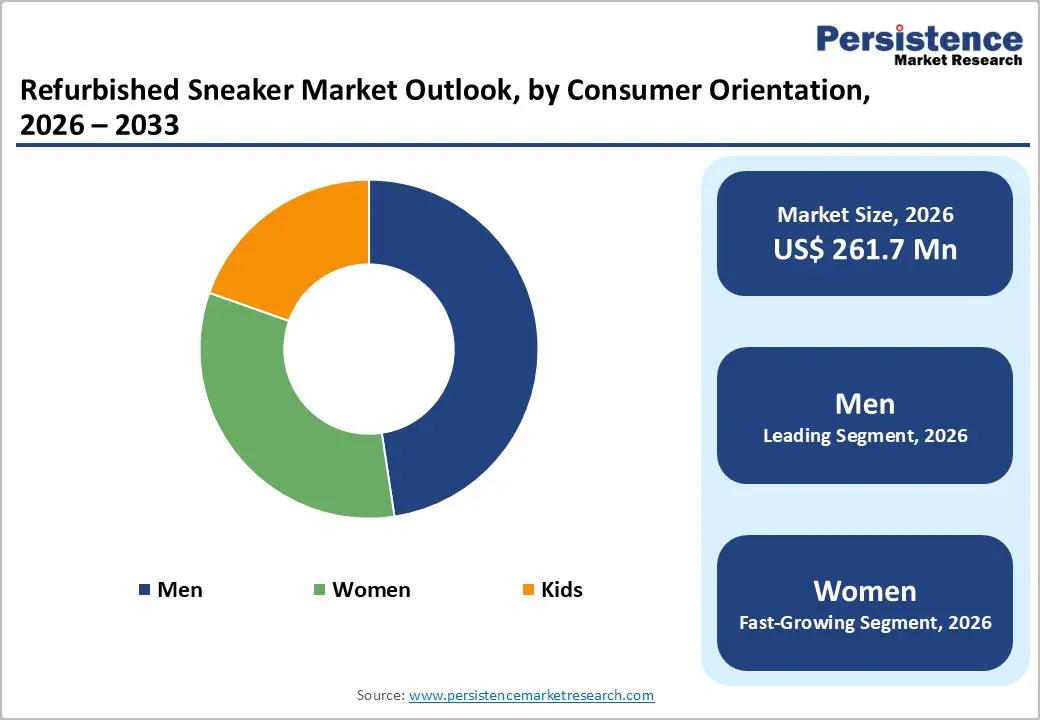
Male consumers command 48% of refurbished sneaker market share, reflecting concentration in performance and athletic footwear categories where men demonstrate stronger engagement with sneaker culture and collectibility behaviors. This dominance reflects historical male skew in sneaker enthusiast communities, competitive sneaker release anticipation, and brand loyalty patterns concentrated among male demographics.
Female consumers expand at 10.3% CAGR, driven by apparel category expansion and lifestyle sneaker normalization within fashion communities. GOAT's experience documenting 500% year-over-year apparel sales growth with women representing 40% of apparel purchasers demonstrates female demographic demand expansion extending beyond traditional performance categories. This growth trajectory reflects the broader fashion industry normalization of athletic footwear as a lifestyle statement rather than purely functional equipment.
Price Range Insights
Mass-market refurbished sneakers maintain 58% market share, reflecting cost-sensitivity across a broader consumer base prioritizing value optimization. This segment anchors market volume and accessibility, enabling price-conscious consumers to access branded sneakers 40-50% below retail pricing. Market dominance reflects consumer purchasing power distribution with majority segments seeking cost-effective alternatives to full-price retail.
Premium refurbished sneakers expand at 11.3% CAGR, driven by affluent consumer segments seeking limited-edition collectibles, vintage rare releases, and authenticated luxury footwear at secondary market discounts. This segment attracts brand partnerships and direct manufacturer refurbishment programs, supporting higher-margin operations. Premium positioning attracts authenticated luxury resale platforms, capturing a growing segment of collectors and fashion-forward consumers.
Sales Channel Insights
Online channels command 62% market share through e-commerce platforms (StockX, GOAT, Vinted, The RealReal) offering unmatched product selection, transparent pricing, and convenience enabling global consumer reach. Platform maturity and infrastructure investment have established online as default purchasing channel for refurbished products, particularly among younger demographics. Real-time pricing transparency, authentication guarantees, and standardized condition grading established online as the preferred channel across consumer segments.
Offline retail expansion at 5.9% CAGR reflects brand-led refurbishment program integration into physical store networks. Nike operates 96 refurbishment locations globally as of 2024, establishing accessibility for consumers preferring tactile inspection before purchase. Offline integration establishes credibility and brand proximity, supporting premium positioning and consumer confidence in condition representation.
Regional Insights
North America Refurbished Sneaker Market Analysis
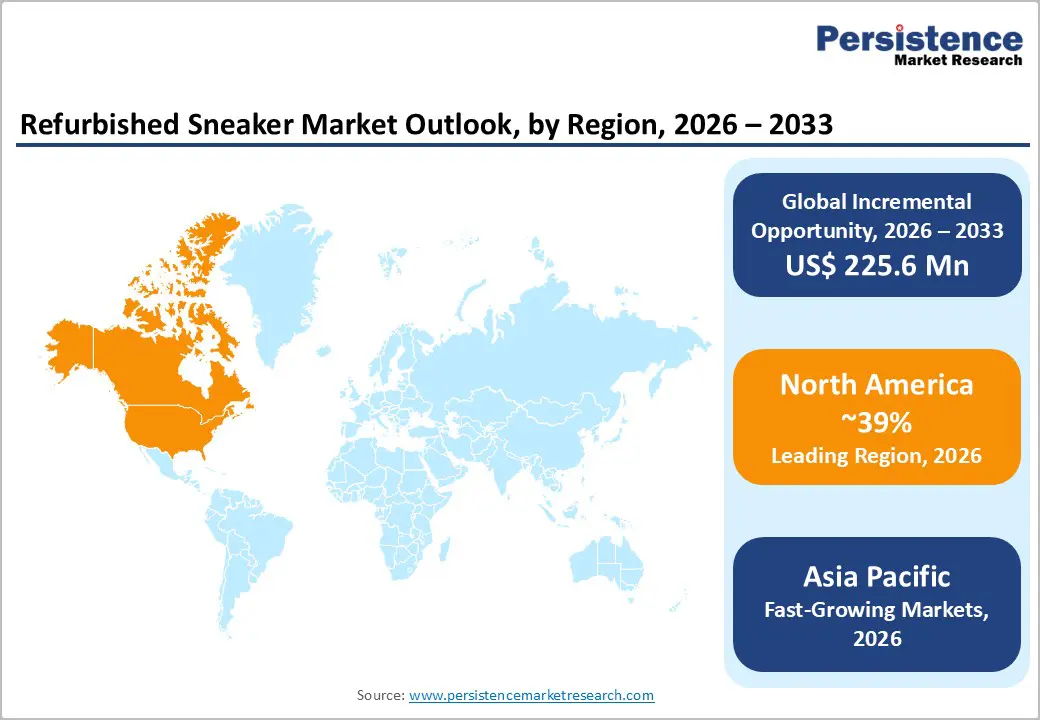
North America dominates with approximately 39% global market share, reflecting mature e-commerce infrastructure, established sneaker culture, and high consumer purchasing power concentrated in the United States. The US market specifically demonstrates 8.5% CAGR through 2035, driven by resale platform headquarters concentration (StockX, GOAT established in US), extensive sneaker collector communities, and mainstream acceptance of secondary market participation. Canada represents 8-10% of regional value, concentrated in major metropolitan areas with established e-commerce accessibility.
North America's regulatory framework emphasizes consumer protection and counterfeiting deterrence, establishing a foundation for advanced authentication technology investment. The 2025 Nike-StockX blockchain settlement case refined legal standards for NFT-based authentication, establishing precedent for digital product verification methods. Regional concentration of technology innovation enables rapid authentication system deployment, with platforms competing on AI-driven condition grading and blockchain-backed provenance tracking.
Europe Refurbished Sneaker Market Analysis
Europe maintains approximately 25% global market share with a prominent growth pace driven by sustainability mandates, circular economy policy emphasis, and strong environmental consciousness among consumer base. United Kingdom demonstrates 7.8% CAGR through 2035, supported by circular fashion trends and growing sneaker resale economy normalized through platforms like Vinted. Germany and Scandinavia specifically demonstrate premium positioning reflecting environmental regulatory strictness and high consumer purchasing power.
European Union environmental directives emphasizing circular economy and waste reduction establish structural competitive advantage for refurbished alternatives. Extended producer responsibility (EPR) regulations increasingly mandate brand responsibility for end-of-life product management, incentivizing brand-led refurbishment programs as compliant waste reduction strategies. Germany's leadership in circular economy practice creates advanced consumer base valuing sustainability credentials and authenticated refurbishment processes.
Asia Pacific Refurbished Sneaker Market Analysis
Asia Pacific establishes fastest growth trajectory at 11.1% CAGR, driven by rapid urbanization in tier-2/tier-3 cities, emerging middle-class consumption patterns, and e-commerce infrastructure maturation. China commands a substantial share through platform integration into existing digital commerce ecosystems, while India represents the highest-potential growth opportunity through the National Logistics Policy infrastructure enabling digital marketplace access. Japan's mature market (sophisticated automation, quality focus) contrasts with emerging market segments demonstrating explosive growth.
Asia-Pacific manufacturing concentration enables cost-competitive refurbishment operations, with platforms establishing regional processing facilities supporting quality control and logistics efficiency. Platform localization GOAT and StockX establishing partnerships with regional players, enables customized user experience addressing local preferences while leveraging global supply chain infrastructure.
Competitive Landscape
Market leaders employ differentiated strategic approaches: platform players (StockX, GOAT) emphasize authentication technology and marketplace network effects, competing on transaction volume and user acquisition. Brand-led initiatives (Nike, Adidas) leverage manufacturing expertise and customer relationships, positioning refurbishment as brand sustainability narrative. Specialized premium platforms differentiate through curation, expert authentication, and lifestyle positioning targeting affluent collector demographics. Dominant business model trends include AI-driven quality assessment, blockchain-based provenance tracking, subscription-based circular ownership models, and direct-to-consumer refurbishment platforms.
Strategic Developments
- In January 2025, StockX officially launched ReCrafted, dedicated refurbishment division focusing on used sneaker authentication, light restoration, and resale operations, combining platform infrastructure with refurbishment capabilities addressing secondary market opportunity directly and systematically.
- In October 2023 - 2024, Nike expanded Nike Refurbished program across eight European countries (Belgium, Netherlands, Germany, France, Spain, Italy, Hungary, Czech Republic), establishing 96 global retail locations by 2024, refurbishing 680,000+ pairs annually supporting circular economy sustainability commitments.
Companies Covered in Refurbished Sneaker Market
- StockX
- GOAT Group
- The Edit LDN
- Vinted
- The RealReal
- Nike Inc.
- Adidas AG
- PUMA SE
- Reebok
- Greensole.in
- Etsy
- Skechers India
- RELAY
- ThredUp
- Poshmark
Frequently Asked Questions
The global Refurbished Sneaker Market was valued at US$159.5 Million in 2020, reached US$261.7 Million in 2026, and is projected to reach US$487.3 Million by 2033.
Growth is propelled by authenticated e-commerce resale platforms, sustainability consciousness, limited-edition collectibility, social media normalization, tech-enabled trust, and brand-led refurbishment programs.
The Refurbished Sneaker Market is projected to grow at CAGR of 9.3% between 2026 and 2033.
Key opportunities include APAC expansion, premium collectible demand, subscription-based circular models, and scaling of brand-led refurbishment programs.
Leading players include StockX, GOAT, The Edit LDN, Vinted, The RealReal, Nike, Adidas, Greensole.in, Etsy, Skechers India, RELAY, ThredUp, and Poshmark driving regional and global market presence.


