Quinoa Seed Market Size, Share, and Growth Forecast for 2025 - 2032

Market Study on Quinoa Seed: Analysing the Widening Perception About Quinoa Seed as an Immunity Enhancing Agent, Rising Demand for Gluten-free and Plant-based Diets, and Expanding Cultivation in Various Regions, PMR Anticipates Numerous Prospects Ahead for Producers in this Space

ID: PMRREP33781
Calendar

February 2025

152 Pages

Author : Amol Patil

Quinoa Seed Market

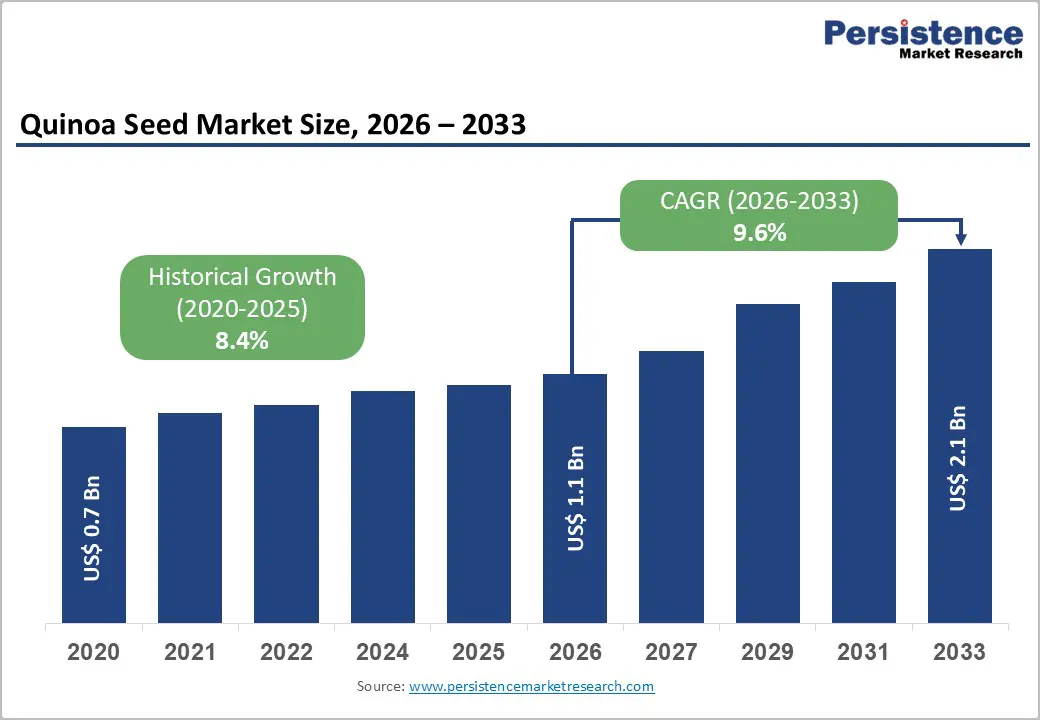
The global quinoa seed market is forecast to expand at a CAGR of 9.8% and thereby increase from a value of US$ 1,073.7 Mn in 2025, to US$ 2,065.8 Mn by the end of 2032.

Attributes

Key Insights

Quinoa Seed Market Size (2025E)

US$ 1,073.7 Mn

Projected Market Value (2032F)

US$ 2,065.8 Mn

Global Market Growth Rate (CAGR 2025 to 2032)

9.8%

Historical Market Growth Rate (CAGR 2019 to 2024)

2.8%

Market Introduction and Definition

Quinoa, an Andean pseudocereal, has garnered international acclaim due to its remarkable nutritional composition and remarkable ability to thrive in diverse climatic conditions. Quinoa, which is botanically classified as a seed, is frequently utilized in culinary contexts as a grain. Quorum-free quinoa, which is renowned for its gluten-free status, high protein content, and amino acid profile, has become a mainstay in contemporary diets, appealing to the health-conscious and those with dietary restrictions. Demand has increased significantly due to quinoa's adaptability in salads, bowls, and as a substitute for rice; consequently, a robust quinoa seed market has developed, with an emphasis on sustainable cultivation methods to meet global demands.

The worldwide quinoa seed market is driven by several significant factors. The escalating consciousness regarding health and wellness, in conjunction with the expanding inclination towards plant-based protein sources, has caused a surge in the demand for quinoa. Moreover, the adaptability of its cultivation to various climates facilitates worldwide production. Veggie and vegan dietary trends, as well as the demand for gluten-free products, contribute to the expansion of the market. As individuals in search of wholesome substitutes, the quinoa seed industry gains advantages from its abundant nutrient composition. Furthermore, endeavours that advocate for sustainable agriculture and equitable trade practices bolster the expansion of the market, as they correspond with the environmentally aware preferences of producers and consumers alike.

Market Growth Drivers

Global Increase in Consumer Awareness of Health and Wellness

The expansion of the global quinoa seed market at an exponential rate is significantly impacted by the rising consciousness of health and wellness among consumers on an international scale. Quinoa has gained significant attention as a nutritional powerhouse, owing to its wide array of vital nutrients and extraordinary health benefits. Quinoa, which is abundant in protein, fiber, vitamins, and minerals, provides solutions to current dietary-related health concerns such as malnutrition and obesity. In light of the growing emphasis on nutrient-dense and well-balanced diets among consumers, quinoa has become an increasingly sought-after staple in health-conscious households.

A fundamental catalyst for this phenomenon is the evolving paradigm that consumers are adopting about culinary options. In response to the increasing prevalence of chronic health conditions and sedentary lifestyles, individuals are actively pursuing nutritious alternatives to conventional staple foods. Quinoa, due to its comprehensive protein profile comprising all vital amino acids, functions as a valuable alternative to meat and other protein sources, thereby appealing to individuals who follow a vegetarian or vegan diet or are striving to decrease their meat intake. Additionally, the absence of gluten in the product accommodates individuals who have celiac disease or gluten sensitivities, which has contributed to its extensive acceptance. The positive qualities of quinoa have been further disseminated due to the proliferation of health-conscious influencers and the rise of social media. This has resulted in a ripple effect that transcends specialist markets and influences mainstream consumer decisions.

Market Restraints

Production Costs' Inherent Volatility

One of the primary factors restraining the expansion of the worldwide quinoa seed industry is the intrinsic volatility of its production costs. Although quinoa's nutritional value and adaptability in contemporary diets have contributed to its soaring demand, the market is beset by difficulties stemming from price fluctuations, which affect both producers and consumers. Due to the vulnerability of the quinoa plant to environmental factors and the restricted geographic areas that are conducive to cultivation, its manufacturing processes are susceptible to fluctuations in climate and disruptions in the supply chain. A direct threat to crop yields is posed by the susceptibility of quinoa cultivation to weather conditions, including fluctuations in temperature and precipitation patterns.

Impact of Intensive Agriculture on Biodiversity

One significant obstacle that the worldwide quinoa seed market encounters is the potential ramifications of intensive agricultural methods on biodiversity. The increasing demand for quinoa gives rise to the potential for monoculture, a farming practice characterized by the exclusive cultivation of vast tracts of land. Although this may temporarily increase crop yields, it endangers biodiversity by restricting the variety of plants that can be grown in a given region. Monoculture has the potential to induce soil degradation, heighten vulnerability to pests and diseases, and deprive natural habitats of their habitats, thereby compromising the intricate ecological equilibrium.

Opportunities

Growing Demand for Plant-based Proteins

An important factor driving the worldwide quinoa seed market is the increasing demand for proteins derived from plants. In light of growing consumer interest in plant-centric diets driven by concerns over health, ethics, and the environment, quinoa emerges as a highly adaptable and nourishing alternative. Quinoa, due to its comprehensive protein profile comprising all vital amino acids, has emerged as a fundamental component in fulfilling the protein requirements of individuals who choose vegetarian, vegan, or flexitarian ways of life. The growing recognition of the ecological consequences associated with conventional meat farming, in addition to apprehensions regarding the long-term viability of meat manufacturing, has established quinoa as a significant contender in the expanding market for plant-based proteins.

The transition to plant-based diets is a paradigm shift in consumer behaviour that is impacting industries and societies worldwide. The ability of quinoa to bridge the protein deficiency in these diets has resulted in its extensive integration into a variety of food items, including treats high in protein and plant-based meat substitutes. Quinoa's multifunctionality surpasses its conventional application in culinary preparations, rendering it an appealing constituent in the development of novel and health-oriented food merchandise.

The recognition of quinoa as a gluten-free protein source, which accommodates individuals with celiac disease and gluten sensitivities, contributes to the increased demand. The increasing demand for plant-based proteins among health-conscious consumers for ethically sourced alternatives creates a substantial opportunity for the quinoa seed market to capitalize on this trend. This development is in line with broader global efforts to establish a more balanced and sustainable food system.

Analyst’s Viewpoint

The worldwide quinoa seed industry is positioned for substantial expansion, propelled by a convergence of elements encompassing consumer inclinations, sustainability concerns, and developing dietary patterns. Growing consciousness regarding health and wellness is a significant factor driving market expansion. In recent times, quinoa has gained significant attention in contemporary diets due to its status as a nutrient-dense, gluten-free, plant-based protein source, which has increased consumer awareness and concern regarding their dietary choices. Consequently, quinoa has experienced an upsurge in popularity among health-conscious individuals, vegetarians, and vegans, among other demographic groups, which has contributed to the market's sustained expansion.

The interplay between manufacturers and consumers significantly influences the dynamics of the quinoa seed market. In response to consumer demand for innovative and convenient quinoa-based products, manufacturers are producing a variety of ready-to-eat meals and quinoa flakes and crackers. By proactively addressing changing consumer preferences, this approach also improves the accessibility of quinoa, thereby establishing it as a widely used ingredient. Furthermore, quinoa producers and consumers who prioritize ethical considerations can cultivate a favorable relationship through the implementation of sustainable and equitable trade practices.

The symbiotic relationship between consumers who prioritize the environmental and social impact of their food choices and the emphasis on responsible sourcing and cultivation practices contributes to the overall growth of the market. On a global scale, the quinoa seed market is anticipated to continue expanding, which bodes well for its future. With the increasing adoption of quinoa as a dietary staple in various regions, especially Asia, and the Pacific, the market is anticipated to experience a diversification of demand sources.

The supportive efforts of governments and international organizations towards sustainable agricultural practices and poverty alleviation initiatives in regions where quinoa is produced serve to fortify the market's upward trajectory. Furthermore, continuous efforts in research and development to optimize quinoa cultivars, increase crop productivity, and accommodate varying climatic conditions bolster the market's robustness and capacity for long-term expansion. A dynamic and sustainable future for the global quinoa market will be significantly influenced by the collaborative efforts of stakeholders throughout the supply chain.

Supply-side Dynamics

Andean Valley, Quinoa Foods Company, and Ancient Harvest are industry leaders that influence the competitive landscape of the worldwide quinoa seed market. These corporations have positioned themselves as frontrunners in the production, refining, and distribution of quinoa, greatly impacting market trends and establishing benchmarks within the industry. Although quinoa cultivation initially emerged in the Andean region, market utilization has since spread beyond South America to become prevalent in other countries. Prominent quinoa market utilization has been observed in the US, Canada, and various European countries, including France and the UK. As an illustration, quinoa has become a fundamental component of health-conscious diets in the United States, resulting in an exponential increase in the demand for quinoa-based breakfast cereals and salads. This demonstrates the market's capacity to accommodate a wide variety of consumer preferences.

The industry leaders in quinoa seed are proactively influencing the terrain using strategic undertakings, diversification of products, and commitments to sustainability. Ancient Harvest and similar companies are emphasizing broadening their range of products by introducing novel convenience foods and munchies formulated with quinoa, to accommodate the changing preferences of consumers. Furthermore, industry leaders are making investments in ethical and sustainable procurement methods in response to the increasing consumer demand for quinoa that is produced responsibly. These endeavors not only serve to distinguish these businesses in the marketplace but also enhance the quinoa brand's reputation as a sustainable and health-conscious option.

In addition, the establishment of strategic alliances and cooperative ventures with regional farmers and agricultural communities is bolstering the supply chain's robustness, thereby guaranteeing a consistent and dependable provision of quinoa for international markets. By consistently promoting sustainability and innovation, dominant actors significantly influence the trajectory of the quinoa seed market moving forward.

Top Regional Markets

North America’s Leadership Position Intact

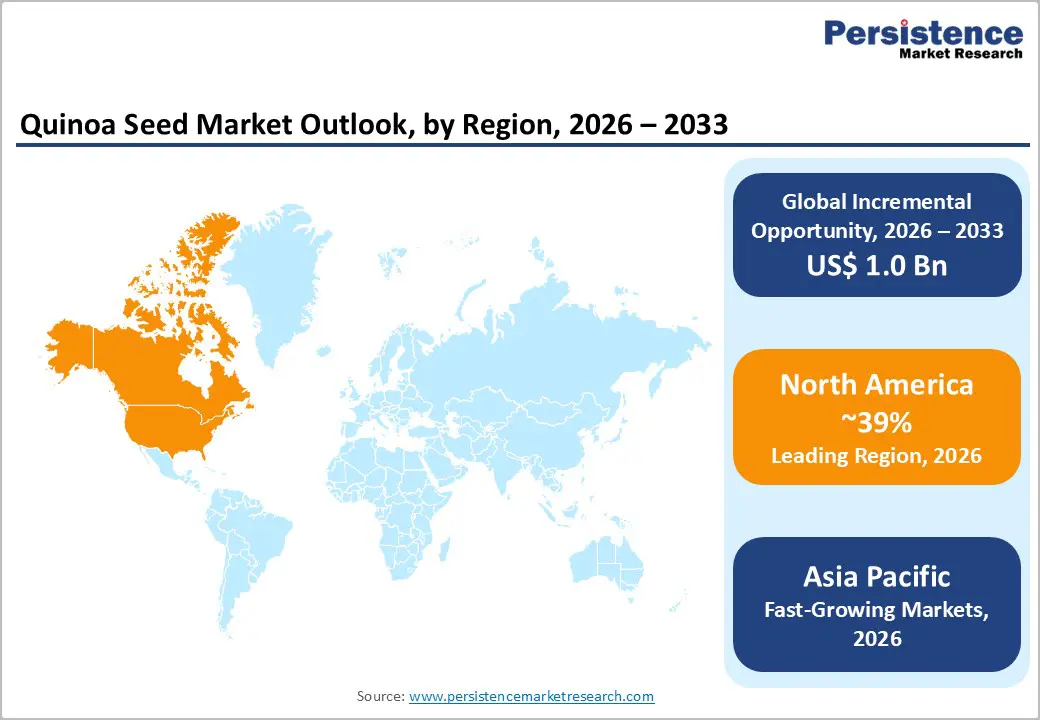
It is anticipated that North America will hold the largest market share of the worldwide quinoa seed industry. The region's health and wellness trends, in which consumers increasingly choose versatile and nutritious foods like quinoa, are responsible for this dominance. Particularly in the US, demand for plant-based proteins has increased significantly; quinoa effortlessly integrates into this dietary transition. Due to the broad range of quinoa products available in the market, including processed snacks and whole grains, as well as the continent's extensive distribution network and general consciousness, North America holds a significant position in the international quinoa industry. Furthermore, the market expansion in this region is reinforced by the inclusion of quinoa in the product offerings of major food and beverage corporations.

Revenue Generation Opportunities Ample in South Asia, and the Pacific

The region of South Asia, and the Pacific is anticipated to witness the most rapid expansion of the worldwide quinoa seed market. Changing dietary preferences, raising awareness of the nutritional advantages of quinoa, and a growing population with rising disposable income all contribute to this expansion. In tandem with the increasing demand for quinoa, the region is experiencing a transition towards healthier food options as a result of urbanization and globalization. South Asian and Pacific nations, such as Australia and India, are experiencing a surge in the prevalence of health-conscious diets; quinoa, which is gluten-free and contains a high protein content, satisfies this demand.

Government initiatives advocating for sustainable agriculture and the capacity of quinoa cultivation to thrive in various climates throughout the region contribute to the accelerated expansion of the quinoa market in South Asia, and the Pacific. Consequently, this geographical area offers substantial unexplored prospects and developing challenges for domestic and global participants in the quinoa seed industry.

Competitive Intelligence and Business Strategy

Prominent contenders in the quinoa seed industry, including Ancient Harvest, Quinoa Foods Company, and Andean Valley, utilize strategic initiatives as a means to safeguard and augment their market dominance. Vertical integration, in which businesses control every stage of the supply chain from cultivation to distribution, is a crucial strategy. An example of this is Andean Valley, a Bolivia-based company that has implemented vertical integration by establishing close collaborations with nearby producers to guarantee a steady and superior provision of quinoa. By this integration, they are endowed with enhanced authority over the production process, thereby guaranteeing compliance with sustainability principles and quality benchmarks.

An additional critical approach is the diversification of product portfolios. Prominent competitors acknowledge the significance of accommodating a wide range of consumer lifestyles and preferences. Ancient Harvest, a market leader, has diversified its product portfolio to include convenient and inventive items such as quinoa-based pasta, flour, and ready-to-eat meals, in addition to conventional quinoa cereals. By offering consumers a diversity of quinoa-based options, this diversification not only serves to penetrate new market segments but also enhances brand loyalty.

Ethical and sustainable practices are fundamental elements of the strategies implemented by industry leaders. As an illustration, Quinoa Foods Company demonstrates a proactive posture towards fair trade by ensuring that farmers are adequately compensated for their agricultural products. Customers who place a premium on the social and environmental consequences of their food selections are moved by these ethical considerations. Prominent entities utilize these strategies not only to uphold ethical standards but also to distinguish their products in a marketplace where sustainability is progressively being recognized as a critical attribute. Moreover, expansion into international markets is a prevalent objective among dominant entities. Organizations such as Andean Valley and Quinoa Foods Company proactively pursue market expansion through their comprehension and adjustment to the heterogeneous culinary inclinations of consumers across the globe.

Key Recent Developments

New Product

In January 2021, a specialized measurement technique was devised by the Department of Primary Industries and Regional Development (DPIRD) in Australia to accurately quantify the saponin content of quinoa seed.

Market Impact: The Department of Primary Industries and Regional Development (DPIRD) in Australia has devised a specialized measurement technique to precisely quantify the saponin content of quinoa seeds. This innovation carries substantial ramifications for the international market. Quaker quinoa contains naturally occurring saponins, the precise measurement of which is critical because it affects the flavor and quality of the grain. This innovation contributes to the assurance of quality and consistency in quinoa products worldwide by establishing a standardized method for evaluating saponin levels, thereby improving the overall quality control procedures in the quinoa seed market.

(Source: DPIRD)

Quinoa Seed Market Research Segmentation

By Nature:

  • Organic
  • Conventional

By Form:

  • Whole Grain
  • Flour
  • Crisps & Flakes

By Region:

  • North America
  • Europe
  • East Asia
  • South Asia & Oceania
  • Latin America
  • Middle East & Africa


Companies Covered in Quinoa Seed Market

  • Above Food Inc.
  • Alter Eco
  • Irupana Andean Organic Food SA
  • Andean Naturals
  • Industrial and Technological Complex Yanapasiñani SRL
  • Arrowhead Mills Inc.
  • Quinoabol SRL
  • The British Quinoa Company
  • Ancient Harvest
  • Quinoa Foods Company
Frequently Asked Questions

The market is anticipated to grow at a CAGR of 9.8% during the projected period.

The quinoa seed market will be valued at US$ 1073.7 million in 2025.

The US will held the largest market share in 2025.

The prominent players in the market include Above Food Inc., Alter Eco, Irupana Andean Organic Food SA, Andean Naturals, and Industrial and Technological Complex Yanapasiñani SRL.

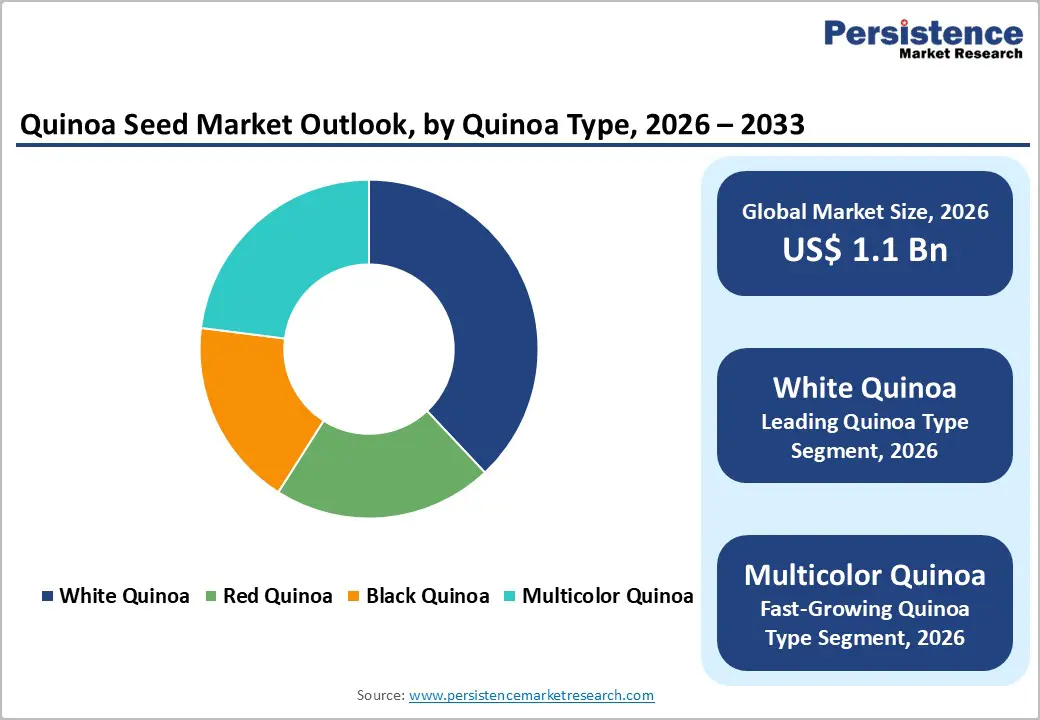
The crisps & flakes segment is expected to grow at the fastest growth rate during the forecast period.

Market Segmentation

Which is the Leading Segment by Nature?

Sales of Conventional Seeds Most Extensive due to Traditional Farming, and Economies of Scale

Amidst the present market conditions, the conventional quinoa seed sector is positioned to acquire the most substantial portion of the market. The extensive utilization of conventional agricultural methods, economies of scale, and well-established supply chains, which serve the majority of the worldwide quinoa market, are factors contributing to this dominance. Traditional quinoa seeds, which are frequently accessible and priced competitively, attract a wider range of consumers, which significantly contributes to their substantial market share. Although the conventional segment currently holds a dominant position, it is expected that the organic quinoa seed segment will witness the most rapid expansion in the future years.

Increasing consumer awareness of the environmental and health benefits associated with organic farming, in conjunction with a growing preference for organic and sustainably produced foods, is fuelling the surge in demand for organic quinoa seeds. The rapid expansion of this sector is driven by an international transition towards conscientious consumption, wherein individuals give preference to goods and services that correspond with their values, such as health awareness and environmental sustainability.

Which is the Highest Selling Form?

Whole-grain Quinoa Sales Dominant on Account of Nutrition-packed Profile

The market is anticipated to be dominated by whole-grain quinoa, which is projected to hold the largest market share. Quinoa, when unprocessed, is a nutrient-dense food that is in high demand due to its adaptability in a variety of culinary contexts. The growing awareness among consumers regarding the health benefits associated with the consumption of whole grains has significantly impacted the market share of whole-grain quinoa. The quinoa morsels and flakes market is anticipated to expand at the quickest rate.

Quinoa's intrinsic nutritional properties, in conjunction with the increasing demand for convenience foods and munchies, establish quinoa crisps and flakes as a swiftly expanding market segment. These processed forms provide consumers with a flavourful and convenient means of incorporating quinoa into their diets, which has contributed to their rapid market expansion as a favoured option in the ever-changing market for healthy and convenient snacks.

Quinoa Seed Market Report Scope

Attribute

Details

Forecast Period

2025 to 2032

Historical Data Available for

2019 to 2024

Market Analysis Units  Value: US$ Bn/Mn, Volume: As applicable

Key Regions Covered

  • North America
  • Latin America
  • Europe
  • South Asia & Pacific
  • East Asia
  • The Middle East & Africa  

Key Countries Covered

  • United States
  • Canada
  • Germany
  • United Kingdom
  • France
  • Italy
  • Spain
  • Russia
  • China
  • Japan
  • South Korea
  • India
  • Thailand
  • Malaysia
  • Indonesia
  • Australia
  • New Zealand
  • GCC Countries
  • South Africa  

Key Market Segments Covered

  • Nature
  • Form
  • Region

Key Companies Profiled

  • Above Food Inc.
  • Alter Eco
  • Irupana Andean Organic Food SA
  • Andean Naturals
  • Industrial and Technological Complex Yanapasiñani SRL
  • Arrowhead Mills Inc.
  • Quinoabol SRL
  • The British Quinoa Company
  • Ancient Harvest
  • Quinoa Foods Company
Report Highlights 
  • Market Forecast and Trends 
  • Competitive Intelligence & Share Analysis 
  • Growth Factors and Challenges 
  • Strategic Growth Initiatives 
  • Pricing Analysis & Technology Roadmap 
  • Future Opportunities and Revenue Pockets 
  • Industry Market Analysis Tools 

Customization & Pricing

Available upon request

Related Reports

1. Executive Summary

    1.1. Global Quinoa Seed Market Snapshot, 2025 and 2032

    1.2. Market Opportunity Assessment, 2025 - 2032, US$ Mn

    1.3. Key Market Trends

    1.4. Future Market Projections

    1.5. Premium Market Insights

    1.6. Industry Developments and Key Market Events   

    1.7. PMR Analysis and Recommendations

2. Market Overview

    2.1. Market Scope and Definition

    2.2. Market Dynamics

        2.2.1. Drivers

        2.2.2. Restraints

        2.2.3. Opportunity

        2.2.4. Challenges

        2.2.5. Key Trends

    2.3. Nature Lifecycle Analysis

    2.4. Quinoa Seed Market: Value Chain

        2.4.1. List of Raw Material Supplier

        2.4.2. List of Manufacturers

        2.4.3. List of Distributors

        2.4.4. List of Applications

        2.4.5. Profitability Analysis

    2.5. Porter Five Forces Analysis

    2.6. Geopolitical Tensions: Market Impact   

    2.7. Macro-Economic Factors

        2.7.1. Global Sectorial Outlook

        2.7.2. Global GDP Growth Outlook

        2.7.3. Global Parent Market Overview

    2.8. Forecast Factors - Relevance and Impact

    2.9. Regulatory and Technology Landscape

3. Global Quinoa Seed Outlook, 2019 - 2032

    3.1. Key Highlights

        3.1.1. Market Volume (Units) Projections

        3.1.2. Market Size and Y-o-Y Growth

        3.1.3. Absolute $ Opportunity

    3.2. Market Size (US$ Mn) Analysis and Forecast

        3.2.1. Historical Market Size Analysis, 2019–2023

        3.2.2. Current Market Size Forecast, 2024–2032

    3.3. Global Quinoa Seed Market Outlook: Nature

        3.3.1. Introduction/Key Findings

        3.3.2. Historical Market Size (US$ Mn) and Volume (Units) Analysis by Nature, 2019 - 2023

        3.3.3. Current Market Size (US$ Mn) and Volume (Units) Forecast by Nature, 2024 - 2032

            3.3.3.1. Organic

            3.3.3.2. Conventional

    3.4. Market Attractiveness Analysis: Nature

    3.5. Global Quinoa Seed Market Outlook: Form

        3.5.1. Introduction/Key Findings

        3.5.2. Historical Market Size (US$ Mn) and Volume (Units) Analysis by Form, 2019 - 2023

        3.5.3. Current Market Size (US$ Mn) and Volume (Units) Forecast by Form, 2024 - 2032

            3.5.3.1. Whole Grain

            3.5.3.2. Flour

            3.5.3.3. Crisps & Flakes

    3.6. Market Attractiveness Analysis: Form

4. Global Quinoa Seed Market Outlook: Region

    4.1. Key Highlights

    4.2. Historical Market Size (US$ Mn) and Volume (Units) Analysis by Region, 2019 - 2023

    4.3. Current Market Size (US$ Mn) and Volume (Units) Forecast by Region, 2024 - 2032

        4.3.1. North America

        4.3.2. Europe

        4.3.3. East Asia

        4.3.4. South Asia and Oceania

        4.3.5. Latin America

        4.3.6. Middle East & Africa (MEA)

    4.4. Market Attractiveness Analysis: Region

5. North America Quinoa Seed Outlook, 2019 - 2032 

    5.1. Key Highlights

    5.2. Pricing Analysis

    5.3. Historical Market Size (US$ Mn) and Volume (Units) Analysis by Market, 2019 - 2023

        5.3.1. By Country

        5.3.2. By Nature

        5.3.3. By Form

    5.4. Current Market Size (US$ Mn) and Volume (Units) Forecast by Country, 2024 - 2032

        5.4.1. U.S.

        5.4.2. Canada

    5.5. Current Market Size (US$ Mn) and Volume (Units) Forecast by Nature, 2024 - 2032

        5.5.1. Organic

        5.5.2. Conventional

    5.6. Current Market Size (US$ Mn) and Volume (Units) Forecast by Form, 2024 - 2032

        5.6.1. Whole Grain

        5.6.2. Flour

        5.6.3. Crisps & Flakes

    5.7. Market Attractiveness Analysis

6. Europe Quinoa Seed Outlook, 2019 - 2032

    6.1. Key Highlights

    6.2. Pricing Analysis

    6.3. Historical Market Size (US$ Mn) and Volume (Units) Analysis by Market, 2019 - 2023

        6.3.1. By Country

        6.3.2. By Nature

        6.3.3. By Form

    6.4. Current Market Size (US$ Mn) and Volume (Units) Forecast by Country, 2024 - 2032

        6.4.1. Germany

        6.4.2. France

        6.4.3. U.K.

        6.4.4. Italy

        6.4.5. Spain

        6.4.6. Russia

        6.4.7. Türkiye

        6.4.8. Rest of Europe

    6.5. Current Market Size (US$ Mn) and Volume (Units) Forecast by Nature, 2024 - 2032

        6.5.1. Organic

        6.5.2. Conventional

    6.6. Current Market Size (US$ Mn) and Volume (Units) Forecast by Form, 2024 - 2032

        6.6.1. Whole Grain

        6.6.2. Flour

        6.6.3. Crisps & Flakes

    6.7. Market Attractiveness Analysis

7. East Asia Quinoa Seed Outlook, 2019 - 2032

    7.1. Key Highlights

    7.2. Pricing Analysis

    7.3. Historical Market Size (US$ Mn) and Volume (Units) Analysis by Market, 2019 - 2023

        7.3.1. By Country

        7.3.2. By Nature

        7.3.3. By Form

    7.4. Current Market Size (US$ Mn) and Volume (Units) Forecast by Country, 2024 - 2032

        7.4.1. China

        7.4.2. Japan

        7.4.3. South Korea

    7.5. Current Market Size (US$ Mn) and Volume (Units) Forecast by Nature, 2024 - 2032

        7.5.1. Organic

        7.5.2. Conventional

    7.6. Current Market Size (US$ Mn) and Volume (Units) Forecast by Form, 2024 - 2032

        7.6.1. Whole Grain

        7.6.2. Flour

        7.6.3. Crisps & Flakes

    7.7. Market Attractiveness Analysis

8. South Asia & Oceania Quinoa Seed Outlook, 2019 - 2032

    8.1. Key Highlights

    8.2. Pricing Analysis

    8.3. Historical Market Size (US$ Mn) and Volume (Units) Analysis by Market, 2019 - 2023

        8.3.1. By Country

        8.3.2. By Nature

        8.3.3. By Form

    8.4. Current Market Size (US$ Mn) and Volume (Units) Forecast by Country, 2024 - 2032

        8.4.1. India

        8.4.2. Southeast Asia

        8.4.3. ANZ

        8.4.4. Rest of South Asia & Oceania

    8.5. Current Market Size (US$ Mn) and Volume (Units) Forecast by Nature, 2024 - 2032

        8.5.1. Organic

        8.5.2. Conventional

    8.6. Current Market Size (US$ Mn) and Volume (Units) Forecast by Form, 2024 - 2032

        8.6.1. Whole Grain

        8.6.2. Flour

        8.6.3. Crisps & Flakes

    8.7. Market Attractiveness Analysis

9. Latin America Quinoa Seed Outlook, 2019 - 2032

    9.1. Key Highlights

    9.2. Pricing Analysis

    9.3. Historical Market Size (US$ Mn) and Volume (Units) Analysis by Market, 2019 - 2023

        9.3.1. By Country

        9.3.2. By Nature

        9.3.3. By Form

    9.4. Current Market Size (US$ Mn) and Volume (Units) Forecast by Country, 2024 - 2032

        9.4.1. Brazil

        9.4.2. Mexico

        9.4.3. Rest of Latin America

    9.5. Current Market Size (US$ Mn) and Volume (Units) Forecast by Nature, 2024 - 2032

        9.5.1. Organic

        9.5.2. Conventional

    9.6. Current Market Size (US$ Mn) and Volume (Units) Forecast by Form, 2024 - 2032

        9.6.1. Whole Grain

        9.6.2. Flour

        9.6.3. Crisps & Flakes

    9.7. Market Attractiveness Analysis

10. Middle East & Africa Quinoa Seed Outlook, 2019 - 2032

    10.1. Key Highlights

    10.2. Pricing Analysis

    10.3. Historical Market Size (US$ Mn) and Volume (Units) Analysis by Market, 2019 - 2023

        10.3.1. By Country

        10.3.2. By Nature

        10.3.3. By Form

    10.4. Current Market Size (US$ Mn) and Volume (Units) Forecast by Country, 2024 - 2032

        10.4.1. GCC

        10.4.2. Egypt

        10.4.3. South Africa

        10.4.4. Northern Africa

        10.4.5. Rest of Middle East & Africa

    10.5. Current Market Size (US$ Mn) and Volume (Units) Forecast by Nature, 2024 - 2032

        10.5.1. Organic

        10.5.2. Conventional

    10.6. Current Market Size (US$ Mn) and Volume (Units) Forecast by Form, 2024 - 2032

        10.6.1. Whole Grain

        10.6.2. Flour

        10.6.3. Crisps & Flakes

    10.7. Market Attractiveness Analysis

11. Competition Landscape

    11.1. Market Share Analysis, 2024

    11.2. Market Structure

        11.2.1. Competition Intensity Mapping by Market  

        11.2.2. Competition Analog IC

        11.2.3. Apparent Nature Capacity

    11.3. Company Profiles (Details - Overview, Financials, Strategy, Recent Developments)

        11.3.1. Above Food Inc.

            11.3.1.1. Overview

            11.3.1.2. Segments and Nature

            11.3.1.3. Key Financials

            11.3.1.4. Market Developments

            11.3.1.5. Market Strategy

        11.3.2. Alter Eco

            11.3.2.1. Overview

            11.3.2.2. Segments and Nature

            11.3.2.3. Key Financials

            11.3.2.4. Market Developments

            11.3.2.5. Market Strategy

        11.3.3. Irupana Andean Organic Food SA

            11.3.3.1. Overview

            11.3.3.2. Segments and Nature

            11.3.3.3. Key Financials

            11.3.3.4. Market Developments

            11.3.3.5. Market Strategy

        11.3.4. Andean Naturals

            11.3.4.1. Overview

            11.3.4.2. Segments and Nature

            11.3.4.3. Key Financials

            11.3.4.4. Market Developments

            11.3.4.5. Market Strategy

        11.3.5. Industrial and Technological Complex Yanapasinani SRL

            11.3.5.1. Overview

            11.3.5.2. Segments and Nature

            11.3.5.3. Key Financials

            11.3.5.4. Market Developments

            11.3.5.5. Market Strategy

        11.3.6. Arrowhead Mills Inc.

            11.3.6.1. Overview

            11.3.6.2. Segments and Nature

            11.3.6.3. Key Financials

            11.3.6.4. Market Developments

            11.3.6.5. Market Strategy

        11.3.7. Quinoabol SRL

            11.3.7.1. Overview

            11.3.7.2. Segments and Nature

            11.3.7.3. Key Financials

            11.3.7.4. Market Developments

            11.3.7.5. Market Strategy

        11.3.8. The British Quinoa Company

            11.3.8.1. Overview

            11.3.8.2. Segments and Nature

            11.3.8.3. Key Financials

            11.3.8.4. Market Developments

            11.3.8.5. Market Strategy

        11.3.9. Ancient Harvest

            11.3.9.1. Overview

            11.3.9.2. Segments and Nature

            11.3.9.3. Key Financials

            11.3.9.4. Market Developments

            11.3.9.5. Market Strategy

        11.3.10. Quinoa Foods Company

            11.3.10.1. Overview

            11.3.10.2. Segments and Nature

            11.3.10.3. Key Financials

            11.3.10.4. Market Developments

            11.3.10.5. Market Strategy

12. Appendix

    12.1. Research Methodology

    12.2. Research Assumptions

    12.3. Acronyms and Abbreviations


Research Methodology Framework for Market Research Excellence

At Persistence Market Research, we implement a comprehensive, validated, and multi-dimensional approachto market analysis that delivers actionable insights across complex market landscapes. Our methodology combines the analytical rigor of leading consulting firms with innovative research techniques, ensuring robust market assessments that guide strategic decision-making with confidence.

Core Research Philosophy

Our methodology is built on four foundational pillars:

Research Philosophy Image

At Persistence Market Research, our methodology is designed to transcend conventional market studies by combining analytical rigor, multi-source validation, and future-focused insights.

We integrate advanced research frameworks, robust data collection strategies, cutting-edge analytics, and innovative technologies to deliver a 360-degree view of complex markets.

We integrate advanced research frameworks, robust data collection strategies, cutting-edge analytics, and innovative technologies to deliver a 360-degree view of complex markets.

Each stage spanning from strategic scoping and hypothesis-building to competitive intelligence, quality validation, and actionable recommendations is engineered to provide clients with unmatched clarity, precision, and confidence in decision-making.

By embedding innovation and technology at the core, our approach ensures that insights are not only comprehensive but also predictive, empowering businesses to seize opportunities, mitigate risks, and achieve sustainable growth

Research Philosophy Image

Capturing Key Information and Events

During this phase, key research objectives focus on essential information and data points for assessing the market, including:

Research Philosophy Image

TAM-SAM-SOM Framework Implementation

We employ both top-down and bottom-up approaches to ensure accurate market sizing.

Top-Down Market SizingBottom-Up Market Sizing
Universe Definition: Total global/regional market identificationUnit Economics: Average transaction values, purchase frequencies, customer lifecycle
Segmentation Filters: Geographic, demographic, and behavioral constraintsCustomer Segmentation: Detailed buyer persona development and sizing
Market Share Analysis: Competitive landscape assessment and share allocationPenetration Analysis: Market penetration rates by segment and geography
Growth Rate Application: Historical trends and forward-looking growth assumptionsScaling Methodology: Extrapolation techniques with confidence intervals

Validation & Cross-Verification

  • Triangulation: Comparing top-down and bottom-up results for consistency
  • Sensitivity Analysis: Testing key assumptions and parameter variations
  • Peer Benchmarking: Comparison with analogous markets and industry benchmarks
  • Expert Review: External validation through industry specialist consultation

Research Philosophy Image

Forecasting & Projection Modeling

Our proprietary forecasting models incorporate multiple variables and scenarios.

Forecasting Components

  • Historical Trend Analysis: 10-year historical growth patterns and cyclical variations
  • Driver-Based Modeling: Economic indicators, demographic shifts, technology adoption
  • Scenario Planning: Base case, optimistic, and conservative projections
  • Monte Carlo Simulations: Probability-weighted outcomes and risk assessments

Model Validation

  • Back-Testing: Historical accuracy assessment over 3–5-year periods
  • Cross-Validation: Multiple modeling approaches for result comparison
  • External Benchmarking: Comparison with established market forecasts
  • Continuous Calibration: Quarterly model updates based on new data

Comprehensive Data Collection Strategy

Our secondary research phase establishes a robust knowledge base utilizing diverse, credible sources.

Secondary Data Sourcess

  • Industry Publications & Reports
  • Government & Regulatory Data
  • Financial Intelligence (filings & reports)
  • Academic Research & Digital Intelligence

Quality Assurance Protocol

  • Source credibility assessment and publication date validation
  • Data consistency checks across multiple sources
  • Bias identification and neutralization techniques
  • Information gap tracking for primary research prioritization

Research Philosophy Image

Primary Research Excellence

Our primary research methodology employs best-in-class techniques to capture unique market insights.

Quantitative Research Methods

  • Large-Scale Surveys: Statistically representative samples with 95% confidence intervals
  • Survey Methodology: Multi-channel deployment (online, telephone, in-person)
  • Question Architecture and Response Optimization

Qualitative Research Methods

  • Executive Interviews
  • Focus Groups
  • Expert Consultations

Quality Assurance & Validation Framework

Multi-Stage Validation Process

  • Source Verification and Consistency Testing
  • Outlier Detection and Bias Assessment
  • Peer Review Process and External Validation
  • Sensitivity Analysis and Confidence Intervals

Research Philosophy Image

Methodology Validation & Credibility

Our research methodology has been extensively validated through:

  • Academic Partnerships: Collaborations with top-tier business schools and research institutions
  • Client Success Stories: Documented case studies demonstrating research impact and ROI
  • Continuous Benchmarking: Performance comparison with leading global research firms

This comprehensive methodology framework positions Persistence Market Research at the forefront of market intelligence, combining the analytical sophistication of top-tier consulting firms with innovative research techniques. Our approach ensures that every market assessment delivers precise, actionable, and strategically valuable insights that drive business success in competitive market environments.

Ready to unlock your market potential? Contact our research experts to discuss how our validated methodology can transform your strategic decision-making with data-driven market intelligence.

Copyright © 2026 Persistence Market Research. All Rights Reserved

Connect With Us -
Quinoa Seed Market Size, Share & Growth Analysis, 2032