




- Power Generation, Transmission, & Distribution
- Ozone Generators Market
Ozone Generators Market Size, Share, and Growth Forecast 2026 - 2033
Ozone Generators Market by Technology (Corona Discharge, Cold Plasma, Electrolysis, Ultraviolet), Application (Wastewater Treatment, Air Treatment, Laboratory & Medical Equipment, Others), End-user (Municipal, Industrial, Commercial, Residential), and Regional Analysis for 2026 - 2033

Ozone Generators Market Size and Trend Analysis
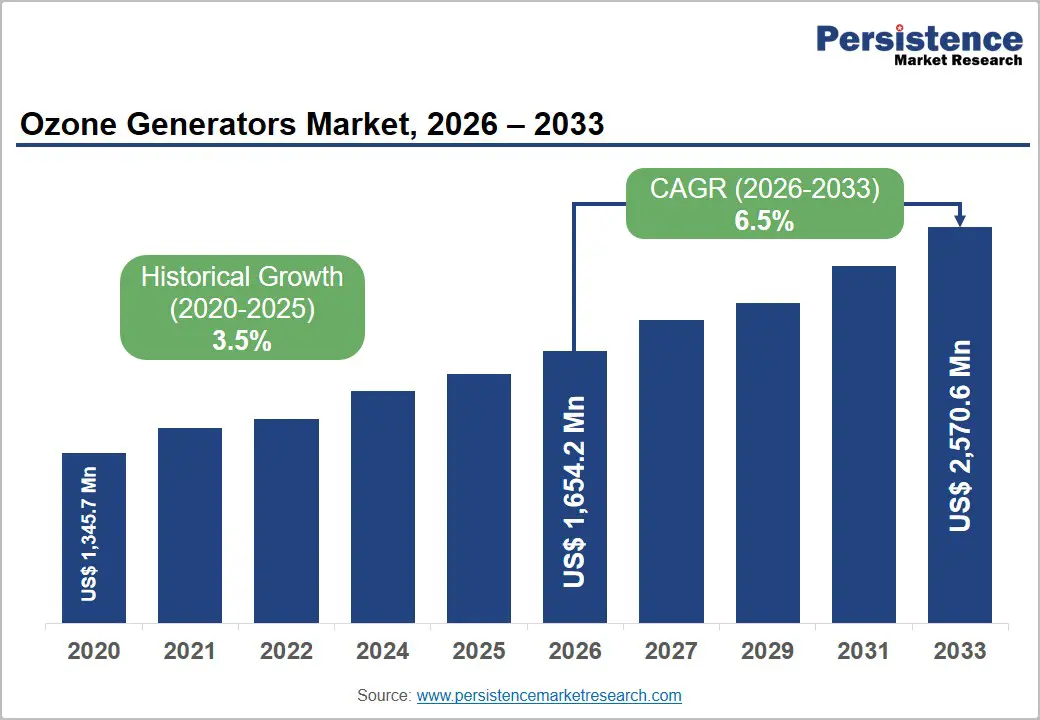
The global ozone generators market size is valued at US$ 1,654.2 million in 2026 and is projected to reach US$ 2,570.6 million, growing at a CAGR of 6.5% between 2026 and 2033.
The market is witnessing strong growth due to rising global concerns regarding water scarcity, contamination, and stricter environmental regulations on disinfection byproducts. Guidelines from the U.S. Environmental Protection Agency and World Health Organization are encouraging municipal and industrial operators to adopt ozone-based treatment systems as an environmentally friendly alternative to chlorine-based disinfection.
Key Market Highlights
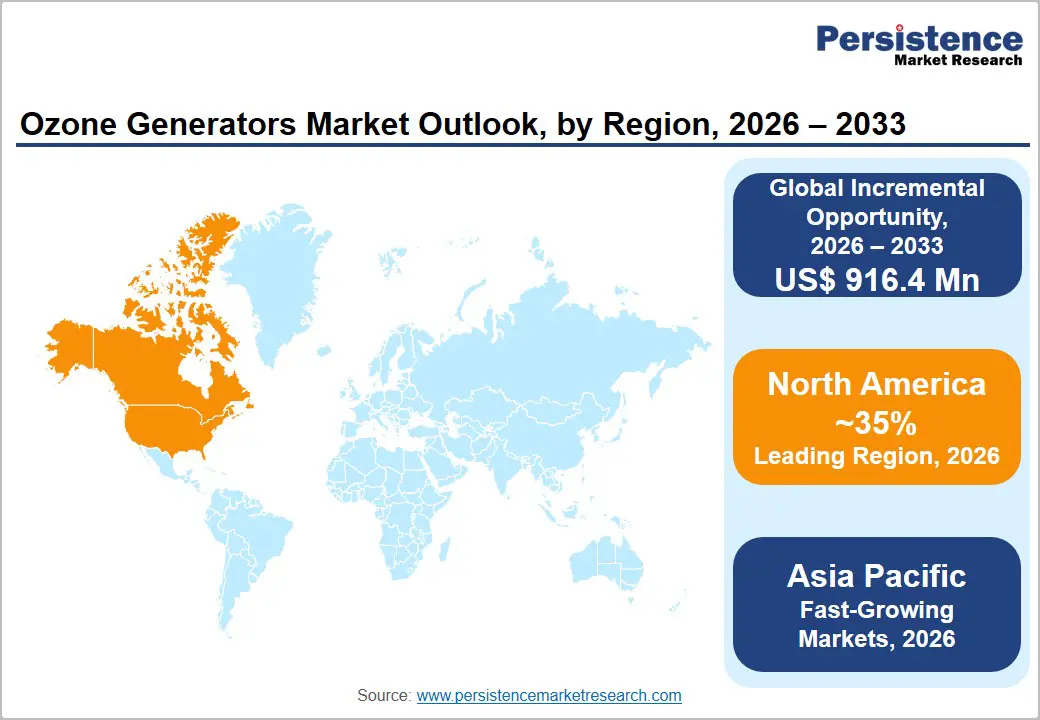
- Leading Region: North America leads the global ozone generators market with approximately 32% share, driven by EPA-mandated municipal water treatment upgrades, food safety regulations, and robust commercial air treatment adoption across healthcare and hospitality sectors.
- Fast-Growing Market: Asia Pacific is the fastest-growing region at a 7.8% CAGR, propelled by China's Five-Year Plan water infrastructure investments and India's Jal Jeevan Mission generating multi-year procurement pipelines for ozone-based treatment systems.
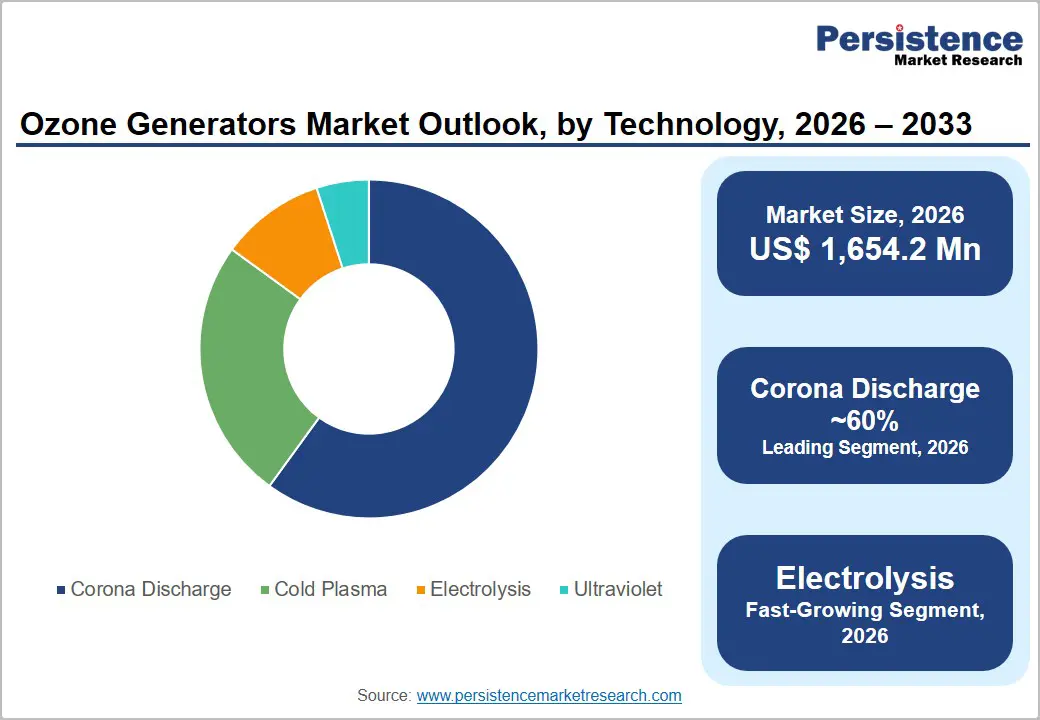
- Dominant Segment: Corona Discharge technology commands approximately 62% market share, reflecting its superior energy efficiency, scalable output range, and established deployment across global municipal and industrial ozone treatment applications.
- Fastest Growing Segment: Cold Plasma technology is the fastest-growing technology segment, driven by emerging air treatment and medical sterilization applications, offering chemical-free pathogen elimination at lower ozone output concentrations for sensitive occupied environments.
- Key Market Opportunity: Food & beverage industry adoption of ozone-based sanitation approved as FDA GRAS offers significant untapped opportunity, with FAO estimating 14% of global food production lost to microbial spoilage addressable by ozone treatment systems.
DRO Analysis
Drivers - Rise in Global Demand for Safe Drinking Water and Advanced Wastewater Treatment
Water scarcity and contamination represent two of the most pressing global public health challenges of the 21st century. According to UN Water, over 2 billion people currently lack access to safely managed drinking water services. Ozone generators deliver superior microbial inactivation including against chlorine-resistant pathogens such as Cryptosporidium and Giardia without generating harmful chlorination byproducts classified under U.S. EPA Disinfection Byproducts Rules.
Governments across North America, Europe, and Asia Pacific are mandating upgrades to aging water infrastructure; the U.S. Infrastructure Investment and Jobs Act (2021) allocated US$ 55 Bn specifically for water and wastewater system improvements, creating significant procurement opportunities for ozone-based treatment technology providers.
Tightening Air Quality Regulations Accelerating Ozone-Based Air Treatment Adoption
Indoor and outdoor air quality standards are becoming increasingly stringent globally. The WHO Global Air Quality Guidelines (2021) substantially reduced recommended limits for key pollutants including PM2.5, PM10, and NO2, prompting facility operators across healthcare, food processing, hospitality, and pharmaceutical sectors to invest in advanced air purification systems.
Ozone generators, particularly those based on Corona Discharge and Cold Plasma technologies, can neutralize volatile organic compounds (VOCs), bacteria, viruses, and Odors at concentrations unachievable by conventional HEPA or activated carbon filtration alone.
Restraints - Health and Safety Risks Associated with Elevated Ozone Concentrations
Ozone at concentrations above 0.1 ppm (OSHA permissible exposure limit) poses documented respiratory health risks including lung irritation, aggravated asthma, and reduced lung function. This dual-use nature beneficial as a disinfectant but harmful at elevated human exposure levels creates significant operational and liability concerns for commercial and residential ozone generator deployments. U.S. EPA and Health
Canada has both issued advisories cautioning against ozone air purifiers in occupied spaces, limiting residential market penetration and creating reputational headwinds that constrain broader commercial adoption in sensitive environments.
High Capital Cost and Technical Complexity of Industrial-Scale Installations
Large-scale municipal and industrial ozone generation systems require significant upfront capital investment, encompassing ozone generation units, oxygen feed systems, contact chambers, and off-gas destruction equipment. Installation costs for municipal-scale systems can range from US$ 500,000 to over US$ 5 Mn depending on treatment capacity, deterring adoption in developing markets with constrained municipal infrastructure budgets.
Additionally, ozone systems require skilled operators and regular maintenance of dielectric elements, power electronics, and gas handling components, creating operational complexity and recurring cost burdens that challenge cost-sensitive end-users in emerging economies.
Market Opportunities
Food & Beverage Industry Adoption: Chemical-Free Processing Compliance Opportunity
The global food and beverage industry faces mounting regulatory pressure to eliminate chemical disinfectant residues from processing operations. The U.S. FDA approved ozone as a GRAS (Generally Recognized as Safe) substance for direct food contact applications in 2001, and subsequent EU Regulation (EC) 852/2004 on food hygiene has similarly affirmed ozone's role in sanitation.
Growing consumer demand for clean-label, preservative-free food products is compelling food manufacturers to replace chlorinated wash solutions with ozone-based systems for produce washing, surface decontamination, and cold storage disinfection. According to the Food and Agriculture Organization (FAO), approximately 14% of global food production is lost post-harvest due to microbial spoilage a problem ozone treatment demonstrably addresses.
Emerging Markets Water Infrastructure Investment: Municipal End-Use Expansion
Rapid urbanization across South Asia, Southeast Asia, Latin America, and Sub-Saharan Africa is driving unprecedented investment in municipal water and wastewater infrastructure. The Asian Development Bank (ADB) estimates that Asia alone requires US$ 1.7 trillion in water infrastructure investment through 2030 to meet urban demand.
India's Jal Jeevan Mission, targeting universal tap water access to 192 million rural households by 2024, has generated significant procurement activity for advanced water treatment equipment. Similarly, China's 14th Five-Year Plan allocates over RMB 2 trillion (approximately US$ 280 Bn) for ecological and environmental infrastructure, including advanced wastewater treatment upgrades.
Category-wise Analysis
Technology Insights
Corona Discharge technology dominates the ozone generators market, commanding approximately 62% of total market share. This commanding position reflects the technology's superior ozone production efficiency, scalability across a broad output range from small commercial units to large municipal systems and its established track record across wastewater and air treatment applications.
Corona discharge generators produce ozone by passing dry air or oxygen between two electrodes subject to a high-voltage alternating current field, offering energy-efficient ozone generation at competitive per-gram costs relative to alternative technologies.
Application Insights
Wastewater treatment is the leading application segment, accounting for approximately 47% of total ozone generators market revenue. The segment's dominance reflects the growing global volume of industrial and municipal wastewater requiring advanced treatment before discharge or reuse, under increasingly strict effluent quality standards.
Ozone's ability to achieve high levels of pathogen inactivation, micropollutant degradation including pharmaceuticals, hormones, and pesticides classified as emerging contaminants and colour/Odor removal without generating persistent disinfection byproducts makes it the preferred advanced treatment technology for upgrading legacy chlorine-based systems.
End-user Insights
The municipal end-user segment leads the ozone generators market, representing approximately 43% of total market revenue. Municipal water and wastewater utilities globally are the single largest procurement segment for ozone generation equipment, driven by regulatory mandates, public health obligations, and the operational scale required to justify the capital investment in advanced ozone systems.
The U.S. EPA's Stage 2 Disinfectants and Disinfection Byproducts Rule (DBPR) has accelerated ozone adoption in U.S. municipal systems by penalizing trihalomethane and haloacetic acid formation from chlorine disinfection.
Regional Analysis
North America Ozone Generators Market Trends & Analysis
North America holds an estimated 32% share of the global ozone generators market, underpinned by a mature regulatory environment, significant infrastructure upgrade spending, and advanced adoption of ozone across municipal water treatment, food processing, and commercial air treatment applications. The U.S. Infrastructure Investment and Jobs Act and ongoing EPA regulatory enforcement are sustaining strong ozone system procurement across the region.
Canada's expanding municipal water infrastructure investment particularly in provinces addressing aging treatment facilities and growing food processing sector adoption of ozone-based sanitation are providing incremental market growth.
U.S. Ozone Generators Market Size
The United States accounts for approximately US$ 420 Mn of the global ozone generators market in 2026, representing the single largest national market globally. Growing at an estimated CAGR of 6.2% through 2033, U.S. demand is anchored by EPA-driven municipal water upgrade mandates, food safety compliance requirements under the FDA Food Safety Modernization Act (FSMA).
Europe Ozone Generators Market Trends, Drivers & Insights
Europe holds approximately 25% of global ozone generators market share, led by Germany, France, and the United Kingdom. The region's advanced regulatory framework including the revised EU Drinking Water Directive, Urban Wastewater Treatment Directive, and Industrial Emissions Directive creates robust and sustained institutional demand for ozone-based water and air treatment systems.
European food and pharmaceutical manufacturers are accelerating ozone adoption under EU Green Deal commitments to reduce chemical inputs in production processes. Germany and France host significant ozone generator manufacturing capacity, while the U.K.'s water utility sector following Ofwat's AMP8 investment cycle requirements is projected to drive substantial ozone system procurement through 2030.
Germany Ozone Generators Market Size
Germany is the leading European market for ozone generators, valued at approximately US$ 115 Mn in 2026, growing at a CAGR of approximately 5.8%. Its market leadership reflects Germany's position as Europe's largest economy and its dense industrial and municipal water infrastructure base.
U.K. Ozone Generators Market Size
U.K. ozone generators market is valued at approximately US$ 70 Mn in 2026, with a projected CAGR of approximately 6.0%. Growth is driven by Thames Water, Severn Trent, and United Utilities investing in advanced treatment upgrades under Ofwat AMP8 regulatory requirements.
France Ozone Generators Market Size
France's ozone generators market is estimated at approximately US$ 55-65 Mn in 2026, growing at a CAGR of approximately 5.5%. France has historically been an early adopter of ozone in municipal water treatment; Paris's water treatment infrastructure has used ozone since the 1970s.
Asia Pacific Ozone Generators Market Drivers & Analysis
Asia Pacific is the fastest-growing regional market, commanding approximately ~33% of global ozone generators market share and expanding at a CAGR of approximately 7.8%. The region's growth is propelled by massive government investment in water and wastewater infrastructure, rapid industrialization generating complex effluent treatment requirements, and rising urban air quality concerns across China, India, Japan, and ASEAN nations.
China and India together represent the dominant share of regional demand, with both governments allocating substantial capital to water treatment modernization. Japan's mature and technology-forward ozone market is additionally driven by food safety applications and advanced semiconductor manufacturing process water treatment requirements.
China Ozone Generators Market Size
China is the largest Asia Pacific market for ozone generators, estimated at approximately US$ 310 Mn in 2026, growing at a CAGR of approximately 8.2%. China's 14th Five-Year Plan targets for ecological civilization construction and wastewater treatment capacity expansion across tier-2 and tier-3 cities are driving multi-year ozone system procurement.
India Ozone Generators Market Size
India's ozone generators market is estimated at approximately US$ 95-110 Mn in 2026, expanding at a CAGR of approximately 9.1%the fastest among major national markets. Jal Jeevan Mission and the National Mission for Clean Ganga (NMCG) are the two flagship programs generating large-volume procurement pipelines for advanced water treatment equipment including ozone generators, supported by urban local body infrastructure grants.
Japan Ozone Generators Market Size
Japan's ozone generators market is estimated at approximately US$ 80-90 Mn in 2026, with a steady CAGR of approximately 5.2%. Japan is a technologically mature ozone market with deep penetration in municipal water treatment, food processing, and semiconductor wafer cleaning applications.
Competitive Landscape
The global ozone generators market is moderately fragmented, with established multinational companies including Xylem Inc., Suez Water Technologies & Solutions, Mitsubishi Electric, and Evoqua Water Technologies competing alongside a significant number of regional and specialist manufacturers.
Key differentiators include technology platform superiority (particularly corona discharge efficiency), system integration capabilities, regulatory certifications (NSF, CE, FDA compliance), and after-sales service networks. Market leaders are investing in IoT-enabled smart ozone monitoring systems, modular skid-mounted installations for faster deployment, and energy-efficient dielectric designs. Emerging business models include ozone-as-a-service arrangements and performance-based water treatment contracts, particularly in municipal end markets where capital budget constraints create demand for alternative financing structures.
Key Developments:
- In April 2025, RainHarvest Systems introduced its new Pro Series and M Series ozone generator product lines. The six advanced systems are designed to deliver high-performance water purification across residential, commercial, and industrial applications.
- In October 2024, Salher introduced OZ Wizard, an automatic ozone generation system designed for water disinfection and environmental protection. The compact, modular equipment supports drinking water and wastewater treatment, offering an efficient, chemical?free solution adaptable to municipal, industrial, and environmental applications.
Companies Covered in Ozone Generators Market
- Xylem Inc. (WEDECO)
- Mitsubishi Electric Corporation
- Evoqua Water Technologies
- Suez Water Technologies & Solutions
- Toshiba Infrastructure Systems
- Primozone Production AB
- Ozonia (Veolia Group)
- Pacific Ozone Technology
- BWT AG
- Ebara Corporation
- Absolute Ozone
- Spartan Environmental Technologies
- DEL Ozone (Hayward Industries)
Frequently Asked Questions
The global Ozone Generators market is valued at US$ 1,654.2 Mn in 2026 and is projected to reach US$ 2,570.6 Mn by 2033, growing at a CAGR of 6.5%.
Key drivers include global water scarcity and contamination challenges, tightening EPA and WHO drinking water and wastewater regulations, growing food safety compliance requirements under FDA FSMA, and increasing commercial and municipal adoption of chemical-free disinfection technologies across North America, Europe, and Asia Pacific.
Corona Discharge technology leads with approximately 62% market share, owing to its superior ozone production efficiency, scalability for both small commercial and large municipal applications, and the established installed base across major water treatment facilities worldwide.
North America leads with approximately ~32% of global market share, anchored by the U.S. market estimated at US$ 420 Mn in 2026. EPA-mandated disinfection byproduct compliance, FSMA food safety requirements, and robust commercial air treatment adoption underpin the region's market leadership.
The global ozone generators market is led by Xylem Inc. (WEDECO brand), Mitsubishi Electric Corporation, Evoqua Water Technologies, Suez Water Technologies & Solutions, and Toshiba Infrastructure Systems.


