




- Biotechnology
- Nanoparticle Formulation Market
Nanoparticle Formulation Market Size, Share, and Growth Forecast, 2026 – 2033
Nanoparticle Formulation Market by Product Type (Lipid Nanoparticles, Polymeric Nanoparticles, Metal Nanoparticles, Inorganic Nanoparticles, Others), Application (Drug Delivery Systems, Vaccines & Therapeutics, Diagnostics & Imaging, Cosmetics & Personal Care, Food & Beverages, Agriculture, Others), End-User (Pharmaceutical & Biotechnology, Cosmetics & Personal Care, Food & Beverages, Agriculture, Chemical Manufacturing, Electronics & Energy), and Regional Analysis for 2026-2033

Nanoparticle Formulation Market Share and Trends Analysis
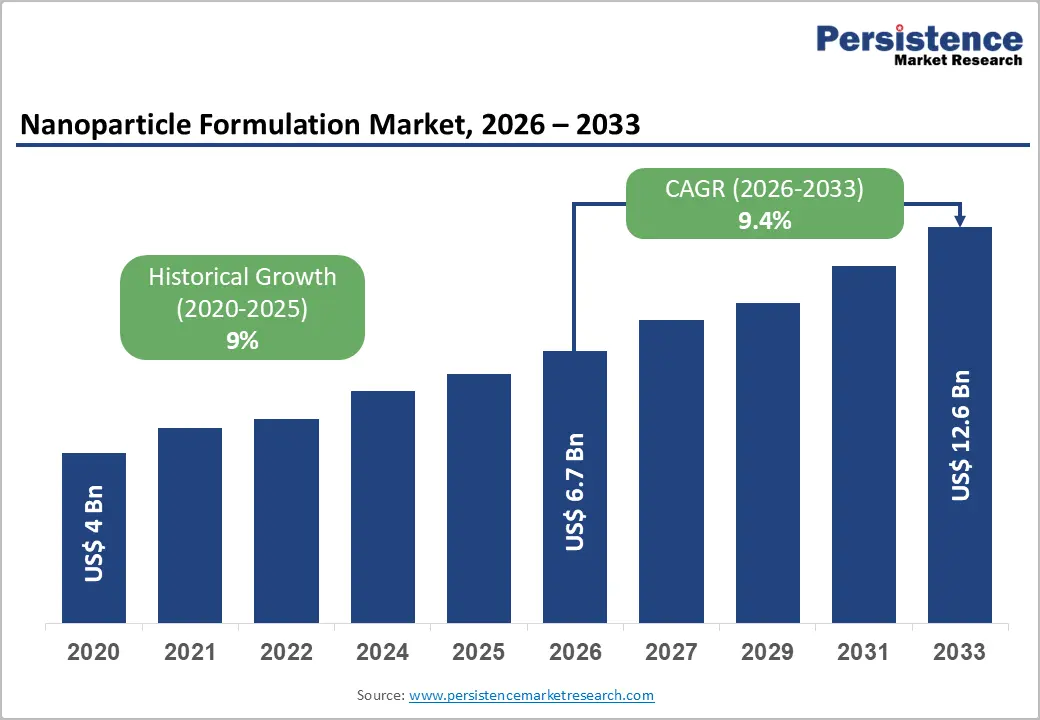
The global nanoparticle formulation market size is likely to be valued at US$ 6.7 billion in 2026, and is projected to reach US$ 12.6 billion by 2033, growing at a CAGR of 9.4% during the forecast period 2026−2033. Market expansion is propelled by structural transformation across healthcare, life sciences, and advanced material industries, where nanoscale engineering increasingly defines therapeutic precision, functional performance, and commercial differentiation.
Rising prevalence of chronic and complex diseases among aging and urban populations fuels demand for targeted delivery platforms that enhance bioavailability and minimize systemic toxicity. Increasing clinical awareness among healthcare professionals regarding nanoparticle-enabled therapeutics supports faster integration into treatment protocols, particularly within oncology, infectious diseases, and immunotherapy. Adoption of these therapies demonstrates measurable benefits in dosing efficiency, patient adherence, and formulation stability across oral, injectable, and transdermal administration routes.
Key Industry Highlights
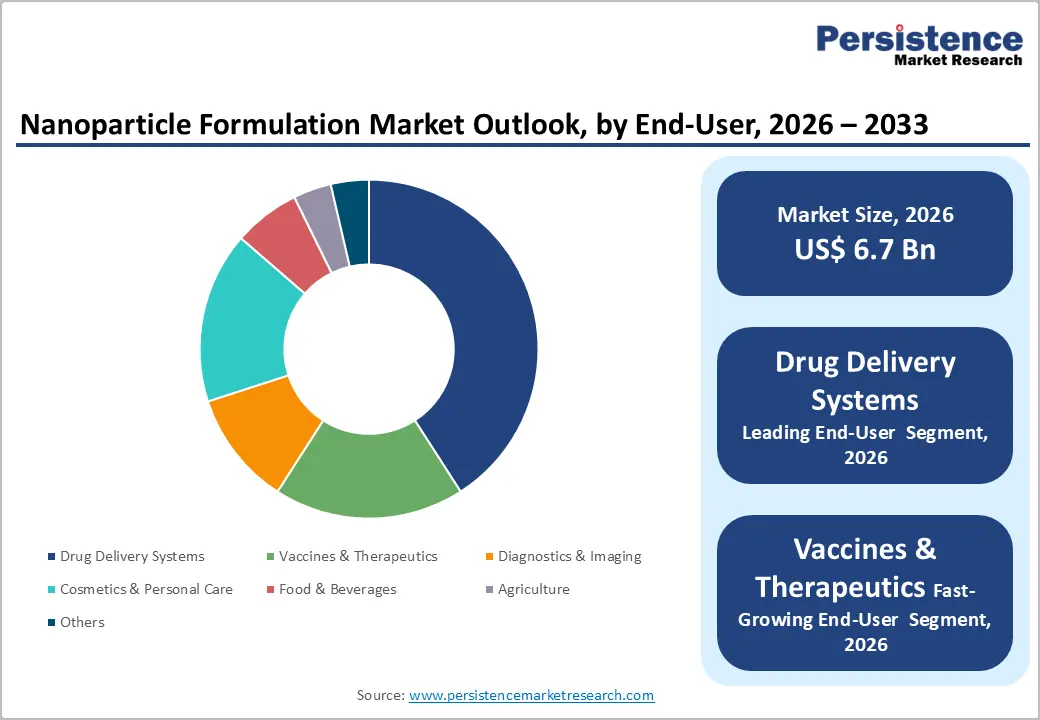
- Application Leadership: Drug delivery systems are projected to hold over 45% market share in 2026, fueled by high pharmaceutical demand and enhanced bioavailability.
- Fastest-growing Application: Vaccines and therapeutics are expected to grow fastest from 2026 to 2033, driven by expanded immunization programs and advancements in mRNA and viral vector technologies.
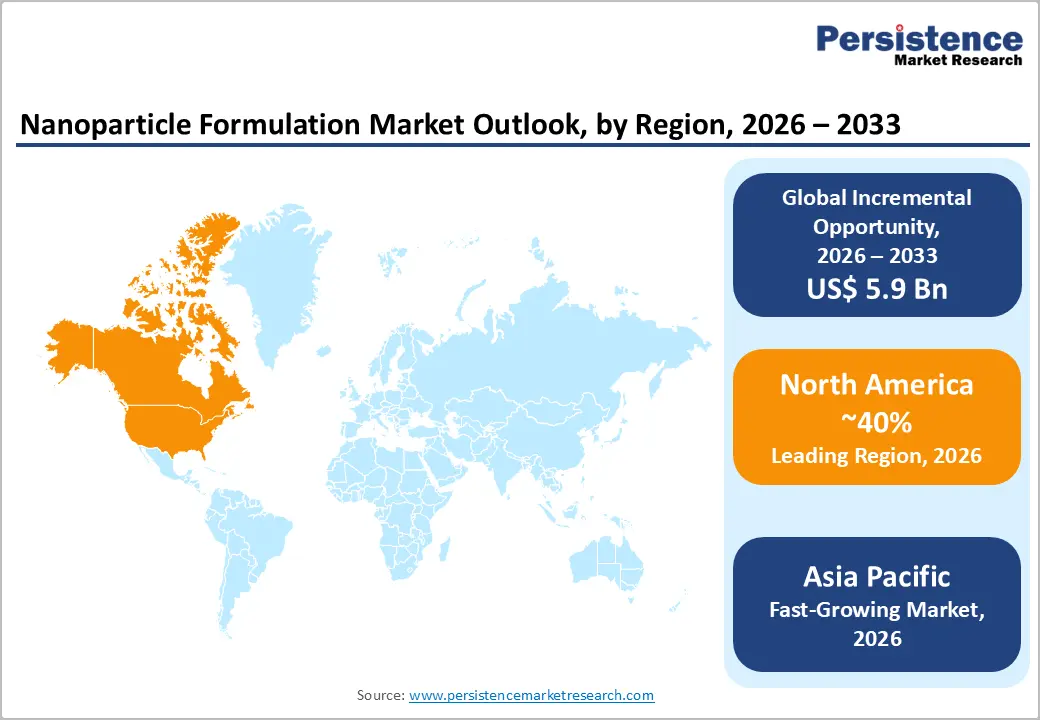
- Dominant Region: North America is set to lead with nearly 40% market share in 2026, propelled by strong biotech R&D investment and billions in federal nanotechnology funding.
- Fastest-growing Market: Asia Pacific is projected as the fastest-growing market through 2033, powered by rising chronic disease prevalence and increasing biotech investment.
- January 2026: Purdue University researchers announced that virus-mimicking nanoparticles successfully delivered mRNA to bladder cancer cells with stability after freeze-drying and without triggering immune activation.
| Key Insights | Details |
|---|---|
| Nanoparticle Formulation Market Size (2026E) | US$ 6.7 Bn |
| Market Value Forecast (2033F) | US$ 12.6 Bn |
| Projected Growth (CAGR 2026 to 2033) | 9.4% |
| Historical Market Growth (CAGR 2020 to 2025) | 9% |
Market Factors – Growth, Barriers, and Opportunity Analysis
Acceleration of Biologics, Nucleic Acid, and Vaccine Platforms
The growing emphasis on biologics, nucleic acid therapies, and advanced vaccines is driving increased demand for nanoparticle-based delivery systems. These therapeutic modalities are inherently complex, with challenges including instability, rapid degradation, and limited cellular uptake that can limit clinical efficacy. Nanoparticle formulations offer precise encapsulation, protection against enzymatic breakdown, and controlled release, ensuring that these sensitive molecules reach their intended target sites effectively. Integration of nanoparticles allows for optimization of pharmacokinetics and pharmacodynamics, improving therapeutic outcomes while reducing dosage frequency and systemic exposure. This capability aligns with the broader healthcare objective of enhancing patient adherence and treatment efficiency for sophisticated therapeutics.
Advances in biotechnology and immunology have accelerated the development of personalized and next-generation therapies, including mRNA-based vaccines and gene-editing applications. Nanoparticles facilitate the safe and targeted delivery of these therapies to specific tissues or cells, addressing delivery bottlenecks that would otherwise limit their clinical potential. The ability to engineer particle size, surface characteristics, and release profiles provides developers with a high degree of flexibility in formulating treatments that meet stringent safety and efficacy standards. This convergence of innovative biologics with advanced delivery platforms drives investment in nanoparticle technologies and encourages the adoption of precision medicine approaches across diverse therapeutic areas, reinforcing their strategic importance in modern healthcare development.
Complexity of Scale-Up and Manufacturing Standardization
Scaling nanoparticle formulations from laboratory to commercial production presents significant technical and operational challenges. The processes involved in nanoparticle synthesis, such as emulsion techniques, solvent evaporation, or self-assembly methods, demand precise control over particle size, surface properties, and uniformity. Minor deviations in these parameters can compromise product efficacy, stability, and safety, creating stringent requirements for quality assurance and reproducibility. Maintaining batch-to-batch consistency becomes increasingly difficult at larger volumes, as minor variations in temperature, mixing speed, or raw material characteristics can lead to significant differences in particle behavior. These challenges necessitate substantial investment in specialized equipment, process optimization, and highly skilled personnel, which can limit the speed of commercialization and increase production costs.
Integration of standardized manufacturing practices across nanoparticle production remains constrained by the diversity of formulation types and therapeutic applications. Each formulation may require unique process parameters, making universal standardization impractical and slowing industrial adoption. Supply chain complexity for high-purity raw materials and advanced excipients introduces additional variability, while maintaining sterility and preventing contamination adds operational risk. These factors collectively limit large-scale production flexibility, reduce economies of scale, and pose a barrier to rapid market expansion. Companies must carefully balance innovation with process reliability, often prioritizing small-scale, controlled production over mass manufacturing, which restricts broader accessibility and slows market penetration for emerging nanoparticle therapeutics.
Integration with Advanced Diagnostics and Theranostics
The convergence of nanoparticle formulations with advanced diagnostics and theranostics represents a strategic opportunity to enable precise, personalized treatment strategies. Nanoparticles can be engineered to carry both therapeutic agents and diagnostic markers, facilitating real-time monitoring of disease progression and treatment response. This dual functionality allows clinicians to adjust dosing regimens dynamically, improving therapeutic outcomes while minimizing adverse effects. In oncology, for instance, nanoparticle-based theranostic platforms can identify tumor biomarkers, deliver targeted chemotherapy, and track therapeutic efficacy simultaneously, streamlining patient management and enhancing clinical decision-making. The integration of these technologies supports efficiency in drug development pipelines, as preclinical and clinical evaluations can be closely aligned with measurable diagnostic feedback, reducing time-to-market for new formulations.
Adoption of nanoparticle-enabled theranostic solutions also strengthens the value proposition for healthcare providers and patients by enhancing the precision and predictability of treatment outcomes. By linking diagnostic insights directly with therapeutic delivery, treatment regimens can be optimized for individual patient profiles, addressing heterogeneity in disease presentation and drug response. This capability is particularly relevant in managing complex and chronic conditions, where conventional therapies often fail to achieve consistent results. Furthermore, the capacity to track and visualize therapeutic distribution in real time fosters regulatory confidence, supporting broader clinical acceptance.
Category-wise Analysis
Product Type Insights
Lipid nanoparticles are anticipated to secure around 38% of the market revenue share in 2026, reflecting strong clinical validation, scalable manufacturing familiarity, and regulatory acceptance across vaccine and gene therapy applications. Their structural composition enables encapsulation of sensitive biomolecules, such as mRNA, DNA, and peptides, while protecting them from enzymatic degradation and enhancing delivery efficiency. High biocompatibility and efficient cellular uptake support widespread adoption across injectable formulations. Lipid nanoparticles also facilitate controlled biodistribution, improving therapeutic index and reducing systemic toxicity. Provider preference aligns with established safety profiles and compatibility with nucleic acid payloads, reinforcing leadership positioning.
Polymeric nanoparticles are expected to be the fastest-growing segment during the 2026–2033 forecast period, propelled by formulation flexibility, tunable release kinetics, and expanding use in oral and implantable delivery systems. Their ability to be engineered from a variety of biodegradable polymers allows precise control over degradation rates, drug release profiles, and tissue targeting. Innovation across polymer chemistry and nanoparticle surface modification enhances stability, bioavailability, and patient compliance, particularly in chronic therapies. Polymeric systems can encapsulate a wide range of small molecules, proteins, and nucleic acids, supporting next-generation drug development.
Application Insights
Drug delivery system extracts are poised to dominate, with approximately 45% of the nanoparticle formulation market revenue share in 2026, driven by sustained pharmaceutical demand for enhanced bioavailability and controlled release. These systems improve therapeutic outcomes by optimizing drug absorption, minimizing dosing frequency, and reducing side effects, which enhances patient adherence. Strong clinician trust and integration into standard care pathways reinforce dominance across therapeutic categories. Ongoing innovation in formulation technologies, such as nanoemulsions, liposomes, and sustained-release matrices, further strengthens their applicability across oral, injectable, and transdermal routes. Collaboration between pharmaceutical developers and healthcare providers ensures continued adoption and regulatory alignment, solidifying their leadership in advanced drug delivery solutions.
Vaccines and therapeutics are estimated to be the fastest-growing segment from 2026 to 2033, fueled by expanding immunization programs, preparedness frameworks, and rapid development platforms. Increasing investment in preventive care and outbreak management accelerates the need for novel vaccine formulations, including nanoparticle-based delivery systems. Digital commerce expansion across healthcare procurement improves distribution efficiency, allowing faster, more reliable delivery to diverse populations. Advances in mRNA and viral vector technologies further enhance product adaptability and scalability. Growing public health initiatives, coupled with heightened regulatory support, create favorable conditions for accelerated adoption, positioning vaccines and therapeutics as a major growth driver in the nanoparticle formulation landscape.
End-User Insights
Pharmaceutical and biotechnology are likely to be the leading end-user segment with a projected 52% of the nanoparticle formulation market share in 2026 due to strong research investment, regulatory alignment, and commercial scalability. The segment benefits from increasing demand for targeted drug delivery systems, gene therapies, and precision medicine solutions, where nanoparticles improve bioavailability and reduce systemic toxicity. Integration of advanced nanomaterials into clinical pipelines enables improved patient outcomes and accelerates product approval timelines. Collaborative efforts between academia, biotechnology firms, and pharmaceutical manufacturers drive innovation, scale-up, and commercialization.
Electronics and energy are anticipated to be the fastest-growing end-user segment from 2026 to 2033, fueled by demand for high-performance materials in batteries, coatings, and conductive applications supported by energy transition policies. Nanoparticle formulations enhance electrical conductivity, thermal stability, and mechanical strength, which are critical for next-generation batteries, supercapacitors, and flexible electronics. Growing adoption of renewable energy technologies and electric vehicles further amplifies market potential. Research into advanced nanomaterials, including metal oxides, quantum dots, and conductive polymers, continues to expand functionality and efficiency.
Regional Insights
North America Nanoparticle Formulation Market Trends
North America is expected to dominate with an estimated 40% of the nanoparticle formulation market share in 2026, reflecting concentrated investment in research and development, advanced therapeutic ecosystems, and well-established manufacturing capabilities. Leadership is reinforced by strong translational pipelines that convert laboratory innovations into clinically validated nanoparticle formulations, particularly in oncology, gene therapy, and infectious disease treatments. Sophisticated clinical trial networks and regulatory frameworks support accelerated evaluation and approval of novel therapies, while large-scale production of lipid and polymeric nanoparticles ensures consistent supply for high-demand applications. Strategic collaborations between industry and research institutions further enhance competitive positioning through integrated development, rapid prototyping, and validation of multifunctional nanoparticles. Federal support under the U.S. National Nanotechnology Initiative, with over $45 billion in cumulative funding for nanoscale research and development, strengthens scientific capabilities and infrastructure, directly enabling innovation in advanced nanoparticle therapies.
High clinical adoption also underpins market dominance, with healthcare providers integrating advanced therapeutics into treatment protocols that demonstrate improved bioavailability, targeted delivery, and safety profiles. Widespread acceptance of nanoparticle-enabled formulations in hospital and outpatient settings reinforces trust among clinicians, enabling rapid adoption of new therapies across multiple disease areas. Access to specialized talent, advanced imaging, and analytical technologies enables design of personalized formulations tailored for diverse patient populations, ensuring optimal therapeutic outcomes and reduced off-target effects. Supportive digital infrastructure, including real-time monitoring, predictive analytics, and data-driven performance tracking, strengthens feedback loops for formulation optimization, accelerates decision-making, and facilitates regulatory alignment.
Europe Nanoparticle Formulation Market Trends
Europe is expected to hold a significant position in the market for nanoparticle formulations due to robust regulatory frameworks, extensive utilization of advanced therapeutics, and established pharmaceutical and biotechnology sectors. Leadership is supported by integrated research networks, translational science programs, and collaborative initiatives between universities, hospitals, and industry. Investment in cutting-edge manufacturing facilities and analytical technologies ensures high-quality production of lipid, polymeric, and metallic nanoparticles, enabling scalable delivery of complex therapies. Clinical infrastructure supports rapid evaluation of novel formulations, particularly in oncology, immunotherapy, and rare disease treatments. Early adoption of personalized medicine approaches and precision-targeted delivery systems reinforces market strength, while a mature healthcare system facilitates reimbursement and commercialization of advanced nanoparticle therapeutics.
Regulatory agencies maintain rigorous standards for safety and efficacy, driving innovation while ensuring clinical reliability. Growth is further reinforced by increasing demand for targeted drug delivery, rising prevalence of chronic and age-related conditions, and strong government and private-sector support for biomedical research. Investment in digital integration, including real-time monitoring, patient data analytics, and clinical trial management platforms, improves efficiency and treatment optimization. Skilled talent in nanotechnology, materials science, and pharmaceutical development supports rapid formulation design and commercialization. Expansion of cross-border collaborative programs enhances access to novel therapeutics and accelerates market entry timelines.
Asia Pacific Nanoparticle Formulation Market Trends
Asia Pacific is forecasted to be the fastest-growing market for nanoparticle formulations between 2026 and 2033, stimulated by rapid expansion of healthcare infrastructure, increasing prevalence of chronic and complex diseases, and rising investment in advanced pharmaceutical manufacturing. Strategic development of biotechnology hubs and specialized research centers enhances capabilities in nanoparticle-based therapeutics, particularly in gene therapy, vaccines, and targeted drug delivery. Streamlined regulatory pathways and government-led innovation programs accelerate translation of novel formulations into clinical practice. High population density and urbanization create substantial patient pools, supporting faster adoption of advanced therapies. Localized production of lipid, polymeric, and metallic nanoparticles reduces dependency on imports while improving cost efficiency, strengthening competitiveness and market scalability.
Expanding access to healthcare financing, rising disposable income, and growing clinical awareness further drive adoption of nanoparticle-enabled therapies. Advanced manufacturing technologies, including automated nanoparticle characterization and continuous flow synthesis, support consistent production and quality standards. Integration of telemedicine, real-time monitoring, and data analytics enhances treatment personalization and outcome predictability. Investment in workforce development, analytical infrastructure, and quality assurance ensures compliance with evolving regulatory standards and safety requirements.
Competitive Landscape
The global nanoparticle formulation market structure demonstrates moderate fragmentation, with multinational pharmaceutical companies, specialized nanotechnology firms, and contract development and manufacturing organizations (CDMOs) competing across therapeutic, material, and application segments. Market dynamics are shaped by technological innovation, regulatory compliance, and formulation expertise, which serve as key differentiators for competitive positioning. Leading players, including Pfizer, Catalent, Thermo Fisher Scientific, Merck, and Lonza, leverage extensive research and development capabilities to develop lipid, polymeric, and metallic nanoparticle platforms. Strategic collaborations, licensing agreements, and joint ventures enable rapid translation of laboratory innovations into clinically validated formulations, particularly in high-demand areas such as oncology, gene therapy, and vaccines.
Top market participants collectively account for approximately 40% of global revenue, reflecting both concentrated expertise and the highly competitive nature of emerging segments. Competitive advantage is increasingly driven by demonstrated regulatory track record, scalable manufacturing capabilities, and portfolio diversification across multiple nanoparticle technologies. Investment in automated production, quality control, and digital monitoring systems allows for consistent delivery of high-complexity formulations, supporting operational efficiency and compliance. Additionally, the ability to integrate analytical, clinical, and manufacturing workflows strengthens formulation optimization and accelerates time-to-market for novel therapies.
Key Industry Developments
- In November 2025, researchers at the University of Pennsylvania revealed that detailed biophysical analysis of lipid nanoparticles showed diverse internal structures linked to delivery performance, paving the way for more precisely tailored targeted treatments.
- In October 2025, University of Massachusetts Amherst scientists demonstrated that a super-adjuvant nanoparticle vaccine prevented melanoma, pancreatic, and triple-negative breast cancer in mice, with up to 88% of vaccinated animals remaining tumor-free and showing resistance to metastatic spread.
- In October 2025, UChicago Pritzker School of Molecular Engineering developed thermoreversible polymer nanoparticles that self-assemble in water at room temperature, encapsulating proteins/RNA without solvents or microfluidics for scalable drug/vaccine delivery. Tested successfully for immune activation, suppression, and tumor gene silencing, they enable freeze-dried storage and decentralized production worldwide.
Companies Covered in Nanoparticle Formulation Market
- Pfizer Inc.
- Catalent, Inc
- Thermo Fisher Scientific Inc.
- Merck KGaA
- Lonza.
- AbbVie Inc.
- AstraZeneca
- Sanofi
- Samsung Biologics.
- Novartis AG
Frequently Asked Questions
The global nanoparticle formulation market is projected to reach US$ 6.7 billion in 2026.
Growth in targeted drug delivery demand, rising chronic disease burden, advancements in nano‑engineering, and expanding clinical adoption drive the market.
The market is poised to witness a CAGR of 9.4% from 2026 to 2033.
Integration with advanced diagnostics and theranostics, expansion in vaccines and gene therapies, and adoption in personalized medicine are presenting novel market opportunities.
Some of the key market players include Pfizer Inc., Catalent, Inc., Thermo Fisher Scientific Inc., Merck KGaA, and Lonza.


