




- Advanced Materials
- Metal Carbide Nanoparticles Market
Metal Carbide Nanoparticles Market Size, Share, and Growth Forecast, 2026 – 2033
Metal Carbide Nanoparticles Market By Product Type (Titanium Carbide Nanoparticles, Others), Application (Automotive Industry, Others), End-user (Manufacturing & Construction, Others), and Regional Analysis for 2026 – 2033

Metal Carbide Nanoparticles Market Size and Trends Analysis
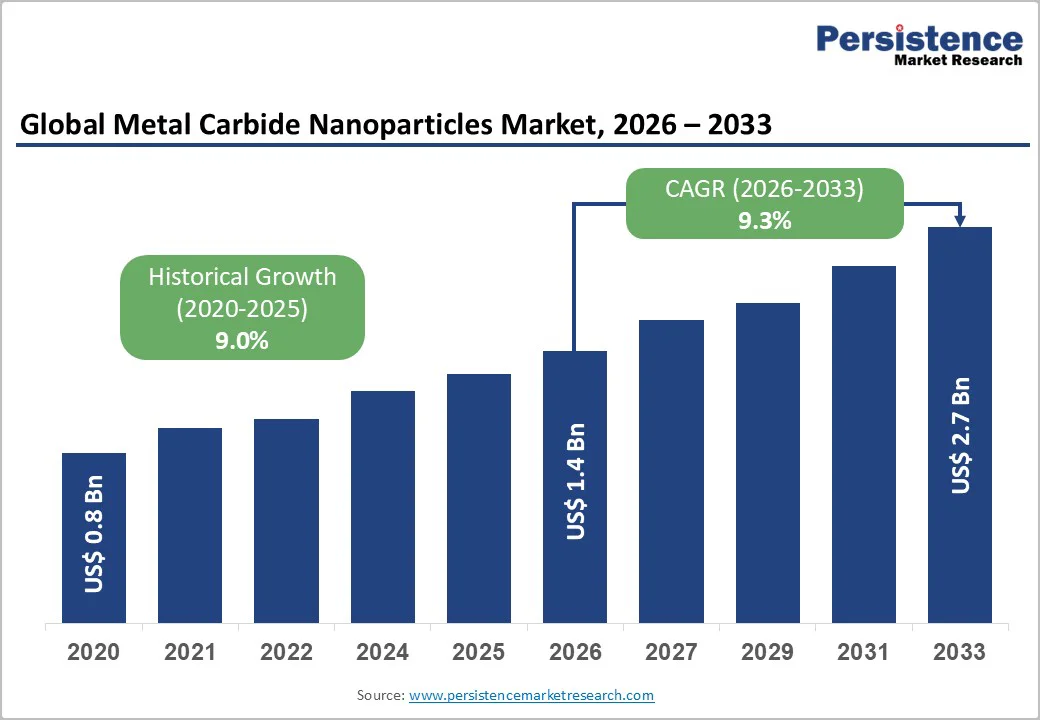
The global metal carbide nanoparticles market size is likely to be valued at US$1.4 billion in 2026 and is expected to reach US$2.7 billion by 2033, growing at a CAGR of 9.3% during the forecast period from 2026 to 2033, driven by rising demand for high-performance materials with superior hardness, thermal stability, and wear resistance across sectors such as automotive, aerospace, energy, and electronics. Nanostructured carbide materials are increasingly used in advanced coatings, cutting tools, and industrial machinery. Advances in nanoparticle synthesis, such as chemical vapor deposition, sol-gel, and plasma methods, are improving purity, consistency, and scalability, making them more cost-effective for large-scale applications.
Key Industry Highlights:
- Leading Region: Asia Pacific is anticipated to be the leading region, accounting for a market share of 35% in 2026, driven by China’s dominance and strong regional manufacturing bases.
- Fastest-growing Region: Asia Pacific is likely to be the fastest-growing region in 2026, fueled by industrialization, policy incentives, and rising investments.
- Leading Product Type: Tungsten carbide nanoparticles are projected to represent the leading product type in 2026, accounting for 35% of the market share, driven by their superior hardness and dominance in cutting and metallurgical applications.
- Leading Application: The automotive industry is anticipated to be the leading application, accounting for over 25% of the revenue share in 2026, supported by its widespread use in durability enhancement and next-generation vehicle components.
- Leading End-user: Manufacturing and construction is the leading end-user segment, contributing 40% of total revenue due to benefiting from extensive use of carbide nanoparticles in high-strength tools and industrial materials.
| Report Attribute | Details |
|---|---|
|
Metal Carbide Nanoparticles Market Size (2026E) |
US$1.4 Bn |
|
Market Value Forecast (2033F) |
US$2.7 Bn |
|
Projected Growth (CAGR 2026 to 2033) |
9.3% |
|
Historical Market Growth (CAGR 2020 to 2025) |
9.0% |
Market Factors – Growth, Barriers, and Opportunity Analysis
Demand for Advanced Materials in Automotive and Aerospace
Demand for advanced materials in the automotive and aerospace sectors is a major driver for the market, as industries increasingly prioritize performance, efficiency, and durability. Automakers are integrating carbide-based nanomaterials into engine components, braking systems, and wear-resistant coatings to improve longevity and reduce maintenance. These nanoparticles enhance hardness, thermal resistance, and load-bearing capacity qualities essential for modern high-temperature, high-stress automotive environments, including electric vehicle (EV) powertrains.
In aerospace, the demand is even more pronounced due to stringent requirements for extreme temperature stability, oxidation resistance, and structural integrity. Metal carbide nanoparticles, particularly tungsten and titanium carbides, are increasingly used in thermal protection layers, turbine components, and advanced composite materials. As aircraft manufacturers push for higher fuel efficiency and longer component life cycles, these nanoparticles enable superior performance under harsh aerospace operating conditions.
Health and Environmental Concerns
Health and environmental concerns act as a significant restraint for the market, primarily due to uncertainties surrounding nanoparticle toxicity and long-term exposure risks. Metal carbide nanoparticles, such as tungsten, titanium, and chromium carbides, can enter the human body through inhalation or skin contact during manufacturing, handling, or disposal. Their ultra-small size allows them to penetrate deep into lung tissue and potentially enter the bloodstream, raising concerns related to respiratory issues, inflammation, and cellular damage.
Environmental risks contribute to restraint, as improper disposal or accidental release of nanoparticles can contaminate soil and water systems due to their chemical stability and persistence. These particles may interact with microorganisms, plants, or aquatic species in ways that are not yet fully understood, prompting caution from environmental agencies. As global sustainability standards tighten, manufacturers must invest in eco-friendly production methods, recycling systems, and robust waste-management practices.
Expansion in Electronics and Biomedical Applications
Expansion in electronics and biomedical applications presents a major opportunity for the metal carbide nanoparticles market, supported by the increasing need for high-performance, miniaturized, and reliable materials. In electronics, metal carbide nanoparticles are gaining traction in conductive films, semiconductor components, and heat-dissipation systems due to their exceptional electrical conductivity, chemical stability, and thermal resilience.
Biomedical applications offer an equally promising avenue, driven by the growing demand for advanced materials in implants, diagnostic tools, and therapeutic technologies. Metal carbide nanoparticles exhibit strong biocompatibility, enhanced wear resistance, and stability in harsh biological environments, enabling their use in surgical instruments, prosthetics, and targeted drug-delivery systems. Innovations in nanomedicine and biomedical device engineering continue to stimulate research into carbide-based nanomaterials for improved performance and longevity.
Demand for advanced materials in the automotive and aerospace sectors is a major driver for the market, as industries increasingly prioritize performance, efficiency, and durability. Automakers are integrating carbide-based nanomaterials into engine components, braking systems, and wear-resistant coatings to improve longevity and reduce maintenance. These nanoparticles enhance hardness, thermal resistance, and load-bearing capacity qualities essential for modern high-temperature, high-stress automotive environments, including electric vehicle (EV) powertrains.
In aerospace, the demand is even more pronounced due to stringent requirements for extreme temperature stability, oxidation resistance, and structural integrity. Metal carbide nanoparticles, particularly tungsten and titanium carbides, are increasingly used in thermal protection layers, turbine components, and advanced composite materials. As aircraft manufacturers push for higher fuel efficiency and longer component life cycles, these nanoparticles enable superior performance under harsh aerospace operating conditions.
Health and Environmental Concerns
Health and environmental concerns act as a significant restraint for the market, primarily due to uncertainties surrounding nanoparticle toxicity and long-term exposure risks. Metal carbide nanoparticles, such as tungsten, titanium, and chromium carbides, can enter the human body through inhalation or skin contact during manufacturing, handling, or disposal. Their ultra-small size allows them to penetrate deep into lung tissue and potentially enter the bloodstream, raising concerns related to respiratory issues, inflammation, and cellular damage.
Environmental risks contribute to restraint, as improper disposal or accidental release of nanoparticles can contaminate soil and water systems due to their chemical stability and persistence. These particles may interact with microorganisms, plants, or aquatic species in ways that are not yet fully understood, prompting caution from environmental agencies. As global sustainability standards tighten, manufacturers must invest in eco-friendly production methods, recycling systems, and robust waste-management practices.
Expansion in Electronics and Biomedical Applications
Expansion in electronics and biomedical applications presents a major opportunity for the metal carbide nanoparticles market, supported by the increasing need for high-performance, miniaturized, and reliable materials. In electronics, metal carbide nanoparticles are gaining traction in conductive films, semiconductor components, and heat-dissipation systems due to their exceptional electrical conductivity, chemical stability, and thermal resilience.
Biomedical applications offer an equally promising avenue, driven by the growing demand for advanced materials in implants, diagnostic tools, and therapeutic technologies. Metal carbide nanoparticles exhibit strong biocompatibility, enhanced wear resistance, and stability in harsh biological environments, enabling their use in surgical instruments, prosthetics, and targeted drug-delivery systems. Innovations in nanomedicine and biomedical device engineering continue to stimulate research into carbide-based nanomaterials for improved performance and longevity.
Category-wise Analysis
Product Type Insights
Tungsten carbide (WC) nanoparticles are expected to dominate the market, accounting for approximately 35% of total revenue in 2026, due to their exceptional hardness, thermal stability, and superior wear resistance. These properties make WC nanoparticles ideal for cutting tools, industrial machinery, and metallurgical applications. They are extensively used in steel alloy reinforcement and coating solutions, where durability and performance are critical. For example, automotive part manufacturers employ WC nanoparticle coatings on cutting tools used for engine components, which significantly extend tool life, reduce maintenance downtime, and enhance the overall production efficiency. Tungsten carbide nanoparticles are cost-effective compared to titanium carbide, further strengthening their market dominance.
Titanium Carbide (TiC) nanoparticles are likely to represent the fastest-growing product types in 2026, driven by applications requiring high-temperature stability up to 3000°C. TiC is increasingly adopted in aerospace coatings, turbine components, and high-performance composites where extreme heat resistance is essential. American Elements, a leading supplier, has expanded production capacity to meet rising demand, supporting a 25% increase in volume. The demand for lightweight, high-strength materials in next-generation aerospace and energy applications continues to propel the growth of TiC nanoparticles, establishing them as a key growth driver for the metal carbide nanoparticles market.
Application Type Insights
The automotive industry is projected to lead the metal carbide nanoparticles market, capturing around 25% of the total revenue share in 2026, driven by the integration of metal carbide nanoparticles in engine components, braking systems, and wear-resistant coatings. Incorporating WC and TiC nanoparticles improves thermal resistance, load-bearing capacity, and component longevity, enhancing overall vehicle reliability. For example, metal carbide nanoparticles are used in precision machining tools to manufacture engine components, improving tool life, surface finish, and manufacturing efficiency in automotive production lines. The adoption of nanoparticles in automotive manufacturing reduces tool wear and enhances the reliability of high-performance parts.
The aerospace industry is likely to be the fastest-growing product type in 2026, driven by the need for lightweight, high-strength, and heat-resistant materials. Metal carbide nanoparticles, particularly TiC and WC, are applied in thermal barrier coatings, turbine blades, and structural composites to improve performance and fuel efficiency. The rising demand for next-generation aircraft with enhanced performance, longer life cycles, and reduced operational costs is accelerating the adoption of metal carbide nanoparticles in aerospace applications.
End-user Insights
The manufacturing and construction segment is projected to lead the market in 2026, capturing around 40% of the total revenue share, due to the extensive use of metal carbide nanoparticles in tools, industrial machinery, and construction equipment. These nanoparticles enhance material hardness, thermal resistance, and overall durability, ensuring efficient performance under high-stress conditions. For example, carbide-reinforced cutting and forming tools are widely used in steel processing plants to improve productivity and reduce tool replacement frequency. The integration of WC and TiC nanoparticles in construction machinery and heavy industrial equipment significantly increases operational efficiency.
The aerospace and defense segment is likely to be the fastest-growing end-user category in 2026, driven by increasing demand for advanced materials that can withstand extreme conditions. For example, TiC nanoparticles are used in fighter jet turbine blades and satellite components, providing heat resistance, wear protection, and weight reduction. Growing aerospace programs and defense modernization initiatives drive the adoption of metal carbide nanoparticles, ensuring high performance, durability, and efficiency in critical applications. The continuous focus on lightweight, thermally stable, and high-strength materials positions aerospace and defense as a key growth opportunity within the market.

Regional Insights
North America Metal Carbide Nanoparticles Market Trends
Market growth in North America is driven largely by robust demand from aerospace, defense, electronics, and high?precision manufacturing sectors. The region benefits from well?established research infrastructure, significant R&D funding, and strict quality standards, all of which favor the adoption of high?purity metal carbide and nano powder products. North America’s demand for ultra?high?purity Nano powders is driven by aerospace, defense, and advanced electronics, where performance and precision outweigh cost.
North America is seeing a growing emphasis on advanced manufacturing, customization, and specialized applications, which is supporting the steady growth of carbide?based nanoparticles. There’s increasing interest in ceramics, coatings, and thermal? or wear?resistant composites for aerospace, medical, and industrial machinery applications. While tungsten carbide powders remain widely used in cutting, mining, and tooling, emerging niches in defense, aerospace, and medical applications are driving demand for high-purity, high-performance carbide nanoparticles.
Europe Metal Carbide Nanoparticles Market Trends
Market growth in Europe is shaped by a strong industrial base in automotive, aerospace, and advanced manufacturing sectors, particularly in countries such as Germany, France, and the United Kingdom that prioritize high?performance, durable, and wear?resistant materials. There is growing interest in sustainable nanomaterials, partly due to strict environmental and safety regulations throughout the region. This regulatory pressure is encouraging firms to adopt greener synthesis methods and drive innovation in Nano powder production that meets high environmental and quality standards.
Europe’s metal carbide nanoparticles market is evolving toward specialized, high?value applications rather than bulk commodity use. There is increasing adoption in sectors such as renewable energy, electronics, advanced coatings, and high?precision manufacturing, which demand strict purity and performance metrics. The region’s emphasis on research and development, often via collaborations between industry and academia, is fostering the development of next?generation Nano powders and composites optimized for performance, sustainability, and regulatory compliance.
Asia Pacific Metal Carbide Nanoparticles Market Trends
The Asia Pacific region is anticipated to be the leading region in the metal carbide nanoparticle market with a 35% share in 2026, driven by expanding infrastructure and growing manufacturing base across countries such as China, India, Japan, and South Korea. The region’s rapidly growing automotive, electronics, and heavy?machinery sectors drive demand for carbide-based powders and nanoparticles in cutting tools, wear?resistant coatings, and high?performance components.
Asia Pacific is seeing diversification and growth into specialized applications and advanced industries. There is growing uptake of carbide nanoparticles and other advanced nanomaterials in high?precision manufacturing, electronics, defense, and energy sectors, demanding high?purity, high?performance materials. Increasing R&D investments and expanding production capacity for Nano powders and powders in countries, including China, Japan, and India, are fueling innovation and enabling broader use in aerospace components, industrial machinery, and coatings.

Competitive Landscape
The global metal carbide nanoparticles market exhibits a moderately fragmented structure, driven by diverse end-use demand across automotive, aerospace, electronics, and industrial manufacturing, and by varying regional capabilities in nano powder production. With key leaders including American Elements, U.S. Research Nanomaterials, EPRUI Nanoparticles & Microspheres, NanoAmor, Buffalo Tungsten, Nanoshel, NanoComposix, SkySpring Nanomaterials, Strem Chemicals, Inframat Advanced Materials, Merck KGaA, Element Six, and Plansee Group, competition centers on technology, supply reliability, and regulatory compliance.
These players compete through targeted R&D, proprietary synthesis routes, and tailored customer solutions that meet strict purity and performance requirements for aerospace, defense, and medical applications. They differentiate via investments in production capacity, quality certifications, collaborative partnerships with OEMs and research institutes, and by offering bespoke surface modifications and dispersions for specific applications. Regional expansion, particularly capacity growth in Asia Pacific, and emphasis on safer, greener production processes and supply-chain resilience are also shaping competitive moves, while occasional M&A and strategic alliances accelerate capability consolidation.
Key Industry Developments:
- In April 2024, Sandvik announced a stronger focus on sustainable production and supply-chain localization following its acquisition of Buffalo Tungsten (BTI). The company revealed plans to manufacture tungsten powders using hydropower-based energy at BTI’s U.S. facilities, significantly reducing long-distance material shipments and lowering overall environmental impact.
- In December 2024, Zhuzhou Cemented Carbide Group began trial operations of its newly constructed ultra-fine tungsten carbide powder “intelligent production line,” developed by Minmetals 23rd Metallurgical Construction Group. The advanced facility is engineered with automated material handling, precision process control, and digital quality-monitoring systems to support large-scale, high-purity WC powder manufacturing.
Companies Covered in Metal Carbide Nanoparticles Market
- American Elements
- US Research Nanomaterials
- EPRUI Nanoparticles & Microspheres
- NanoAmor
- Buffalo Tungsten
Frequently Asked Questions
The global metal carbide nanoparticles market is projected to reach US$1.4 billion in 2026.
Advanced material adoption in automotive, aerospace, electronics, and defense industries is driven by the need for superior hardness, thermal stability, and high-performance nanomaterials.
The metal carbide nanoparticles market is expected to grow at a CAGR of 9.3% from 2026 to 2033.
Growing adoption of metal carbide nanoparticles in advanced electronics, semiconductor production, and biomedical applications requires ultra-pure, high-performance materials.
American Elements, US Research Nanomaterials, EPRUI Nanoparticles & Microspheres, Nano Amor, and Buffalo Tungsten are the leading players.


