




- Hardware & Software IT Services
- Full Life Cycle API Management Market
Full Life Cycle API Management Market Size, Share, and Growth Forecast, 2026 - 2033
Full Life Cycle API Management Market by Deployment Type (On-Premise, Cloud-Based, Hybrid), Component (API Gateway, API Analytics, API Security, API Developer Portal, API Lifecycle Management), End-User (Banking, Financial Services, & Insurance (BFSI), Healthcare, Retail & E-Commerce, Telecommunications, Manufacturing, Media & Entertainment, Government), and Regional Analysis for 2026 - 2033

Full Life Cycle API Management Market Share and Trends Analysis
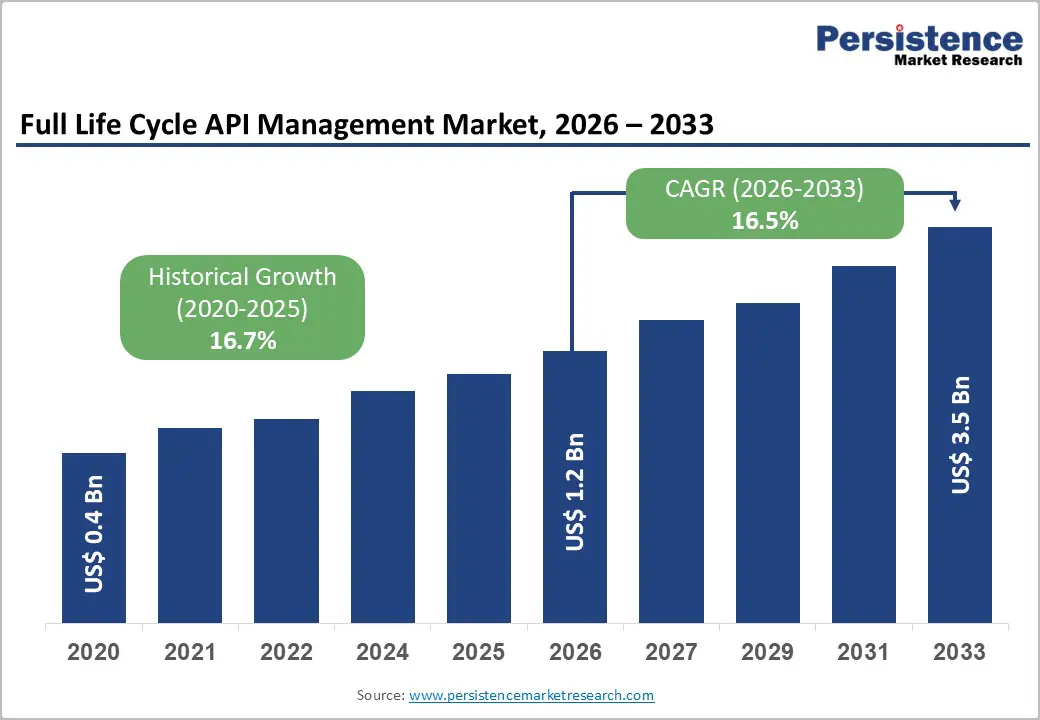
The global full life cycle API management market size is likely to be valued at US$ 1.2 billion in 2026, and is projected to reach US$ 3.5 billion by 2033, growing at a CAGR of 16.5% during the forecast period 2026−2033. Growth is primarily driven by increasing digital transformation initiatives across industries, which generate demand for robust application programming interface (API) governance, monitoring, and lifecycle solutions. Expanding enterprise adoption of cloud and hybrid information technology (IT) architectures enhances the need for secure, scalable, and efficient API management platforms.
Technological integration, particularly in analytics, artificial intelligence (AI), and automation, allows organizations to streamline API design, deployment, and monitoring. Regulatory frameworks promoting data security and interoperability create additional impetus, compelling enterprises to adopt comprehensive API management solutions. Rapid digitalization across banking, financial services, & insurance (BFSI), healthcare, retail, and government sectors further strengthens demand, as organizations seek to maintain seamless connectivity and operational efficiency.
Key Industry Highlights
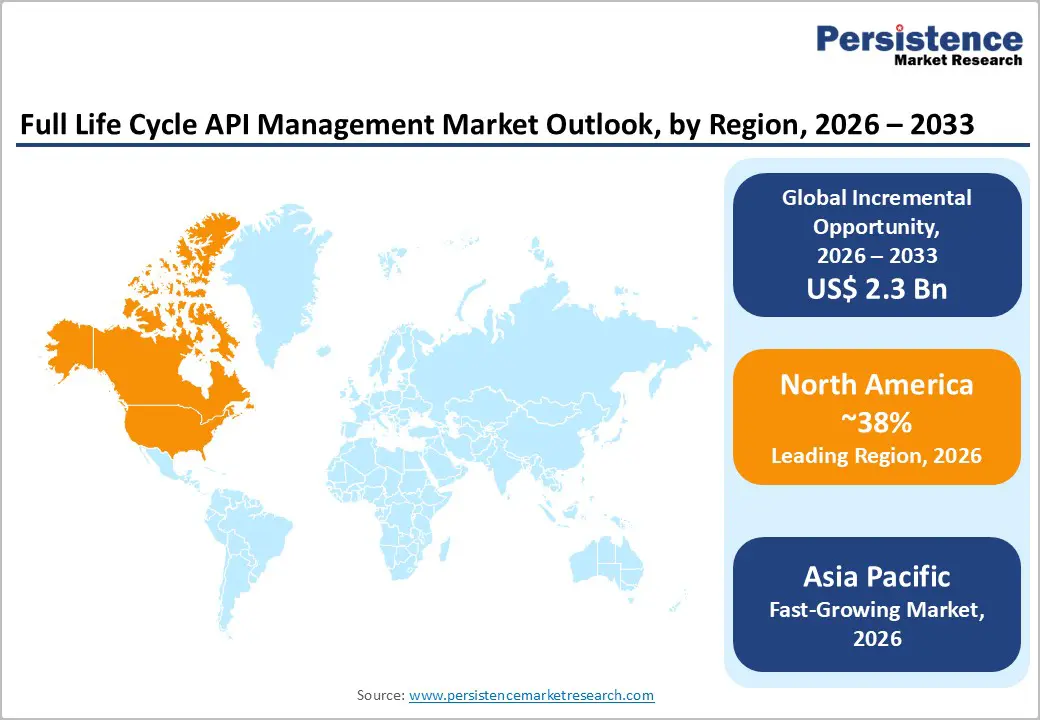
- Dominant Region: North America is projected to hold an approximate market share of 38% in 2026, driven by advanced enterprise infrastructure and cloud adoption.
- Fastest-growing Regional Market: Asia Pacific is forecasted as the fastest-growing market between 2026 and 2033, fueled by digital adoption and demand for secure, scalable API solutions.
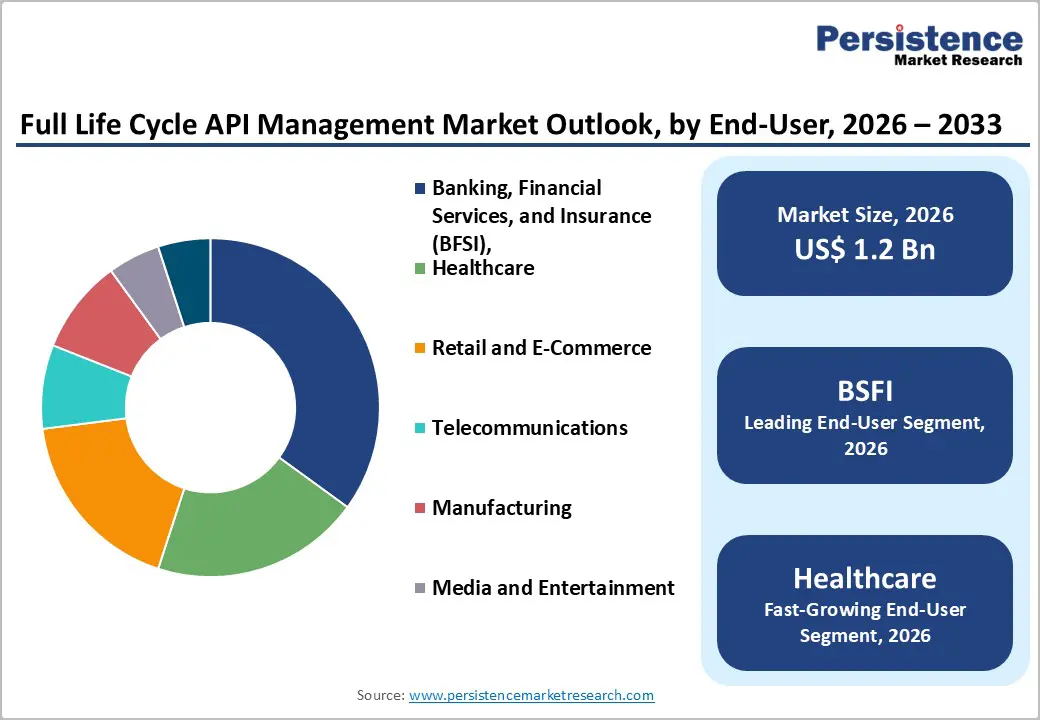
- Leading End-User: BFSI is expected to hold around 35% of the market revenue share in 2026, supported by digitalization and high compliance requirements.
- Fastest-growing End-User: Healthcare is expected to be the fastest-growing segment during the 2026-2033 forecast period, driven by electronic health record (EHR) and telemedicine adoption.
| Key Insights | Details |
|---|---|
|
Full Life Cycle API Management Market Size (2026E) |
US$ 1.2 Bn |
|
Market Value Forecast (2033F) |
US$ 3.5 Bn |
|
Projected Growth (CAGR 2026 to 2033) |
16.5% |
|
Historical Market Growth (CAGR 2020 to 2025) |
16.7% |
Market Factors - Growth, Barriers, and Opportunity Analysis
Digital Transformation Acceleration
Rapid adoption of digital technologies across public and private sectors is reshaping how organizations design, integrate, and govern digital services. Enterprises are moving from monolithic systems toward modular architectures that require seamless connectivity between applications, platforms, and data sources to meet evolving customer expectations and operational demands. This need for secure, scalable, and interoperable connectivity elevates the role of APIs as foundational digital building blocks and drives investment in governance, monitoring, security, and lifecycle practices. Structured API management ensures performance, reliability, and compliance under increased usage, supporting continuous service delivery and operational efficiency in complex digital ecosystems.
Growth in digital initiatives expands ecosystem complexity and accelerates the need to streamline development and operational processes. As enterprises deploy hybrid and cloud native environments, structured governance becomes essential to manage API proliferation, enforce security policies, and maintain regulatory compliance across distributed teams. Digital first strategies in government and industry foster data driven operations, real time service delivery, and standardization of digital assets, prompting investment in automated lifecycle management, performance analytics, and secure access control. Disciplined API practices underpin strategic digital priorities and operational agility across sectors.
Regulatory and Security Compliance
Governance and compliance obligations from regulators and government bodies require organizations to embed security controls into all stages of API development and operations. Guidelines such as the National Institute of Standards and Technology Special Publication 800-228, released in 2025, define best practices for API protection, including validating inputs, enforcing policies, and monitoring runtime behavior to reduce risks like data leakage and unauthorized access. Organizations must align with these standards to satisfy audit and risk-management requirements, making security and compliance a structural necessity. Noncompliance can result in audits, penalties, and revoked authorizations.
Security-centric compliance frameworks also limit exposure to breaches that trigger regulatory reporting and remediation mandates. In sectors such as healthcare, financial services, and critical infrastructure, APIs are primary channels for sensitive data. Rules from the Centers for Medicare & Medicaid Services define technical standards for API interfaces to secure health data exchange. Organizations prioritize security to meet these requirements, influencing architecture and procurement decisions and embedding risk management into API governance, monitoring, and lifecycle operations.
High Implementation and Operational Costs
Deployment of full life cycle API management solutions involves substantial financial outlay, limiting adoption among enterprises. Investment in API gateways, developer portals, analytics modules, and security frameworks demands significant capital. Integration with existing enterprise systems requires specialized technical expertise, raising consulting and staffing costs. Licensing fees for advanced platforms, combined with recurring maintenance and upgrades, create a continuous financial burden. Small and medium-sized enterprises face challenges scaling infrastructure while ensuring interoperability with cloud or hybrid IT environments. Continuous monitoring, performance tuning, and compliance adherence add operational expenses, making sustained implementation costly for organizations pursuing digital transformation initiatives.
Complexity of full life cycle API management amplifies cost pressures for organizations. Resources must be allocated for designing, deploying, and monitoring APIs while maintaining security and regulatory compliance. Training development teams in platform-specific tools extends timelines and operational overhead. Customization of API workflows to meet business needs introduces additional technical and financial commitments. Multi-cloud or hybrid architectures increase integration expenses due to infrastructure, data protocol, and security variations. Investment in automated monitoring, analytics, and artificial intelligence modules enhances performance but elevates operational costs, requiring continuous adaptation to evolving business requirements and cybersecurity threats.
Complexity of Integration and Skill Shortage
Integration across multiple systems, legacy applications, and third-party services increases operational complexity in full life cycle API management. Enterprises operate heterogeneous environments, including on-premises infrastructure, cloud platforms, and hybrid IT architectures. Coordinating APIs in these ecosystems requires precise orchestration, testing, and version control. Ensuring consistent performance, data integrity, and security across interconnected services presents challenges. Mismatched interfaces or lack of standardized protocols delay deployment and increase operational costs. Technical teams must align API workflows with business objectives, demanding expertise in design, implementation, and monitoring frameworks to maintain operational efficiency and service reliability.
Shortage of skilled professionals in API development, management, and security amplifies integration difficulties. Enterprises need talent capable of managing the full API lifecycle, from design and deployment to analytics and governance. Gaps in expertise for microservices architecture, cloud-native solutions, and artificial intelligence-enabled automation limit effective adoption of API management platforms. Training existing personnel increases expenditure and delays, while dependence on external consultants introduces operational risks. Recruiting and retaining professionals with technical and strategic API management skills remains challenging, restricting enterprise agility, scalability, and ability to execute complex API strategies in evolving digital environments.
Digital Technology Advancements in Emerging Markets
Emerging economies are experiencing rapid digital transformation, driving demand for efficient and secure integration technologies. Governments and public agencies are modernizing service delivery, focusing on transparency, operational efficiency, and user engagement. Expanding internet and mobile penetration increases expectations for real-time digital services, requiring seamless connections between legacy systems and new platforms. Enterprises and service providers in these regions must adapt to evolving digital infrastructure, adopting robust governance, monitoring, and operational frameworks. Public policy emphasizing data interoperability and secure digital identities encourages private sector participation in open integration ecosystems, strengthening the need for comprehensive lifecycle management solutions.
Policy initiatives and regulatory frameworks in emerging markets promote standardized digital operations and encourage adoption of scalable technology platforms. Enterprises align with government digital strategies, implementing secure, efficient, and managed integration across multiple systems. Growing demand in sectors such as banking, healthcare, and e-commerce drives investment in tools that support development, deployment, and monitoring of digital interfaces. Organizations prioritize consistency, compliance, and operational reliability to meet increasing user expectations. This environment fosters opportunities for technology platforms that offer centralized management, analytics, and security, enabling sustainable digital transformation across public and private sectors.
Technological Convergence and Integration with AI/Analytics
Enterprise platforms achieve significant efficiency when AI and analytics integrate into API ecosystems. AI-driven insights enable real-time monitoring of traffic flows, performance bottlenecks, and usage anomalies. Automated scaling and predictive routing optimize response times and resource allocation. Analytics provide visibility into service performance, supporting proactive decision-making for internal systems and external integrations. Organizations can streamline API deployment and management while reducing operational risks. The combination of AI and analytics enhances reliability and ensures seamless service delivery across digital platforms, supporting growing demand for scalable, secure, and adaptive API infrastructures in sectors such as banking, healthcare, and retail.
Embedding analytics and AI across development and runtime environments improves automation in governance, testing, and performance optimization. Machine learning models detect anomalous API calls, mitigate potential security risks, and enhance test coverage. Usage pattern analysis informs versioning, deprecation, and resource allocation decisions without manual intervention. Automated intelligence accelerates release cycles, strengthens service-level agreements, and aligns API operations with organizational goals. This integration supports enterprise objectives for digital transformation, operational efficiency, and risk management. It also allows organizations to respond quickly to market demands while maintaining consistent, high-quality service delivery.
Category-wise Analysis
Deployment Type Insights
On-premise deployment is likely to be the leading segment with about 45% of the full cycle API management market revenue share in 2026, supported by regulatory compliance, data security, and enterprise control requirements. Organizations with sensitive information, particularly in BFSI and government sectors, prefer on-premise solutions for data residency and auditability. Centralized infrastructure enables consistent policy enforcement, system performance optimization, and integration with legacy systems. Decision-makers value stability, operational oversight, and internal governance, reinforcing preference for on-premise models. Providers offering robust on-site support and lifecycle management services enhance adoption and retention. Strong security requirements, regional compliance mandates, and enterprise IT governance consolidate on-premise dominance.
Cloud-based deployment is expected to witness the fastest growth between 2026 and 2033, driven by scalability, cost efficiency, and rapid provisioning. Cloud-native API management platforms offer multi-region availability, reduced infrastructure expenditure, and simplified integration with hybrid IT environments. Enterprises with global operations and remote workforce requirements adopt cloud solutions for agility, maintenance simplification, and seamless upgrades. Rapid innovation in cloud APIs, managed services, and serverless architectures further accelerates adoption. Cloud platforms facilitate analytics-driven lifecycle monitoring, automated security enforcement, and service orchestration, supporting growth across diverse verticals.
End-User Insights
BFSI is positioned as the dominant segment with nearly 35% market share in 2026, supported by high digitalization, regulatory compliance, and need for secure customer-facing applications. Banks, insurers, and financial service providers require API management for digital banking platforms, payment systems, and partner integrations. Strong governance, compliance adherence, and operational efficiency drive enterprise adoption. Investment in lifecycle platforms ensures secure access, enhanced analytics, and scalable integration with legacy systems, reinforcing segment dominance.
Healthcare is expected to emerge as the fastest-growing segment between 2026 and 2033, driven by increasing EHR adoption, telemedicine services, and interoperability mandates. Healthcare providers and payers require secure, efficient API platforms to manage sensitive patient data, integrate clinical applications, and support analytics. Growth is reinforced by government policies promoting health information exchange and patient-centered care. Cloud-enabled API management platforms provide scalability, monitoring, and compliance enforcement, supporting rapid adoption in the sector.
Regional Insights
North America Full Life Cycle API Management Market Trends
North America is expected to lead with an estimated 38% of the full life cycle API management market share in 2026, supported by strong enterprise technology infrastructure and early adoption of cloud-native frameworks in the United States and Canada. Widespread integration of digital platforms across financial services, healthcare, and retail drives demand for unified API governance, analytics, and automation. Hyperscale cloud providers and platform innovators enable rapid experimentation with API design and security tooling. Large organizations prioritize comprehensive management frameworks to reduce operational risk, streamline deployment, and enhance scalability. Partnerships between technology vendors and systems integrators accelerate adoption of advanced API capabilities.
Developer communities and skilled talent pools in the United States and Canada sustain innovation in API lifecycle management. Machine learning and predictive analytics enhance performance monitoring, anomaly detection, and dynamic policy enforcement across digital architectures. Rising customer expectations for uninterrupted digital experiences push enterprises to adopt real-time insights and adaptive security controls. Investment trends favor scalable platforms capable of managing complex partner ecosystems and variable workloads. Concentrated technological investment, digital modernization, and enterprise prioritization create a reinforcing cycle that drives leadership in full lifecycle API governance and operations.
Europe Full Life Cycle API Management Market Trends
Europe is positioned as a significant market for full life cycle API management, driven by strong regulatory frameworks and enterprise focus on secure, interoperable digital infrastructures. Organizations in finance, healthcare, and public services prioritize compliance with data protection standards, increasing adoption of API platforms with governance, auditing, and security features. Cloud-native architectures and microservices-based applications create demand for tools that streamline API design, deployment, and monitoring across complex IT environments. Digital transformation initiatives among mid-size and large enterprises further boost adoption of integrated lifecycle solutions supporting continuous integration, performance monitoring, and predictive analytics. Strategic partnerships accelerate implementation and operational efficiency.
Innovation in digital services, including open banking, e-health platforms, and smart government programs, reinforces demand for lifecycle management solutions that adapt to evolving enterprise requirements. Real-time analytics, automated security enforcement, and intelligent policy management ensure consistent service delivery across multiple channels and third-party integrations. Development of skilled technology talent and investment in research hubs support customization and optimization of API management frameworks. Adoption of hybrid and multi-cloud strategies drives solutions capable of managing distributed architectures while maintaining regulatory compliance and operational resilience.
Asia Pacific Full Life Cycle API Management Market Trends
Asia Pacific is forecasted to be the fastest-growing market for full life cycle API management between 2026 and 2033, stimulated by rapid digital adoption in large emerging economies such as China, India, and Indonesia. Expansion of mobile platforms and online services drives demand for API solutions that manage complex partner networks and high transaction volumes. Local technology firms increasingly integrate lifecycle tools into digital transformation programs, accelerating adoption of governance, security, and analytics. Progressive regulatory frameworks promoting interoperability across financial and public systems compel organizations to adopt standardized API management. Enterprise focus on agility further strengthens demand for end-to-end API solutions.
Strong growth in digital-first sectors such as electronic payments, e-commerce, and telecommunications accelerates adoption of API lifecycle platforms in China, India, and Indonesia. Enterprises prioritize scalable architectures that handle demand surges and diverse third-party integrations. Investments by global cloud providers into local data centers reduce latency and improve performance, increasing adoption of comprehensive API solutions. Upskilling development talent and forming strategic partnerships enhances customization of governance and analytics capabilities. These factors create a favorable environment for sustained expansion of lifecycle API solutions, enabling resilient and adaptive digital operations.
Competitive Landscape
The global full life cycle API management market structure is moderately consolidated, with leading players holding around 45–50% combined share. Key companies such as IBM, Microsoft, Google Cloud, MuleSoft, Red Hat, and Apigee lead with comprehensive solutions covering API design, security, analytics, and lifecycle management. Platforms integrate cloud-native architectures and enterprise applications, enabling seamless connectivity. Differentiation relies on AI-driven automation, robust security, and advanced analytics, meeting complex enterprise requirements and compliance standards across large-scale deployments.
Fragmentation exists among regional and niche vendors providing specialized or lightweight API solutions. These players compete on customization, integration flexibility, and cost-effectiveness, addressing gaps that larger platforms may not cover. Strategies focus on ecosystem partnerships, platform extensibility, and continuous enhancement of governance and security features. Emphasis on developer experience, monitoring, and predictive analytics supports relevance in dynamic IT environments, balancing dominance of multinationals with innovation from specialized providers.
Key Industry Developments
- In February 2026, HES FinTech launched HES Collection Agent, an AI-driven platform for intelligent debtor scoring and automated full-lifecycle collections to modernize debt recovery workflows for banks and lenders.
- In January 2026, Radware completed the acquisition of Pynt, an API security testing firm, strengthening its API security portfolio to deliver continuous protection from design through production.
- In September 2025, Cisco launched Cisco IQ, a unified AI-powered digital interface that delivers real-time insights, automated troubleshooting, personalized learning, and lifecycle visibility to help organizations plan, deploy, manage, secure, and optimize technology investments across the entire customer journey.
Companies Covered in Full Life Cycle API Management Market
- IBM
- Microsoft
- Google Cloud
- MuleSoft
- Red Hat
- Apigee
- Axway
- WSO2
- Software AG
- TIBCO Software
- Kong Inc.
- Postman
Frequently Asked Questions
The global full life cycle API management market is projected to reach US$ 1.2 billion in 2026.
Increasing digital transformation, cloud adoption, and demand for secure, scalable, and integrated API governance are driving the market.
The market is poised to witness a CAGR of 16.5% from 2026 to 2033.
Integration with AI, analytics, and digital health platforms presents key growth opportunities in the market.
Some of the key market players include IBM, Microsoft, Google Cloud, MuleSoft, Red Hat, Apigee, and Axway.


