




- Medical Devices
- Endoscopic Submucosal Dissection Market
Endoscopic Submucosal Dissection Market Size, Share, Growth, and Regional Forecast, 2026 - 2033
Endoscopic Submucosal Dissection Market by Product (Knives, Tissue Retractors, Grasp/Clips, Injecting Agents, Gastroscopes and Colonoscopes, Others), Indication (Esophageal Cancer, Stomach Cancer, Colon Cancer), End User (Hospitals, Ambulatory Surgical Centers, Specialty Clinics), and Regional Analysis from 2026 - 2033

Endoscopic Submucosal Dissection Market Share and Trends Analysis
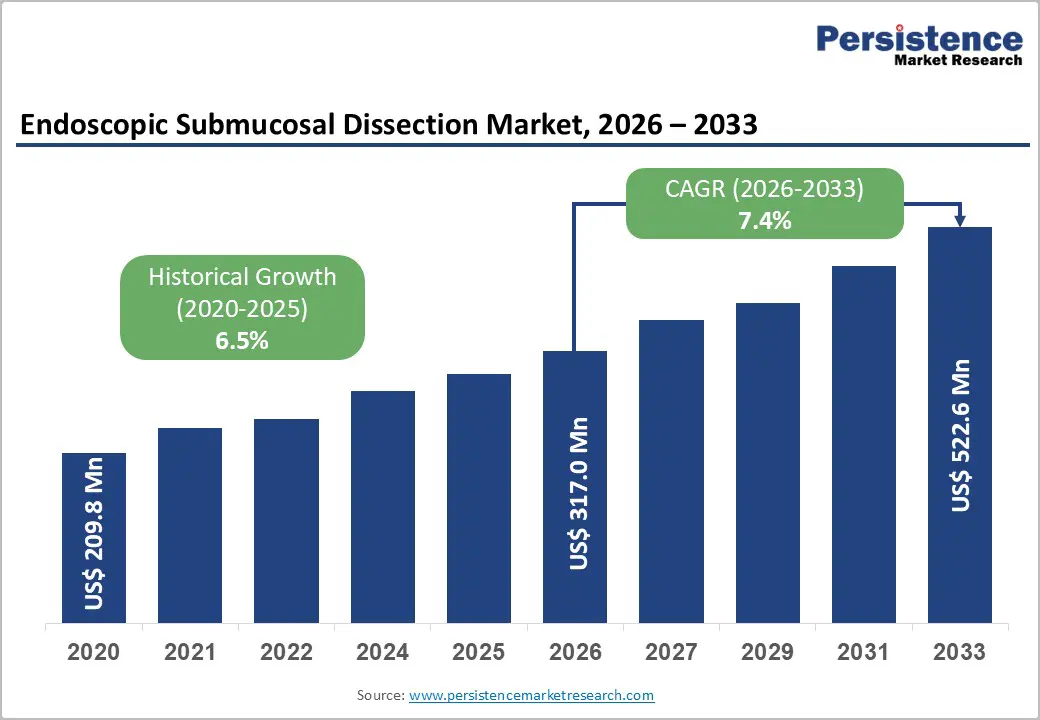
The global endoscopic submucosal dissection market is estimated to grow from US$ 317.0 Mn in 2026 to US$ 522.6 Mn by 2033. The market is projected to record a CAGR of 7.4% during the forecast period from 2026 to 2033.
The global market is witnessing steady growth, driven by rising gastrointestinal cancer incidence, increasing adoption of minimally invasive procedures, and advancements in endoscopic technologies. North America leads due to strong healthcare infrastructure and early adoption. Asia-Pacific is the fastest-growing region, supported by high disease burden, expanding healthcare access, and growing screening programs.
Key Industry Highlights:
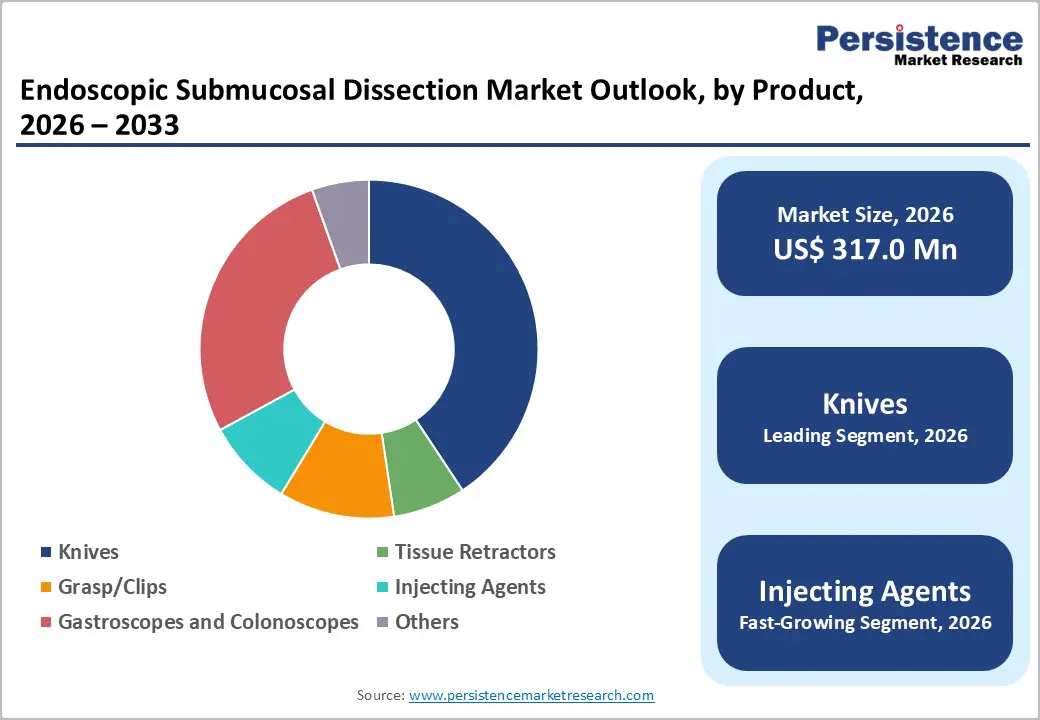
- Dominant Product Segment: Knives held the largest share 40.7% in 2025, driven by their critical role in precise mucosal incision and submucosal dissection, making them essential tools in all ESD procedures across gastrointestinal indications.
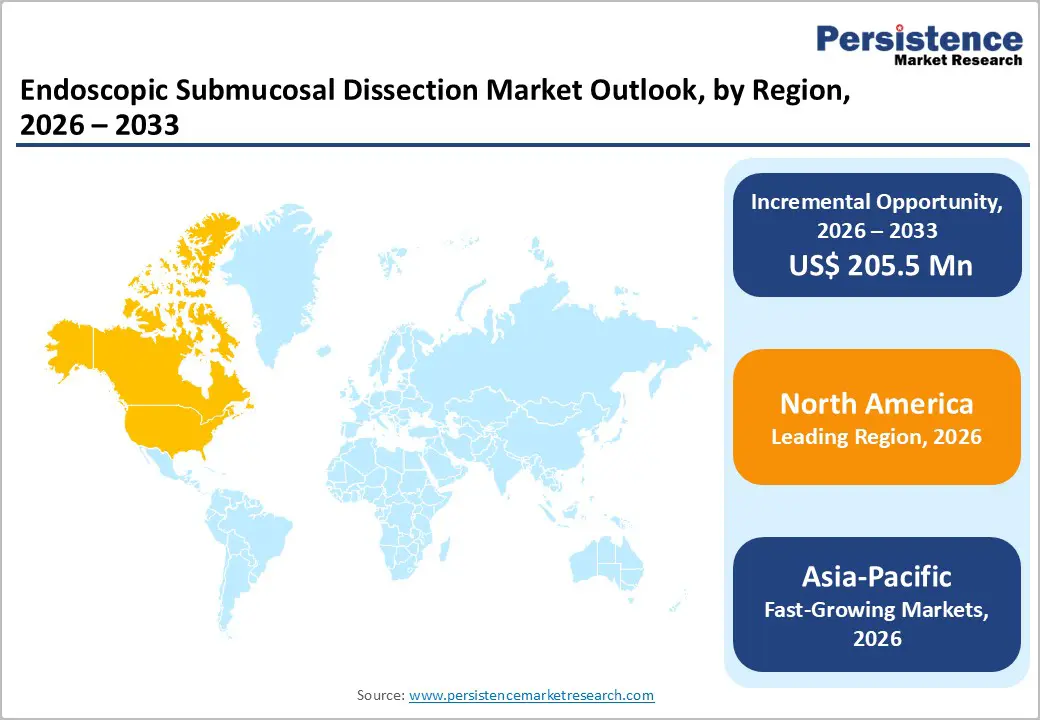
- Dominant Region: North America led the Endoscopic Submucosal Dissection Market in 2025 with 38.9% share, supported by advanced healthcare infrastructure, high adoption of minimally invasive procedures, strong presence of key market players, and increasing awareness and screening for gastrointestinal cancers.
- Growth Indicators: Rise in gastrointestinal cancer incidence, increasing preference for minimally invasive procedures, advancements in endoscopic technologies, and expanding screening and early diagnosis programs globally.
- Market Opportunity: Opportunities exist in the development of advanced ESD devices, expansion into Western markets, increasing training of endoscopists, and growing adoption in emerging regions with improving healthcare infrastructure.
| Key Insights | Details |
|---|---|
|
Global Endoscopic Submucosal Dissection Market Size (2026E) |
US$ 317.0 Mn |
|
Market Value Forecast (2033F) |
US$ 522.6 Mn |
|
Projected Growth (CAGR 2026 to 2033) |
7.4% |
|
Historical Market Growth (CAGR 2020 to 2025) |
6.5% |
Market Dynamics
Driver: Increasing Early Cancer Detection and Screening Programs
The growing emphasis on early cancer detection is a major driver for the Endoscopic Submucosal Dissection (ESD) market, as ESD is primarily used for treating early-stage gastrointestinal cancers. According to the World Health Organization, colorectal cancer alone accounted for around 1.9 million new cases and over 900,000 deaths globally in 2022, making it one of the most significant cancer burdens worldwide. Early detection is critical because survival rates are substantially higher when cancers are identified at an early stage. As screening programs expand globally, more early-stage lesions are detected, directly increasing the need for minimally invasive procedures like ESD.
Screening programs have demonstrated strong clinical impact, further supporting ESD adoption. Large-scale studies show that colonoscopy screening reduces colorectal cancer incidence by ~52% and mortality by ~62%, highlighting the effectiveness of early detection initiatives. Additionally, in high-income countries, gastrointestinal cancer incidence exceeds 50 cases per 100,000 population, emphasizing the need for structured screening programs. As governments continue investing in screening infrastructure and awareness campaigns, the pool of patients eligible for ESD procedures is expected to expand significantly.
Restraint: High Procedure Complexity and Skill Requirement
Despite its clinical advantages, ESD is technically demanding and requires a high level of expertise, which limits its widespread adoption. The procedure involves precise dissection of submucosal layers, increasing the risk of complications such as perforation and bleeding. Clinical data indicate that colonoscopy-related perforations occur in approximately 3.1 per 10,000 procedures, while major bleeding occurs in 14.6 per 10,000 cases, reflecting the inherent risks associated with advanced endoscopic interventions. Since ESD is more complex than standard endoscopic procedures, complication risks are comparatively higher when performed by less experienced practitioners.
Additionally, there is a global shortage of highly trained endoscopists capable of performing ESD effectively. Even in developed countries, screening uptake and procedural execution remain suboptimal due to resource and skill limitations. For example, colorectal cancer screening rates were only 54% in the U.S. and 20–30% in Germany in earlier program phases, partly due to limited specialist availability. The steep learning curve, need for specialized training, and longer procedure times continue to restrict adoption, particularly in Western and emerging markets.
Opportunity: Technological Innovations in ESD Devices
Technological innovation presents a strong growth opportunity in the ESD market by improving the safety, efficiency, and accessibility of procedures. Advances in endoscopic imaging, electrosurgical tools, and AI-assisted detection systems are significantly enhancing procedural precision. Recent developments in AI-supported colonoscopy have shown improved detection of precancerous lesions, which can lead to earlier intervention and increased use of ESD techniques. Enhanced visualization technologies and specialized ESD knives are also reducing procedure time and complication rates, making the procedure more feasible across a wider range of healthcare settings.
Furthermore, innovation is helping overcome existing procedural limitations by simplifying techniques and reducing dependence on highly specialized skills. Studies indicate that screening and diagnostic improvements can reduce cancer incidence by up to 69% and mortality by ~68% when combined with advanced endoscopic interventions. The integration of better devices, robotic assistance, and real-time imaging is expected to standardize ESD procedures globally. As these technologies continue to evolve, they will play a critical role in expanding adoption beyond specialized centers into mainstream clinical practice.
Category-wise Analysis
By Product Insights
ESD knives dominate the market with 40.7% share in 2025, because they are the core instrument required in every procedure, directly enabling mucosal incision and submucosal dissection. Unlike accessories, the procedure cannot be performed without specialized knives, making them indispensable. Technically, ESD involves precise layer-by-layer dissection of the gastrointestinal wall, and dedicated knives (e.g., insulated-tip, dual knives) are specifically designed for controlled cutting and minimizing tissue damage. This universal requirement across all indications drives their consistently high utilization compared to other supporting tools.
Clinical practice further supports this dominance. Studies show that ESD is widely adopted as a standard minimally invasive treatment for early gastrointestinal cancers, requiring specialized dissection tools for successful outcomes. The increasing number of ESD procedures globally, particularly for early-stage lesions, directly translates into higher demand for knives, reinforcing their leading share.
By Indication Insights
Stomach cancer dominates the ESD market because the procedure is most established and clinically validated for early gastric cancer (EGC). ESD is considered the gold standard treatment for early-stage gastric tumors, as it allows en bloc resection with high curative rates while preserving the stomach. This strong clinical endorsement has led to widespread adoption, especially in countries like Japan and South Korea, where screening programs detect large numbers of early gastric lesions suitable for ESD.
The disease burden further supports this dominance. Gastric cancer remains one of the most common cancers globally, with over 950,000 new cases annually, creating a large eligible patient pool for ESD treatment. Additionally, studies report 5-year survival rates exceeding 90% after curative ESD, demonstrating its effectiveness and reinforcing its preference over surgical alternatives.
Regional Insights
North America Endoscopic Submucosal Dissection Market Trends
North America dominates the ESD market primarily due to its advanced healthcare infrastructure, high screening rates, and strong reimbursement systems. The United States has one of the highest healthcare expenditures globally, exceeding $4.3 trillion annually, enabling rapid adoption of advanced endoscopic technologies and procedures. Additionally, colorectal cancer is the third most common cancer in the U.S., creating a large patient pool requiring early detection and treatment. High awareness and widespread use of colonoscopy as a primary screening tool further support procedural volumes.
Moreover, screening programs are well established, with colonoscopy widely used as the preferred diagnostic method, ensuring early detection of lesions suitable for ESD. Strong insurance coverage and government-backed preventive care initiatives improve access to advanced procedures. Combined with early adoption of innovative technologies such as AI-assisted endoscopy, North America maintains a leading position in procedural volumes and device utilization.
Europe Endoscopic Submucosal Dissection Market Trends
Europe represents a key region due to its structured, population-based cancer screening programs and strong public healthcare systems. By 2016, 22 out of 28 European Union countries had implemented or piloted organized colorectal cancer screening programs, demonstrating widespread institutional support for early detection. These programs increase identification of early-stage lesions, directly supporting demand for minimally invasive procedures such as ESD.
In addition, Europe has a high disease burden, with colorectal cancer incidence rates reaching 35–42 cases per 100,000 population in men, among the highest globally. High participation rates in countries such as the Netherlands and the UK (around 70–75% screening uptake) further strengthen procedural volumes. Combined with strong clinical guidelines and adoption of advanced imaging technologies, Europe remains a significant and stable contributor to the ESD market.
Asia Pacific Endoscopic Submucosal Dissection Market Trends
Asia Pacific is the fastest-growing region due to its rapidly increasing cancer burden, expanding screening programs, and improving healthcare access. Colorectal cancer incidence is rising significantly across Asia, with studies indicating it is becoming a major cause of cancer-related deaths in several countries. Additionally, countries such as Japan, South Korea, and China have actively expanded screening initiatives and early detection programs, increasing the pool of patients eligible for ESD.
The region is also witnessing strong healthcare development and technology adoption. National screening programs are being implemented across multiple countries, with 8 countries in Asia already having organized screening systems. Furthermore, Japan has historically been a pioneer in ESD techniques and device innovation, supporting widespread clinical adoption. The combination of high disease prevalence, improving infrastructure, and growing awareness continues to drive rapid regional growth.
Competitive Landscape
The endoscopic submucosal dissection market is highly competitive, led by companies such as Olympus Corporation, Fujifilm Holdings Corporation, Boston Scientific Corporation, Medtronic plc, and HOYA Corporation. These players focus on advanced endoscopic devices, precision instruments, technological innovation, expanding clinical applications, and strengthening global distribution to meet growing demand for minimally invasive procedures.
Key Industry Developments:
- In January 2026, AWC®duo was reported to reduce procedure time in endoscopic submucosal dissection (ESD) while enhancing procedural safety. The device facilitated improved tissue traction and visualization, enabling more efficient and controlled resections. Clinicians observed that its dual-channel functionality supported better instrument handling, contributing to safer and faster ESD procedures.
- In February 2025, Fujifilm Holdings Corporation partnered with EndoSim to expand access to advanced endoscopy training. The collaboration aimed to enhance clinical education by integrating simulation-based learning with advanced imaging technologies. It was expected to improve physician proficiency in complex procedures such as endoscopic submucosal dissection (ESD), supporting better patient outcomes and broader adoption of minimally invasive techniques.
Companies Covered in Endoscopic Submucosal Dissection Market
- Erbe Elektromedizin GmbH
- Sumitomo Bakelite Co., Ltd.
- Ovesco Endoscopy AG
- FUJIFILM Holdings Corporation
- Olympus Corporation
- Boston Scientific Corporation
- COOK Group
- ConMed
- Steris
- Medtronic plc
- Creo Medical Group plc
- HOYA Corporation (PENTAX Medical)
- Karl Storz SE & Co. KG
- Micro-Tech Endoscopy
- Others
Frequently Asked Questions
The global endoscopic submucosal dissection market is projected to be valued at US$ 317.0 Mn in 2026.
Rising gastrointestinal cancers, increasing early detection, minimally invasive preference, technological advancements, and expanding endoscopy infrastructure globally.
The global endoscopic submucosal dissection market is poised to witness a CAGR of 7.4% between 2026 and 2033.
Advancing ESD technologies, expanding emerging markets, increasing training programs, AI integration, and growing minimally invasive adoption.
Erbe Elektromedizin GmbH, Sumitomo Bakelite Co., Ltd., Ovesco Endoscopy AG, FUJIFILM Holdings Corporation, Olympus Corporation, Boston Scientific Corporation.


