




- Specialty & Fine Chemicals
- Emulsifiers Market
Emulsifiers Market Size, Share, Trends, and Growth Forecast, 2025 - 2032
Emulsifiers Market by Source (Synthetic, Bio-Based), Application (Food, Cosmetic & Personal Care, Oilfield Chemicals, Pharmaceuticals, Agrochemicals, Others), Product Type (Lecithins, Mono & di-glycerides of fatty acid, Lactic esters of fatty acids, Esters of monoglycerides of fatty acid, Polysorbates, Polyglycerol Esters, Polyglycerol Polyricinoleate, and Others), and Regional Analysis for 2025 - 2032

Emulsifiers Market Size and Trends Analysis
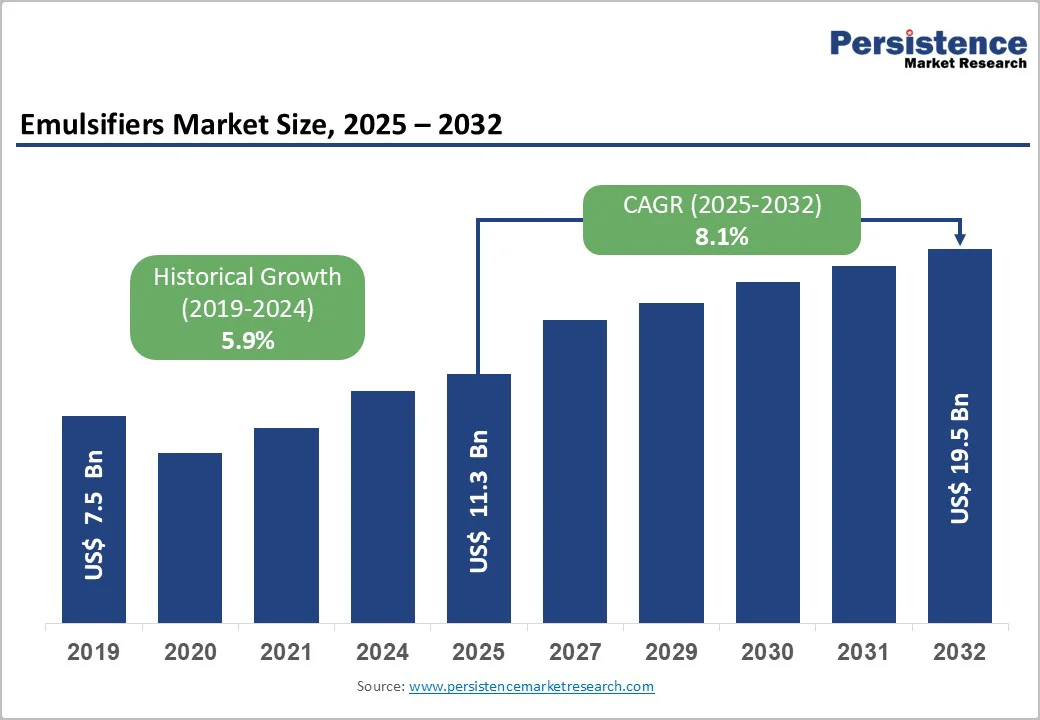
The global emulsifiers market size is valued at US$11.3 billion in 2025 and is projected to reach US$19.5 billion by 2032, growing at a CAGR of 8.1% between 2025 and 2032.
This robust expansion is driven by accelerating demand from the food and beverage industry, particularly in processed and convenience foods that require enhanced texture, stability, and extended shelf life.
The market's historical performance demonstrated steady growth at a CAGR of 5.9% from 2019, indicating strengthening momentum as manufacturers increasingly prioritize clean-label formulations and bio-based alternatives to meet evolving consumer preferences for natural ingredients across food, cosmetics, and pharmaceutical applications.
Key Industry Highlights:
- Synthetic sources dominate with a 70%+ revenue share, driven by cost-effectiveness and established infrastructure, while bio-based emulsifiers are the fastest-growing segment, responding to sustainability imperatives and natural ingredient preferences.
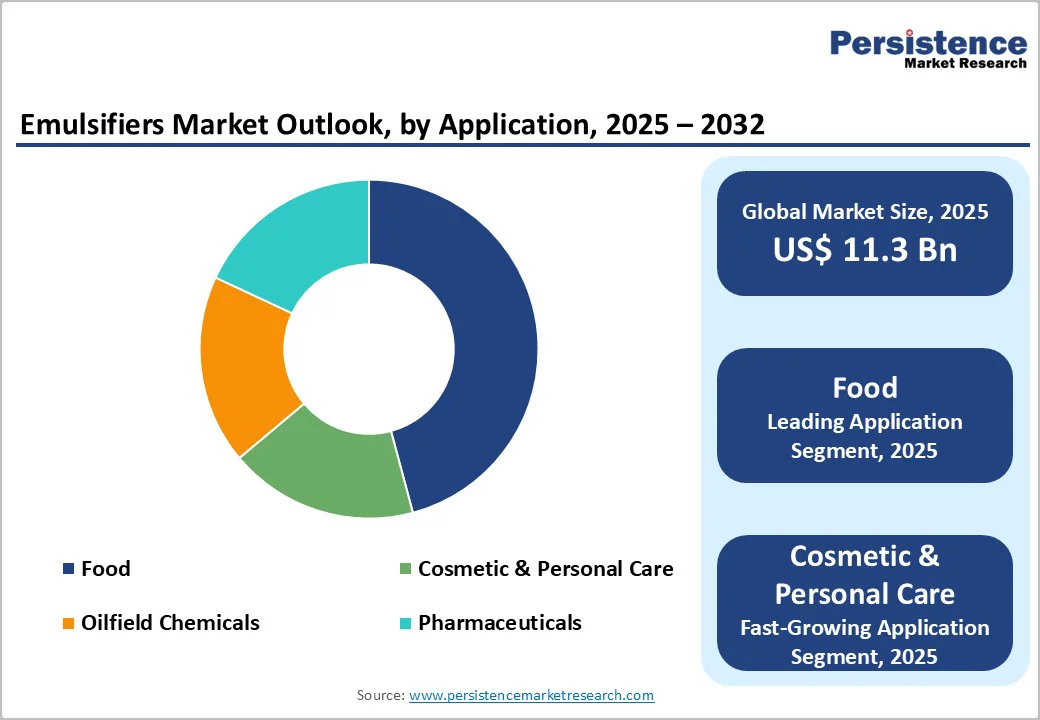
- Food application leads with 40%+ market share across bakery, dairy, and processed foods, while cosmetics and personal care are the fastest-growing applications at a 6.5% CAGR.
- Lecithins command 20%+ product type share with versatile functionality across applications, while mono- and di-glycerides represent the fastest-growing category due to exceptional emulsification properties and regulatory approval across industries.
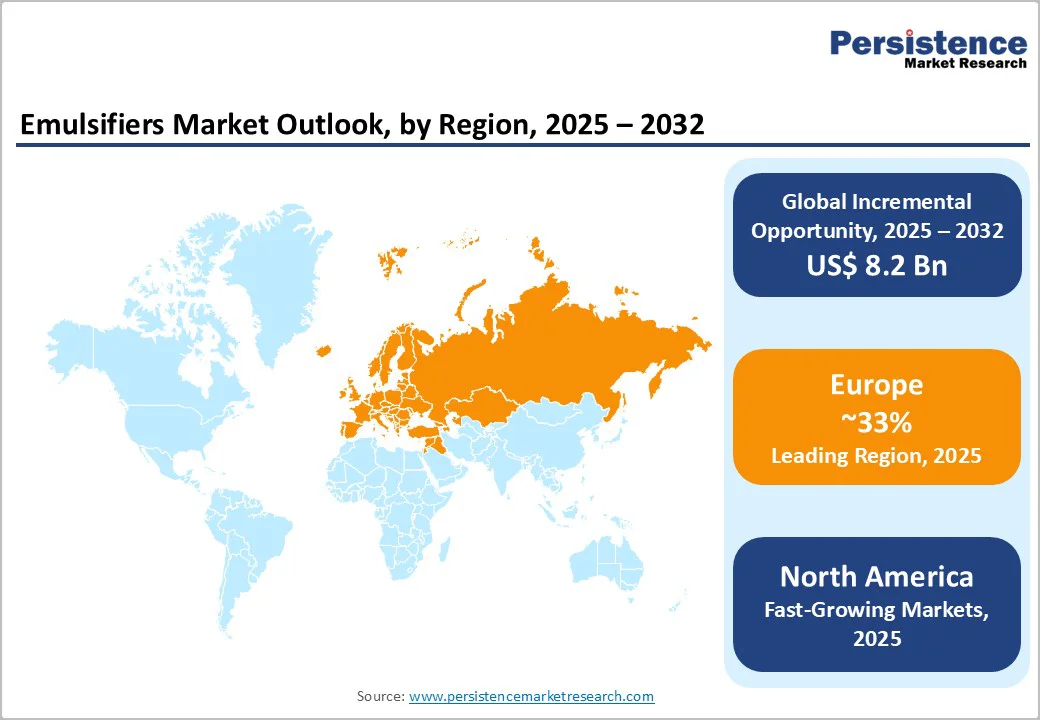
- North America maintains market leadership with 30%+ revenue share supported by advanced infrastructure and innovation ecosystems, while Europe emerges as the fastest-growing region driven by stringent sustainability standards and natural ingredient adoption.
- Asia Pacific exhibits double-digit growth, with India (17.7% CAGR) and China (15.8% CAGR) leading regional expansion, fueled by urbanization, rising incomes, and the penetration of the processed food market.
- Market consolidation features the top five players (Cargill, ADM, DuPont, BASF, Kerry Group) holding 50%+ combined market share through strategic acquisitions, including Kingswood's US$362 million purchase of Corbion's emulsifier business, creating the largest North American pure-play platform.
| Key Details | Insights |
|---|---|
| Emulsifiers Market Size (2025E) | US$11.3 Bn |
| Market Value Forecast (2032F) | US$19.5 Bn |
| Projected Growth (CAGR 2025 to 2032) | 8.1% |
| Historical Market Growth (CAGR 2019 to 2024) | 5.9% |
Market Dynamics
Drivers - Rapid Growth of Processed and Convenience Food Consumption
The global processed food industry continues to expand at an accelerated pace, creating substantial demand for emulsifiers as essential functional ingredients.
According to the India Brand Equity Foundation (IBEF), the Indian food processing industry grew at an average annual rate of 8.3% over the past five years, reaching a market size of US$866 billion in 2022. The National Food Management Center of China reported that despite pandemic challenges, China's food sector demonstrated strong momentum and resilience in 2022 and maintained a growth trajectory through 2023.
Emulsifiers play a critical role in maintaining texture consistency, preventing ingredient separation, and extending the shelf life of packaged foods, including bakery products, dairy items, confections, sauces, and ready-to-eat meals.
As urbanization accelerates across emerging markets and consumer lifestyles become increasingly time-constrained, the demand for convenient, shelf-stable food products requiring emulsifier technology continues to surge, positioning this segment as the primary market growth.
Rising Consumer Demand for Natural and Clean-Label Products
The paradigm shift toward health-conscious consumption patterns is fundamentally reshaping emulsifier market dynamics. Consumers across developed and emerging markets are increasingly scrutinizing ingredient lists and demanding products with recognizable, natural components rather than synthetic additives.
According to FDA guidelines under the Generally Recognized as Safe (GRAS) framework, food manufacturers must meet stringent safety standards while addressing consumer preferences for clean-label formulations.
The European Food Safety Authority (EFSA) has implemented revised specifications for emulsifier E 471 (mono- and diglycerides of fatty acids), establishing maximum technically achievable levels for contaminants including 3-MCPD and glycidyl esters, reflecting heightened regulatory focus on ingredient purity.
This regulatory environment, combined with consumer advocacy, is accelerating the adoption of bio-based emulsifiers derived from renewable sources such as soy, sunflower, rapeseed, and emerging microbial fermentation technologies.
Restraint - Complex Regulatory Landscape and Stringent Compliance Requirements
The global emulsifiers market operates under an intricate regulatory framework that varies significantly across regions and jurisdictions. The U.S. Food and Drug Administration (FDA) employs GRAS designation processes requiring comprehensive toxicology data, dietary exposure assessments, and intended use validation.
The European Food Safety Authority (EFSA) maintains rigorous evaluation protocols and recently updated specifications for emulsifier E 471, requiring manufacturers to implement advanced quality control measures to meet contaminant limits. The Joint FAO/WHO Expert Committee on Food Additives (JECFA) establishes international standards that must be reconciled with national regulations.
Compliance with these diverse regulatory requirements necessitates substantial investment in analytical capabilities, documentation systems, and reformulation efforts when specifications change. For manufacturers operating in multiple markets, the requirement to meet varying regulatory standards creates operational complexity and increases time-to-market for new products.
Additionally, evolving regulations on synthetic additives and increasing restrictions on certain chemical classes are driving reformulation efforts that require significant research and development expenditures and validation processes.
Opportunity - Growing Pharmaceutical and Nutraceutical Applications
The pharmaceutical emulsifiers market is experiencing significant expansion driven by advancements in drug delivery systems and increasing demand for functional formulations. Emulsifiers enhance the bioavailability of poorly soluble drugs, enable controlled-release mechanisms, and improve stability in medicinal products, including topical creams, oral solutions, and injectable medications.
The growing focus on personalized medicine and targeted drug delivery creates demand for specialized emulsifiers that enable uniform distribution of active pharmaceutical ingredients while maintaining formulation integrity throughout manufacturing, storage, and administration.
The dietary supplement and nutraceutical sectors are also expanding rapidly, with lecithin gaining particular prominence for its recognized benefits in cholesterol management, liver health, and cognitive function.
The functional foods trend, emphasizing products enriched with proteins, omega-3 fatty acids, amino acids, and bioactive compounds, requires sophisticated emulsification technology to ensure ingredient stability and optimal delivery, creating ongoing opportunities for emulsifier innovation in health-oriented applications.
Category-wise Analysis
Source Insights
The synthetic emulsifiers segment dominates the market, accounting for over 70% of revenue, primarily due to its established production infrastructure, cost-effectiveness, and consistent performance across various applications.
Synthetic emulsifiers, predominantly derived from petroleum-based feedstocks and chemical synthesis, offer predictable functionality, extended shelf stability, and scalability advantages, making them preferred choices for large-scale food processing, industrial applications, and conventional personal care products.
Major manufacturers have developed extensive portfolios of synthetic emulsifier variants optimized for specific applications, including mono- and di-glycerides, polysorbates, and polyglycerols. However, the bio-based emulsifiers segment represents the fastest-growing source category, driven by the fundamental shift toward natural ingredients, sustainability imperatives, and clean-label consumer preferences.
Bio-based emulsifiers derived from plant sources, including soy, sunflower, rapeseed, and canola, as well as microbial fermentation-derived variants, are experiencing accelerated adoption across food, cosmetics, and pharmaceutical applications.
Application Mode Insights
The food application segment dominates with a revenue share above 40%, reflecting the indispensable role of emulsifiers in modern food processing across bakery, dairy, confectionery, sauces, dressings, and convenience food categories. Emulsifiers serve critical functions, including texture enhancement, ingredient stabilization, shelf-life extension, and quality consistency, that are essential for processed food manufacturing.
According to the Asian-Pacific Food Emulsifier Market analysis, demand is particularly robust in dairy products and bakery/confectionery applications where emulsifiers ensure smooth textures, prevent separation, and improve product mouthfeel. Lecithin, representing 35% of the food emulsifier market share, exemplifies the segment's importance with widespread use in chocolate milk, ice cream, baked goods, and margarine.
Mono- and di-glycerides account for 28% of food emulsifier applications, commonly utilized in confectionery, bakery, and dairy formulations. This acceleration reflects rising consumer investment in skincare routines, expanding male grooming trends, and increasing demand for premium formulations featuring complex active ingredients that require sophisticated emulsification technology.
The segment benefits from the shift toward natural and organic products, with manufacturers integrating bio-based emulsifiers into facial cleansers, moisturizers, serums, hair care products, and anti-aging formulations to meet clean-beauty standards while delivering enhanced stability and sensory attributes.
Product Type Insights
Lecithins lead due to natural versatility while mono- and di-glycerides emerge as the fastest-growing emulsifiers.
Lecithins dominate the product type segment, with a revenue share above 20%, attributed to their versatility, natural origin, and proven functionality across food, pharmaceutical, and industrial applications. Lecithin, a phospholipid derived primarily from soybeans, sunflower seeds, and egg yolk, serves as an effective emulsifier, improving texture, stability, viscosity, and mouthfeel across diverse food products.
The growing demand for non-GMO lecithin, particularly sunflower-based variants, reflects consumer preferences for clean-label alternatives. Mono- and di-glycerides of fatty acids represent the fastest-growing product type segment, experiencing accelerated adoption across food, cosmetic, and pharmaceutical industries.
These emulsifiers, produced through glycerolysis of triglycerides, offer exceptional functionality in stabilizing oil-water emulsions, improving texture in bakery products, and enhancing bioavailability in pharmaceutical formulations.
The European Commission's revised specification for emulsifier E 471 (mono- and diglycerides), with updated contaminant limits, demonstrates regulatory recognition of its importance and safety when produced to appropriate standards.
Their cost-effectiveness, functional versatility, and applicability across multiple industries position mono- and di-glycerides for sustained growth as manufacturers seek reliable emulsification solutions that balance performance with regulatory compliance.
Regional Insights and Trends
North America leads the emulsifiers market with strong innovation, regulatory support, and expanding sustainable product demand.
North America dominates the global emulsifiers market with above 30% revenue share, projected to maintain a substantial market presence throughout the forecast period. The region's leadership position is underpinned by the presence of major food and beverage manufacturers, pharmaceutical companies, cosmetics producers, and industrial chemical firms that require sophisticated emulsifier technologies.
The United States is the primary growth engine, characterized by established regulatory frameworks under FDA oversight that provide clear pathways for ingredient approval and ensure consumer safety through rigorous GRAS evaluation processes.
The market benefits from continuous innovation in emulsifier technology, with leading suppliers investing substantially in research and development to create multifunctional products, clean-label alternatives, and bio-based options to address consumer demand for natural ingredients.
Recent strategic developments include Kingswood Capital Management's April 2024 completion of Corbion's emulsifier business acquisition for US$362 million, creating Patco as the largest standalone pure-play emulsifier business in North America, serving food, polymer additives, pet food, personal care, and pharmaceutical end markets.
The region's competitive landscape features established players, including Cargill, ADM, DuPont, and Kerry Group, maintaining strong market positions through extensive distribution networks and diversified product portfolios.
Investment trends indicate a continued focus on sustainable production methods, the development of palm-free alternatives, and the expansion of bio-based emulsifier offerings to align with evolving regulatory requirements and consumer preferences for environmentally responsible ingredients.
Europe drives rapid emulsifier market growth through strict regulations, natural ingredient demand, and sustainable innovations.
Europe represents a significant market with substantial growth momentum, driven by stringent regulatory standards, strong consumer preference for natural ingredients, and advanced manufacturing capabilities across key member states. Major markets including Germany, the United Kingdom, France, and Spain demonstrate strong performance, characterized by sophisticated consumer bases demanding high-quality products with minimal synthetic additives.
The regulatory environment, governed by the European Food Safety Authority (EFSA) and European Commission, maintains rigorous safety evaluation protocols and recently updated specifications for key emulsifiers, including E 471, establishing maximum limits for contaminants such as 3-MCPD and glycidyl esters.
These regulatory developments compel manufacturers to implement advanced quality control measures and invest in purification technologies to ensure compliance.
The region's food and pharmaceutical industries adhere to stringent standards favoring naturally derived, non-GMO ingredients, creating favorable conditions for the adoption of bio-based emulsifiers. BASF's October 2024 launch of the Emulgade Verde line of natural-based emulsifiers for personal care at the SEPAWA Congress exemplifies industry innovation in response to market demands.
Europe is emerging as the fastest-growing region, benefiting from accelerating consumer awareness regarding sustainability, expanding organic and natural product segments, and government initiatives supporting green chemistry and circular economy principles.
Investment trends indicate substantial R&D focus on developing biodegradable emulsifiers, palm-free alternatives, and carbon-neutral production processes. Companies such as Stepan Company's focus on organic-certified emulsifier production for European markets and widespread adoption of sunflower and rapeseed lecithin to replace soy-based options demonstrate the region's leadership in sustainable emulsifier technologies.
Competitive Landscape
The global emulsifiers market exhibits moderate consolidation, with leading multinational corporations controlling about 55% of the market, regional players 30%, and niche specialists 15%.
The top five companies Cargill, ADM, DuPont, BASF, and Kerry Group collectively hold over 50% market share, supported by broad distribution networks, diversified portfolios, and strong relationships with major food and beverage brands. Recent developments show manufacturers increasingly prioritizing sustainability, high-performance formulations, and regulatory-compliant solutions.
Companies such as LEHVOSS and Lucas Meyer Cosmetics are launching next-generation mild and skin-friendly emulsifiers, while Indorama Ventures expands Kosher- and Halal-certified food-grade offerings. MaGie Creations is pioneering upcycled grain-derived emulsifiers, and Perstorp is enabling low-VOC waterborne alkyd technologies.
Mid-tier players like Palsgaard, Fine Organics, Guangzhou Cardlo Biotech, and Riken Vitamin continue to strengthen their market presence through regional customization, competitive pricing, and application-specific expertise. Overall, competitive positioning is increasingly defined by innovation, sustainability credentials, multifunctionality, and robust technical support capabilities.
Key Industry Developments:
- In October 2025, LEHVOSS Personal Care announced the launch of MELIVEA®, a multifunctional range of emulsifiers and mild surfactants that offers formulators enhanced freedom to design modern personal care products. Developed to address rising demand for sustainable and high-performance ingredients, MELIVEA® delivers versatility, mildness, and formulation reliability.
- In October 2025, Lucas Meyer Cosmetics by Clariant introduced Pickmulse, a quinoa-based, skin-friendly emulsifier. This surfactant-free innovation offers customizable encapsulation and serves as a next-generation 2-in-1 solution, balancing formulation requirements with improved skin health and sensory performance.
- In October 2025, Indovinya, the specialty chemicals division of Indorama Ventures, strengthened its food-grade emulsifier portfolio by expanding its Kosher- and Halal-certified Sorbitan® ester offering.
- This enhancement supports growing global demand for compliant, high-quality emulsifiers in food applications.
- In June 2025, MaGie Creations launched the world’s first emulsifier derived from upcycled brewer’s grain. The ALKEST SP 80 K® and ALKEST SP 60 K® product lines cater to bread, confectionery, dairy, oils, and beverage applications, providing essential emulsifying and emollient properties that enhance product quality and processing performance.
- In March 2025, Perstorp a global innovator in specialty chemicals and a subsidiary of PETRONAS Chemicals Group Berhad (PCG) introduced the Neptem™ range for alkyds. The portfolio consists of advanced emulsifier solutions that enable the next generation of high-performance, low-VOC waterborne alkyd formulations.
Companies Covered in Emulsifiers Market
- Ashland
- Cargill
- ADM (Archer Daniels Midland)
- DuPont
- BASF
- Kerry Group
- Palsgaard
- Fine Organics
- Guangzhou Cardlo Biotech
- Riken Vitamin
- LEHVOSS Personal Care
- Lucas Meyer Cosmetics
- Indorama Ventures / Indovinya
- MaGie Creations
- Perstorp
- Other Market Players
Frequently Asked Questions
The Emulsifiers market is valued at US$ 11.3 Bn in 2025.
The key demand driver for the emulsifiers market is the growing global demand for processed, convenience, and functional foods, which rely heavily on emulsifiers to improve texture, stability, shelf life, and product quality across bakery, dairy, confectionery, and beverage applications.
In 2025, the North America region will dominate the market with an exceeding 30% revenue share in the global Emulsifiers market.
Among applications, food has the highest preference, capturing beyond 40% of the market revenue share in 2025, surpassing other applications.
Cargill, ADM (Archer Daniels Midland), DuPont, Kerry Group, and Palsgaard are a few leading players in the Emulsifiers market.


