




- Food Ingredients & Additives
- Citrus Fiber Market
Citrus Fiber Market Size, Share, Growth, and Regional Forecast, 2025 - 2032
Citrus Fiber Market by Source (Orange, Lemon, Lime, Mandarin / Tangerine, Others), Nature (Organic, Conventional), Grade (Food, Pharma), End Use (Food & Beverage, Nutraceuticals & Supplements, Cosmetics & Personal Care, Animal Nutrition), and Regional Analysis from 2025 - 2032

Citrus Fiber Market Share and Trends Analysis
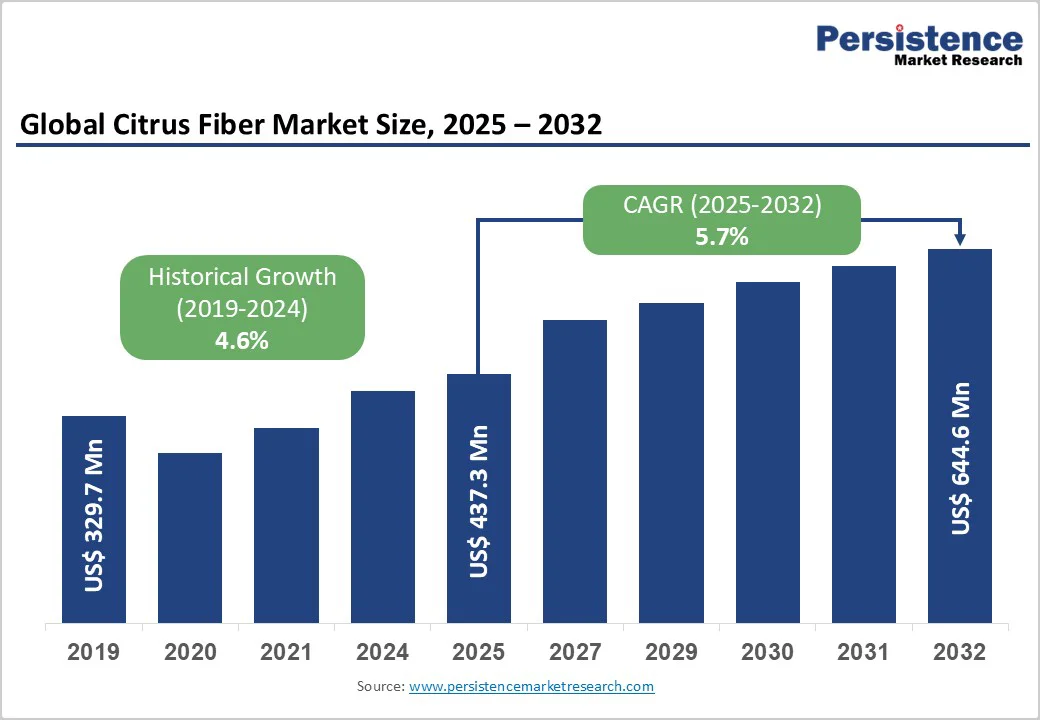
The Citrus fiber market size is valued at US$ 437.3 million in 2025 and projected to reach US$ 644.6 million by 2032. The market is projected to record a CAGR of 5.7% during the forecast period from 2025 to 2032.
Global citrus fiber is rapidly reshaping clean-label innovation across food and beverage sectors, offering multifunctional, naturally derived solutions for texture, viscosity, and sugar reduction. With rising consumer demand for organic, minimally processed ingredients, and increasing regulatory scrutiny on additives, citrus fiber is becoming an indispensable tool for brands seeking to deliver both authenticity and high-quality sensory experiences.
Key Highlights of the Market
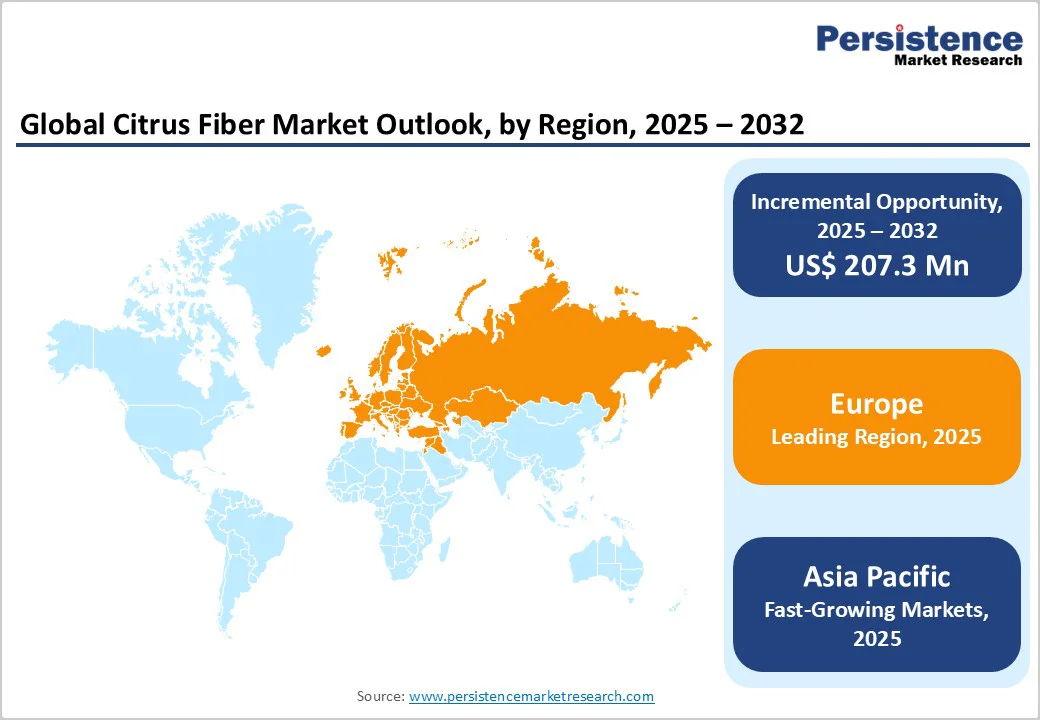
- Leading Region: Europe, holding approximately 37% market share, driven by clean-label reformulations, sustainable sourcing, and growing adoption in plant-based, dairy alternative, and premium bakery applications.
- Fastest-Growing Region: Asia Pacific, expanding at a CAGR of 7.9%, fueled by functional, label-friendly ingredient adoption in beverages, bakery, dairy alternatives, and plant-based foods.
- Fastest-Growing Segment: Organic Citrus Fiber, projected to grow at a CAGR of 9.2%, as brands increasingly prioritize certified organic, minimally processed, and sustainable ingredients for premium applications.
- Market Drivers: Rising clean-label reformulations and ingredient transparency are pushing citrus fiber into mainstream adoption, leveraging its water-binding, viscosity, and texturizing properties across multiple food categories.
- Opportunities: Developing customized citrus fiber blends for sugar reduction in beverages and confectionery, offering application-specific solutions with optimized hydration, texture, and flavor release.
- Key Developments: In October 2025, Ingredion spotlighted FIBERTEX™ CF citrus fiber as a catalyst for clean-label transformation, improving functionality and supporting sustainability in bakery, beverage, plant-based, and savory applications. In May 2024, CP Kelco completed a $60 million expansion of its citrus fiber production capacity to meet growing market demand.
| Key Insights | Details |
|---|---|
|
Global Citrus Fiber Market Size (2025E) |
US$ 437.3 Mn |
|
Market Value Forecast (2032F) |
US$ 644.6 Mn |
|
Projected Growth (CAGR 2025 to 2032) |
5.7% |
|
Historical Market Growth (CAGR 2019 to 2024) |
4.6% |
Market Dynamics
Driver - Rising clean-label reformulations are boosting demand for citrus fiber
A growing shift toward ingredient transparency is reshaping global formulation strategies, placing citrus fiber at the center of clean-label innovation. As brands overhaul recipes to eliminate artificial stabilizers, modified starches, and synthetic emulsifiers, citrus fiber offers a multifunctional, naturally derived alternative that aligns with consumer expectations for authenticity and minimal processing. Food and beverage manufacturers are leveraging its water-binding capacity, viscosity enhancement, and texturizing properties to maintain product quality while simplifying ingredient lists. Demand is accelerating across bakery, dairy, plant-based meats, beverages, and ready meals, where clean-label positioning directly influences purchasing decisions. With regulators tightening scrutiny on additives, citrus fiber is becoming a strategic tool for reformulation, helping companies meet evolving standards without compromising sensory performance.
Restraints - Seasonal fluctuations in citrus harvests cause price volatility and inconsistent raw material availability
Seasonal shifts in citrus harvests introduce a level of instability that directly disrupts the steady flow of raw material needed for citrus fiber production. Weather disturbances, irregular rainfall, and temperature swings influence fruit yield and quality, creating unpredictable supply cycles for processors. This variability leads to price volatility as manufacturers compete for limited volumes during weak harvest periods, complicating contract planning and year-round procurement. Producers relying on orange, lemon, or lime peels must frequently adjust sourcing strategies, reformulate blends, or explore secondary suppliers when availability tightens. These fluctuations strain operational efficiency for fiber processors that depend on consistent input streams to maintain stable production costs, uniform functionality, and reliable output for food, beverage, and clean-label applications.
Opportunity - Offering customized citrus fiber blends for sugar reduction in beverages and confectionery
A shift toward healthier formulations is opening a sharp competitive window for companies capable of developing customized citrus fiber blends engineered for sugar reduction in beverages and confectionery. Brands worldwide are racing to cut sucrose levels without compromising mouthfeel, viscosity, or flavor release, and citrus fiber offers a clean-label route to achieve this balance. Tailored blends can mimic the body and sweetness perception that sugar typically delivers, enabling smoother textures in juices, gummies, chewy candies, and flavored waters. Startups can differentiate by offering application-specific solutions that integrate pectin–cellulose ratios, optimized hydration behavior, and neutral flavor profiles. As manufacturers lean into natural reformulation tools, suppliers offering co-development support, pilot-scale trials, and rapid prototyping stand to secure long-term, high-value partnerships across global food and beverage portfolios.
Category-wise Analysis
By Source Insights
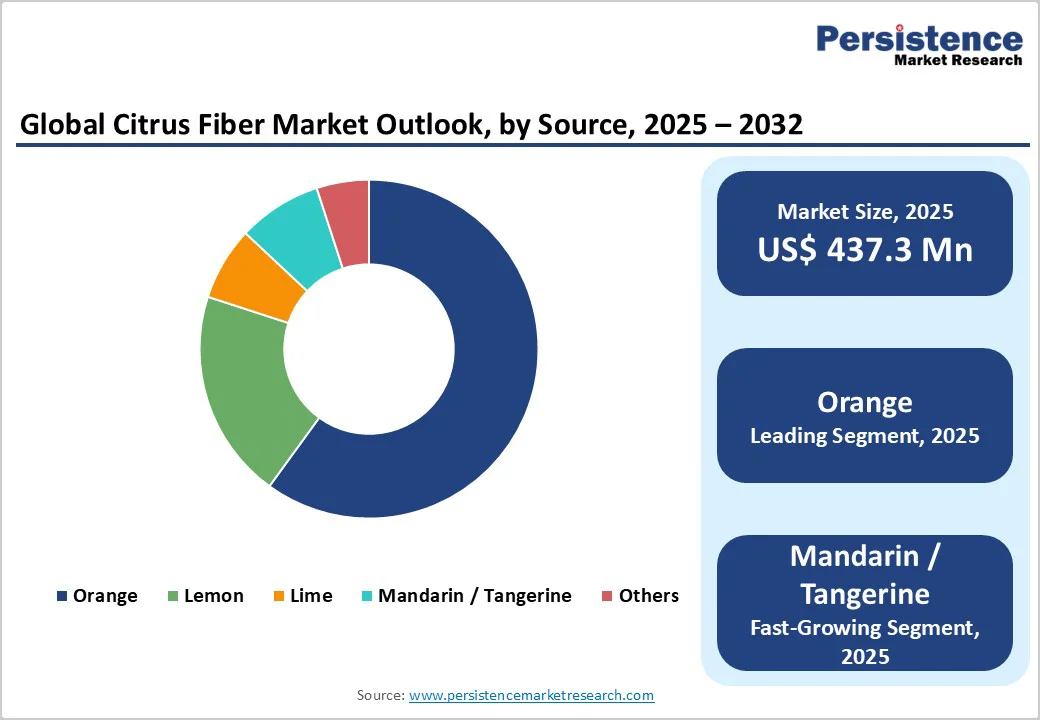
Oranges hold approx. 67% market share as of 2025, a position strengthened by their abundant global cultivation and consistently high biomass yield, making them the most dependable source of citrus fiber for large-scale processors. Their peels offer a balanced pectin–cellulose structure, strong water-binding capacity, and a neutral flavor impact, giving formulators flexibility across beverages, bakery, dairy alternatives, and meat analogues. Lemon-derived fiber is gaining traction for applications needing higher viscosity and a slightly sharper sensory profile. Lime-based fiber appeals to niche segments where acidity management and clean-label stabilization are priorities. Mandarin and tangerine sources contribute smaller volumes yet attract interest in premium categories seeking unique aroma notes and softer gel behavior, particularly in confectionery and gourmet beverage innovations.
By Nature Insights
Organic citrus fiber is projected to grow at a CAGR of 9.2% during the forecast period, accelerating as clean-label expectations reshape formulation strategies across food, beverage, and nutraceutical categories. This momentum reflects a decisive shift among manufacturers seeking ingredients free from synthetic residues while responding to consumers who prefer products aligned with regenerative agriculture and transparent sourcing. Organic citrus fiber delivers strong water retention, fat mimicking, and texture enhancement, making it a natural fit for reformulating dairy alternatives, low-sugar beverages, and premium bakery mixes. Demand is intensifying among brands targeting the organic, plant-forward, and minimally processed segments. As certified organic citrus supply chains expand and processors adopt gentler extraction methods, adoption widens across high-value applications globally.
Regional Insights
Europe Citrus Fiber Market Trends
Europe holds approximately 37% market share in the global citrus fiber market, and its momentum is being reshaped by reformulation pressures, clean-label commitments, and a sharp push toward sustainable ingredient sourcing. Germany is driving uptake in plant-based meats and dairy alternatives that rely on citrus fiber for juiciness and stability. Italy and Spain are expanding use in premium bakery and artisanal pasta to improve texture while supporting reduced-fat recipes. The U.K. sees rising adoption in low-sugar beverages and functional drinks, while France utilizes citrus fiber to elevate pâtisserie, sauces, and gourmet condiments. Leading European players such as Cargill, Fiberstar, and Herbafood Ingredients are scaling advanced extraction capabilities and tailored blends to meet evolving regional demand.
Asia Pacific Citrus Fiber Market Trends
Asia Pacific Citrus Fiber Market is expected to grow at a positive CAGR in the forecast period, and this expansion is being accelerated by rapid shifts in food manufacturing practices and rising consumer interest in functional, label-friendly ingredients. China is increasing use of citrus fiber in drinkable yogurts, ready-to-drink teas, and reformulated bakery lines aiming for better moisture retention. India is integrating it into spice blends, chutneys, and dairy alternatives to improve consistency under high-heat cooking conditions. Japan is adopting high-purity citrus fiber for premium confectionery, jelly desserts, and low-oil frying applications where stability is critical. Southeast Asian markets are deploying citrus fiber in plant-based meat, instant beverages, and noodle products as processors seek cost-effective natural binders that enhance texture and extend shelf performance.
Market Competitive Landscape
A steadily evolving and moderately fragmented market structure defines the global citrus fiber landscape, creating room for both established ingredient suppliers and agile startups to push innovation. Leading companies are scaling high-purity extraction facilities, tightening vertical integration from peel sourcing to finished fiber, and expanding certified organic lines to meet rising clean-label expectations. Startups are entering with customized blends for sugar reduction, fat mimicking, and vegan texturizing, targeting niche applications across beverages, confectionery, and plant-based foods. Producers are investing in advanced drying, micronization, and solvent-free processing technologies to improve yield consistency while aligning with stricter sustainability regulations. Collaborations between citrus processors, food tech firms, and research institutes are accelerating product innovation, enabling new functionalities in stability, emulsification, and dietary fiber enrichment.
Key Industry Developments:
- In October 2025, Ingredion spotlighted its FIBERTEX™ CF citrus fiber as a catalyst for clean-label transformation across global food categories. The company emphasized its role in boosting functionality, lowering formulation costs, and supporting sustainability goals in bakery, beverage, plant-based, and savory applications.
- In July 2024, Ingredion launched FIBERTEX® CF 500 and CF 100 citrus fibers in the EMEA region. These multi-benefit fibers offer enhanced texturizing and clean-label solutions for consumer-preferred food products.
- In May 2024, CP Kelco completed a $60 million expansion of its citrus fiber production capacity. The move strengthens the company’s ability to meet growing customer demand and future market needs.
- In January 2023, Fiberstar, Inc. introduced the Citri-Fi® 400 series, a new line of organic citrus fibers. This launch addresses growing demand for natural, sustainable, and organic food ingredients.
Companies Covered in Citrus Fiber Market
- Fiberstar, Inc.
- Ceamsa
- Herbafood Ingredients GmbH
- Cargill, Inc
- Prodalim group
- Ingredion
- JRS Silvateam Ingredients S.r.l.
- Tate & Lyle
- DSM
- Silvateam S.p.A.
- Others
Frequently Asked Questions
The global Citrus Fiber market is projected to be valued at US$ 437.3 Mn in 2025.
Rising clean-label reformulations are boosting demand for citrus fiber is driving interest in Citrus Fiber.
The global Citrus Fiber market is poised to witness a CAGR of 5.7% between 2025 and 2032.
Offering customized citrus fiber blends for sugar reduction in beverages and confectionery is the key market opportunity.
Major players in the global Citrus Fiber market include Fiberstar, Inc., Cargill, Inc, Ingredion, Tate & Lyle, DSM, and others.


