




- Medical Devices
- Cardiac Bio Implant Devices Market
Cardiac Bio Implant Devices Market Size, Share, and Growth Forecast 2026 - 2033
Cardiac Bio Implant Devices Market by Type (Pacemaker, ICDs, CRT), Application (Arrhythmias, Myocardial Ischemia, Acute Myocardial Infarction, Heart Failure), End User (Hospitals, Ambulatory Surgical Centers), and Regional Analysis, 2026 - 2033

Cardiac Bio Implant Devices Market Size and Trend Analysis
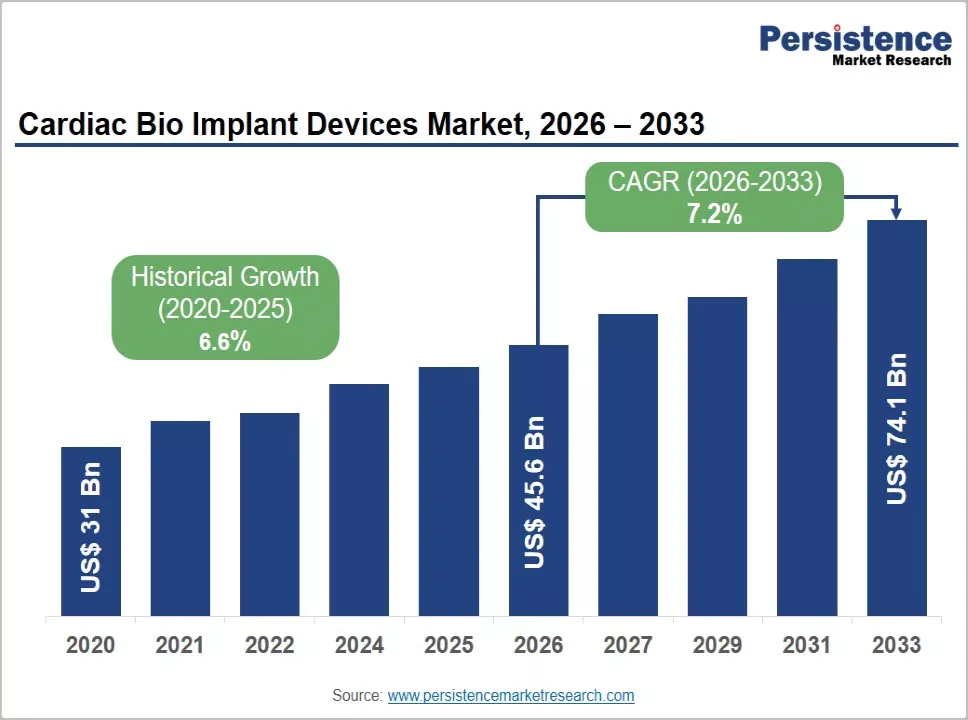
The global cardiac bio implant devices market is expected to be valued at US$ 45.60 billion in 2026 and is projected to reach US$ 74.19 billion by 2033, growing at a CAGR of 7.2% between 2026 and 2033.
Cardiovascular disease remains the leading cause of mortality worldwide, according to the World Health Organization (WHO). The structural demand this creates for active implantable medical devices is now generating a measurable acceleration in procurement cycles across both mature and emerging health systems. This trajectory reflects a convergence of ageing demographics, rising prevalence of arrhythmias and heart failure, and a generational leap in device miniaturization and remote monitoring capability. The European Heart Rhythm Association (EHRA) has formally endorsed expanded implantation guidelines for cardiac resynchronization therapy, reinforcing institutional demand.
Key Industry Highlights
- Dominant Region: North America is projected to dominate the regional market driven by the ACC and HRS guideline infrastructure that embeds device therapy into standard cardiology practice.
- Fastest-growing Region: Growing at a CAGR of 8.8%, Asia Pacific is outpacing every other region in this market, as public health financing reforms including India's PM-JAY scheme and China's VBP procurement program bring cardiac implant procedures within economic reach of patient populations that were previously excluded from device therapy entirely.
- Leading Type: Pacemakers hold 43% of market share in 2026, sustained by the broadest arrhythmia indication coverage, predictable device replacement cycles averaging seven to twelve years, and expanding eligibility driven by leadless platforms approved by the FDA making this segment the most institutionally entrenched in the cardiac bio implant devices landscape.
- Fastest-growing Type: Cardiac resynchronization therapy represents the fastest-growing device type in the cardiac bio implant devices industry, with patient selection criteria evolving to include previously excluded anatomical profiles a trend accelerated by Abbott's Aveir DR dual-chamber leadless CRT approval and published real-world outcome data from expanded CRT indication trials demonstrating mortality benefit in broader heart failure populations.
- Fastest-growing End User: Ambulatory surgical centers present the most actionable near-term channel opportunity for device manufacturers, following CMS policy changes that formalized outpatient reimbursement for cardiac implant procedures positioning high-volume ASC operators such as SCA Health as significant new procurement decision-makers alongside traditional hospital cardiology department buyers.
DRO Analysis
Driver - Rising Global Burden of Cardiovascular Disease and Clinician-Led Implantation Protocols
Cardiovascular conditions including atrial fibrillation, ventricular tachycardia, and advanced heart failure collectively affect an estimated 620 million people globally, per WHO Global Health Estimates 2024. This disease burden translates directly into procedure volumes for electrophysiologists and interventional cardiologists recommending pacemaker implantation, ICD therapy, and CRT.
Health systems across the Organization for Economic Co-operation and Development (OECD) have embedded implantable device protocols into their guideline-driven care pathways, making demand structurally recurring rather than discretionary. Hospitals with established electrophysiology programs systematically replace and upgrade devices on five-to-ten-year cycles, sustaining a durable baseline of implant procedures independent of near-term economic conditions.
Restraint - High Device Costs and Reimbursement Variability Across Health Systems
The unit economics of cardiac bio implant devices particularly CRT-D systems and subcutaneous ICDs place them among the highest-cost items in a hospital's interventional cardiology budget. In many middle-income markets, national health insurance schemes either exclude these devices from covered procedures or apply reimbursement caps that fall below the actual device acquisition price. The Centers for Medicare and Medicaid Services (CMS) periodically revises Diagnosis-Related Group (DRG) reimbursement rates, creating pricing uncertainty for U.S. hospital systems managing implant program margins. This cost sensitivity slows adoption among community hospitals and constrains volume growth in price-sensitive geographies.
Opportunity - Remote Monitoring Integration and Digital Cardiac Implant Ecosystems
Implantable cardiac devices are increasingly functioning as continuous biosensors, transmitting haemodynamic and arrhythmia data to clinicians via secure remote monitoring platforms. Boston Scientific Corporation has scaled its LATITUDE NXT remote patient management network, which connects tens of thousands of implanted devices to cardiac care teams without requiring in-person clinic visits.
The American Heart Association (AHA) published a 2023 scientific statement endorsing remote monitoring as a standard of care for ICD and CRT recipients. This shift creates a durable aftermarket service layer connecting hardware sales to recurring software and monitoring revenue that strengthens long-term customer relationships for leading device manufacturers and elevates switching costs for clinical programs already embedded in proprietary ecosystems.
Category-wise Analysis
Type Insights
Why Do Pacemakers Dominate the Cardiac Bio Implant Devices Market?
Pacemakers are projected to dominate type segment hold about 43% of cardiac bio implant devices market in 2026, propelled by address the broadest spectrum of bradyarrhythmia indications, requiring implantation across the widest patient demographic from congenital heart block in pediatric patients to sick sinus syndrome in elderly adults.
Electrophysiology units at tertiary referral centers such as the Cleveland Clinic and Mayo Clinic in the U.S. perform several hundred pacemaker implantations annually under established, guideline-driven protocols, creating predictable, high-volume procurement demand. The segment's durability rests on device replacement cycles: a standard dual-chamber pacemaker carries a battery longevity of seven to twelve years, generating a recurring replacement cohort that sustains revenue floors independent of new-diagnosis growth.
CRT (Cardiac Resynchronization Therapy) is likely to be the fastest-growing segment, propelled by expanding heart failure prevalence and refined patient selection criteria. Abbott's Aveir DR dual-chamber leadless CRT system, cleared by the FDA in 2023, opened therapy access to patients with venous anatomy incompatible with traditional transvenous CRT leads a previously underserved population estimated to represent up to 30% of CRT candidates, per published electrophysiology registry data.
Application Insights
What Is Driving Arrhythmia Management to Command Nearly Half the Cardiac Bio Implant Devices Market?
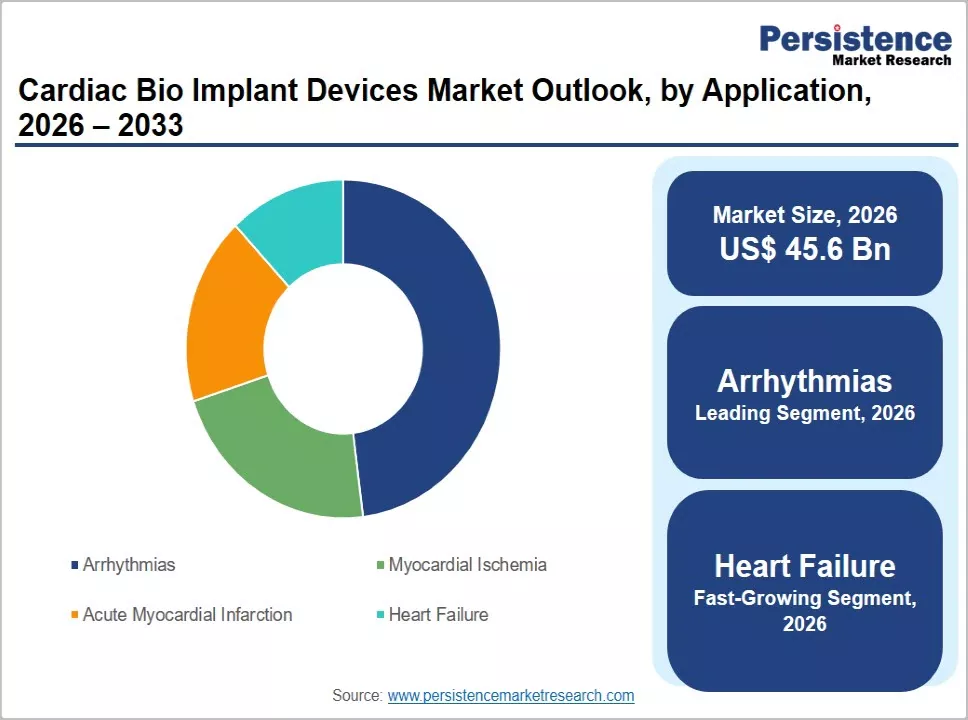
Arrhythmia management is expected to dominate the application segment hold around 48% of market share in 2026, fueled by atrial fibrillation and ventricular arrhythmias collectively represent the most prevalent cardiac conditions requiring device-based intervention globally.
Electrophysiologists at academic medical centers deploy ICDs and dual-chamber pacemakers specifically to detect and terminate life-threatening ventricular fibrillation episodes a use case with zero pharmacological substitute and direct mortality benefit confirmed in landmark trials such as MADIT-II. The segment's dominance also reflects the high procedure repeatability: patients with arrhythmias typically require device replacement, remote monitoring follow-up, and in some cases system upgrades, sustaining multi-decade revenue relationships per patient.
Heart failure is likely to be the fastest-growing application, catalyzed by the rising global prevalence of reduced ejection fraction cardiomyopathy and the expanding CRT indication pool. Medtronic's EV-ICD extravascular ICD system, which gained FDA approval in 2023, specifically addresses heart failure patients who require defibrillation therapy but are not suitable candidates for traditional transvenous systems unlocking a new implant-eligible population that cardiologists had previously managed with medication alone.
End User Insights
Hospitals is estimated to lead the end user segment hold around 69% of market share in 2026. This dominance reflects the procedural complexity of cardiac implantation requiring sterile catheterization suites, intraoperative fluoroscopy, anesthesia support, and trained electrophysiology nursing staff that only fully equipped hospital environments reliably provide.
Large academic medical centers and integrated health networks such as HCA Healthcare maintain dedicated cardiac device implantation programs, negotiating volume-based device contracts directly with manufacturers and internalizing the full revenue cycle from implantation through device clinic follow-up. Emergency pacemaker implantation and in-hospital ICD placement following acute myocardial infarction further cement hospitals as the indispensable implantation setting.
Ambulatory surgical centers (ASCs) are likely to be the fastest-growing end-user channel, driven by CMS reimbursement policy changes in 2023 that formally added cardiac device implantation procedures to the Outpatient Prospective Payment System (OPPS) covered services list. Single-chamber and dual-chamber pacemaker implants are now being performed at high-volume cardiac ASCs such as those operated by SCA Health (Surgical Care Affiliates) in clinically appropriate low-risk patients, reducing facility costs by an estimated 40-60% compared to inpatient hospital settings while maintaining equivalent procedural outcomes.
Regional Insights
North America Cardiac Bio Implant Devices Market Trends and Insights
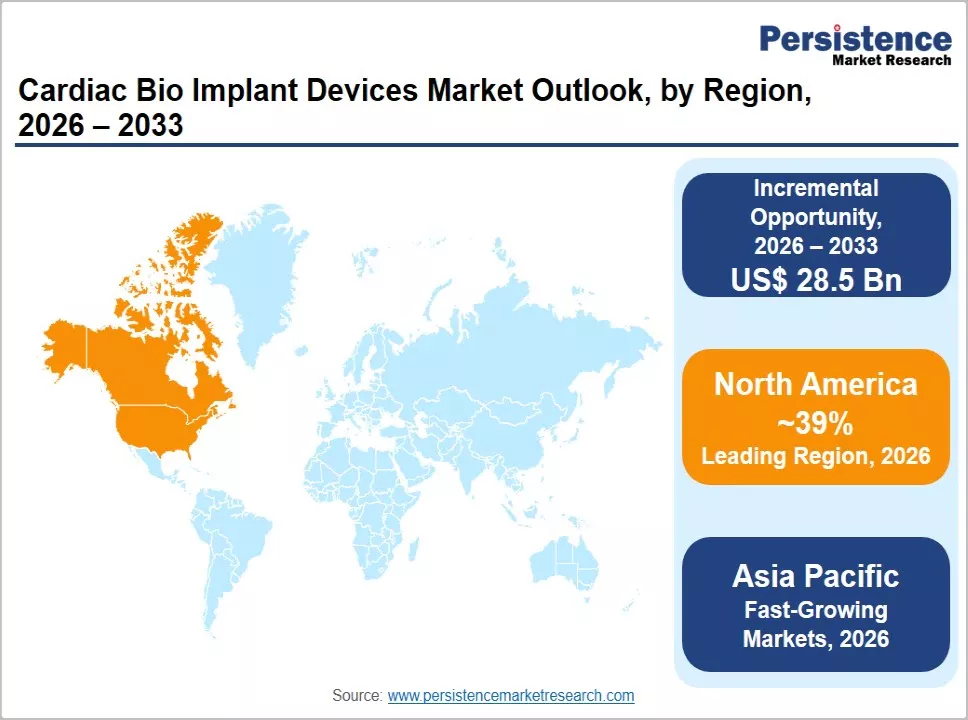
North America is projected to dominate the regional market and capture around 39% of cardiac bio implant devices market in 2026, driven by the highest per-capita ICD and pacemaker implantation rates in the world. The region benefits from mature electrophysiology infrastructure, established CMS reimbursement pathways, and a clinical culture of early device adoption supported by landmark cardiovascular outcome trials conducted at U.S. academic centers. Continued guideline expansion by the American College of Cardiology (ACC) and the Heart Rhythm Society (HRS) is broadening device-eligible patient populations through 2033.
U.S. Cardiac Bio Implant Devices Market Size
The U.S. is expected to hold around 88% of the North America regional market in 2026. Demand is sustained by an ageing population the U.S. Census Bureau projects that adults aged 65 and over will represent 21% of the U.S. population by 2030 increasing structural arrhythmia and heart failure incidence. Continued FDA approval activity for next-generation leadless and subcutaneous implant platforms will sustain device replacement and upgrade cycles through the forecast period.
Canada Cardiac Bio Implant Devices Market Size
Canada is estimated to command around 12% of the North America regional market in 2026. Health Canada's progressive adoption of EU MDR-aligned device standards is accelerating approval timelines for novel cardiac implant platforms, improving market access for multinational manufacturers. Ongoing hospital infrastructure investment under provincial cardiac care strategies particularly in Ontario and British Columbia will support incremental procedure volume growth through 2033.
Europe Cardiac Bio Implant Devices Market Trends and Insights
Europe is anticipated to account about 17% of cardiac bio implant devices market in 2026. The region's growth profile reflects an ageing demographic the European Commission projects that adults over 65 will constitute 29% of the EU population by 2050 combined with strong universal healthcare coverage that institutionalizes device therapy within cardiac care pathways. Ongoing EU MDR implementation continues to reshape the competitive dynamics among Notified Bodies and device manufacturers seeking CE mark renewals for existing cardiac implant portfolios.
Germany Cardiac Bio Implant Devices Market Size
Germany is expected to account around 23% of the Europe regional market in 2026. Germany operates Europe's highest density of cardiac catheterization laboratories per capita, per the European Society of Cardiology (ESC) Atlas of Cardiology, sustaining consistently elevated implant procedure volumes. The Gemeinsamer Bundesausschuss (G-BA) benefit assessment framework is progressively incorporating novel cardiac implant technologies, widening reimbursement access for leadless pacemaker systems.
U.K. Cardiac Bio Implant Devices Market Size
The U.K. is projected to hold nearly 17% of the Europe regional market in 2026. The National Health Service (NHS) England cardiac device program prioritizes cost-effective implant platforms assessed by the National Institute for Health and Care Excellence (NICE), with recent NICE guidance supporting broader ICD use in primary prevention of sudden cardiac death. Post-Brexit regulatory alignment through the Medicines and Healthcare Products Regulatory Agency (MHRA) is creating a distinct approval pathway that some manufacturers are leveraging to accelerate UK market entry ahead of EU approvals.
Which Region Will Drive the Fastest Cardiac Bio Implant Devices Market Growth Through 2033?
Asia Pacific is likely to be the fastest growing regional market during the forecast period between 2026 to 2033. Rising cardiovascular disease prevalence, improving electrophysiology training pipelines, and accelerating public health insurance coverage across China, India, Japan, and South Korea collectively underpin this acceleration. National cardiac device localization policies particularly China's "Made in China 2025" initiative targeting domestic production of high-value medical devices are simultaneously stimulating supply-side investment and competitive pricing dynamics that expand the addressable procedure base.
China Cardiac Bio Implant Devices Market Size
China is estimated to command about 31% of the Asia Pacific regional market in 2026. Domestic manufacturers such as MicroPort Scientific Corporation are gaining cardiac device market share through competitively priced pacemaker and ICD platforms approved under NMPA pathways, reducing procedure costs and enabling adoption at lower-tier hospitals. Volume-based procurement reforms under China's national VBP (Volume-Based Procurement) program are reshaping device pricing and driving rapid institutional adoption.
Japan Cardiac Bio Implant Devices Market Size
Japan is anticipated to hold nearly 22% of the Asia Pacific regional market in 2026. Japan's Pharmaceuticals and Medical Devices Agency (PMDA) has accelerated its Sakigake Designation program for innovative cardiac implants, reducing approval timelines for breakthrough devices from international manufacturers. The country's pronounced demographic ageing with adults over 65 constituting approximately 29% of the population per Statistics Japan is translating directly into growing pacemaker and ICD implantation volumes at national hospital centers.
Competitive Landscape
The global cardiac bio implant devices market is moderately concentrated at the premium technology tier, with Medtronic plc, Abbott Laboratories, and Boston Scientific Corporation collectively commanding the majority of global ICD, pacemaker, and CRT implant revenue. Competition centers on device longevity claims, remote monitoring platform integration, implant procedure simplicity, and reimbursement support infrastructure not price alone.
BIOTRONIK SE & Co. KG and LivaNova PLC hold meaningful positions in specific geographies, particularly Europe, where long-standing physician relationships and established distributor networks provide durable competitive moats. Domestic Chinese manufacturers, led by MicroPort Scientific Corporation, are beginning to disrupt mid-tier pricing in Asia Pacific, applying margin pressure on multinational portfolios in public hospital procurement contexts.
Key Industry Developments
- In October 2026, Cleveland Clinic performed the first U.S. implantation of Biotronik’s Acticor Sky DX cardiac resynchronization therapy defibrillator (CRT-D) system. Electrophysiologist Niraj Varma, MD, PhD, carried out the procedure following the U.S. Food and Drug Administration (FDA) approval of the device in April 2026. The Acticor Sky DX system uses Closed Loop Stimulation to regulate heart rate and DX Technology to provide atrial sensing through a single lead. The system also incorporates HeartInsight, which alerts clinicians to signs of worsening heart failure, and MRI Guard 24/7, which facilitates MRI examinations for patients.
- In October 2025, Abbott launched the AVEIR Dual Chamber (DR) Leadless Pacemaker System in India, introducing the world’s first dual-chamber leadless pacemaker. The system uses Abbott proprietary implant-to-implant (i2i) technology to enable real-time, beat-to-beat wireless communication between two miniature pacemakers implanted in the right atrium and right ventricle. Each device is approximately one-tenth the size of a traditional pacemaker and supports synchronized heart rhythm regulation without lead wires or surgical pockets. Abbott designed the system for minimally invasive catheter-based implantation, reducing complications associated with conventional pacemaker leads and supporting faster recovery.
Companies Covered in Cardiac Bio Implant Devices Market
- F. Hoffman-La Roche
- Eurofins Scientific
- Illumina, Inc.
- Natera Inc.
- Abbott Laboratories
- Thermo Fisher Scientific
- Quest Diagnostics
- Agilent Technologies
Frequently Asked Questions
The global cardiac bio implant devices market is valued at US$ 45.60 billion in 2026.
Expanding clinical guidelines endorsed by bodies such as the Heart Rhythm Society (HRS) that broaden ICD and CRT implantation eligibility, and remote monitoring platform adoption endorsed by the American Heart Association as a standard of care for implanted device recipients.
The pacemaker segment hold 43% of cardiac bio implant devices market, the largest share of any device type, because it addresses the widest spectrum of bradyarrhythmia indications across the broadest patient demographic from pediatric congenital conditions to age-related sick sinus syndrome in elderly adults.
North America dominates the cardiac bio implant devices market with 39% share in 2026, driven by the world's highest per-capita ICD and pacemaker implantation rates and mature CMS reimbursement infrastructure supporting device-based cardiac therapy.
The expansion of Asia Pacific's cardiac implant infrastructure particularly through India's Pradhan Mantri Jan Arogya Yojana public insurance scheme and China's NMPA Green Channel expedited device approval program represents the most significant volume-growth opportunity in the cardiac bio implant devices sector through 2033.
Some leading companies include Medtronic plc, Abbott Laboratories, and Boston Scientific Corporation, BIOTRONIK SE & Co. KG and MicroPort Scientific Corporation.


