




- Medical Devices
- Cardiac Troponin Market
Cardiac Troponin Market Size, Share, Trends, Growth, Regional Forecasts, 2026 to 2033
Cardiac Troponin Market by Troponin Type (Troponin I, Troponin T), End-user (Hospitals, Diagnostic Laboratories, Ambulatory Surgical Centers, Others), Testing Type (Laboratory Testing, Point-of-Care Testing), and Regional Analysis for 2026-2033

Cardiac Troponin Market Share and Trends Analysis
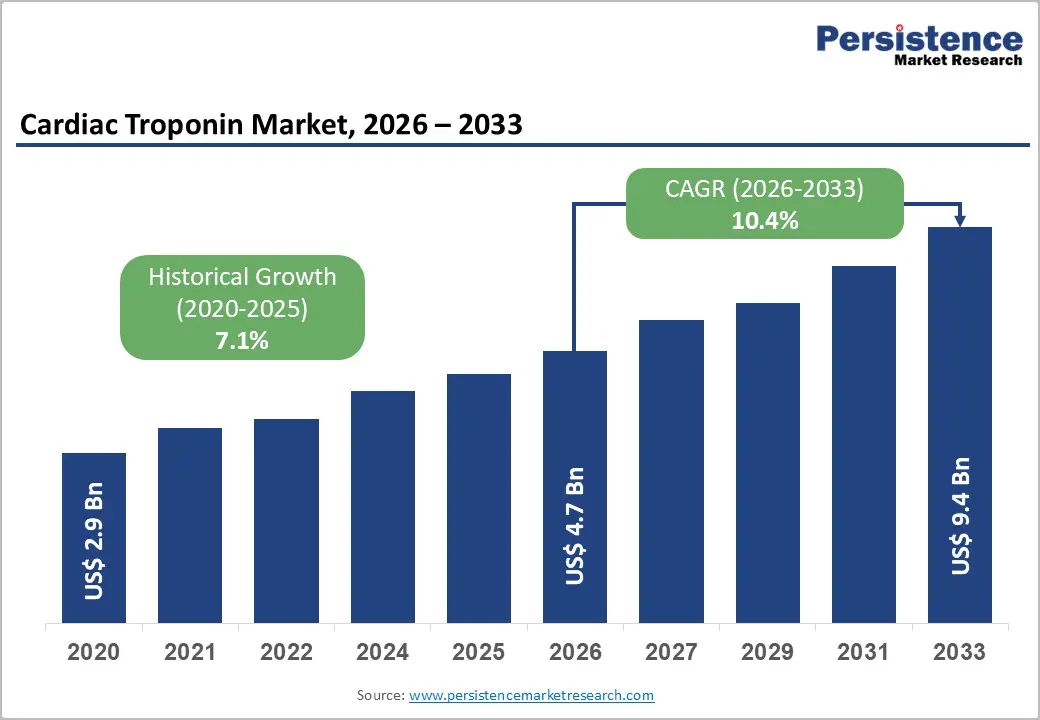
The global cardiac troponin market size is likely to be valued at US$ 4.7 billion in 2026, and is projected to reach US$ 9.4 billion by 2033, growing at a CAGR of 10.4% during the forecast period 2026−2033. Cardiac troponin is a crucial biomarker used to detect injury to the heart muscle. It enables accurate diagnosis, which plays an important role in identifying and managing heart attacks.
Cardiac troponins are a group of proteins present in cardiac muscle fibers that help regulate heart muscle contraction and are essential for proper cardiac function. In clinical practice, two main types are used troponin T (cTnT) and troponin I (cTnI). These proteins are highly specific to the heart and are typically not present in significant levels in the bloodstream under normal conditions. Cardiac troponin testing is widely used to evaluate the extent of myocardial damage and to assess prognosis in conditions such as acute coronary syndromes.
Key Industry Highlights
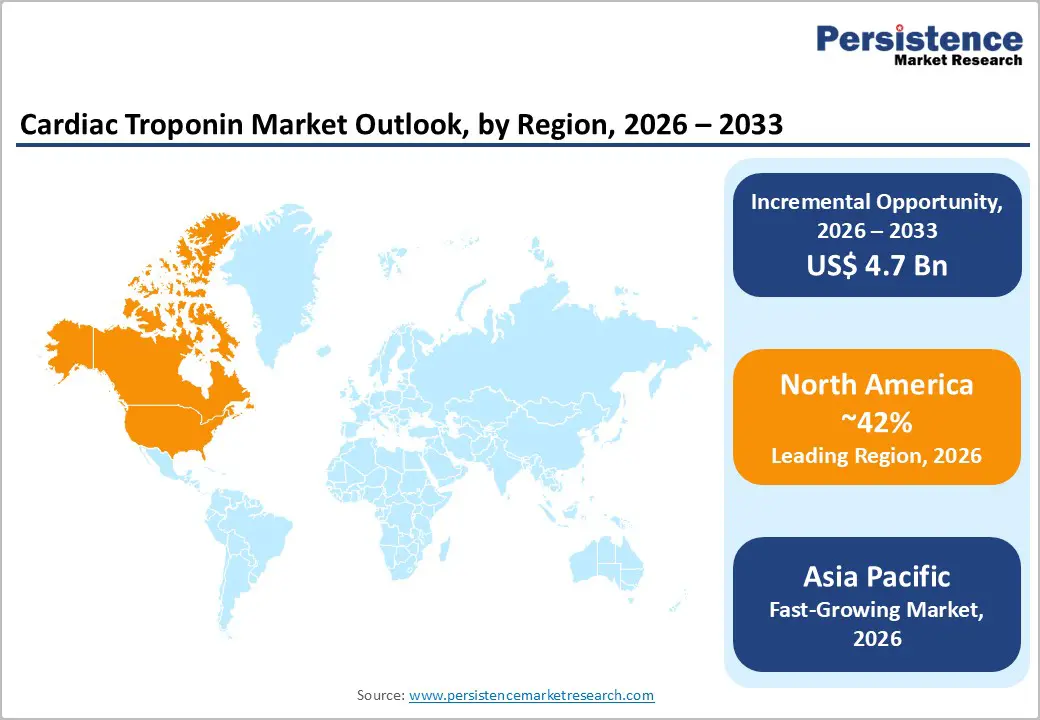
- Dominant Region: North America is expected to command about 42% market share in 2026, supported by advanced healthcare infrastructure, high prevalence of cardiovascular diseases.
- Fastest-growing Region: The Asia Pacific market is set to be the fastest-growing during the forecast period, due to rising incidence of cardiovascular diseases and increasing healthcare investments.
- Leading & Fastest-growing Troponin Types: Troponin I is projected to command approximately 58% of the revenue share in 2026, while troponin T is likely to be the fastest-growing segment during the 2026-2033 forecast period.
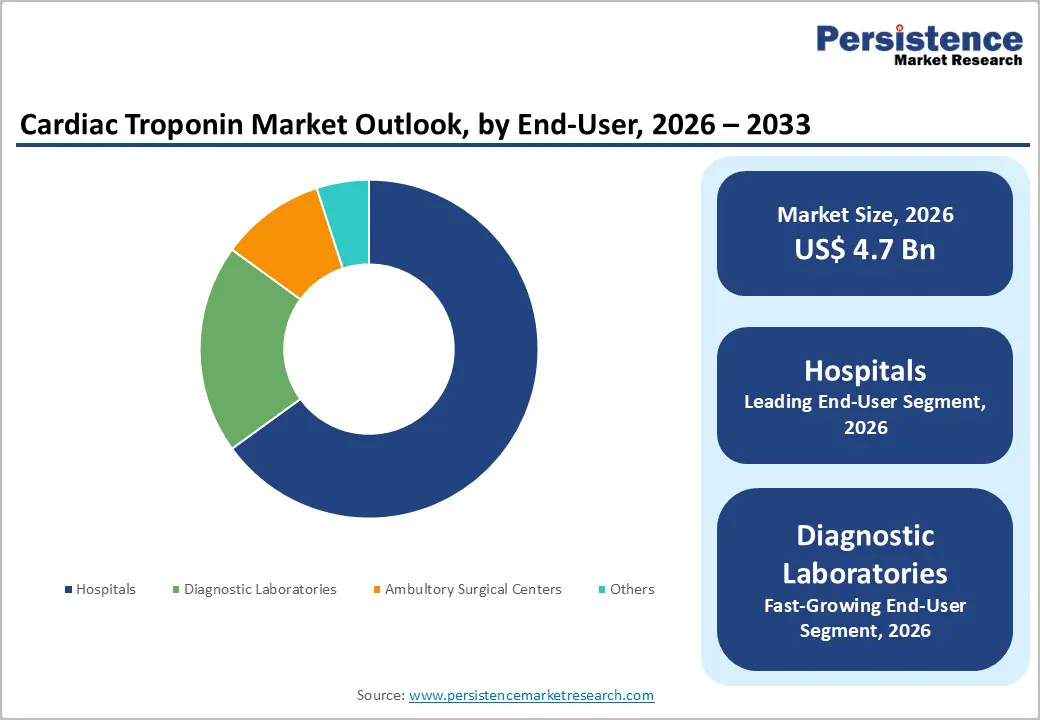
- Leading & Fastest-growing End-Users: Hospitals are poised to lead with nearly 65% of the revenue share in 2026, whereas diagnostic laboratories are expected to be the fastest-growing segment over the 2026-2033 forecast period.
- Market Driver: The shift from conventional troponin testing to high sensitivity cardiac troponin assays (hs cTn) is transforming emergency cardiology practices and driving the market.
| Key Insights | Details |
|---|---|
| Cardiac Troponin Market Size (2026E) | US$ 4.7 Bn |
| Market Value Forecast (2033F) | US$ 9.4 Bn |
| Projected Growth (CAGR 2026 to 2033) | 10.4% |
| Historical Market Growth (CAGR 2020 to 2025) | 7.1% |
DRO Analysis
Rising Global Burden of Cardiovascular Disease
Cardiovascular diseases (CVDs) are continuing to dominate as the primary cause of mortality across the world, creating a persistent burden on healthcare systems. According to World Health Organization (WHO), An estimated 19.8 million people died from CVDs in 2022, representing approximately 32% of all global deaths. Of these deaths, 85% were due to heart attack and stroke. This expanding disease burden is driving a greater need for timely and accurate diagnostic solutions. Healthcare providers are increasingly depending on advanced biomarkers to support early detection and clinical decision-making, which is improving patient management and outcomes.
This rising prevalence is directly increasing the demand for cardiac troponin testing across emergency and outpatient care settings. Clinicians are relying on troponin biomarkers to evaluate suspected cases of acute coronary syndrome (ACS) with higher accuracy and speed. Organizations such as the American Heart Association (AHA) are projecting that a significant proportion of the adult population will be affected by some form of cardiovascular condition in the coming years. This trend is extending to developing regions, where healthcare systems are strengthening diagnostic capabilities. The volume of troponin assays is expected to grow steadily, while contributing to advancements in diagnostic technologies and expanding market opportunities.
Widespread Adoption of High-Sensitivity Troponin Assays
The shift from conventional troponin testing to hs cTn is transforming emergency cardiology practices. These advanced assays are receiving clearance from regulatory bodies such as the United States Food and Drug Administration (FDA) and are gaining strong support from professional organizations such as the European Society of Cardiology (ESC). They are enabling clinicians to detect very low concentrations of troponin, which is improving early diagnosis of acute myocardial infarction (AMI). Hospitals are increasingly adopting these assays to support rapid decision making in emergency departments. This transition is strengthening diagnostic confidence and is allowing physicians to identify cardiac events at an earlier stage, which is improving clinical outcomes and reducing uncertainty during patient evaluation.
Healthcare systems are continuing to integrate hs cTn assays into routine workflows, especially in tertiary care centers. These assays are helping reduce patient waiting times and are streamlining emergency department operations. Clinicians are using faster rule out protocols to manage suspected acute coronary syndrome (ACS) cases more efficiently. Regulatory approvals, updated clinical guidelines, and clearer reimbursement pathways are encouraging wider adoption across both developed and developing regions. Emerging markets are also strengthening their diagnostic infrastructure, which is supporting broader access to advanced testing technologies. As adoption is expanding, the demand for hs cTn platforms is expected to grow steadily, contributing to improved healthcare delivery and supporting long term market expansion.
Regulatory Complexity and Harmonization Challenges
The cardiac troponin market is operating under strict in vitro diagnostic (IVD) regulatory frameworks across major regions. Authorities such as the U.S. FDA are overseeing approvals through the 510(k) pathway in the United States, while the European Union (EU) is enforcing the In Vitro Diagnostic Regulation (IVDR 2017/746). Countries across Asia Pacific are also establishing their own regulatory structures, which are creating a complex approval environment for manufacturers. Companies are navigating detailed clinical validation requirements, extensive documentation, and ongoing compliance obligations. The implementation of IVDR is increasing scrutiny on product safety and performance, which is improving quality standards but is also lengthening approval timelines.
The lack of consistent analytical standardization is continuing to challenge the adoption of cardiac troponin assays. These differences are affecting result comparability and are creating uncertainty among clinicians when interpreting test outcomes. Healthcare providers are seeking reliable and harmonized testing methods to ensure accurate diagnosis and treatment decisions. As guidelines are evolving, laboratories are carefully selecting assays that align with recommended practices. This ongoing transition is expected to drive efforts toward greater standardization, which will strengthen clinical confidence and support broader adoption in the future.
High Cost of High-Sensitivity Assay Systems and Analyzers
High sensitivity cardiac troponin platforms are offering clear clinical advantages, yet their adoption is requiring substantial financial investment. Advanced systems such as fully automated immunoassay analyzers are being installed in central laboratories to support high throughput testing and accurate diagnostics. However, the cost of acquiring these instruments, along with expenses related to installation, maintenance, and reagents, is creating financial pressure for many healthcare providers. Hospitals and diagnostic centers are carefully evaluating return on investment before adopting these technologies. While large institutions are continuing to invest in advanced platforms, smaller facilities are facing challenges in upgrading their infrastructure.
This cost-intensive nature is slowing the transition toward high sensitivity cardiac troponin assays, particularly in regions where healthcare budgets are limited and competing priorities are high. Healthcare systems in developing regions are encountering additional constraints due to gaps in laboratory infrastructure and technical expertise. Organizations such as the World Bank are emphasizing the need for stronger diagnostic capacity in low-income settings. Many facilities are lacking the equipment, trained personnel, and operational support required to implement advanced testing solutions. Access to high quality cardiac diagnostics is remaining uneven across different geographies.
Integration with Digital Health and AI-Driven Diagnostics
The integration of cardiac troponin testing with artificial intelligence (AI) and digital health platforms is reshaping the future of cardiac diagnostics. Advanced AI models are analyzing troponin time series data alongside inputs such as electrocardiogram (ECG) findings and patient clinical information to improve the prediction of ACS. These systems are supporting clinicians by delivering faster and more accurate insights, which is enhancing decision making in critical care settings. Healthcare providers are increasingly adopting AI driven tools to reduce diagnostic uncertainty and to improve patient triage. As these technologies are evolving, they are enabling earlier detection of cardiac events and are helping reduce avoidable hospital admissions while improving overall patient outcomes.
Leading companies such as Siemens Healthineers and Abbott are developing connected diagnostic ecosystems that integrate troponin testing with clinical decision support systems. These platforms are allowing seamless transmission of test results into digital workflows, which is improving efficiency and coordination across care teams. The growing adoption of AI in diagnostics is strengthening the role of cardiac testing within broader digital health strategies. Cardiac diagnostics is emerging as a key focus area due to its high clinical impact and demand for rapid analysis. This convergence is expected to enhance the value of troponin assays by transforming them into integrated decision support tools, which will support long term innovation and create strong competitive differentiation for market participants.
Expanding Applications in Non-ACS Cardiac Conditions
Cardiac troponin testing is expanding beyond its traditional role in diagnosing acute myocardial infarction and is becoming an important tool in broader cardiovascular care. Clinicians are increasingly using troponin measurements to support risk stratification in patients with heart failure, where ongoing monitoring is improving early identification of disease progression. The biomarker is also aiding in the diagnosis of conditions such as myocarditis and is helping assess cardiac injury associated with infections such as the coronavirus disease. In oncology, physicians are applying troponin testing to monitor chemotherapy induced cardiotoxicity, which is enabling timely intervention and better management of treatment related risks.
This expanding scope of applications is increasing the relevance of cardiac troponin testing across multiple healthcare settings. Outpatient cardiology clinics are adopting routine monitoring protocols, while oncology centers are integrating cardiac safety assessments into treatment workflows. These developments are creating new demand channels beyond emergency departments and are strengthening the role of troponin as a versatile biomarker. Healthcare providers are recognizing its value in long term disease management and preventive care. As clinical guidelines are continuing to evolve, the adoption of troponin testing in non-ACS scenarios is expected to accelerate, which will support sustained growth and broaden the overall diagnostic landscape.
Category-wise Analysis
Troponin Type Insights
Troponin I is slated to dominate by commanding approximately 58% of the market revenue share in 2026. Troponin I is a cardiac-specific biomarker that is widely used for the diagnosis of acute myocardial infarction in clinical practice. Its high specificity to heart muscle tissue is enabling accurate detection of cardiac injury, which is supporting timely and informed decision-making in emergency care settings. Cardiologists are relying on this biomarker to quickly assess patients and initiate appropriate treatment. Ongoing research is continuing to validate its clinical reliability and diagnostic value, which is strengthening confidence among healthcare professionals. Troponin I testing is being increasingly adopted across hospitals and diagnostic laboratories, reinforcing its importance in modern cardiovascular diagnostics.
Troponin T is likely to be the fastest-growing segment during the 2026-2033 forecast period, due to its ability to detect a range of cardiac conditions beyond acute myocardial infarction. Clinicians are using it to identify myocardial ischemia and to monitor chronic heart failure, which is expanding its role in cardiovascular care. Its capacity to reflect both long term cardiac stress and acute injury is making it particularly useful in diverse diagnostic scenarios. Healthcare providers are incorporating troponin T into both emergency and routine testing protocols. Ongoing advancements in assay technology are improving its accuracy and reliability, which is strengthening clinical confidence and supporting broader adoption across diagnostic settings.
End-User Insights
Hospitals are likely to lead with an estimated 65% of the cardiac troponin market revenue share in 2026. Hospitals are serving as primary centers for cardiac troponin testing due to their advanced laboratory infrastructure and ability to manage critical cases. These facilities are performing laboratory-based assays that are essential for diagnosing conditions such as myocardial infarction, particularly in emergency and intensive care settings. The rising number of patients presenting with cardiovascular conditions is increasing the need for accurate and timely diagnostic solutions. Clinicians are relying on cardiac biomarkers to support rapid clinical decisions and improve patient outcomes. Hospitals are continuing to play a central role in driving demand for troponin testing and supporting overall market growth.
Diagnostic laboratories are expected to be the fastest-growing segment over the 2026-2033 forecast period. These facilities are supporting early detection and ongoing management of chronic cardiovascular conditions through reliable biomarker analysis. Healthcare providers are increasingly outsourcing laboratory services to specialized diagnostic centers, which is improving efficiency and reducing operational burden on hospitals. This shift is strengthening the role of diagnostic laboratories within the healthcare system. In regions with limited access to advanced medical facilities, these laboratories are providing essential diagnostic support, making them a critical component of accessible and scalable cardiac care delivery.
Regional Insights
North America Cardiac Troponin Market Trends
North America is set to command a significant portion of the cardiac troponin market share at approximately 42% in 2026, with the United States playing a central role in driving regional growth. The region is benefiting from well-established healthcare infrastructure, strong clinical awareness, and a high focus on early diagnosis and preventive care. Healthcare providers are actively adopting advanced diagnostic tools to manage CVDs more effectively. Conditions such as coronary artery disease and heart failure are continuing to place a significant burden on the healthcare system, which is increasing the need for accurate and timely testing. Hospitals and diagnostic centers are prioritizing rapid assessment protocols, which is strengthening the demand for reliable cardiac biomarkers and improving patient care outcomes.
The adoption of hs cTn is expanding across clinical settings, as these tests are enabling earlier detection of cardiac injury. Regulatory support and evolving clinical guidelines are encouraging the use of these advanced assays in routine practice. Companies are investing in research and development to introduce innovative diagnostic technologies that enhance precision and efficiency. Digital health integration and data driven decision support tools are further improving clinical workflows. As innovation is continuing to progress, the region is expected to maintain its leadership by advancing diagnostic capabilities and setting benchmarks for quality and performance in cardiac care.
Europe Cardiac Troponin Market Trends
Europe’s cardiac troponin market is showing consistent development, supported by a mature healthcare system and a steadily increasing elderly population. Aging demographics are contributing to a higher incidence of CVDs, which is increasing the demand for reliable diagnostic solutions. Healthcare providers across the region are prioritizing early detection and effective disease management to improve patient outcomes. Hospitals and diagnostic centers are strengthening their diagnostic capabilities by adopting advanced testing methods. Public health initiatives are also promoting routine screening and preventive care, which is further supporting the use of cardiac biomarkers in clinical practice.
The region is placing strong emphasis on innovation and is actively integrating digital health technologies into diagnostic workflows. Clinicians are using high sensitivity cardiac troponin assays to enhance diagnostic accuracy and to support faster clinical decisions. Healthcare systems are adopting data driven tools to improve efficiency and patient monitoring. Regulatory frameworks and clinical guidelines are encouraging the use of advanced diagnostic approaches, which is strengthening standardization across countries. As technological adoption is continuing to expand, Europe is anticipated to further enhance its diagnostic infrastructure, which will support sustained growth and improve the overall quality of cardiovascular care.
Asia Pacific Cardiac Troponin Market Trends
Asia Pacific is anticipated to emerge as the fastest-growing cardiac troponin market, driven by due to the increasing burden of CVDs and ongoing improvements in healthcare infrastructure. Countries such as China and India are leading this expansion as their healthcare systems are strengthening and access to medical services is improving. Rapid urbanization, changing lifestyles, and rising prevalence of conditions such as diabetes and hypertension are contributing to higher cardiovascular risk. Healthcare providers are responding by prioritizing early diagnosis and effective disease management. Hospitals and diagnostic centers are expanding their capabilities to handle growing patient volumes, which is increasing the demand for accurate and efficient cardiac biomarker testing.
Governments and private organizations are continuing to invest in healthcare development, which is supporting the adoption of advanced diagnostic technologies. The growing middle-class population is seeking better quality care, which is encouraging the use of modern testing solutions such as high sensitivity cardiac troponin assays. Awareness of preventive healthcare is improving, which is driving routine screening and early intervention. Digital health initiatives and telemedicine services are also enhancing access to diagnostics in remote areas. As these trends are progressing, the region is expected to strengthen its diagnostic ecosystem, which will support long term market growth and improve cardiovascular care outcomes.
Competitive Landscape
The global cardiac troponin market structure is moderately consolidated, dominated by leading players such as Roche Diagnostics, Abbott Laboratories, Siemens Healthineers, and Beckman Coulter (Danaher). These players collectively capture 55-60% of the market share. The cardiac troponin market is evolving through continuous innovation, as companies are developing assays that offer improved sensitivity, specificity, and faster turnaround times to meet clinical demands. Manufacturers are focusing on enhancing diagnostic accuracy to support better patient outcomes and efficient decision making.
Strict regulatory requirements are compelling organizations to strengthen product validation and maintain high quality standards. This competitive environment is encouraging ongoing technological advancement. As a result, companies are increasing investments in research and development to sustain market position, introduce advanced solutions, and expand their diagnostic portfolios.
Key Industry Developments
- In October 2025, researchers at BITS Pilani Hyderabad developed ultra-thin, flexible gold electrodes that can detect cardiac biomarkers such as troponin I and uric acid from saliva, enabling non-invasive and portable heart diagnostics. The low-cost sensors offer high sensitivity, stability, and compatibility with portable devices, supporting decentralized, point-of-care testing and potential large-scale healthcare deployment.
- In September 2025, Roche’s sixth-generation high-sensitivity Troponin T test demonstrated enhanced accuracy and sensitivity for diagnosing heart attacks, enabling faster and more reliable emergency triage following CE Mark approval. Validated through a global study of over 13,000 patients, the test supports early rule-in and rule-out of acute myocardial infarction, improving patient outcomes while reducing pressure on emergency departments.
- In April 2025, a study led by the London School of Hygiene & Tropical Medicine (LSHTM) found that a low-cost (£ 5) blood test measuring troponin levels can significantly improve prediction of heart attack and stroke risk by detecting early, silent heart damage. Analysis of over 62,000 individuals shows that adding troponin to standard risk models enhances accuracy and helps identify high-risk patients earlier, enabling timely preventive treatment
Companies Covered in Cardiac Troponin Market
- Roche Diagnostics GmbH
- Abbott Laboratories
- Siemens Healthineers AG
- Beckman Coulter
- bioMérieux SA
- Ortho Clinical Diagnostics
- Quidel Corporation
- Response Biomedical Corp.
- Mindray Medical International
- Fujirebio Inc.
- Randox Laboratories
- Radiometer Medical
- Transasia Bio-Medicals
- LSI Medience Corporation
Frequently Asked Questions
The global cardiac troponin market is projected to reach US$ 4.7 billion in 2026.
Rising CVD prevalence, high-sensitivity assay advancements, and POC infrastructure expansion are driving the market.
The market is poised to witness a CAGR of 10.4% from 2026 to 2033.
Major opportunities lie in POC/homecare expansion, emerging markets/AI integration, and personalized risk stratification.
Roche Diagnostics, Abbott Laboratories, Siemens Healthineers, and Beckman Coulter (Danaher). are some of the key players in the market.


