




- Sporting Goods & Equipment
- Bulletproof Jackets Market
Bulletproof Jackets Market Size, Share, and Growth Forecast 2025 - 2032
Bulletproof Jackets Market by Product Type (Soft Jacket, Hard Jacket), by Protection Level (Level II, Level IIIA & IIIA+, Level III & III+, Level IV), by End User (Military & Defence, Security & Law Enforcement, Civilians, Others), by Regional Analysis, 2025-2032

Bulletproof Jackets Market Size and Trend Analysis
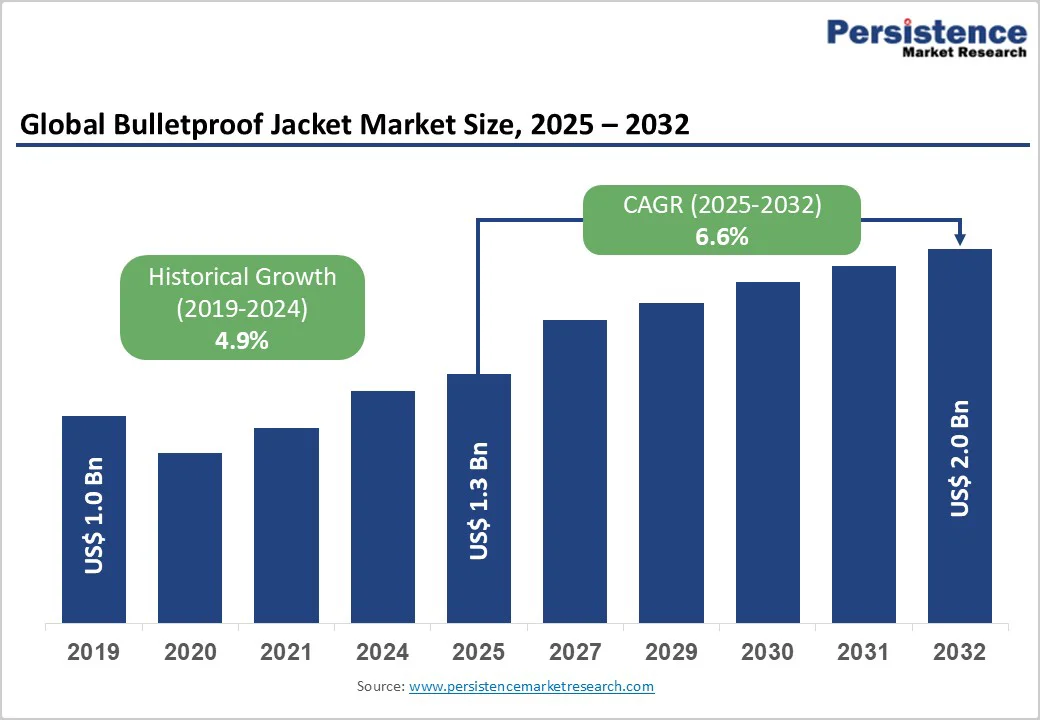
The global bulletproof jackets market size is likely to value at US$ 1.3 billion in 2025 and is projected to reach US$ 2.0 billion by 2032, growing at a CAGR of 6.6% between 2025 and 2032.
Rising geopolitical tensions and increasing defense modernization programs across nations are propelling demand for advanced ballistic protection equipment. According to the Stockholm International Peace Research Institute (SIPRI), world military expenditure rose by 9.4% in 2024 to reach US$ 2,718 billion, the highest global total ever recorded, with defense spending accounting for 2.5% of global GDP. This sustained increase in defense budgets, particularly among NATO members and Asia-Pacific countries, directly translates into procurement of next-generation personal protective equipment, including lightweight bulletproof jackets with enhanced mobility features.
Key Market Highlights
- Leading Region: North America dominates the bulletproof jackets market with 28% market share in 2025, driven by the United States' substantial defense budget of US$ 997 billion and comprehensive law enforcement procurement programs, including the Department of Justice's Bulletproof Vest Partnership, providing federal funding assistance to state and local agencies for protective equipment modernization.
- Fastest Growing Region: Europe exhibits the highest growth trajectory with projected CAGR exceeding 7% during 2025-2032, propelled by military spending increases among NATO allies with European defense expenditure reaching €298.53 billion in 2023, heightened security concerns following terrorist incidents, and substantial procurement driven by the Russia-Ukraine conflict, including UK's delivery of 20,000 body armor plate sets to Ukraine.
- Dominant Product Segment: Soft jackets command approximately 57% market share due to widespread adoption by law enforcement and security personnel requiring concealable, lightweight protection for daily operations, with NIJ Level IIIA representing the most commonly specified protection level utilizing advanced Kevlar and UHMWPE materials offering comprehensive handgun threat coverage while maintaining flexibility and comfort.
- Fastest Growing Protection Level: Level IV hard armor plates represent the fastest-growing protection segment as military forces and tactical law enforcement units increasingly face rifle threats requiring armor-piercing projectile resistance, driven by combat lessons from Ukraine and terrorism incidents where conventional soft armor proved inadequate against high-powered weapons.
- Key Market Opportunity: Integration of smart technologies and female-specific design engineering presents transformative growth opportunities, with Point Blank Enterprises' patent-pending MX6 female vest utilizing Kevlar® EXO™ flexibility and sensor-equipped vests providing health monitoring and threat detection capabilities addressing the fastest-growing law enforcement demographic while advancing connected soldier system concepts.
| Key Insights | Details |
|---|---|
| Bulletproof Jackets Market Size (2025E) | US$ 1.3 Bn |
| Market Value Forecast (2032F) | US$ 2.0 Bn |
| Projected Growth CAGR (2025-2032) | 6.6% |
| Historical Market Growth (2019-2024) | 4.9% |
Market Dynamics
Driver - Rise in Global Security Threats and Military Modernization Programs
Rising terrorism threats, armed conflicts, and border tensions are driving unprecedented demand for advanced ballistic protection systems worldwide. The Islamic State - Khorasan Province (IS-KP) issued specific threats targeting European sporting events in 2024, while the ongoing Russia-Ukraine conflict has dramatically accelerated procurement of protective equipment across European nations.
Military spending in Europe rose by 17% in 2024, with Germany allocating US$ 88.5 billion to defense—the highest since reunification—and providing substantial military aid, including body armor to Ukraine. Law enforcement agencies globally are also upgrading their protective capabilities, with the National Institute of Justice (NIJ) releasing updated standard 0101.07 in 2023 to ensure higher ballistic performance requirements for officers facing evolving threats.
Technological Innovations in Lightweight Materials and Enhanced Comfort
Material science breakthroughs have revolutionized bulletproof jacket manufacturing, with ultra-high molecular weight polyethylene (UHMWPE) and advanced aramid fibers such as DuPont's Kevlar® EXO™ delivering up to 30% weight reduction compared to traditional materials while maintaining superior protection levels. This next-generation material enables unprecedented flexibility and comfort, allowing law enforcement personnel to wear protection for extended periods without mobility constraints.
MKU Limited showcased their Kavro DOMA 360 combat helmet at Milipol Paris in November 2023, capable of withstanding 5 direct hits from an AK-47 rifle from 10 meters distance while providing 360-degree protection—a result of 5 years of research and development. Such innovations address the critical need for protective equipment that does not compromise operational effectiveness, particularly important as female officers comprise the fastest-growing segment in law enforcement.
Market Restraints
High Cost of Advanced Body Armor Materials
The development and manufacturing of advanced bulletproof jackets incorporating cutting-edge materials like UHMWPE, ceramic composites, and next-generation aramid fibers involve substantial research and development investments, resulting in premium pricing that creates barriers for budget-constrained agencies. Advanced NIJ Level IV ceramic plates can cost several hundred dollars per unit, while complete tactical vest systems with Level IIIA soft armor can exceed US$ 2,000, making large-scale procurement challenging for smaller law enforcement departments and developing nations.
Small and medium-sized police departments often struggle to maintain adequate vest replacement cycles, as ballistic materials degrade over time and manufacturers typically recommend replacement every 5 years to ensure optimal protection. This cost constraint is particularly acute in emerging markets where defense budgets remain limited despite growing security threats.
Weight and Thermal Burden Affecting User Compliance
Despite technological advances, body armor systems still impose significant physical and thermal burdens on wearers, leading to compliance issues, particularly among law enforcement officers during routine patrols. Traditional Kevlar-based Level IIIA vests weigh between 2-3 kilograms for soft armor alone, with tactical configurations including hard plates exceeding 7-8 kilograms, causing fatigue during extended wear periods.
The Florida Sheriffs Risk Management Fund documented that officers not routinely wearing body armor are 3.4 times more likely to suffer fatal torso injuries, yet compliance remains challenging due to discomfort in hot climates. Heat stress is a particular concern, with body armor trapping body heat and reducing natural ventilation, leading some officers to remove protection during summer months despite policy requirements.
Market Opportunities
Expansion of Female-Specific Ballistic Protection Systems
The growing participation of women in military and law enforcement roles is now the fastest-growing demographic segment in these professions, and presents significant market opportunities for manufacturers developing female-specific ballistic protection designs. Point Blank Enterprises pioneered a patent-pending female vest model, MX6, designed by a female ballistic engineer, utilizing Kevlar® EXO™ material's flexibility to create feathered, tapered layers that conform to body contours without compromising protection.
Traditional unisex designs often provide inadequate fit for female officers, causing discomfort and reduced compliance, with studies indicating that poorly fitted armor can migrate during movement and expose vital areas. As countries such as India increase female representation in armed forces and NATO members prioritize gender-inclusive equipment standards, manufacturers developing anatomically optimized solutions with equivalent ballistic performance will capture substantial market share in this underserved segment.
Integration of Smart Technologies and Sensor Systems
The convergence of protective equipment with wearable technology represents a transformative opportunity for next-generation bulletproof jackets incorporating health monitoring, communication systems, and threat detection capabilities. Emerging smart vest concepts integrate sensors that monitor wearer's vital signs, detect impacts, and automatically alert command centers when officers are in distress, enhancing situational awareness and emergency response coordination.
The Indian Defence Research and Development Organisation (DRDO) announced in April 2021 the development of lightweight bulletproof jackets using 3D printing technology and advanced composites, demonstrating government investment in next-generation protective systems. Research initiatives are exploring the integration of thermal management systems that actively cool wearers in hot environments, addressing the compliance challenges associated with thermal burden.
Category-wise Insights
Product Type Analysis
The soft jacket segment dominates the bulletproof jackets market with approximately 57% market share in 2025, driven by its widespread adoption among law enforcement and security personnel requiring concealable, lightweight protection for daily operations. Soft bulletproof jackets utilize multiple layers of woven aramid fibers such as Kevlar or UHMWPE materials like Dyneema and Spectra Shield, offering ballistic resistance against handgun ammunition while maintaining flexibility and comfort for extended wear periods.
Soft armor solutions lead revenue generation due to their adaptability across diverse operational scenarios, from routine patrol duties to plainclothes assignments where discretion is paramount. The segment continues to evolve with innovations like EnGarde's MT-PRO™ panels that combine ballistic and stab protection, meeting the Home Office Scientific Development Branch (HOSDB) standards while stopping the P1 blade at 15 joules and hypodermic needles at 5 joules.
Protection Level Analysis
Level IIIA and IIIA+ protection levels command approximately 46% market share in 2025, representing the optimal balance between comprehensive handgun threat protection and practical wearability for daily operational use. This protection category, certified to defeat .357 SIG FMJ Flat Nose projectiles at 448 meters/second and .44 Magnum SJHP rounds at 436 meters/second, provides coverage against virtually all common handgun calibers encountered in law enforcement scenarios.
The California Department of Justice and numerous state procurement specifications mandate minimum Level IIIA protection for uniformed officers, establishing this as the baseline standard for professional duty use. The Alaska Public Risk Alliance offers reimbursement programs covering 50% of vest costs for member agencies, specifically requiring NIJ compliant Threat Level IIIA ballistic vests, demonstrating institutional recognition of this protection level as essential for officer safety. Mehler Vario Systems reports that Level IIIA body armor remains the most common soft armor protection level globally due to its ability to stop almost all handgun rounds while maintaining comfort through advanced materials that reduce weight by up to 40% compared to conventional designs.
End User Analysis
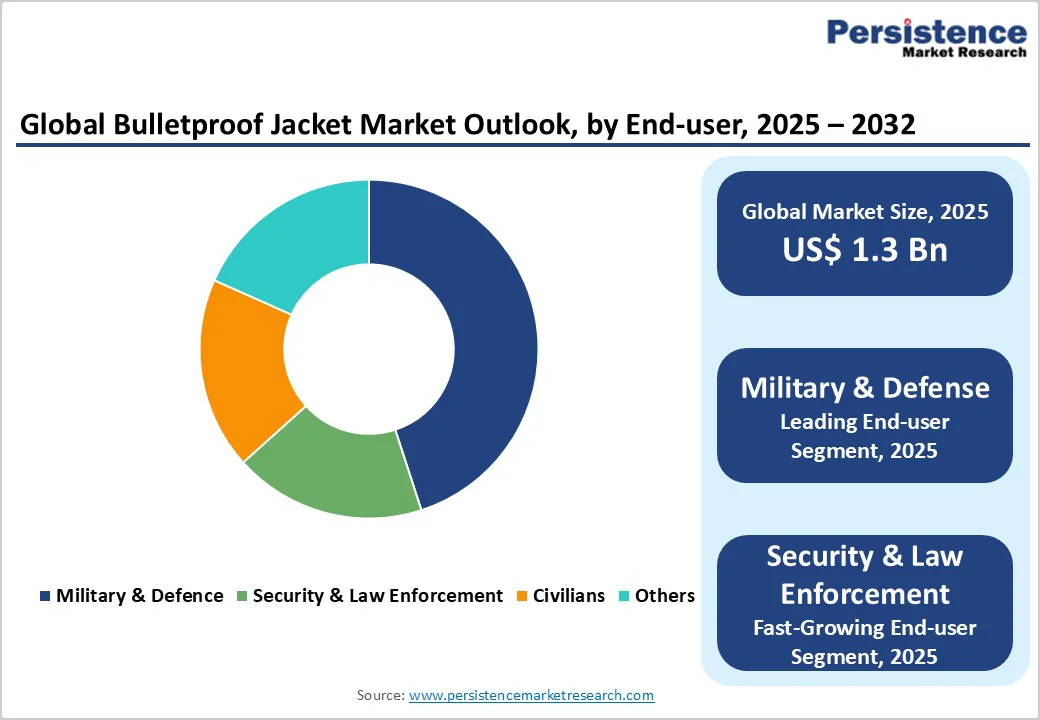
The Military & Defence segment holds the largest market share at approximately 45% in 2025, driven by continuous defense modernization programs, soldier survivability initiatives, and procurement mandates for advanced personal protective equipment across global armed forces. The ongoing Russia-Ukraine conflict has dramatically accelerated military armor procurement, with Asian ceramic component shipments to Russia increasing 69% to over US$ 235 million in 2022, highlighting the wartime surge in demand for protective equipment.
Ukraine received 20,000 sets of life-saving body armor plates from NP Aerospace via UK-NATO support in August 2022, demonstrating the scale of conflict-driven procurement. The Czech Army received deliveries of approximately 31,000 helmets from Argun s.r.o. under a 2017 contract, illustrating routine military replacement cycles and standardization requirements. Military specifications often exceed commercial NIJ standards, with requirements for multi-hit capability, fragmentation protection, and integration with load-bearing equipment and communication systems that distinguish defense applications from civilian law enforcement use.
Regional Insights
North America Bulletproof Jackets Market Trends
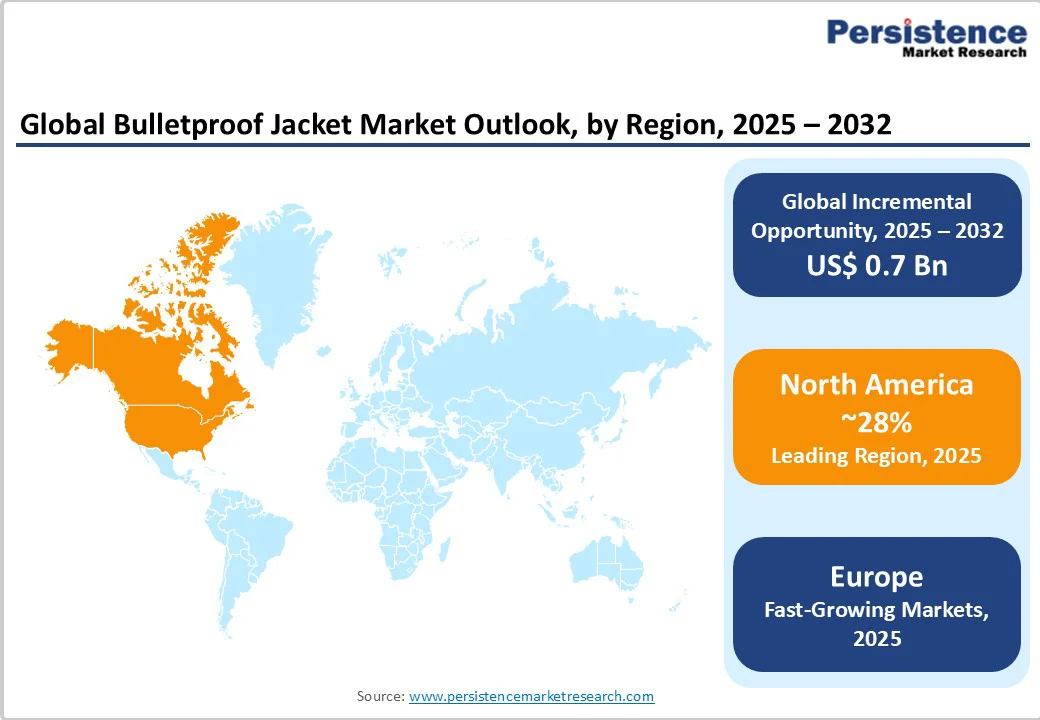
North America leads the global bulletproof jackets market with 28% market share in 2025, driven by the region's substantial law enforcement presence, elevated defense spending, and comprehensive procurement frameworks supporting protective equipment modernization. The United States maintains the world's largest defense budget at US$ 997 billion in 2024, with the Department of Defense allocating significant funding toward soldier protection systems including next-generation body armor leveraging Kevlar® EXO™ technology and advanced composite materials.
The US Department of Justice's Bureau of Justice Assistance operates the Bulletproof Vest Partnership (BVP) program, providing federal funding assistance to state and local law enforcement agencies for vest procurement, having distributed over US$ 500 million since inception. Growing awareness of commercial security risks in retail, healthcare, and education sectors has expanded civilian market adoption, with companies like BulletSafe offering affordable UHMWPE-based Level IIIA vests at accessible price points to address workplace violence concerns.
Canada contributes substantially to regional market dynamics through companies like Canadian Armour Ltd and procurement programs supporting Royal Canadian Mounted Police and Canadian Armed Forces equipment modernization. The region benefits from advanced research and development infrastructure, with ballistic testing facilities operated by manufacturers and independent laboratories ensuring continuous innovation in materials science and protective technologies addressing emerging threats.
Europe Bulletproof Jackets Market Trends
Europe represents the fastest-growing regional market for bulletproof jackets with projected CAGR exceeding 7% during 2025-2032, propelled by heightened security concerns following terrorist incidents, substantial defense spending increases among NATO allies, and regulatory harmonization driving protective equipment standardization. European defense expenditure reached €298.53 billion in 2023 according to the European Defence Agency, with 25 out of 27 member states increasing their military budgets reflecting commitment to defense capability enhancement.
Germany emerged as the fourth-largest global defense spender in 2024 with US$ 88.5 billion allocation, marking a 28% increase from 2023. The Russia-Ukraine conflict has fundamentally reshaped European security priorities, with UK's NP Aerospace delivering 20,000 sets of body armor plates to Ukraine on behalf of NATO governments in August 2022, demonstrating the surge in protective equipment demand.
Belgium awarded the SSC Consortium (Seyntex, Sioen, Crye Precision) a 15-year contract worth €410 million for the comprehensive Belgian Defence Clothing System including ballistic vests and helmets, representing one of Europe's largest integrated soldier system programs. European manufacturers like EnGarde (Netherlands), Seyntex (Belgium), VestGuard UK (United Kingdom), and Argun s.r.o. (Czech Republic) maintain strong regional market positions through compliance with both NIJ and HOSDB standards, enabling access to diverse European and international procurement frameworks.
Asia Pacific Bulletproof Jackets Market Trends
The Asia Pacific region demonstrates robust market growth potential driven by escalating defense modernization programs in China, India, and ASEAN nations, coupled with rising security concerns from terrorism, border conflicts, and civil unrest requiring enhanced protective equipment deployment. India's bulletproof vest market anticipates growth at CAGR over 5% during 2025-2032, fueled by increasing terrorist threats and government initiatives to equip armed forces with modern protective gear. The Indian Army placed orders exceeding ?170-180 crore with MKU Limited for 159,000 ballistic helmets, while DRDO announced development of lightweight bulletproof jackets using advanced composites, demonstrating coordinated government investment in indigenous manufacturing capabilities.
China maintains the world's second-largest defense budget at an estimated US$ 314 billion in 2024, with substantial portions allocated toward soldier modernization programs including next-generation body armor systems. Japan with US$ 55.3 billion, and South Korea with US$ 47.6 billion defense budgets in 2024, highlights continued investments in procurement of defense equipment including protective equipment for personnel facing threats along the demilitarized zone. ASEAN nations including Philippines, Thailand, and Indonesia face persistent terrorism and insurgency challenges, driving law enforcement procurement of protective equipment, while Australia's defense spending and regional security commitments support market expansion through both domestic procurement and regional military assistance programs.
Competitive Landscape
Market Structure Analysis
The bulletproof jackets market exhibits moderate concentration with a mix of established multinational corporations, specialized defense contractors, and regional manufacturers competing across technology leadership, manufacturing scale, and customer relationships. Leading players including DuPont, Point Blank Enterprises, Armor Express, and MKU Limited maintain competitive advantages through proprietary material technologies, extensive NIJ certification portfolios, and strategic partnerships with defense ministries and law enforcement agencies.
Research and development investments focus on lightweight materials utilizing UHMWPE, ceramic composites, and hybrid constructions that reduce weight while maintaining or enhancing ballistic performance. Key differentiators employed by market leaders include in-house ballistic testing facilities with NIJ-accredited capabilities, female-specific design engineering addressing the fastest-growing end-user demographic, and integration of smart textile technologies for next-generation connected soldier systems.
Key Market Developments
January 2024: DuPont announced an exclusive partnership with Point Blank Enterprises to offer body armor made with Kevlar® EXO™ aramid fiber for North American state and local law enforcement departments. This collaboration introduces the Elite EXO™ vest system utilizing next-generation aramid technology that provides 30% weight reduction compared to traditional Kevlar while maintaining NIJ 0101.07 certification compliance and offering unprecedented flexibility for body-inclusive designs including patent-pending female-specific models.
October 2024: DuPont Life Protection received the inaugural Body Armor Innovation Award 2024 for Kevlar® EXO™, securing 35% of public votes and additional expert panel recognition. Industry experts praised the material's combination of lightweight design, superior protection, and enhanced comfort.
November 2023: MKU Limited showcased the Kavro DOMA 360 combat helmet at Milipol Paris, representing the first combat helmet capable of withstanding 5 direct hits from an AK-47 rifle from 10 meters distance while providing full 360-degree protection including crown coverage.
Companies Covered in Bulletproof Jackets Market
- Point Blank Enterprises, Inc.
- Armor Express
- DuPont
- EnGarde
- MKU LIMITED
- ARGUN s.r.o.
- Infidel Body Armor
- Seyntex N.V.
- MARS Armor
- VestGuard UK Ltd
- BulletSafe Bulletproof Vests
- COMPASS INTERNATIONAL CORP. LTD
- Canadian Armour Ltd
- Honeywell International Inc.
- BAE Systems Inc.
- Teijin Limited
- U.S. Armor Corporation
- Safariland LLC
- Royal DSM N.V.
- 3M Company
Frequently Asked Questions
The global bulletproof jackets market is projected to reach US$ 2.0 billion by 2032, growing from US$ 1.3 billion in 2025 at a CAGR of 6.6% during the forecast period.
The bulletproof jackets market is driven by escalating defense modernization programs, rising geopolitical tensions, and increasing law enforcement procurement of advanced protective equipment.
Level IIIA and IIIA+ protection levels command approximately 46% market share in 2025, representing the optimal balance between comprehensive handgun threat coverage and practical wearability for daily law enforcement operations
North America dominates with 28% market share in 2025, driven by the United States’ defense budget of US$ 997 billion, extensive law enforcement infrastructure with approximately 18,000 police departments, and federal funding programs like the Department of Justice’s Bulletproof Vest Partnership supporting protective equipment procurement for state and local agencies.
Significant opportunities include development of female-specific ballistic protection systems addressing the fastest-growing law enforcement demographic and integration of smart technologies incorporating health monitoring sensors.
Leading companies include Point Blank Enterprises, Inc., Armor Express, DuPont, MKU LIMITED, EnGarde, Seyntex N.V., ARGUN s.r.o., VestGuard UK Ltd, COMPASS INTERNATIONAL CORP. LTD, competing through proprietary material technologies, extensive NIJ certifications, and strategic defense ministry partnerships.


