




- Medical Devices
- At Home Molecular Testing Market
At Home Molecular Testing Market Size, Share, Trends, Growth, Regional Forecasts 2026 - 2033
At Home Molecular Testing Market by Test Type (Cassettes, Strips, Test Panels, Dip Cards, Midstream, and Others), Test Type (Pregnancy Tests, HIV Tests, Diabetes, Infectious Diseases, Glucose Tests, Ovulation Predictor Tests, Drug Abuse Tests, and Others), Sample (Urine, Blood, Saliva, and Others) by Distribution Channel (Hospital Pharmacies, Retail Pharmacies, Online Pharmacies, and Others), and Regional Analysis from 2026 to 2033

At home Molecular Testing Market Share and Trends Analysis
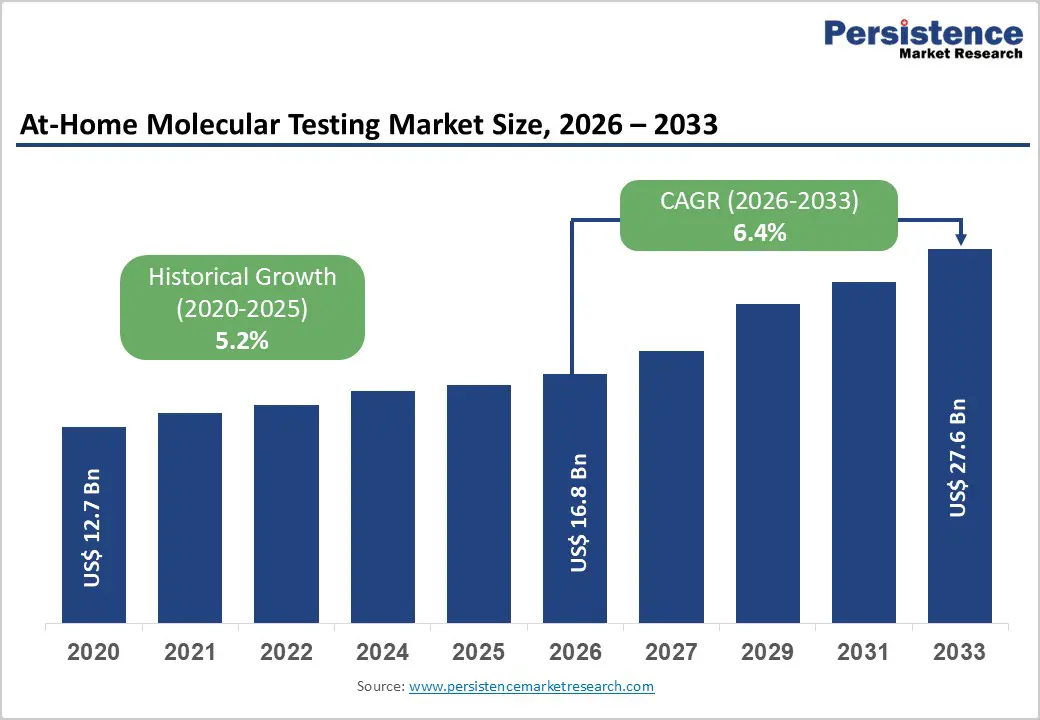
The global at-home molecular testing market is projected to grow from US$ 16.8 billion in 2026 to US$ 27.6 billion by 2033, at a CAGR of 6.4% over the forecast period.
The global demand for at-home molecular testing is rising steadily, driven by the increasing prevalence of infectious diseases, chronic conditions, and reproductive health monitoring needs. Growing awareness of preventive healthcare, rising demand for rapid and private diagnostics, and the shift toward decentralized testing models are expanding the global user base. Increased adoption of self-testing accelerated during recent public health crises and continues to influence long-term consumer behavior.
Advancements in molecular assay design, including higher sensitivity, faster turnaround times, and simplified workflows, are improving test reliability and user confidence. Integration of digital health platforms, smartphone connectivity, and teleconsultation support is further enhancing clinical value and accessibility. Expanding healthcare investments in diagnostics infrastructure, e-commerce distribution, and consumer health technologies are accelerating adoption across both developed and emerging regions. In parallel, ongoing innovation in sample collection methods, assay miniaturization, and cost optimization continues to reinforce sustained market expansion globally.
Key Industry Highlights:
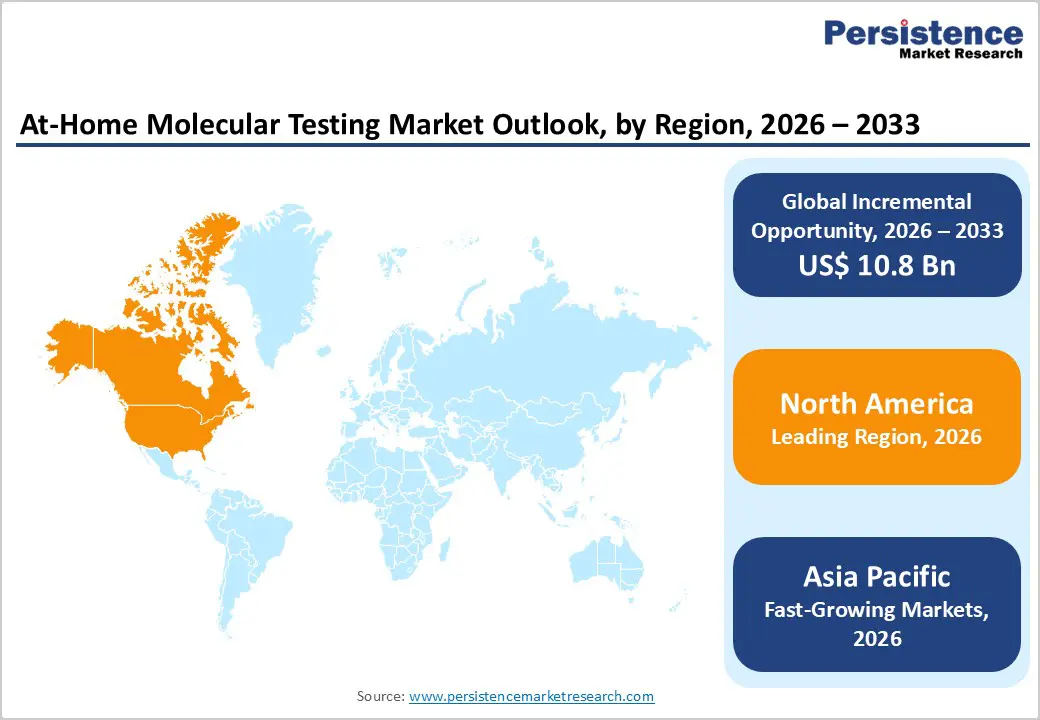
- Leading Region: North America holds the largest market share at 48.5%, supported by high consumer awareness, strong adoption of self-testing solutions, advanced diagnostic infrastructure, favorable regulatory pathways, and widespread availability through retail and online pharmacies.
- Fastest-Growing Region: Asia Pacific is expanding at the fastest pace, driven by a large population base, rising infectious disease burden, improved healthcare access, rapid growth in e-commerce platforms, and increased government focus on decentralized diagnostics.
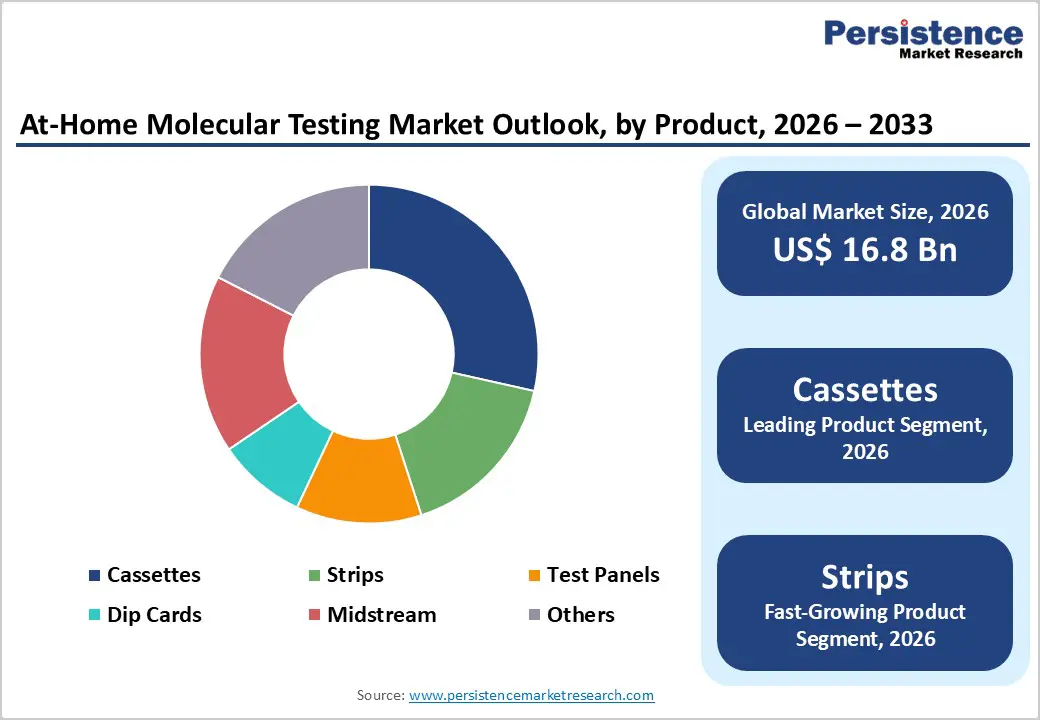
- Leading Product Segment: Cassettes dominate the market due to ease of use, high test accuracy, cost efficiency, and broad applicability across pregnancy, infectious disease, and chronic condition testing.
- Fastest-Growing Product Segment: Strips are witnessing rapid growth as manufacturers expand their use in low-cost, high-frequency testing and emerging market applications.
- Leading Test Type Segment: Pregnancy tests remain the largest application segment due to consistently high testing frequency, strong consumer awareness, and routine use across reproductive-age populations.
- Fastest-Growing Test Type Segment: Glucose tests are expanding rapidly, driven by the rising global prevalence of diabetes and increasing demand for convenient home-based monitoring solutions.
| Key Insights | Details |
|---|---|
| At-Home Molecular Testing Market Size (2026E) | US$ 16.8 Bn |
| Market Value Forecast (2033F) | US$ 27.6 Bn |
| Projected Growth (CAGR 2026 to 2033) | 6.4% |
| Historical Market Growth (CAGR 2020 to 2025) | 5.2% |
Market Dynamics
Driver - Rising Demand for Rapid, Decentralized Diagnostics and Advances in Molecular Testing Technologies Driving Market Growth
The increasing global demand for rapid, accurate, and decentralized diagnostic solutions is a key driver of sustained growth in the at-home molecular testing market. Rising prevalence of infectious diseases, chronic conditions such as diabetes, and reproductive health monitoring needs are significantly expanding the population seeking convenient testing options outside traditional clinical settings. Consumers increasingly prefer at-home testing due to privacy, faster results, fewer healthcare visits, and reduced risk of exposure, particularly following heightened awareness during recent global health emergencies. Aging populations and growing emphasis on preventive healthcare are further accelerating the adoption of self-testing solutions.
Technological advancements in molecular diagnostics are reinforcing this growth trajectory. Innovations in nucleic acid amplification techniques, microfluidics, and assay miniaturization have enabled laboratory-grade sensitivity and specificity in home-use formats. Improvements in sample preparation, reagent stability, and integrated test design have simplified workflows and reduced user error. The incorporation of digital readouts, smartphone connectivity, and cloud-based interpretation of results is enhancing usability and consumer confidence. In parallel, the expansion of regulatory approvals for over-the-counter molecular tests is accelerating commercialization. Together, strong clinical demand and continuous technological innovation are driving steady expansion of the global at-home molecular testing market.
Restraints - High Test Costs, Regulatory Complexity, and Limited Consumer Awareness Constraining Market Adoption
Despite strong growth potential, several factors continue to restrain the broader adoption of at-home molecular testing. High costs associated with molecular test kits remain a key barrier, particularly in price-sensitive and emerging markets. Compared with conventional rapid antigen or lateral flow tests, molecular diagnostics require more complex reagents, manufacturing processes, and quality controls, resulting in higher retail prices. Limited reimbursement coverage for at-home molecular tests in many countries further restricts affordability and repeat usage, especially for chronic disease monitoring.
Regulatory complexity also poses challenges to market expansion. Molecular diagnostics are subject to stringent regulatory scrutiny due to their clinical implications, resulting in lengthy approval timelines and high compliance costs for manufacturers. Variability in regulatory frameworks across regions complicates global product launches and limits scalability. Additionally, concerns regarding test accuracy, improper sample collection, and the interpretation of results persist among certain consumer segments. Limited awareness and understanding of molecular testing technologies can reduce trust and adoption, particularly in rural and underserved areas. Inadequate access to follow-up care or professional guidance after positive results further discourages use. These economic, regulatory, and educational barriers continue to constrain the full penetration of at-home molecular testing solutions.
Opportunity - Expansion of Digital Health Ecosystems and Emerging Market Penetration, Creating New Growth Avenues
The expanding digital health ecosystem presents a significant growth opportunity for the at-home molecular testing market. Integration of test kits with telemedicine platforms, mobile health applications, and remote physician consultations is enhancing the clinical value of home-based diagnostics. Digital connectivity enables real-time sharing of results, clinical interpretation, treatment guidance, and longitudinal health monitoring, thereby increasing consumer confidence and engagement. Employers, insurers, and public health agencies are increasingly adopting connected at-home testing solutions for population health management, screening programs, and early disease detection.
Emerging markets also offer substantial untapped potential. Rapid urbanization, rising healthcare expenditure, expanding middle-class populations, and improving e-commerce infrastructure are increasing access to at-home diagnostic solutions in regions such as the Asia Pacific, Latin America, and the Middle East. Governments are investing in decentralized healthcare delivery to reduce pressure on overstretched laboratory systems, thereby creating favorable conditions for the adoption of home-based testing. Additionally, ongoing research into cost-effective assay chemistries, non-invasive sample types, and simplified device formats is expected to lower entry barriers. Strategic partnerships between global diagnostic companies and local manufacturers will further accelerate market penetration and long-term growth.
Category-wise Analysis
By Product Insights
The cassettes segment is projected to dominate the global at-home molecular testing market in 2026, accounting for a revenue share of 28.5%. Segment leadership is driven by the high versatility of cassette-based formats across a wide range of molecular diagnostics, including pregnancy, infectious disease, and chronic condition testing. Cassettes offer integrated sample processing, reagent containment, and result visualization, reducing user error and improving test reliability in non-clinical settings. Their compatibility with lateral flow and nucleic acid amplification technologies further supports adoption. Cost-effectiveness, long shelf life, and ease of mass manufacturing make cassettes the preferred choice for both manufacturers and consumers. Continuous improvements in assay sensitivity, faster turnaround times, and simplified workflows are reinforcing cassette-based products as the dominant format in the at-home molecular testing landscape.
By Test Type Insights
The pregnancy testing segment is projected to dominate the global at-home molecular testing market in 2026, accounting for 32.5% of revenue. Dominance is primarily attributed to the consistently high testing volume, widespread consumer awareness, and routine use of pregnancy tests across reproductive-age populations. At-home pregnancy testing benefits from strong demand for early, accurate, and private diagnosis, driving repeat purchases and sustained revenue generation. Advancements in molecular sensitivity, early hormone detection, and rapid result delivery are improving test accuracy and user confidence. Additionally, increasing family planning awareness, delayed parenthood trends, and rising fertility monitoring are expanding the addressable user base. The availability of pregnancy tests through retail and online channels further supports segment leadership, making it the most commercially mature and stable test category within the at-home molecular testing market.
By Distribution Channel Insights
The hospital pharmacy segment is projected to dominate the global at-home molecular testing market in 2026, accounting for 45.0% of revenue. Hospitals play a critical role in test recommendations, initial diagnostic confirmation, and patient education, particularly for monitoring infectious diseases and chronic conditions. Hospital pharmacies benefit from higher trust, physician-driven purchasing decisions, and integration into broader diagnostic pathways. They are often the primary access point for newly launched molecular test kits, especially those requiring initial clinical validation or counseling. In addition, hospitals support bulk procurement and standardized quality assurance, reinforcing their leadership position. While retail and online pharmacies are gaining traction, hospital pharmacies continue to dominate due to their established infrastructure, regulatory compliance, and role in bridging clinical diagnostics with home-based testing adoption.
Regional Insights
North America At-Home Molecular Testing Market Trends
The North American at-home molecular testing market is expected to dominate globally, with a 48.5% value share in 2026, led primarily by the United States. The region benefits from a mature diagnostic ecosystem, high consumer awareness, and strong acceptance of self-testing solutions. A high prevalence of infectious diseases, chronic conditions such as diabetes, and reproductive health monitoring drives consistent demand for at-home molecular diagnostics. Favorable regulatory pathways, including emergency and accelerated approvals, have encouraged the rapid commercialization of innovative test kits. Strong insurance coverage, employer-sponsored health programs, and integration with telehealth platforms further support adoption.
The presence of leading diagnostic manufacturers, robust R&D activity, and extensive retail and online pharmacy networks enhances product accessibility. Additionally, consumer preference for privacy, convenience, and rapid results continues to shift testing away from centralized laboratories, reinforcing North America’s leadership in the global at-home molecular testing market.
Europe At-Home Molecular Testing Market Trends
The European at-home molecular testing market is expected to grow steadily, supported by an aging population, rising chronic disease burden, and increasing emphasis on preventive healthcare. Countries such as Germany, the U.K., France, Italy, and the Nordic nations are key contributors due to their strong public health care systems and expanding access to diagnostic services. Growing acceptance of self-testing for infectious diseases, pregnancy, and metabolic monitoring is driving market expansion. Regulatory harmonization across the EU and increased focus on diagnostic accuracy and quality standards are supporting market confidence.
Additionally, government initiatives promoting early disease detection and decentralized healthcare delivery are encouraging adoption of at-home molecular tests. Cost-containment pressures within national health systems are also driving interest in home-based diagnostics as a means of reducing laboratory workload. Increasing digital health integration, including app-based result tracking and teleconsultations, is further strengthening regional growth.
Asia Pacific At-Home Molecular Testing Market Trends
The Asia-Pacific at-home molecular testing market is expected to grow at a relatively high CAGR of approximately 7.9% between 2026 and 2033, driven by rapid healthcare infrastructure development and expanding diagnostic access. Countries including China, India, Japan, South Korea, and Southeast Asian nations are witnessing rising demand for affordable and convenient testing solutions. The growing population, the increasing prevalence of infectious diseases, and the expanding middle-class healthcare spending are key drivers of growth.
Government investments in public health screening programs and diagnostics manufacturing are improving the availability of test kits. The rapid expansion of e-commerce platforms and online pharmacies is significantly enhancing market penetration, particularly in urban areas. Additionally, rising awareness of preventive healthcare, fertility planning, and chronic disease monitoring is accelerating adoption. Partnerships between local manufacturers and global diagnostic companies facilitate technology transfer and support sustained market growth across the region.
Competitive Landscape
The global at-home molecular testing market is highly competitive, with strong participation from companies such as Abbott, ACON Laboratories, Inc., Rapikit, Becton and Dickinson, and Cardinal Health. These players benefit from broad diagnostic product portfolios, established brand credibility, advanced assay development capabilities, and strong global distribution and retail networks. Competitive strategies focus on expanding at-home molecular test menus, improving test accuracy and ease of use, enabling rapid and reliable self-testing, and enhancing overall user experience.
Companies are also investing in clinical validation studies, product line extensions, digital health integration, consumer education programs, and geographic expansion across emerging markets. Continuous innovation in assay chemistry, sample collection methods, device miniaturization, and connected testing platforms is intensifying competition and supporting sustained market evolution.
Key Industry Developments:
- In October 2025, Co-Diagnostics, Inc., a molecular diagnostics company with a proprietary and patented test development platform, announced the development of a novel sample preparation instrument aimed at simplifying and streamlining the workflow for its point-of-care (PoC) Co-Dx PCR Mycobacterium Tuberculosis (MTB) test.
- In December 2023, RIP Molecular Technologies partnered with U.S.-based Molecular Testing Labs (MTL) to develop a new at-home disease testing platform. The collaboration led to a clinical feasibility trial of RIP Molecular Technologies’ patented electronic biosensor technology, which is designed to deliver lab-quality, multi-disease diagnostic results directly to consumers within minutes.
Companies Covered in At Home Molecular Testing Market
- Abbott
- ACON Laboratories, Inc.
- Rapikit
- Becton and Dickinson
- Cardinal Health
- B. Braun Melsungen AG
- Piramal Enterprises Ltd.
- F. Hoffmann-La Roche Ltd
- Quidel Corporation
- Bionime Corporation
- SA Scientific
- ARKRAY USA, Inc.
- Nova Biomedical
- AdvaCare Pharma
- Others
Frequently Asked Questions
The global at-home molecular testing market is projected to be valued at US$ 16.8 Bn in 2026.
Rising demand for rapid, accurate self-diagnostics, increasing prevalence of infectious and chronic diseases, technological advances in molecular assays, and growing consumer preference for decentralized and home-based testing drive the global at-home molecular testing market.
The global at-Home Molecular Testing Market is poised to witness a CAGR of 6.4% between 2026 and 2033.
Key opportunities lie in expanding infectious disease and genetic testing menus, integration of digital health and telemedicine platforms, penetration into emerging markets, and development of low-cost, user-friendly molecular test kits for direct-to-consumer use.
Abbott, ACON Laboratories, Inc., Rapikit, Becton and Dickinson, and Cardinal Health are some of the key players in the at-home molecular testing market.


