




- Nutraceuticals & Functional Foods
- Alpha Lactalbumin Market
Alpha Lactalbumin Market Size, Share, and Growth Forecast 2026 - 2033
Alpha Lactalbumin Market by Form (Powder, Liquid), by Application (Infant Nutrition, Clinical Nutrition, Sports Nutrition, Food & Beverages), End User (Food & Beverage Industry, Pharmaceutical, Nutraceutical), by Regional Analysis, 2026 - 2033

Alpha Lactalbumin Market Share and Trends Analysis
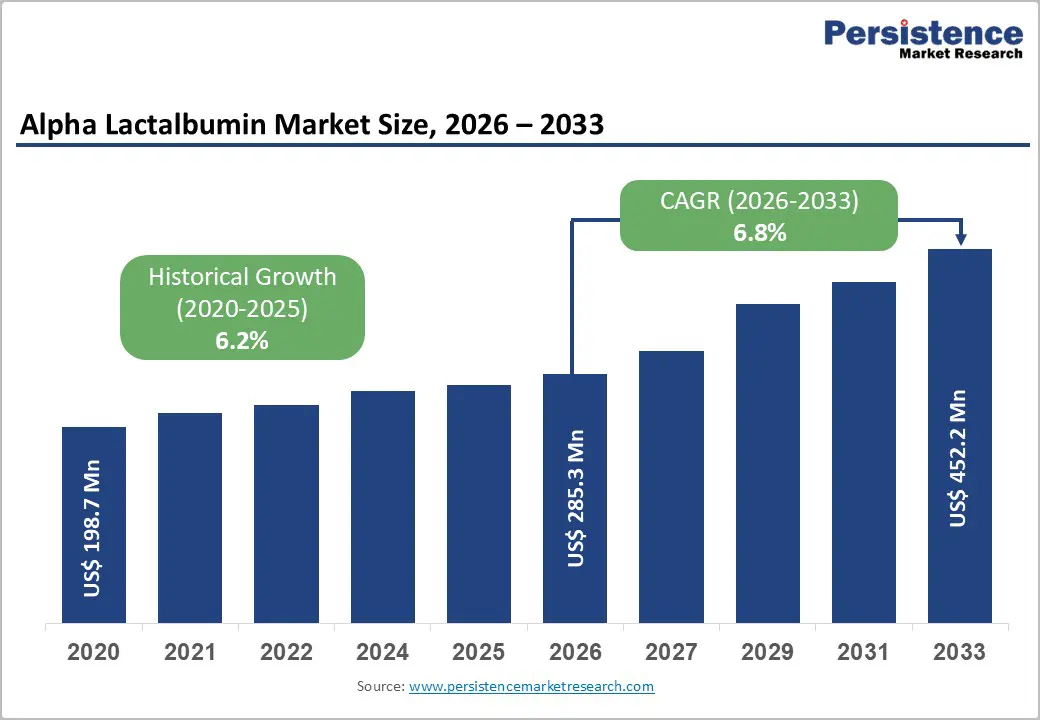
The global alpha lactalbumin market size is expected to be valued at US$ 285.3 million in 2026 and projected to reach US$ 452.2 million by 2033, growing at a CAGR of 6.8% between 2026 and 2033. The market expansion is driven by escalating demand for premium infant nutrition products that closely mimic the nutritional composition of human breast milk, coupled with growing global health consciousness.
The rising focus on optimizing early-life nutrition, along with increased awareness of the long-term health benefits of balanced protein intake in infancy, has prompted manufacturers to incorporate alpha-lactalbumin into specialized formulations. Additionally, the burgeoning sports nutrition sector, projected to grow at a 9-10% CAGR over the next decade, is driving substantial demand for high-quality whey protein ingredients enriched with alpha-lactalbumin for muscle recovery and performance enhancement.
Key Industry Highlights
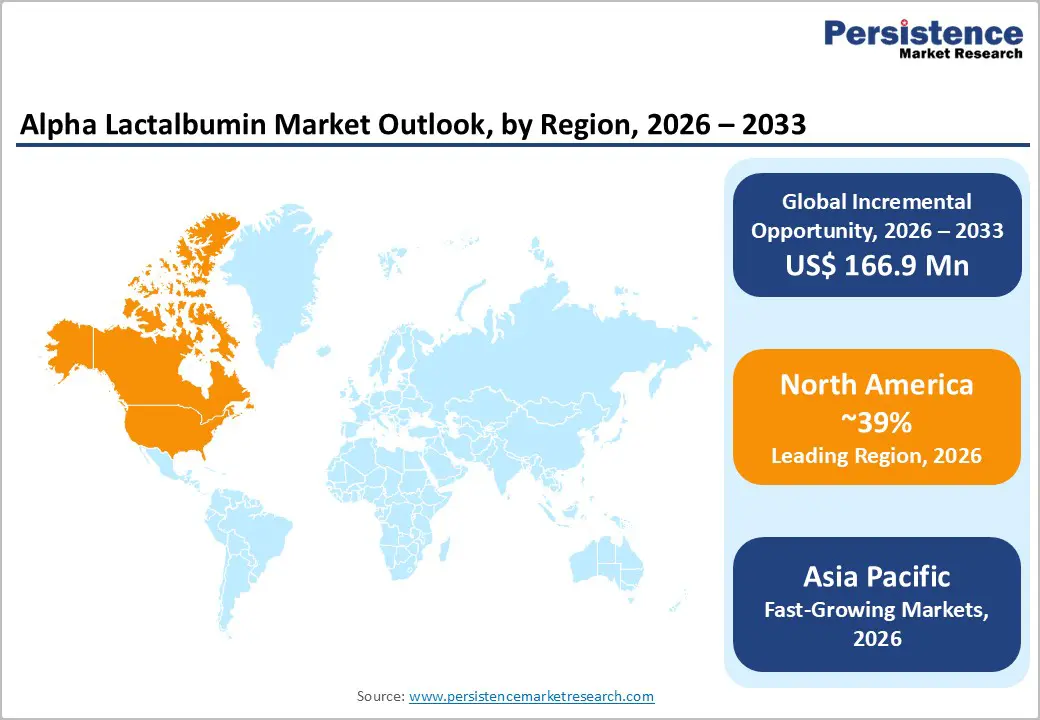
- Leading Region - North America: North America leads the alpha lactalbumin market with about 39% share, underpinned by a highly regulated infant formula sector, sophisticated sports nutrition industry, and strong presence of global dairy ingredient leaders that anchor regional demand and innovation.
- Fastest-Growing Region - Asia-Pacific: Asia-Pacific is the fastest-growing region, supported by rapid urbanization, demographic shifts, rising middle-class incomes, and expanding clinical and consumer nutrition segments that increasingly favor premium proteins like alpha-lactalbumin in infant, medical, and performance formulations.
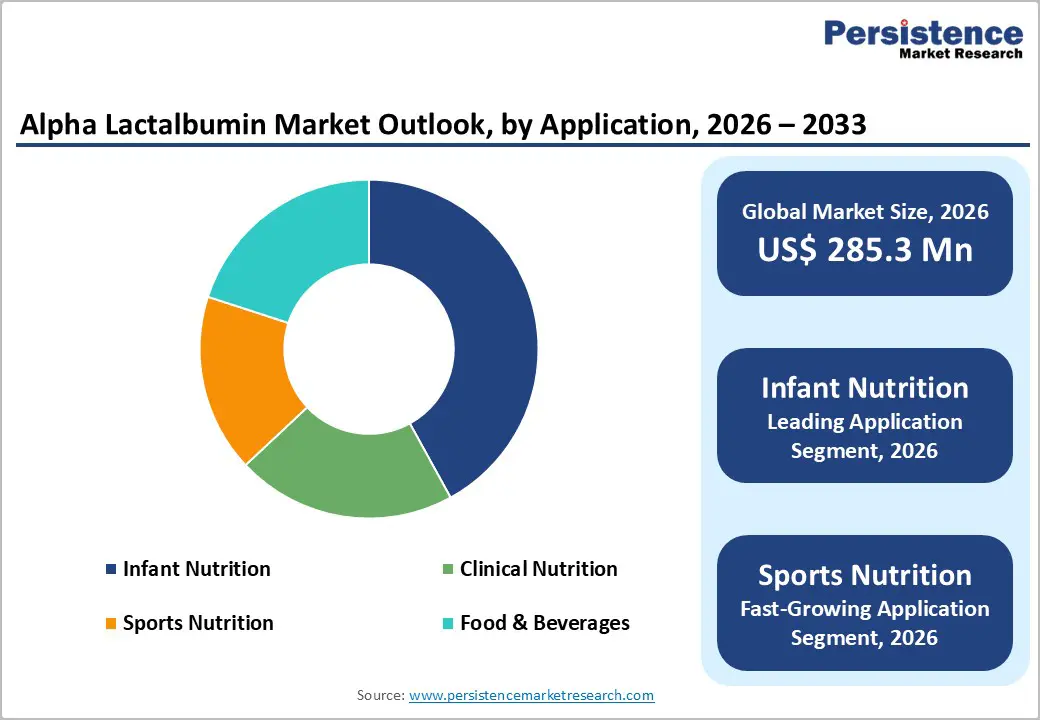
- Dominant Segment - Infant Nutrition: The Infant Nutrition application segment holds the largest share of alpha lactalbumin use, reflecting its key role in human-milk-inspired formulas where amino-acid quality, digestibility, and regulatory focus on early-life nutrition strongly support continued incorporation.
- Fastest-Growing Segment - Sports Nutrition: Sports nutrition represents the fastest-growing use case, as brands adopt alpha lactalbumin to differentiate high-end protein products with evidence-based benefits for muscle recovery, sleep quality, and holistic performance, aligned with the broader high-growth protein supplements category.
- Key Market Opportunity - Clinical and Clean-Label Nutrition: The combination of expanding Asia-Pacific clinical nutrition demand and global clean-label expectations creates a pivotal opportunity for manufacturers to position alpha lactalbumin as a premium, traceable, and science-backed protein across medical, infant, and lifestyle nutrition platforms.
| Alpha Lactalbumin Market Size (2026E) | US$ 285.3 Mn |
| Market Value Forecast (2033F) | US$ 452.2 Mn |
| Projected Growth (CAGR 2026 to 2033) | 6.8% |
| Historical Market Growth (CAGR 2020 to 2025) | 6.2% |
Market Dynamics
Drivers - Increasing prevalence of infant formula adoption
The global infant nutrition market is expanding steadily, driven by rising female workforce participation and changing family structures that increase reliance on packaged infant formula. In Europe, for example, the broader baby food and infant formula space is projected to grow steadily toward 2030, supported by higher spending on premium products and fortified formulations. Alpha lactalbumin, the dominant whey protein in human milk, offers an amino acid profile that closely aligns with breast milk and allows manufacturers to reduce total protein content while maintaining nutritional adequacy. Clinical and regulatory discussions in both Europe and the United States increasingly emphasize avoiding excessive protein intake in infancy due to its association with higher obesity risk later in life, which strengthens the positioning of alpha lactalbumin as a preferred protein fraction in next-generation formulas. Leading brands under groups such as Nestlé S.A., Danone, and others highlight human-milk-inspired formulations, indirectly reinforcing demand for alpha lactalbumin as a differentiating ingredient in premium infant formula ranges.
Growing demand in the sports nutrition segment
The global sports nutrition market is on a strong growth trajectory, with various analyses indicating expansion from the mid-US$ 20 billion range in the mid-2020s to well above US$ 60 billion by the mid-2030s, at a CAGR of 9-10%. Within this landscape, high-value whey protein ingredients remain core to formulations for athletes and active consumers, and alpha-lactalbumin is gaining attention for its high tryptophan content and favorable branched-chain amino acid profile. Peer-reviewed research has shown that alpha-lactalbumin supplementation can increase tryptophan availability, thereby enhancing serotonin and melatonin synthesis, which, in turn, may improve sleep quality and recovery in athletes. This dual functionality, supporting both muscle recovery and sleep, aligns well with holistic performance strategies now adopted by many sports professionals and serious amateurs, and is reflected in new premium whey blends and nighttime recovery products that feature alpha-lactalbumin as a key fraction.
Restraints - Stringent regulatory requirements and manufacturing compliance complexities
Regulation of infant formula and specialized nutrition products is stringent in major markets such as the United States, the European Union, and other developed regions. In the U.S., the Food and Drug Administration (FDA) requires infant formula manufacturers to comply with detailed provisions in 21 CFR Parts 106 and 107, covering good manufacturing practices, quality-control procedures, nutrient requirements, microbial testing, and notification obligations before marketing new formulas. These obligations raise the cost and time needed to introduce new formulations featuring specific proteins, such as alpha-lactalbumin, especially when companies also generate clinical data to support product positioning. For smaller players and new entrants, the complexity of meeting such regulatory expectations can act as a barrier to entry, reducing competitive intensity but also slowing the pace of diversification in alpha lactalbumin applications beyond established multinational manufacturers.
Supply chain volatility and raw-material cost fluctuations
The whey protein value chain has experienced notable price volatility linked to dairy market cycles, energy costs, and capacity utilization in cheese and whey processing facilities. Reports covering the 2024 whey market highlight episodes where whey protein isolate prices increased by double-digit percentages, raising input costs for sports nutrition powders, infant formulas, and other protein-fortified products. Since alpha lactalbumin is a purified fraction derived from whey streams, its economics are sensitive to both upstream milk supply and downstream fractionation capacity utilization. Tight margins in commodity dairy, coupled with elevated capital expenditure for advanced membrane filtration and chromatography technologies, can constrain rapid capacity expansion for high-purity alpha lactalbumin, leading to potential supply-demand imbalances and pricing pressure for formulators in high-growth segments.
Opportunities - Emerging demand in Asia-Pacific clinical and medical nutrition
The Asia-Pacific region is witnessing strong growth in clinical and medical nutrition, driven by aging populations, rising chronic disease incidence, and higher healthcare expenditure in markets such as China, Japan, India, and parts of ASEAN. Regional medical nutrition and meal-replacement product markets are projected to grow at high single-digit CAGRs through 2030-2035, supported by hospital-based nutrition protocols and home-care nutrition programs. In this context, alpha-lactalbumin is attractive for formulations intended for pediatric patients, malnourished individuals, oncology patients, and older adults due to its digestibility and amino acid profile aligned with human needs. As more manufacturers in China and India invest in local high-grade dairy ingredient processing and as regulatory pathways for medical foods in Asia become clearer, there is a meaningful opportunity to position alpha lactalbumin as a premium functional protein in oral nutritional supplements, enteral feeds, and specialized complete-nutrition products.
Clean-label movement and transparency-driven product innovation
Across North America, Europe, and an increasing share of Asia-Pacific, consumers are actively seeking clean-label products with short ingredient lists, clear sourcing stories, and demonstrable sustainability credentials. Dairy ingredient producers such as Arla Foods Ingredients, Fonterra, and others are responding with programs that emphasize pasture management, animal welfare, traceability, and reductions in climate impact across their whey and specialty protein portfolios. Alpha-lactalbumin fits naturally into this narrative as a recognizable dairy protein-derived protein fraction that can be highlighted on pack and in marketing materials for infant nutrition, functional beverages, and sports supplements. The combination of clean-label positioning with science-backed functional benefits such as improved amino-acid quality, potential sleep support, and immune modulation creates room for premium differentiation and value-added line extensions in categories where commoditized protein concentrates and isolates are under price pressure.
Category-wise Analysis
Form Insights
Within the alpha lactalbumin market, the powder form is the leading segment, accounting for an estimated majority share of usage in 2025, often approximated at well over half of total demand. Powder forms are favored by infant formula manufacturers and sports nutrition brands due to their long shelf life, ease of handling, and compatibility with dry-blend processing lines, spray-drying operations, and global logistics that require ambient-temperature stability. Key ingredient suppliers, including Arla Foods Ingredients, Fonterra, Hilmar, and Glanbia Nutritionals, typically focus their high-purity whey fractions on powder formats, leveraging decades of whey-to-powder infrastructure for commodity and specialty proteins. While liquid alpha-lactalbumin solutions are relevant in clinical and ready-to-drink applications, they are more sensitive to microbiological stability, cold-chain needs, and packaging costs, which currently limit their overall share relative to powders in the global market.
End User Insights
Among end users, the Food & Beverage Industry accounts for the largest share of alpha lactalbumin usage, with many applications in infant formula, dairy beverages, yogurts, nutritional bars, and high protein snacks. Large global players such as Nestlé, FrieslandCampina, Kerry Group, and Lactalis integrate specialty whey fractions into branded consumer products, leveraging formulation support from ingredient divisions and external partners. The Pharmaceutical and Nutraceutical sectors represent important and growing end-user groups for clinical nutrition products, immune support supplements, and condition-specific formulations where protein quality and tolerability are critical. The nutraceutical channel, in particular, benefits from faster innovation cycles and relatively flexible regulatory pathways in some markets, allowing the launch of alpha-lactalbumin-containing products positioned for sleep, mood, or recovery support without the extended timelines typical of strictly regulated medicinal products.
Regional Insights
North America Alpha Lactalbumin Market Trends and Insights
North America is the leading regional market, with estimates indicating it accounts for close to 39% of global alpha-lactalbumin demand around 2025, anchored by the sizeable and premiumized U.S. infant formula and sports nutrition industries. The FDA has, in recent years, strengthened its oversight of infant formula manufacturing in response to shortages and safety concerns, issuing updated guidance, inspection priorities, and initiatives in 2024-2025 to improve supply resilience and quality management. These measures favor well-established manufacturers with robust quality systems, which often have both the incentive and the capability to reformulate products with high-value ingredients like alpha-lactalbumin to differentiate in a tightly regulated environment.
In parallel, the North American sports nutrition market continues to expand, with strong participation in fitness, endurance sports, and active-lifestyle pursuits driving demand for protein powders, RTD shakes, and fortified foods. Ingredient players such as Glanbia Nutritionals and Arla Foods Ingredients are active in supplying advanced whey fractions and supporting brands with formulation and application expertise. The innovation ecosystem-spanning startups, contract manufacturers, academic institutions, and digital-health platforms-also supports the emergence of personalized nutrition solutions where targeted protein fractions like alpha lactalbumin can be used in customized blends for specific recovery, sleep, or metabolic goals.
Asia Pacific Alpha Lactalbumin Market Trends and Insights
Asia-Pacific is the fastest-growing region for specialized nutrition and dairy ingredients, driven by population scale, rising incomes, and rapidly changing dietary habits in China, India, Japan, and Southeast Asia. Chinese demand for high-quality infant formula has remained strong, with continuing interest in imported brands and premium domestic offerings that emphasize safety, traceability, and advanced formulations inspired by human milk. This is favorable for alpha lactalbumin, particularly in premium and super-premium formulas marketed in urban centers and via cross-border e-commerce.
At the same time, the region’s medical nutrition and meal replacement markets are growing at robust, high-single-digit CAGRs, supported by demographic aging, urban stress, and increased attention to disease-related malnutrition and metabolic health. Domestic and international players are investing in local production infrastructure, including dairy processing plants and blending facilities in China, India, and Oceania, to improve supply security and cost competitiveness for advanced whey fractions. Regulatory modernization in markets such as China, India, and members of ASEAN is gradually clarifying routes to market for foods for special medical purposes and high-value nutritional products, offering a pathway for wider use of alpha lactalbumin in both clinical settings and consumer health channels across the region.
Competitive Landscape
The Alpha Lactalbumin market is moderately consolidated, with a few large players holding a significant share due to strong production capabilities and advanced protein extraction technologies. Competition is driven by product quality, purity levels, and compliance with strict regulatory standards, especially for infant nutrition applications. Companies focus on innovation, expanding production capacity, and improving supply chain efficiency to maintain their position. Meanwhile, smaller and regional players are entering the market with cost-effective offerings, increasing competitive pressure.
Key Market Developments
- In July 2025, 21st.BIO launched of a precision fermentation development program for bovine alpha-lactalbumin after securing an exclusive license for a high-yield microbial strain from Novonesis. The initiative focused on optimizing the strain for industrial-scale fermentation, commercialization, and cost competitiveness compared to traditional dairy-derived protein.
- In December 2025, Dyadic Applied BioSolutions and BRIG BIO signed a development and commercialization agreement to jointly develop and commercialize animal-free bovine alpha-lactalbumin for global nutrition markets. The collaboration aimed to enable scalable and cost-effective production using precision fermentation technology, targeting applications in infant, clinical, and healthy aging nutrition.
- In May 2025, ByHeart launched its “Anywhere Pack,” a first-of-its-kind travel-ready infant formula designed to provide convenience for modern parents. The product was introduced as a compact, pre-portioned, single-serve format that simplifies bottle preparation during travel and daily activities.
Companies Covered in Alpha Lactalbumin Market
- Arla Foods Ingredients
- Fonterra Co-operative Group
- Agropur Cooperative
- Hilmar Ingredients
- Glanbia Nutritionals
- FrieslandCampina
- Kerry Group
- Milk Specialties Global
- Lactalis Group
- Nestlé S.A.
- Merck KGaA
- Abcam plc
- Others
Frequently Asked Questions
The global alpha lactalbumin market is expected to reach about US$ 285.3 million in 2026, forming the baseline for steady expansion through 2033 as demand rises across infant, sports, and clinical nutrition.
Key demand drivers include growing adoption of premium infant formulas that emulate human milk, rapid expansion of the sports nutrition category, rising awareness of protein quality and early‑life nutrition, and emerging clinical nutrition applications using alpha lactalbumin for tolerable, high‑quality protein delivery.
North America currently holds the largest regional share, supported by a regulated and premium‑focused infant formula sector, a large and sophisticated sports nutrition market, and strong participation of leading global dairy ingredient suppliers.
The most significant opportunity lies in combining Asia‑Pacific clinical and medical nutrition growth with global clean‑label trends, enabling alpha lactalbumin to be positioned as a premium, traceable, science‑backed protein in medical, infant, and active‑lifestyle applications.
Key players include Arla Foods Ingredients, Fonterra Co-operative Group, FrieslandCampina, Glanbia Nutritionals, Hilmar Ingredients, Agropur Cooperative, Kerry Group, Milk Specialties Global, Lactalis Group, Nestlé S.A., Abbott Laboratories, Danone S.A., Merck KGaA, Abcam plc, Saputo Inc., Perrigo Company plc, China Mengniu Dairy Co., Ltd., and Walgreens Boots Alliance, Inc.


