Centrifugal Industrial Dryer Market Size, Trends, Share, and Growth Forecast 2026 - 2033

Centrifugal Industrial Dryer by Dryer Type (Batch, Continuous, Semi-continuous, Custom-built), by Capacity (Low Capacity, Medium Capacity, High Capacity), Power Source (Electric, Steam, Gas-fired, Hybrid), Distribution Channel (Direct Sales, Distributors, OEM Partnerships, Aftermarket Services), Industry, and Regional Analysis, 20262033

ID: PMRREP19348
Calendar

February 2026

189 Pages

Author : Jitendra Deviputra

Centrifugal Industrial Dryer Market Size and Trend Analysis

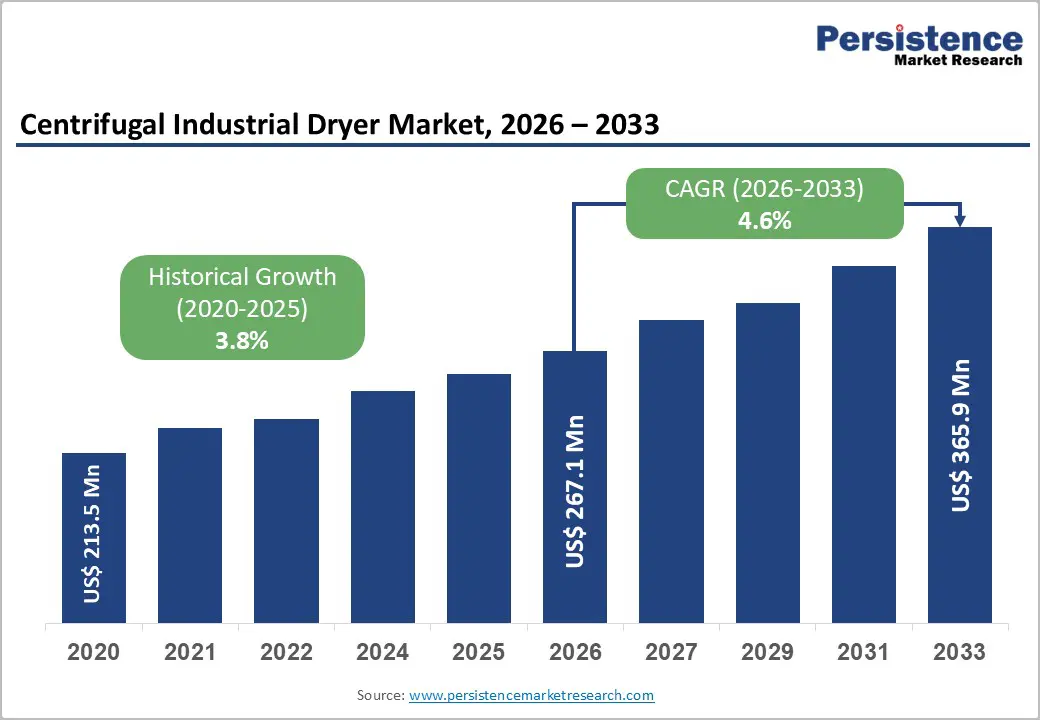
The global centrifugal industrial dryer market is projected to reach US$ 267.1 million in 2026 and US$ 365.9 million by 2033, growing at a CAGR of 4.6% over the forecast period. Market growth is driven by Asia-Pacific industrialization, rising pharmaceutical API drying needs under GMP standards, and Industry 4.0 integration, which is transforming centrifugal dryers into smart, energy-efficient systems.

Key Market Highlights

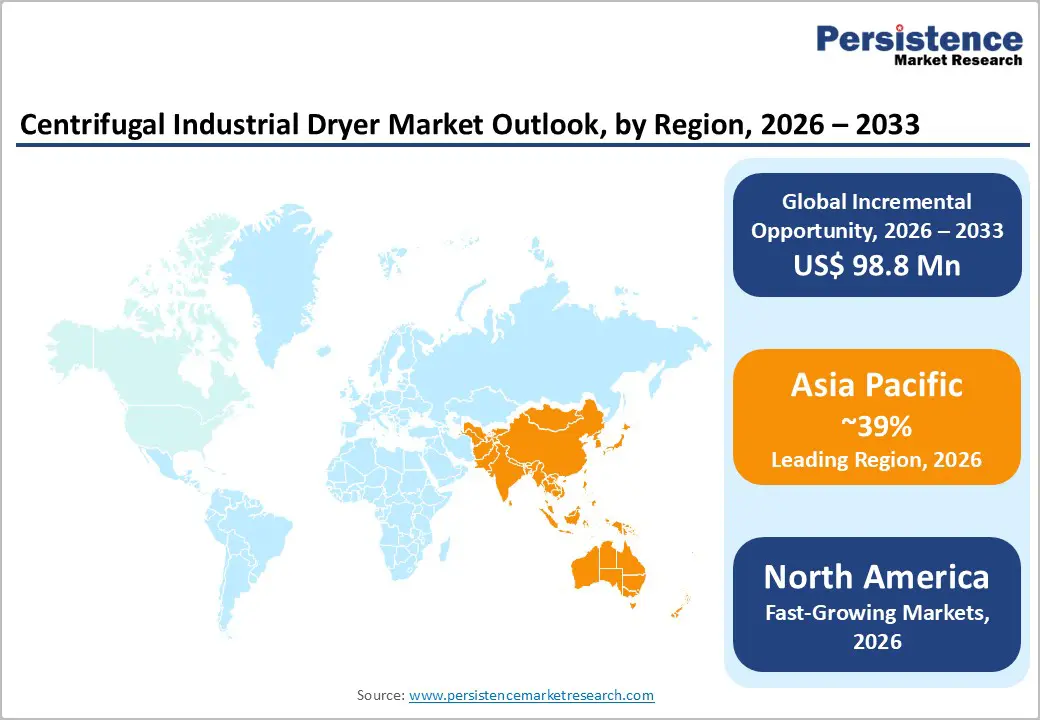
  • Leading Region: Asia-Pacific dominates the global centrifugal industrial dryer market, holding a 39% share, driven by rapid industrialization in China and India, the expansion of pharmaceutical manufacturing, and large-scale food-processing operations that require efficient drying solutions to optimize production.
  • Fastest Growing Region: North America maintains a strong market position with established manufacturing infrastructure, stringent regulatory frameworks, and advanced technology adoption, and is growing steadily through semiconductor manufacturing, pharmaceutical production, and food processing expansion.
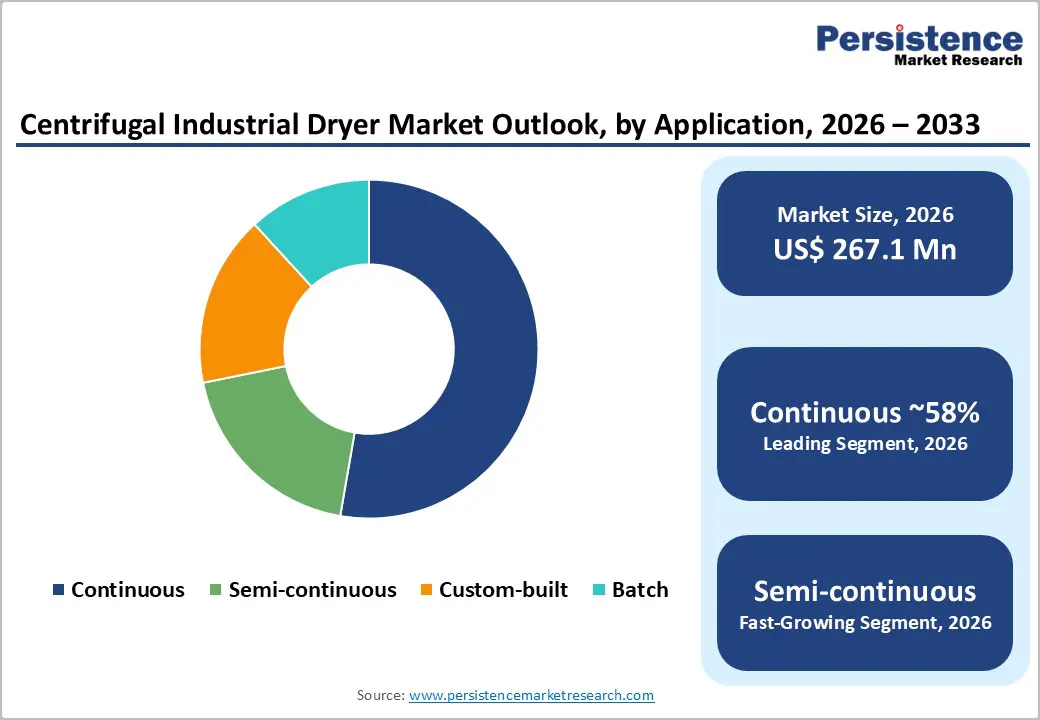
  • Leading Segment: Continuous centrifugal dryer systems account for approximately 58% of the market, and are preferred for high-volume production environments that require efficient, uninterrupted drying operations to support large-scale manufacturing and optimize production efficiency.
  • Fastest-Growing Segment: Electric-powered centrifugal dryers exhibit a 7.8% CAGR, driven by precise temperature control, superior Industry 4.0 compatibility, and widespread electrical infrastructure that supports adoption across pharmaceutical and specialty applications.
  • Key Opportunity: Pharmaceutical active pharmaceutical ingredient (API) drying and GMP-compliant drying solutions represent the fastest-growing segment, with expanding pharmaceutical manufacturing across the Asia-Pacific region and stringent regulatory requirements driving demand for specialized, precision-engineered centrifugal drying systems.
Key Insights Details
Centrifugal Industrial Dryer Market Size (2026E) US$267.1 Mn
Market Value Forecast (2033F) US$ 365.9 Mn
Projected Growth (CAGR 2026 to 2033) 4.6%
Historical Market Growth (CAGR 2020 to 2025) 3.8%

centrifugal-industrial-dryer-market-2026–2033

Market Dynamics

Drivers - Rapid industrial growth in Asia Pacific is accelerating demand for advanced centrifugal dryers across food and pharmaceutical manufacturing sectors

Rapid industrial growth across the Asia Pacific region, especially in China and India, is strongly increasing demand for advanced centrifugal drying solutions across multiple manufacturing industries. The food processing sector remains the leading application area, valued at around US$ 1,050 million in 2024 and expected to reach nearly US$ 1,540 million by 2035. This growth is supported by continuous demand for efficient drying systems that help preserve flavour, extend shelf life, and ensure food safety through accurate moisture control. At the same time, the pharmaceutical industry is witnessing rapid expansion due to the rising production of active pharmaceutical ingredients (APIs).

Manufacturers increasingly require high-performance centrifugal dryers that operate in GMP-compliant environments and deliver precise temperature and moisture control for heat-sensitive compounds. Additionally, rising urbanization, expanding middle-class populations, and growing industrial infrastructure across emerging economies are creating sustained demand for efficient manufacturing equipment that improves productivity, reduces operational costs, and supports long-term industrial growth.

Industry 4.0 integration is transforming centrifugal dryers into intelligent, data-driven systems, enabling efficiency, predictive maintenance, and process optimization

The integration of Industry 4.0 technologies such as artificial intelligence, the Internet of Things, and predictive analytics is transforming centrifugal dryers into intelligent, connected production assets. By 2025, more than half of industrial companies are expected to adopt Industry 4.0 solutions, driving strong demand for smart drying systems with real-time monitoring and automated process optimization. Modern centrifugal dryers now offer AI-enabled predictive maintenance that reduces unexpected downtime, improves energy efficiency, and maintains consistent product quality.

Cloud-based connectivity enables manufacturers to track equipment performance across multiple facilities, identify inefficiencies, and anticipate component failures. This digital transformation is also creating new opportunities for waste reduction, energy optimization, and resource efficiency. As a result, manufacturers are increasingly willing to pay premium prices for advanced drying systems that deliver long-term operational savings, higher reliability, and improved sustainability performance.

Restraints - High upfront costs, complex retrofitting requirements, and regulatory compliance challenges limit centrifugal dryer adoption, particularly for small manufacturers

Centrifugal dryer systems require significant upfront capital investment, particularly for advanced models that include automation, specialized materials, and customized engineering designs. These costs can be challenging for small and mid-sized manufacturers with limited budgets. Integration becomes even more complex when upgrading or retrofitting existing production facilities, as it often requires major structural modifications, utility upgrades, and extensive operator training. Such requirements extend project timelines and increase overall ownership costs.

In addition, stringent environmental regulations require the installation of wastewater treatment units, emission control systems, and energy-efficient components, thereby increasing capital and compliance costs. Market growth is also affected by supply chain disruptions, fluctuations in raw material prices, and dependence on specialized components. These factors increase lead times for customized equipment and limit access for manufacturers that lack strong technical expertise or financial flexibility.

Rising energy costs and strict environmental regulations are increasing compliance burdens and pushing demand toward more sustainable drying technologies

Industrial drying processes consume substantial amounts of energy, making centrifugal dryers a key focus area for cost control and sustainability initiatives. Rising energy prices and increasing pressure to reduce carbon emissions are creating challenges for both equipment manufacturers and end users. Environmental regulations governing air emissions, wastewater discharges, and waste handling require continuous monitoring and additional pollution-control systems, thereby increasing operational complexity and compliance costs.

Many governments are introducing stricter policies to promote energy efficiency, low-emission manufacturing, and circular-economy practices. These policies encourage companies to explore alternative technologies or upgrade to more energy-efficient systems. As a result, conventional centrifugal dryer providers face increasing competition from innovative solutions that promise lower energy consumption and reduced environmental impact, thereby exerting pressure on pricing and accelerating the need for technological advancements.

Opportunity - Growing wastewater treatment investments are creating strong demand for centrifugal dryers supporting sludge reduction, resource recovery, and environmental compliance

The water and wastewater treatment sector offers strong growth potential for centrifugal dryer manufacturers, driven by rising demand for efficient sludge dehydration and solids handling solutions. Municipal treatment plants and industrial facilities are increasingly focused on reducing sludge volume, lowering disposal costs, and meeting strict discharge regulations. Centrifugal dryers play a critical role in the treatment of mineralized mine water and in zero-waste processes by enabling water recovery and the extraction of valuable mineral salts.

Rapid investment in water infrastructure across the Asia-Pacific and emerging regions is further increasing demand for advanced dehydration systems. Wastewater treatment operators are prioritizing technologies that improve operational efficiency while supporting environmental compliance. As regulations become more stringent and disposal costs rise, demand for reliable centrifugal drying equipment that enables resource recovery and long-term cost savings is expected to grow steadily.

AI-enabled smart dryers with predictive maintenance capabilities are improving reliability, reducing downtime, and unlocking premium market opportunities

Technological advancements in artificial intelligence and IoT are creating significant opportunities for next-generation centrifugal dryers. Smart dryers equipped with advanced sensors and analytics enable real-time performance monitoring, predictive maintenance, and automated process optimization. These features help reduce unplanned downtime, extend equipment life, and lower maintenance costs by shifting from fixed schedules to condition-based servicing. Remote monitoring capabilities allow manufacturers to manage equipment across multiple sites and respond quickly to performance issues.

Companies investing in intelligent process control and AI-driven optimization are gaining access to premium customer segments by offering lower total cost of ownership and higher operational reliability. The adoption of edge computing and high-speed connectivity further enhances system responsiveness, making smart centrifugal dryers highly attractive for pharmaceutical, chemical, and food processing industries seeking efficiency and consistent quality.

Category-wise Analysis

Dryer Type Insights

Continuous centrifugal dryers account for approximately 58% of the total share, supported by their strong performance in high-volume, uninterrupted production environments. These systems are widely used in industries that require consistent throughput and minimal downtime, allowing manufacturers to maximize productivity and equipment utilization. Continuous dryers are particularly well-suited for large-scale food processing, chemical, and pharmaceutical operations where stable moisture control and predictable output are essential. Their dominance reflects growing preference for automation and streamlined production workflows. Batch centrifugal dryers hold around 32% market share and continue to grow steadily, especially among manufacturers that require greater flexibility. These systems allow precise control over processing parameters and are ideal for handling varying batch sizes and specialized products. Manual and automated batch options make them attractive for niche and high-value applications.

Power Source Insights

Electric-powered centrifugal dryers lead the market with approximately 52% share, driven by their wide availability, precise temperature control, and easy integration with automated production systems. These systems are especially favored in pharmaceutical and specialty chemical industries where strict process control is critical. Electric dryers also align well with Industry 4.0 technologies, enabling real-time monitoring and digital optimization.

Steam-powered systems account for around 28% of market demand and are valued for their indirect heating capability, which reduces contamination risks. They are commonly used in food and pharmaceutical applications where product purity is essential. Gas-fired and hybrid dryers make up the remaining share, offering flexibility and cost advantages for large-scale operations. These systems allow manufacturers to optimize energy use through fuel switching and support long-term operational efficiency.

Capacity Insights

Medium-capacity centrifugal dryers represent nearly 48% of total market demand, offering an ideal balance between investment cost and production efficiency. With processing capacities ranging from 5,000 to 15,000 kg per hour, these systems meet the needs of most mid-sized manufacturing facilities across the food, chemical, and pharmaceutical sectors. They provide operational flexibility while maintaining favorable economics.

High-capacity dryers account for about 35% of the market, reflecting increasing consolidation toward large-scale manufacturing facilities that benefit from economies of scale and lower per-unit processing costs. These systems are commonly used in large industrial plants with continuous production requirements. Low-capacity dryers serve specialized and small-scale applications, representing approximately 17% of demand. They are typically used for niche products and customized processing needs.

Distribution Channel Insights

Direct sales dominate the market with around 54% share, as large and customized centrifugal dryer systems require close collaboration between manufacturers and end users. This channel allows suppliers to provide tailored engineering support, installation services, and long-term maintenance solutions. Distributor networks account for approximately 28% of market demand and play an important role in expanding regional reach and improving equipment accessibility.

OEM partnerships represent about 12% of the market, with centrifugal dryers integrated into complete processing systems supplied by equipment manufacturers. Aftermarket services contribute roughly 6% of total market value, including spare parts, maintenance contracts, and system upgrades. These services strengthen customer relationships, ensure equipment longevity, and generate recurring revenue for manufacturers.
centrifugal-industrial-dryer-market-outlook-by-application-2026–2033

Regional Insights

North America Centrifugal Industrial Dryer Market Trends

North America is a mature and well-established market. Growth is supported by strong demand for advanced, high-performance drying solutions across pharmaceutical, food processing, and water treatment sectors. The region benefits from robust industrial infrastructure and strict regulatory standards related to product quality and environmental compliance.

The United States remains a global leader in pharmaceutical manufacturing, with strong domestic API and formulation production driving demand for GMP-compliant centrifugal dryers. Additionally, growth in the food processing industry and increasing focus on extended shelf life are supporting the adoption of modern drying technologies. Investments in water treatment infrastructure and Industry 4.0 adoption further accelerate demand for smart, connected centrifugal dryers with predictive maintenance capabilities.

Europe Centrifugal Industrial Dryer Trends

Europe represents a significant market. Strong pharmaceutical manufacturing, advanced food processing industries, and strict environmental regulations support steady demand for centrifugal dryers. Countries such as Germany, the United Kingdom, France, and Spain play a key role due to their established industrial base. European manufacturers are increasingly focused on sustainability, energy efficiency, and circular economy practices.

As a result, drying technologies that support waste reduction, sludge treatment, and resource recovery are gaining traction. Regulatory frameworks related to emissions control and energy efficiency are driving the modernization of industrial equipment. These factors allow manufacturers offering advanced, energy-efficient systems to achieve premium pricing and long-term customer loyalty.

Asia Pacific Centrifugal Industrial Dryer Trends

Asia Pacific leads the global centrifugal industrial dryer market, supported by rapid industrialization and expanding manufacturing sectors. China dominates regional demand due to its strong chemical, pharmaceutical, and food processing industries, creating a consistent need for high-capacity drying solutions. India is experiencing rapid growth in pharmaceutical manufacturing, particularly in API production, driving demand for GMP-compliant centrifugal dryers.

Southeast Asian countries are benefiting from urbanization, industrial expansion, and infrastructure development, further supporting market growth. Japan continues to demand high-end, technologically advanced dryers for specialty chemical and pharmaceutical applications. Government-led industrial initiatives and supportive investment policies across the region are accelerating equipment adoption.
centrifugal-industrial-dryer-market-outlook-by-region-2026–2033

Competitive Landscape

The global centrifugal industrial dryer market is moderately consolidated, with approximately 15–20 major global manufacturers holding strong technological and market positions. Gala Industries, founded in 1959, is the largest manufacturer, holding an estimated 18% global market share. The company offers a broad product range from 500 kg/hr to 150,000 kg/hr and has delivered over 8,000 units worldwide.

Other key players, including ZIRBUS technology GmbH, Rösler Oberflächentechnik GmbH, Wave Power Equipment, and Sukup Manufacturing Co., collectively hold an additional 35–40% share. Competition from Chinese manufacturers is increasing due to cost advantages and application-specific solutions. Market differentiation is driven by energy efficiency, digital integration, customization capabilities, and long-term service support.

Key Market Developments

  • In September 2025: Gala Industries strengthened its technology leadership by integrating AI-driven IoT and predictive maintenance into centrifugal dryers, enabling real-time monitoring, proactive failure detection, and automated process optimization, significantly reducing downtime and improving efficiency for pharmaceutical and food manufacturers.
  • In May 2025: Rösler Oberflächentechnik GmbH introduced closed-loop water recycling solutions combined with centrifugal drying technology, helping industrial users lower water consumption, reduce operating costs, and achieve sustainability goals through efficient waste minimization and process water reuse.
  • In January 2025: ZIRBUS technology GmbH launched a modular centrifugal dryer platform tailored for pharmaceutical API drying, offering scalable capacity, strict GMP compliance, enhanced contamination control, and seamless integration with existing production lines to improve operational flexibility.

Companies Covered in Centrifugal Industrial Dryer Market

  • Gala Industries, Inc.
  • ZIRBUS technology GmbH
  • Gostol TST d.d.
  • Genox Recycling Tech Co., Ltd.
  • Firex s.r.l.
  • Sukup Manufacturing Co.
  • Auto Technology Company
  • BelAir Finishing Supply Corp.
  • Rösler Oberflächentechnik GmbH
  • Wave Power Equipment
  • Sino-alloy Machinery Inc.
  • Greco Brothers Incorporated
  • Brüel Systems A/S
  • Delcra Chemicals
  • FLS
  • MAAG Group
  • Kerone
  • Sunkaier Industrial Technology
Frequently Asked Questions

The global centrifugal industrial dryer market is expected to reach US$ 365.9 million by 2033, growing at a 4.6% CAGR.

Market growth is driven by Asia Pacific industrialization, expanding pharmaceutical API production, and rapid adoption of AI- and IoT-enabled smart dryers.

Continuous centrifugal dryers lead the market with about 58% share, supported by high-volume, uninterrupted industrial production requirements.

Pacific dominates the global market due to rapid industrial growth, while North America remains strong in premium and advanced systems.

Major opportunities lie in pharmaceutical API drying, GMP-compliant systems, and wastewater sludge dehydration applications.

The market is led by Gala Industries, ZIRBUS technology GmbH, Rösler Oberflächentechnik GmbH, Wave Power Equipment, and Sukup Manufacturing Co.

Global Centrifugal Industrial Dryer Report Scope
Report Attribute Details
Historical Data/Actuals 2020 - 2025
Forecast Period 2026 - 2033
Market Analysis Value: US$ Mn; Volume (Units) If Applicable
Geographical Coverage
  • North America
  • Europe
  • East Asia
  • South Asia and Oceania
  • Middle East and Africa
  • Latin America
Segmental Coverage
  • Dryer Type
  • Capacity
  • Power Source
  • Distribution Channel
  • End-Use
Competitive Analysis
  • Gala Industries, Inc.
  • ZIRBUS technology GmbH
  • Gostol TST d.d.
  • Genox Recycling Tech Co., Ltd.
  • Firex s.r.l.
  • Sukup Manufacturing Co.
  • Auto Technology Company
  • BelAir Finishing Supply Corp.
  • Rösler Oberflächentechnik GmbH
  • Wave Power Equipment
  • Sino-alloy Machinery Inc.
  • Greco Brothers Incorporated
  • Brüel Systems A/S
  • Delcra Chemicals
  • FLS
  • MAAG Group
  • Kerone
  • Sunkaier Industrial Technology
Report Highlights
  • Market Forecast and Trends
  • Competitive Intelligence & Share Analysis
  • Growth Factors and Challenges
  • Strategic Growth Initiatives
  • Future Opportunities and Revenue Pockets
  • Market Analysis Tools

Related Reports

  1. Executive Summary
    1. Global Centrifugal Industrial Dryer Market Snapshot 2026 and 2033
    2. Market Opportunity Assessment, 2026-2033, US$ Mn
    3. Key Market Trends
    4. Industry Developments and Key Market Events
    5. Demand Side and Supply Side Analysis
    6. PMR Analysis and Recommendations
  2. Market Overview
    1. Market Scope and Definitions
    2. Value Chain Analysis
    3. Macro-Economic Factors
      1. Global GDP Outlook
      2. Global Pharmaceuticals Industry Overview
      3. Global Chemical Industry Overview
      4. Global Water & Wastewater Industry Overview
    4. Forecast Factors – Relevance and Impact
    5. COVID-19 Impact Assessment
    6. PESTLE Analysis
    7. Porter's Five Forces Analysis
    8. Geopolitical Tensions: Market Impact
    9. Regulatory and Technology Landscape
  3. Market Dynamics
    1. Drivers
    2. Restraints
    3. Opportunities
    4. Trends
  4. Price Trend Analysis, 2020 – 2033
    1. Region-wise Price Analysis
    2. Price by Segments
    3. Price Impact Factors
  5. Global Centrifugal Industrial Dryer Market Outlook: Historical (2020 – 2025) and Forecast (2026 – 2033)
    1. Key Highlights
    2. Global Centrifugal Industrial Dryer Market Outlook: Dryer Type
      1. Introduction/Key Findings
      2. Historical Market Size (US$ Mn) and Volume (Units ) Analysis by Dryer Type, 2020-2025
      3. Current Market Size (US$ Mn) and Volume (Units ) Forecast, by Dryer Type, 2026-2033
        1. Batch
        2. Continuous
        3. Semi-continuous
        4. Custom-built
        5. Others
      4. Market Attractiveness Analysis: Dryer Type
    3. Global Centrifugal Industrial Dryer Market Outlook: Capacity
      1. Introduction/Key Findings
      2. Historical Market Size (US$ Mn) and Volume (Units ) Analysis by Capacity, 2020-2025
      3. Current Market Size (US$ Mn) and Volume (Units ) Forecast, by Capacity, 2026-2033
        1. Low Capacity
        2. Medium Capacity
        3. High Capacity
      4. Market Attractiveness Analysis: Capacity
    4. Global Centrifugal Industrial Dryer Market Outlook: Power Source
      1. Introduction/Key Findings
      2. Historical Market Size (US$ Mn) and Volume (Units ) Analysis by Power Source , 2020-2025
      3. Current Market Size (US$ Mn) and Volume (Units ) Forecast, by Power Source , 2026-2033
        1. Electric
        2. Steam
        3. Gas-fired
        4. Hybrid
      4. Market Attractiveness Analysis: Power Source
    5. Global Centrifugal Industrial Dryer Market Outlook: Distribution Channel
      1. Introduction/Key Findings
      2. Historical Market Size (US$ Mn) and Volume (Units ) Analysis by Distribution Channel, 2020-2025
      3. Current Market Size (US$ Mn) and Volume (Units ) Forecast, by Distribution Channel, 2026-2033
        1. Direct Sales
        2. Distributors
        3. OEM Partnerships
        4. Aftermarket Services
      4. Market Attractiveness Analysis: Distribution Channel
    6. Global Centrifugal Industrial Dryer Market Outlook: End-Use
      1. Introduction/Key Findings
      2. Historical Market Size (US$ Mn) and Volume (Units ) Analysis by End-Use , 2020-2025
      3. Current Market Size (US$ Mn) and Volume (Units ) Forecast, by End-Use , 2026-2033
        1. Chemical
        2. Pharmaceutical
        3. Food & Beverage
        4. Water & Wastewater
        5. Metals & Mining
        6. Textile
        7. Pulp & Paper
      4. Market Attractiveness Analysis: End-Use
  6. Global Centrifugal Industrial Dryer Market Outlook: Region
    1. Key Highlights
    2. Historical Market Size (US$ Mn) and Volume (Units ) Analysis by Region, 2020-2025
    3. Current Market Size (US$ Mn) and Volume (Units ) Forecast, by Region, 2026-2033
      1. North America
      2. Europe
      3. East Asia
      4. South Asia & Oceania
      5. Latin America
      6. Middle East & Africa
    4. Market Attractiveness Analysis: Region
  7. North America Centrifugal Industrial Dryer Market Outlook: Historical (2020 – 2025) and Forecast (2026 – 2033)
    1. Key Highlights
    2. Pricing Analysis
    3. North America Market Size (US$ Mn) and Volume (Units ) Forecast, by Country, 2026-2033
      1. U.S.
      2. Canada
    4. North America Market Size (US$ Mn) and Volume (Units ) Forecast, by Dryer Type, 2026-2033
      1. Batch
      2. Continuous
      3. Semi-continuous
      4. Custom-built
      5. Others
    5. North America Market Size (US$ Mn) and Volume (Units ) Forecast, by Capacity, 2026-2033
      1. Low Capacity
      2. Medium Capacity
      3. High Capacity
    6. North America Market Size (US$ Mn) and Volume (Units ) Forecast, by Power Source , 2026-2033
      1. Electric
      2. Steam
      3. Gas-fired
      4. Hybrid
    7. North America Market Size (US$ Mn) and Volume (Units ) Forecast, by Distribution Channel, 2026-2033
      1. Direct Sales
      2. Distributors
      3. OEM Partnerships
      4. Aftermarket Services
    8. North America Market Size (US$ Mn) and Volume (Units ) Forecast, by End-Use , 2026-2033
      1. Chemical
      2. Pharmaceutical
      3. Food & Beverage
      4. Water & Wastewater
      5. Metals & Mining
      6. Textile
      7. Pulp & Paper
  8. Europe Centrifugal Industrial Dryer Market Outlook: Historical (2020 – 2025) and Forecast (2026 – 2033)
    1. Key Highlights
    2. Pricing Analysis
    3. Europe Market Size (US$ Mn) and Volume (Units ) Forecast, by Country, 2026-2033
      1. Germany
      2. Italy
      3. France
      4. U.K.
      5. Spain
      6. Russia
      7. Rest of Europe
    4. Europe Market Size (US$ Mn) and Volume (Units ) Forecast, by Dryer Type, 2026-2033
      1. Batch
      2. Continuous
      3. Semi-continuous
      4. Custom-built
      5. Others
    5. Europe Market Size (US$ Mn) and Volume (Units ) Forecast, by Capacity, 2026-2033
      1. Low Capacity
      2. Medium Capacity
      3. High Capacity
    6. Europe Market Size (US$ Mn) and Volume (Units ) Forecast, by Power Source , 2026-2033
      1. Electric
      2. Steam
      3. Gas-fired
      4. Hybrid
    7. Europe Market Size (US$ Mn) and Volume (Units ) Forecast, by Distribution Channel, 2026-2033
      1. Direct Sales
      2. Distributors
      3. OEM Partnerships
      4. Aftermarket Services
    8. Europe Market Size (US$ Mn) and Volume (Units ) Forecast, by End-Use , 2026-2033
      1. Chemical
      2. Pharmaceutical
      3. Food & Beverage
      4. Water & Wastewater
      5. Metals & Mining
      6. Textile
      7. Pulp & Paper
  9. East Asia Centrifugal Industrial Dryer Market Outlook: Historical (2020 – 2025) and Forecast (2026 – 2033)
    1. Key Highlights
    2. Pricing Analysis
    3. East Asia Market Size (US$ Mn) and Volume (Units ) Forecast, by Country, 2026-2033
      1. China
      2. Japan
      3. South Korea
    4. East Asia Market Size (US$ Mn) and Volume (Units ) Forecast, by Dryer Type, 2026-2033
      1. Batch
      2. Continuous
      3. Semi-continuous
      4. Custom-built
      5. Others
    5. East Asia Market Size (US$ Mn) and Volume (Units ) Forecast, by Capacity, 2026-2033
      1. Low Capacity
      2. Medium Capacity
      3. High Capacity
    6. East Asia Market Size (US$ Mn) and Volume (Units ) Forecast, by Power Source , 2026-2033
      1. Electric
      2. Steam
      3. Gas-fired
      4. Hybrid
    7. East Asia Market Size (US$ Mn) and Volume (Units ) Forecast, by Distribution Channel, 2026-2033
      1. Direct Sales
      2. Distributors
      3. OEM Partnerships
      4. Aftermarket Services
    8. East Asia Market Size (US$ Mn) and Volume (Units ) Forecast, by End-Use , 2026-2033
      1. Chemical
      2. Pharmaceutical
      3. Food & Beverage
      4. Water & Wastewater
      5. Metals & Mining
      6. Textile
      7. Pulp & Paper
  10. South Asia & Oceania Centrifugal Industrial Dryer Market Outlook: Historical (2020 – 2025) and Forecast (2026 – 2033)
    1. Key Highlights
    2. Pricing Analysis
    3. South Asia & Oceania Market Size (US$ Mn) and Volume (Units ) Forecast, by Country, 2026-2033
      1. India
      2. Southeast Asia
      3. ANZ
      4. Rest of SAO
    4. South Asia & Oceania Market Size (US$ Mn) and Volume (Units ) Forecast, by Dryer Type, 2026-2033
      1. Batch
      2. Continuous
      3. Semi-continuous
      4. Custom-built
      5. Others
    5. South Asia & Oceania Market Size (US$ Mn) and Volume (Units ) Forecast, by Capacity, 2026-2033
      1. Low Capacity
      2. Medium Capacity
      3. High Capacity
    6. South Asia & Oceania Market Size (US$ Mn) and Volume (Units ) Forecast, by Power Source , 2026-2033
      1. Electric
      2. Steam
      3. Gas-fired
      4. Hybrid
    7. South Asia & Oceania Market Size (US$ Mn) and Volume (Units ) Forecast, by Distribution Channel, 2026-2033
      1. Direct Sales
      2. Distributors
      3. OEM Partnerships
      4. Aftermarket Services
    8. South Asia & Oceania Market Size (US$ Mn) and Volume (Units ) Forecast, by End-Use , 2026-2033
      1. Chemical
      2. Pharmaceutical
      3. Food & Beverage
      4. Water & Wastewater
      5. Metals & Mining
      6. Textile
      7. Pulp & Paper
  11. Latin America Centrifugal Industrial Dryer Market Outlook: Historical (2020 – 2025) and Forecast (2026 – 2033)
    1. Key Highlights
    2. Pricing Analysis
    3. Latin America Market Size (US$ Mn) and Volume (Units ) Forecast, by Country, 2026-2033
      1. Brazil
      2. Mexico
      3. Rest of LATAM
    4. Latin America Market Size (US$ Mn) and Volume (Units ) Forecast, by Dryer Type, 2026-2033
      1. Batch
      2. Continuous
      3. Semi-continuous
      4. Custom-built
      5. Others
    5. Latin America Market Size (US$ Mn) and Volume (Units ) Forecast, by Capacity, 2026-2033
      1. Low Capacity
      2. Medium Capacity
      3. High Capacity
    6. Latin America Market Size (US$ Mn) and Volume (Units ) Forecast, by Power Source , 2026-2033
      1. Electric
      2. Steam
      3. Gas-fired
      4. Hybrid
    7. Latin America Market Size (US$ Mn) and Volume (Units ) Forecast, by Distribution Channel, 2026-2033
      1. Direct Sales
      2. Distributors
      3. OEM Partnerships
      4. Aftermarket Services
    8. Latin America Market Size (US$ Mn) and Volume (Units ) Forecast, by End-Use , 2026-2033
      1. Chemical
      2. Pharmaceutical
      3. Food & Beverage
      4. Water & Wastewater
      5. Metals & Mining
      6. Textile
      7. Pulp & Paper
  12. Middle East & Africa Centrifugal Industrial Dryer Market Outlook: Historical (2020 – 2025) and Forecast (2026 – 2033)
    1. Key Highlights
    2. Pricing Analysis
    3. Middle East & Africa Market Size (US$ Mn) and Volume (Units ) Forecast, by Country, 2026-2033
      1. GCC Countries
      2. South Africa
      3. Northern Africa
      4. Rest of MEA
    4. Middle East & Africa Market Size (US$ Mn) and Volume (Units ) Forecast, by Dryer Type, 2026-2033
      1. Batch
      2. Continuous
      3. Semi-continuous
      4. Custom-built
      5. Others
    5. Middle East & Africa Market Size (US$ Mn) and Volume (Units ) Forecast, by Capacity, 2026-2033
      1. Low Capacity
      2. Medium Capacity
      3. High Capacity
    6. Middle East & Africa Market Size (US$ Mn) and Volume (Units ) Forecast, by Power Source , 2026-2033
      1. Electric
      2. Steam
      3. Gas-fired
      4. Hybrid
    7. Middle East & Africa Market Size (US$ Mn) and Volume (Units ) Forecast, by Distribution Channel, 2026-2033
      1. Direct Sales
      2. Distributors
      3. OEM Partnerships
      4. Aftermarket Services
    8. Middle East & Africa Market Size (US$ Mn) and Volume (Units ) Forecast, by End-Use , 2026-2033
      1. Chemical
      2. Pharmaceutical
      3. Food & Beverage
      4. Water & Wastewater
      5. Metals & Mining
      6. Textile
      7. Pulp & Paper
  13. Competition Landscape
    1. Market Share Analysis, 2025
    2. Market Structure
      1. Competition Intensity Mapping
      2. Competition Dashboard
    3. Company Profiles
      1. Gala Industries, Inc.
        1. Company Overview
        2. Product Portfolio/Offerings
        3. Key Financials
        4. SWOT Analysis
        5. Company Strategy and Key Developments
      2. ZIRBUS technology GmbH
      3. Gostol TST d.d.
      4. Genox Recycling Tech Co., Ltd.
      5. Firex s.r.l.
      6. Sukup Manufacturing Co.
      7. Auto Technology Company
      8. BelAir Finishing Supply Corp.
      9. Rösler Oberflächentechnik GmbH
      10. Wave Power Equipment
      11. Sino-alloy Machinery Inc.
      12. Greco Brothers Incorporated
      13. Brüel Systems A/S
      14. Delcra Chemicals
      15. Others.
  14. Appendix
    1. Research Methodology
    2. Research Assumptions
    3. Acronyms and Abbreviations

Research Methodology Framework for Market Research Excellence

At Persistence Market Research, we implement a comprehensive, validated, and multi-dimensional approachto market analysis that delivers actionable insights across complex market landscapes. Our methodology combines the analytical rigor of leading consulting firms with innovative research techniques, ensuring robust market assessments that guide strategic decision-making with confidence.

Core Research Philosophy

Our methodology is built on four foundational pillars:

Research Philosophy Image

At Persistence Market Research, our methodology is designed to transcend conventional market studies by combining analytical rigor, multi-source validation, and future-focused insights.

We integrate advanced research frameworks, robust data collection strategies, cutting-edge analytics, and innovative technologies to deliver a 360-degree view of complex markets.

We integrate advanced research frameworks, robust data collection strategies, cutting-edge analytics, and innovative technologies to deliver a 360-degree view of complex markets.

Each stage spanning from strategic scoping and hypothesis-building to competitive intelligence, quality validation, and actionable recommendations is engineered to provide clients with unmatched clarity, precision, and confidence in decision-making.

By embedding innovation and technology at the core, our approach ensures that insights are not only comprehensive but also predictive, empowering businesses to seize opportunities, mitigate risks, and achieve sustainable growth

Research Philosophy Image

Capturing Key Information and Events

During this phase, key research objectives focus on essential information and data points for assessing the market, including:

Research Philosophy Image

TAM-SAM-SOM Framework Implementation

We employ both top-down and bottom-up approaches to ensure accurate market sizing.

Top-Down Market SizingBottom-Up Market Sizing
Universe Definition: Total global/regional market identificationUnit Economics: Average transaction values, purchase frequencies, customer lifecycle
Segmentation Filters: Geographic, demographic, and behavioral constraintsCustomer Segmentation: Detailed buyer persona development and sizing
Market Share Analysis: Competitive landscape assessment and share allocationPenetration Analysis: Market penetration rates by segment and geography
Growth Rate Application: Historical trends and forward-looking growth assumptionsScaling Methodology: Extrapolation techniques with confidence intervals

Validation & Cross-Verification

  • Triangulation: Comparing top-down and bottom-up results for consistency
  • Sensitivity Analysis: Testing key assumptions and parameter variations
  • Peer Benchmarking: Comparison with analogous markets and industry benchmarks
  • Expert Review: External validation through industry specialist consultation

Research Philosophy Image

Forecasting & Projection Modeling

Our proprietary forecasting models incorporate multiple variables and scenarios.

Forecasting Components

  • Historical Trend Analysis: 10-year historical growth patterns and cyclical variations
  • Driver-Based Modeling: Economic indicators, demographic shifts, technology adoption
  • Scenario Planning: Base case, optimistic, and conservative projections
  • Monte Carlo Simulations: Probability-weighted outcomes and risk assessments

Model Validation

  • Back-Testing: Historical accuracy assessment over 3–5-year periods
  • Cross-Validation: Multiple modeling approaches for result comparison
  • External Benchmarking: Comparison with established market forecasts
  • Continuous Calibration: Quarterly model updates based on new data

Comprehensive Data Collection Strategy

Our secondary research phase establishes a robust knowledge base utilizing diverse, credible sources.

Secondary Data Sourcess

  • Industry Publications & Reports
  • Government & Regulatory Data
  • Financial Intelligence (filings & reports)
  • Academic Research & Digital Intelligence

Quality Assurance Protocol

  • Source credibility assessment and publication date validation
  • Data consistency checks across multiple sources
  • Bias identification and neutralization techniques
  • Information gap tracking for primary research prioritization

Research Philosophy Image

Primary Research Excellence

Our primary research methodology employs best-in-class techniques to capture unique market insights.

Quantitative Research Methods

  • Large-Scale Surveys: Statistically representative samples with 95% confidence intervals
  • Survey Methodology: Multi-channel deployment (online, telephone, in-person)
  • Question Architecture and Response Optimization

Qualitative Research Methods

  • Executive Interviews
  • Focus Groups
  • Expert Consultations

Quality Assurance & Validation Framework

Multi-Stage Validation Process

  • Source Verification and Consistency Testing
  • Outlier Detection and Bias Assessment
  • Peer Review Process and External Validation
  • Sensitivity Analysis and Confidence Intervals

Research Philosophy Image

Methodology Validation & Credibility

Our research methodology has been extensively validated through:

  • Academic Partnerships: Collaborations with top-tier business schools and research institutions
  • Client Success Stories: Documented case studies demonstrating research impact and ROI
  • Continuous Benchmarking: Performance comparison with leading global research firms

This comprehensive methodology framework positions Persistence Market Research at the forefront of market intelligence, combining the analytical sophistication of top-tier consulting firms with innovative research techniques. Our approach ensures that every market assessment delivers precise, actionable, and strategically valuable insights that drive business success in competitive market environments.

Ready to unlock your market potential? Contact our research experts to discuss how our validated methodology can transform your strategic decision-making with data-driven market intelligence.

Copyright © 2026 Persistence Market Research. All Rights Reserved

Connect With Us -