




- Metalworking & Fabrication
- Waterjet Cutting Machines Market
Waterjet Cutting Machines Market Size, Share, and Growth Forecast for 2026 - 2033
Waterjet Cutting Machines Market by Pump Type (Direct Drive Pumps, Intensifier Pumps), Application (One-Dimensional Cutting, Two-Dimensional Cutting, Three-Dimensional Cutting), Pressure Range, Industry, and Regional Analysis from 2026 to 2033

Waterjet Cutting Machines Market Size and Share Analysis
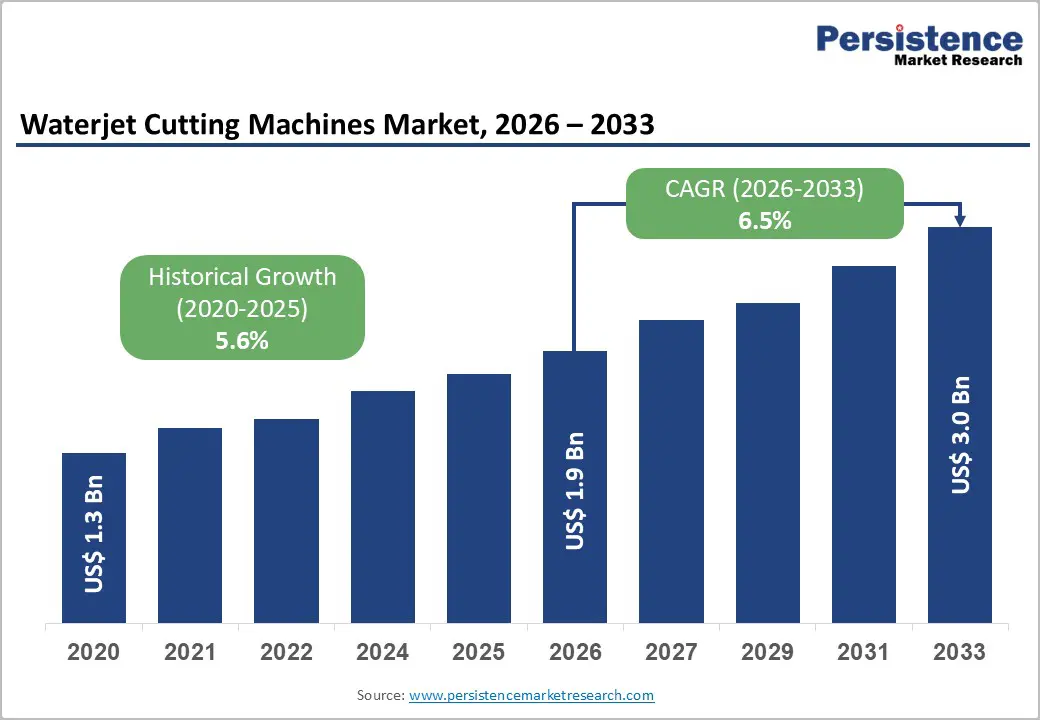
The global waterjet cutting machines market is likely to reach a size of US$ 1.9 billion in 2026. It is predicted to rise at a CAGR of 6.5% through the forecast period to reach a value of US$ 3.0 Bn by 2033. The waterjet cutting machines industry is experiencing growth, driven by the demand for eco-friendly cutting solutions and technological advancements. These cutters are used for the precise cutting of a wide range of materials, including metals, glass, composites, and flammable substances.
Key Industry Highlights:
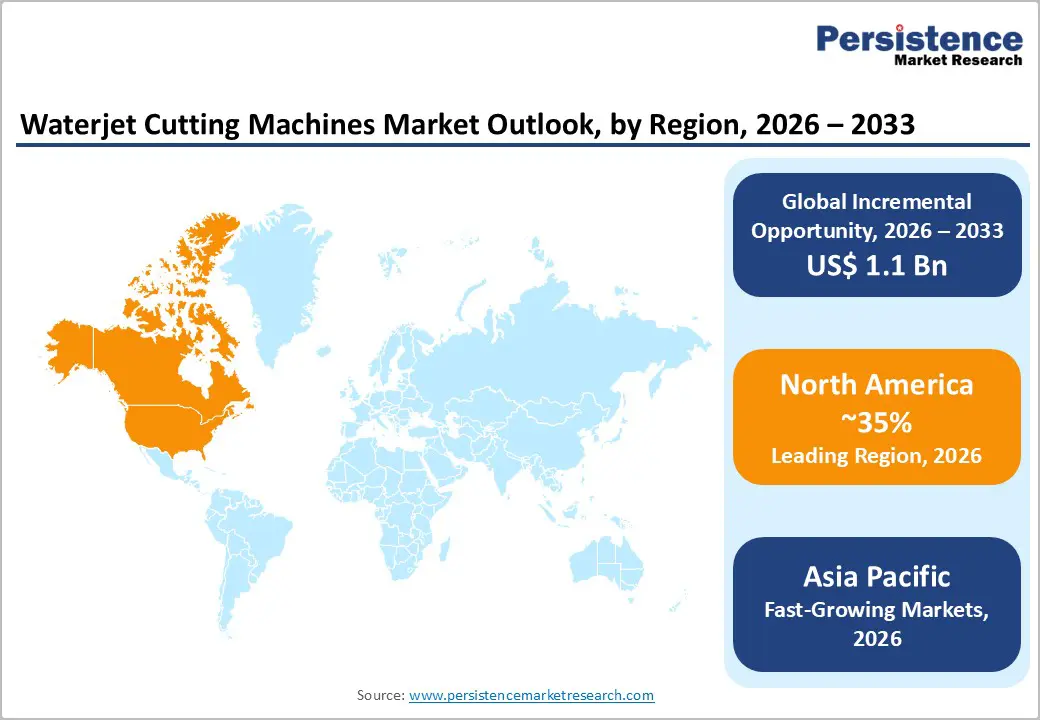
- Leading Region: North America leads the global waterjet cutting machine market with a 35% share in 2026, driven by continuous innovation, integration of automation, and strong demand across aerospace, automotive, and metal fabrication sectors. The region’s emphasis on advanced manufacturing and precision engineering supports sustained equipment adoption.
- Fastest-Growing Region: Europe is expected to hold a 28% market share in 2026 and continue expanding through Industry 4.0 integration. Automation adoption, coupled with advanced production systems in Germany, Italy, and the U.K., is accelerating the deployment of high-precision, energy-efficient waterjet cutting solutions.
- Dominant Pressure Range: The above 4200 bar segment dominates with an estimated 55% share in 2026, driven by industries requiring ultra-high-pressure systems for superior cutting accuracy, faster processing, and minimal material deformation across metals, ceramics, and composites.
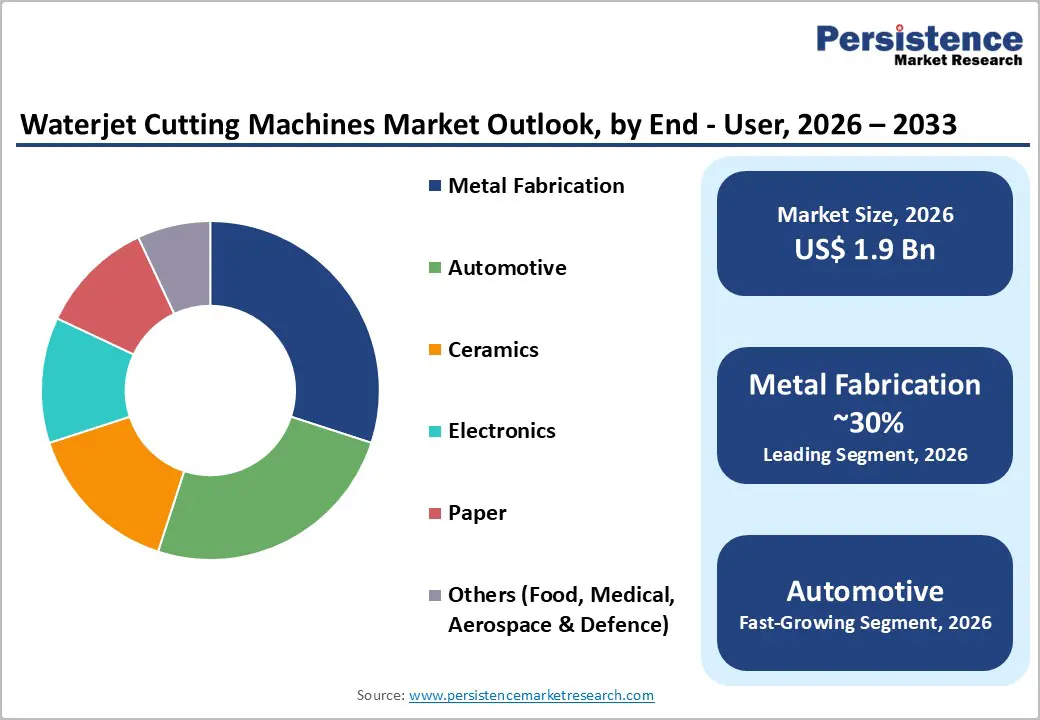
- Industry Leadership: The metal fabrication segment commands around 30% of market share in 2026, supported by rising demand for intricate, non-thermal cutting in construction, machinery, and custom metal component manufacturing.
- Technological Advancement: The market is propelled by the adoption of high-efficiency pumps, AI-driven motion control, and precision cutting nozzles enabling enhanced performance, reduced waste, and improved operational efficiency across industrial sectors.
- Import–Export Scenario: Developed markets such as the U.S., Germany, and Japan dominate exports of high-pressure waterjet systems, while emerging economies like China and India serve as key importers, supported by rapid industrialization, infrastructure growth, and rising investment in precision manufacturing technologies.
| Key Insights | Details |
|---|---|
| Waterjet Cutting Machines Market Size (2026E) | US$ 1.9 Bn |
| Projected Market Value (2033F) | US$ 3.0 Bn |
| Global Market Growth Rate (CAGR 2026 to 2033) | 6.5% |
| Historical Market Growth Rate (CAGR 2020 to 2024) | 5.6% |
Market Dynamics
Drivers - Automation Trend in Manufacturing Settings Prospers Innovation
The integration of waterjet cutting machines with computer-aided design (CAD) and CAM systems is a significant trend in modern manufacturing. This integration allows for the translation of digital designs into precise cutting instructions, reducing programming time and human error.
In 2023, leading waterjet machine manufacturers like OMAX and Flow International introduced advanced software platforms that provide real-time optimization of cutting paths, material usage, and machine performance. These platforms use AI-driven algorithms to predict cutting parameters, improving efficiency by up to 35%.
Industry surveys show that adopting integrated CAD/CAM waterjet cutting systems leads to a 40% reduction in setup times, 25% improvement in material utilization, and a significant reduction in design-to-production cycles.
Developing Aerospace and Automotive Industry Remains a Prominent Driver
Advanced cutting solutions for complicated geometries and a variety of materials are needed by the automotive and aerospace sectors. For accuracy, effectiveness, and adaptability, cutting-edge technology such as waterjet cutting machines are essential. These systems are crucial for high-performance applications because they can cut a variety of materials, including carbon composites, titanium, and aluminum, without changing their characteristics.
The aerospace industry is predicted to be fueled by waterjet cutting machines in 2024 because of their high precision and low waste, which make them essential for lightweight components and fuel economy. The automobile sector is using these technologies for quick prototyping and complex designs.
Improvements in technology, such as robotic waterjet cutters with sophisticated software, have accelerated their usage. To comply with industry norms, top manufacturers have used automated cutting systems.
Restraint - High Cost of Complimentary Components Restraints Market Growth
The necessity for pressured water streams combined with abrasives like garnet, which make up more than half of operating expenses, presents a problem for waterjet cutting machines. The high cost of sapphire or diamond orifices restricts their affordability and market expansion. Key component replacement raises maintenance costs and downtime, which drives up operational costs even further.
The total cost structure of waterjet operations is strained by the requirement for constant material replacement, which limits its applicability to smaller companies or sectors with narrow profit margins. In an effort to cut expenses, businesses are now concentrating on maximizing the use of consumables and investigating substitute materials.
Opportunities - Increasing Demand for Glass Protection in Smartphones and Gadgets Presents Opportunity
Since worldwide smartphone shipments are expected to reach over 1.3 billion units in 2023 and premium devices with larger, more delicate screens are becoming popular, there is an increasing need for glass protection in portable devices and smartphones.
Protective glass for screens, such as Corning's Gorilla Glass, a screen protector, has achieved significant appeal due to its resilience to scratches, spills, and impact, with over 7 billion devices adopting it in 2023.
The demand for scratch-resistant and shatterproof glass is surging in the portable gadget segment, including wearables and tablets. Consumers prioritize screen protection due to rising device costs, leading to a lucrative market for glass protection products with innovations like anti-microbial coatings and ultra-thin, thin glass.
Robotic Integration Enhances Appeal and Presents Avenues
The manufacturing industry's growing reliance on automation has boosted demand for mechanized waterjet cutters, which are expected to account for over 40% of the market share in 2024. These systems offer superior accuracy, minimize waste, and significantly reduce production time, benefiting industries like fabrication, automotive, and aerospace.
Leading manufacturers have introduced robotic integration and intelligent control systems to enhance the appeal of mechanized cutters. OMAX Corporation's robotic waterjet systems enable seamless automation in high-volume production, particularly in the automotive sector.
The waterjet systems are crucial for precise, waste-efficient cutting of lightweight composite materials, meeting sustainability and efficiency goals. This presents a lucrative growth opportunity for market players.
Category-wise Analysis
Industry Insights - Metal Fabrication Fuels Demand for Cutting-edge Machines
The metal fabrication sector is expected to utilize the demand for waterjet cutting machines in 2024, accounting for over 30% of the market share. The growth is driven by the need for precise cutting solutions in industries like automotive, aerospace, and construction. Waterjet machines are adept at handling delicate materials and non-metals without altering their structural properties. Advancements, like 5-axis cutting technology, are driving innovation in the industry, enabling faster and more accurate cuts for complex geometries. Manufacturers such as OMAX and Flow Waterjet are continuously innovating to meet industry demands.
Pressure Insights - Demand for More than 4200 Bar Caters Array of Industries
The waterjet cutting machines market is classified into segments such as up to 4200 bar and more than 4200 bar. The > 4200 bar is anticipated to account for more than 55% of the market share in 2026. Because of its high-volume cutting capabilities, which make it crucial for heavy sectors like aerospace, military, and automotive, the more than 4200 bar category is anticipated to develop.
Regional Insights and Trends
North America Waterjet Cutting Machines Market Share - Rising Demand for Innovative Machines Drives North America Waterjet Cutting Machines Market
In 2026, the demand for waterjet cutting machines in North America is expected account for 35% share of the global market, driven by sophisticated manufacturing technologies in industries such as military, automotive, and aerospace. The demand for waterjet cutters in North America is projected to exhibit a CAGR of 4.7% by 2033.
High-precision cutting tools for complicated materials are becoming more in demand in the U.S. With equipment that offer improved performance, long lifespans, and operational efficiency, the industry has been stimulated by established manufacturers and research expenditure.
Europe Waterjet Cutting Machines Market Trends- Trend of Automation and Industry 4.0 in Europe to Presents Novel Opportunities
Automation and Industry 4.0 technologies are being used by the waterjet cutting machine market in Europe to create robotic and multi-axis systems. Consequently, this will increase production efficiency and accuracy in industries including industrial fabrication, automotive, and aerospace. These methods lower labor expenses and material waste when used with sophisticated CAD/CAM systems.
Europe is expected to dominate in Industry 4.0 plans and hold a 28% market share in 2024 due to modern manufacturing technology, especially in Germany, France, and Italy. For instance, significant firms in Europe , such as SERENA Project and Flow International Corporation, introduced new multi-axis waterjet systems with IoT-enabled monitoring and predictive maintenance in September 2023, demonstrating their leadership in manufacturing innovation.
Competitive Landscape
The global waterjet cutting machines market is characterized by a dynamic and cohesive structure that demands continuous innovation and investment. Major industry players are focusing intensely on research and development to refine and expand their product offerings, leveraging the latest technological advancements.
In pursuit of market growth, these companies actively engage in strategic collaborations, initiate product launches, and pursue acquisitions, all while implementing targeted marketing strategies. This multifaceted approach not only drives market expansion but also enables manufacturers to adapt their offerings to align with evolving consumer preferences, ultimately increasing sales and market share.
Recent Industry Developments
- In December 2024, Performatec introduced Flow Mach 150 waterjet cutting machine for Australian manufacturers, offering scalability, flexibility, and automation with FlowMaster software, real-time job costing tools, and installation services.
- In June 2024, Raise3D headquartered in Shanghai, introduced the Pro3 HS Fused Filament Fabrication 3D printer series, featuring improved speed, precision, and accuracy, Hyper Core filaments, a closed-loop stepper motor, and 2.5kg roll storage boxes.
- In May 2024, Kennametal, a Pittsburgh-based cutting tool company, unveiled eight new metal cutting solutions designed to boost productivity, performance, and resistance to wear across a variety of sectors.
Companies Covered in Waterjet Cutting Machines Market
- Kennametal Inc.
- Flow International Corporation
- OMAX Corporation
- CERATIZIT S.A.
- GMA Garnet Pty. Ltd.
- Wardjet Inc.
- Hypertherm Inc.
- TECHNI Waterjet
- Jet Edge, Inc.
- KMT Waterjet
- ALLFI AG
- Opta Minerals Inc.
- Kimblad Technology AB
- H2O Jet
Frequently Asked Questions
The Waterjet Cutting Machines market is estimated to be valued at US$ 1.9 Bn in 2026.
The key demand driver for the Waterjet Cutting Machines Market is the growing need for high-precision, cold-cutting processes across diverse manufacturing industries such as automotive, aerospace, metal fabrication, and electronics.
In 2026, the North America region will dominate the market with an exceeding 35% revenue share in the global Waterjet Cutting Machines market.
Among the Pressure Range, 4200 bar hold the highest preference, capturing beyond 55.2% of the market revenue share in 2026, surpassing other products.
The key players in the Waterjet Cutting Machines market are Kennametal Inc., Flow International Corporation, OMAX Corporation, CERATIZIT S.A. and GMA Garnet Pty. Ltd


