




- Nutraceuticals & Functional Foods
- Walnut Oil Market
Walnut Oil Market Size, Trends, Share, Growth, and Regional Forecast, 2026 to 2033
Walnut Oil Market by Product Type (Cold-pressed walnut oil, Refined walnut oil), by Nature (Organic, Conventional), by Application (Food & Beverage, Pharmaceuticals & Nutraceuticals, Personal Care & Cosmetics, Others), and Regional Analysis from 2026 to 2033

Walnut Oil Market Share and Trends Analysis
The global walnut oil market size is estimated to grow from US$ 881.4 million in 2026 and projected to reach US$ 1,307.9 million by 2033, growing at a CAGR of 6.7% during the forecast period from 2026 to 2033.
The global walnut oil sector is entering a pivotal growth phase as premiumization, clean-label trends, and advanced processing elevate competitiveness across regions and product categories. Rising demand from culinary, skincare, and wellness applications is reshaping how producers strategize, source, and innovate.
Key Industry Highlights:
- Leading Region: North America remains the largest regional contributor, holding around 37% share, supported by expanding use in premium culinary oils, clean-label skincare, and evolving consumer focus on authenticity and traceable sourcing.
- Fastest-Growing Region: Asia Pacific is gaining momentum, driven by rising adoption of cold-pressed gourmet oils, wellness-conscious purchasing, and the integration of walnut oil into both modern and traditional dietary and beauty routines across China, India, Japan, Indonesia, and South Korea.
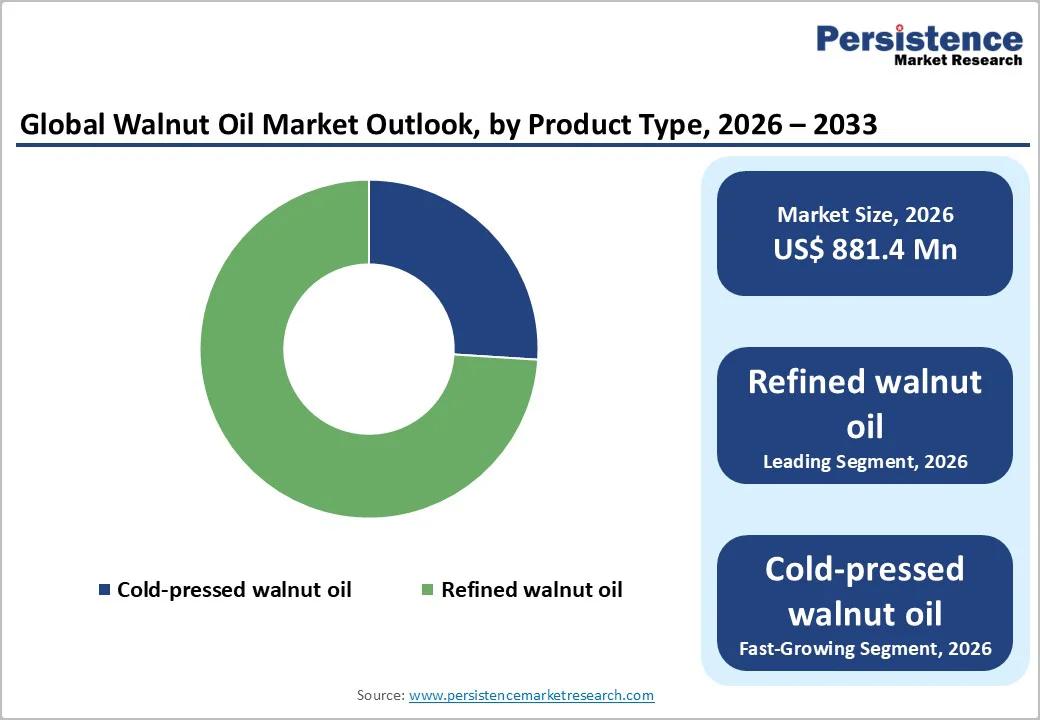
- Fastest-Growing Product Type Segment: Cold-pressed walnut oil is advancing rapidly as demand intensifies for minimally processed, nutrient-dense oils with stronger sensory profiles that appeal to gourmet culinary users and premium skincare formulators.
- Market Drivers: Increasing utilization of walnut oil in skincare and cosmetics is propelling industrial consumption, powered by its lightweight texture, antioxidant strength, and suitability for high-performance, clean-label beauty formulations.
- Opportunities: Rising enthusiasm for artisanal and small-batch cooking oils is widening the market runway for producers able to deliver region-specific sourcing stories, handcrafted extraction techniques, and premium sensory appeal.
- Key Developments: In July 2025, La Tourangelle earned recognition from the Good Food Foundation for excellence in quality and responsible sourcing. In June 2025, the Ministry of Water Resources, Agriculture, and Processing Industry of Kyrgyzstan initiated a technical working group to advance wild walnut development under the “Kyrgyz Jangak” national program.
| Key Insights | Details |
|---|---|
| Global Walnut Oil Market Size (2026E) | US$ 881.4 Mn |
| Market Value Forecast (2033F) | US$ 1,307.9 Mn |
| Projected Growth (CAGR 2026 to 2033) | 5.8% |
| Historical Market Growth (CAGR 2020 to 2025) | 4.3% |

Market Dynamics
Driver - Increasing Use in Skincare and Cosmetics Elevates Industrial Consumption
Rising demand for high-performance natural emollients is pushing walnut oil deeper into skincare and cosmetic formulations, driving industrial consumption at a steady pace. Brands are leaning toward lightweight botanical oils that deliver hydration, antioxidant protection, and improved skin barrier function, and walnut oil fits this technical requirement with its omega-rich composition.
The shift toward cleaner ingredient lists is motivating formulators in facial serums, scalp treatments, body oils, and premium lotions to replace synthetic emollients with nutrient-dense plant alternatives. Growing interest in anti-aging solutions further strengthens adoption, as walnut oil supports elasticity and enhances product sensory appeal.
With consumers seeking multi-functional beauty ingredients backed by recognizable origins, walnut oil’s purity, mild aroma, and formulation versatility continue to stimulate strong upstream demand.
Restraints - Climate-dependent Walnut Farming Introduces Yield Volatility
Unpredictable weather patterns are turning walnut cultivation into a more unstable raw-material pipeline, creating a significant restraint for the global walnut oil market. Temperature spikes, irregular rainfall, unexpected frosts, and prolonged droughts disrupt tree health, reduce nut formation, and weaken overall oil yield. Farmers face fluctuating harvest volumes that complicate long-term supply planning, forcing processors to manage inconsistent input costs and variable quality.
Regions dependent on seasonal rainfall experience sharper swings, with stressed orchards producing smaller kernels and lower oil content. This volatility pushes manufacturers to absorb higher sourcing risks, impacting pricing stability for downstream buyers in beauty, nutraceutical, and culinary sectors. As climate stress intensifies, supply-side uncertainty becomes a persistent structural challenge for the industry.
Opportunity - Increasing Popularity of Artisanal Cooking Oils Opens New Avenues For Small-Batch Producers
A shift toward premium, craft-style culinary products is creating fresh headroom for innovators in the global walnut oil market. Consumers are gravitating toward small-batch oils that emphasize authenticity, region-specific sourcing, and richer sensory profiles, giving new entrants a chance to stand out with distinctive flavor stories and handcrafted production methods.
Established players can leverage this momentum by developing boutique product lines, exploring cold-pressed variants, and highlighting orchard-level transparency to appeal to gourmet kitchens and health-focused home cooks. Restaurants and specialty retailers are expanding shelf space for artisanal oils, strengthening demand for limited-run, high-identity offerings.
This movement rewards producers capable of merging quality cues, clean-label positioning, and traceable sourcing into a compelling premium proposition.
Category-wise Analysis
By Nature Insights
Organic walnut oil is projected to grow at a CAGR of 8.7% during the forecast period, reflecting a clear preference shift toward cleaner extraction practices, chemical-free orchards, and high-purity nutritional profiles. Consumers seeking transparency in sourcing and minimal processing view organic variants as a superior option for both culinary and skincare uses.
Rising adoption of organic certification standards strengthens trust, making these oils a preferred choice in premium retail channels. Conventional walnut oil remains relevant due to its wider availability and lower price points, appealing to mass-market buyers and foodservice operators.
However, tightening consumer scrutiny, increasing wellness awareness, and global demand for sustainable farming methods are positioning organic walnut oil as the category’s most influential growth engine.
By Product Insights
Cold-pressed walnut oil is poised to grow at a CAGR of 9.4% during the forecast period, driven by its clean extraction methods, robust flavor retention, and superior nutrient profile that appeals to consumers prioritizing authenticity in culinary and skincare applications. Its positioning as a minimally processed, antioxidant-rich oil aligns with rising demand for premium natural ingredients across retail and personal care segments.
Growing interest in cold-pressed formats within gourmet cooking, aromatherapeutic blends, and wellness-focused formulations further accelerates adoption. Refined walnut oil continues to serve large-scale food processors and manufacturers due to its neutral taste and higher heat stability, sustaining steady baseline demand.
Even with this, the distinct sensory quality and purity perception surrounding cold-pressed variants place them on a stronger long-term growth trajectory.
Region-wise Insights
North America Walnut Oil Market Trends
North America holds approximately 37% share in the global walnut oil market, and the region is witnessing a shift toward high-purity, premium-grade oils that resonate with wellness-driven consumers. In the US, clean-label preferences and interest in nutrient-rich culinary oils are influencing retailers to expand their specialty oil assortments. Chefs and home cooks are embracing walnut oil for its distinct flavor and versatility in cold dishes, reinforcing steady foodservice demand.
In Canada, rising usage in natural skincare, massage blends, and aromatherapy formulations is strengthening cross-industry adoption. Brands in both countries are experimenting with single-origin batches, sustainability messaging, and eco-friendly packaging, reflecting a maturing market where authenticity, traceability, and craftsmanship increasingly guide purchasing behavior.
Asia Pacific Walnut Oil Market Trends
Asia Pacific Walnut Oil Market is expected to grow at a CAGR of 7.4%, driven by rising interest in premium culinary oils and expanding wellness routines across fast-evolving consumer segments. In China, walnut oil is gaining ground in home cooking due to shifting dietary habits and greater interest in natural fats. India is witnessing momentum in cold-pressed artisanal oils supported by urban health-focused buyers.
Japan’s market leans toward small-format, high-quality variants used in dressings and skincare rituals. Indonesia is seeing traction in specialty food retail as consumers explore alternative gourmet oils. South Korea shows growing adoption in beauty blends and haircare applications. Across the region, demand is shaped by a blend of modern health aspirations, evolving food culture, and curiosity for niche, high-value oils.

Competitive Landscape
The global walnut oil market remains moderately fragmented, creating space for established producers and emerging innovators to shape the competitive landscape in distinct ways. Leading companies are strengthening control across the value chain through vertical integration, investing in orchard management, optimized cracking systems, and advanced cold-pressing units that protect flavor and nutrient integrity.
Many players are expanding organic farming programs to secure residue-free kernels and meet clean-label expectations across aromatherapy, cosmetics, and specialty food channels. Startups are entering with small-batch oils, traceability-focused sourcing, and premium positioning tailored for export-oriented markets.
Certifications related to organic handling and quality assurance are becoming key differentiators, while improvements in filtration, nitrogen flushing, and storage technology are helping brands deliver fresher, higher-stability walnut oil to global buyers.
Key Industry Developments:
- In July 2025, La Tourangelle secured a Good Food Foundation Award. The company is recognized for exceptional quality and responsible sourcing.
- In June 2025, the Ministry of Water Resources, Agriculture, and Processing Industry of the Kyrgyz Republic convened the first technical working group meeting to advance wild walnut development under the national brand “Kyrgyz Jangak.”
Companies Covered in Walnut Oil Market
- La Tourangelle
- Roland Foods
- Borges
- Spectrum Organics
- NOW Foods
- Kevala
- Otto’s Naturals
- Ölmühle Solling
- Ölmühle Fandler
- Schalk Mühle
- Huilerie des Roches
- Ziani Organic Oils
- Fontevita
- Others
Frequently Asked Questions
The global walnut oil market is projected to be valued at US$ 881.4 Mn in 2026.
Increasing use in skincare and cosmetics elevates industrial consumption drives the global walnut oil market.
The global Walnut Oil market is poised to witness a CAGR of 5.8% between 2026 and 2033.
Rising consumer interest in artisanal cooking oils is creating strong growth potential for small-batch walnut oil producers.
Major players in the global Walnut Oil market include La Tourangelle, Roland Foods, Borges, Spectrum Organics, NOW Foods, Kevala, and others.


