




- Medical Devices
- Vein Illuminator Market
Vein Illuminator Market Size, Share, Growth, and Regional Forecast, 2026 to 2033
Vein Illuminator Market by Product (Transillumination, Infrared, Ultrasound), Application (Intravenous Access, Blood Draw, Others), End User (Hospitals, Blood Donation Camps, Academic Institutions, Others), and Regional Analysis from 2026 to 2033

Vein Illuminator Market Size and Trend Analysis
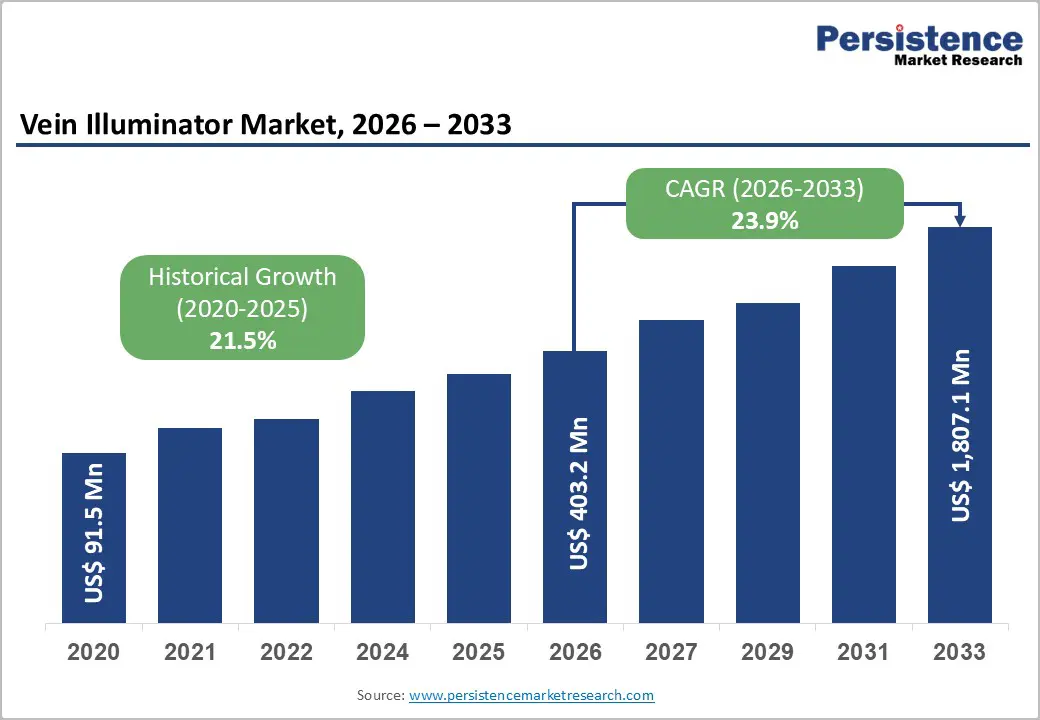
The global vein illuminator market is estimated to grow from US$ 403.2 Mn in 2026 to US$ 1,807.1 Mn by 2033. The market is projected to record a CAGR of 23.9% during the forecast period from 2026 to 2033.
The global vein illuminator market is growing steadily, driven by rising demand for efficient vascular access, increasing hospital procedures, and technological advancements. North America dominates due to advanced healthcare infrastructure, strict regulations, and strong R&D. Asia-Pacific is the fastest-growing region, supported by expanding healthcare access, cost advantages, government initiatives, and rising patient populations requiring intravenous therapies.
Key Industry Highlights
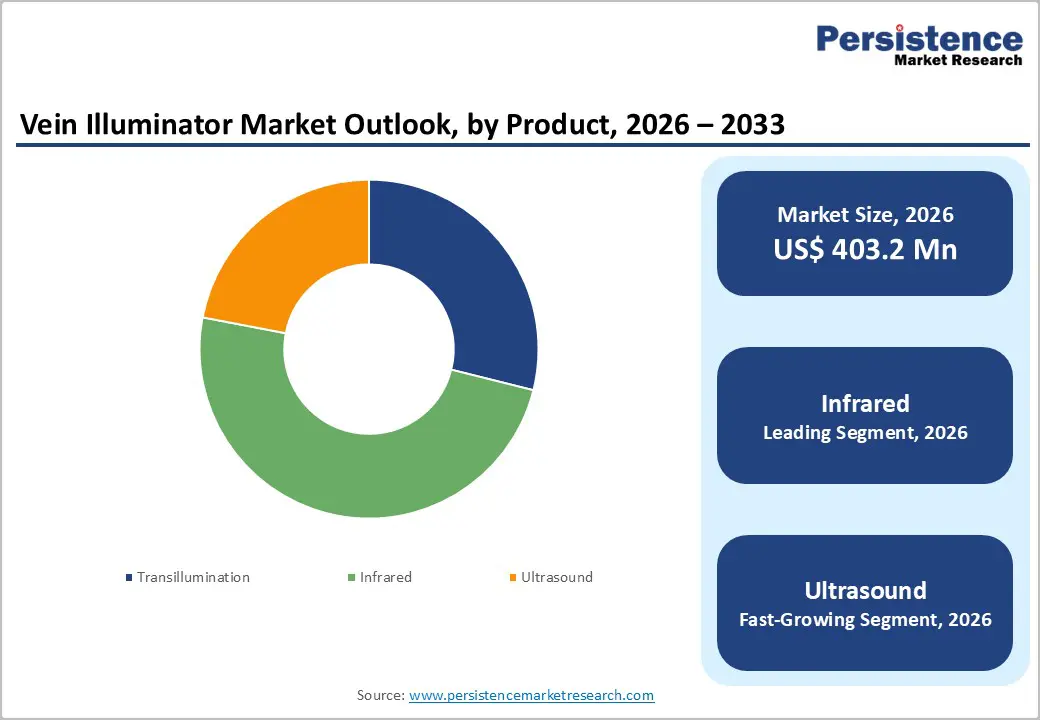
- Dominant Segment: Infrared / Near-Infrared technology led the vein illuminator market with 49.1% share in 2025, driven by high adoption in hospitals and clinics, accurate vein visualization, portability, and improved patient outcomes. Reliable performance, regulatory compliance, and cost-effective solutions enhanced adoption across clinical and diagnostic settings.
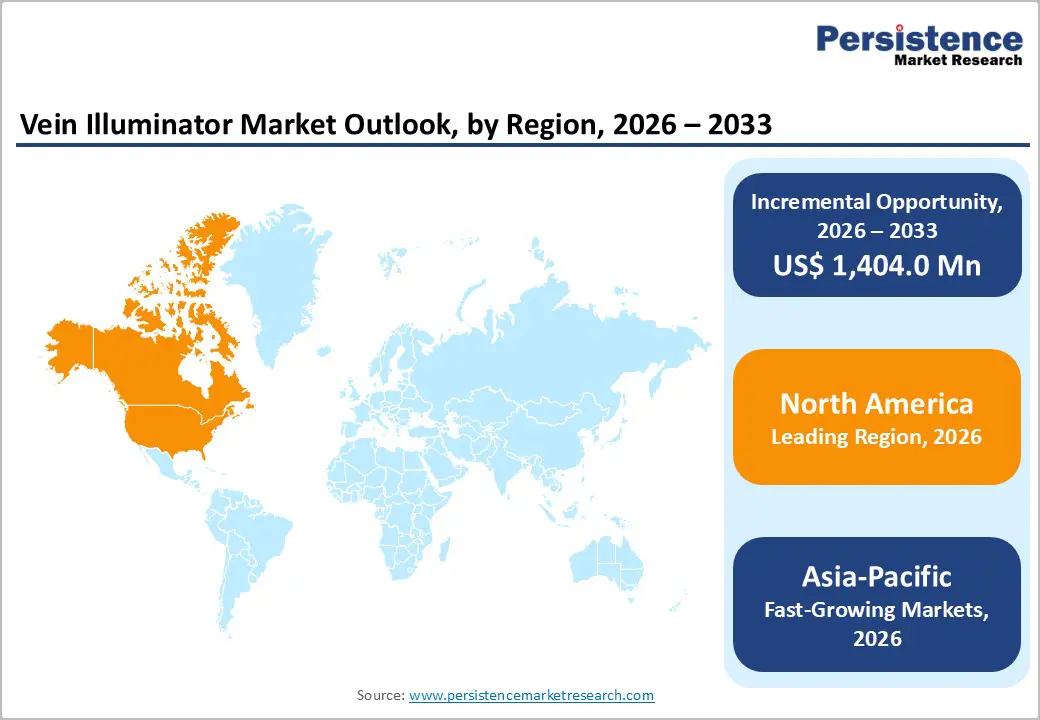
- Dominant Region: North America held 40.4% share in 2025, supported by advanced healthcare infrastructure, strong R&D investment, stringent regulations, and widespread clinical adoption of vein illumination devices.
- Market Drivers: Growth is fueled by rising hospital procedures, increased demand for accurate venous access, technological advancements, and expanding healthcare access globally.
- Market Opportunities: Expansion in portable and wearable devices, integration with ultrasound and AI technologies, adoption in emerging markets, and demand from pediatric, geriatric, and critical care segments.
| Global Market Attributes | Key Insights |
|---|---|
| Global Vein Illuminator Market Size (2026E) | US$ 403.2 Mn |
| Market Value Forecast (2033F) | US$ 1,807.1 Mn |
| Projected Growth (CAGR 2026 to 2033) | 23.9% |
| Historical Market Growth (CAGR 2020 to 2025) | 21.5% |
Market Dynamics
Driver: Rising demand for accurate and efficient venous access in hospitals and clinics
Intravenous (IV) access is one of the most common clinical procedures globally. Peer reviewed prevalence studies estimate that over 1 billion peripheral intravenous catheters (PIVCs) are inserted in hospitalized patients annually worldwide, with approximately 59% of hospitalized patients having at least one PIVC in place at any given time. This reflects the critical role of IV access for fluid therapy, medications, blood products, and nutrition across diverse settings including emergency departments, internal medicine wards, and surgical units, providing a foundational context for technologies that improve vein location and access success rates.
In addition to sheer procedural volume, clinical evidence shows that up to 80% of hospitalised patients receive some form of IV therapy, underscoring the routine dependence of modern healthcare on reliable venous access. However, standard IV access can be challenging due to poor vein visibility, patient comorbidities (e.g., obesity, chronic disease), and procedural difficulties that contribute to first attempt failures and delays in treatment delivery. These clinical realities have driven demand for adjunctive visualization tools, such as infrared and ultrasound guided vein illuminators that improve first attempt success, reduce complications, and enhance workflow efficiency in hospitals and outpatient clinics around the world.
Restraints: High device cost limiting adoption in smaller clinics and developing regions
Advanced medical devices like vein illumination systems and ultrasound guided access tools often carry significant upfront cost barriers, particularly for resource limited healthcare settings. Research on ultrasound access, a related imaging modality that parallels vein illumination adoption shows that lack of access to imaging equipment and its cost were the most frequently reported barriers in low and middle income countries (LMICs), with cost of machines, probes, and equipment cited as a barrier by 83% of respondents in a global healthcare survey. These challenges are emblematic of broader capital constraints that also impact adoption of vein illuminators in smaller clinics and rural hospitals, where budgets for specialty technology acquisition and maintenance may be limited.
Moreover, technological sophistication and cost correlate with institutional size and financial capacity: smaller outpatient clinics and low resource facilities often defer procurement of advanced imaging and access devices due to limited capital expenditure budgets and competing priorities. Although specific cost figures for vein illuminators vary, the broader health technology landscape shows sustained adoption barriers for devices that require trained personnel, ongoing calibration, and integration into clinical workflows. Consequently, high initial acquisition and maintenance expenses restrict the uptake of vein illumination technologies in settings that could benefit from them most contributing to uneven access and slower penetration outside large hospital systems.
Opportunity: Integration with AI and ultrasound for enhanced vein detection accuracy
One of the most promising opportunities in the vein illuminator ecosystem is the integration of advanced imaging technologies like ultrasound with artificial intelligence (AI). Although direct government statistics on vein illumination + AI integration are limited, broader data on AI in medical imaging shows significant clinician enthusiasm (96% agreeing that imaging improves quality of care and outcomes) and highlights that access to imaging equipment is a dominant theme for adoption. Expanding AI enabled imaging into venous access by automating vein detection, enhancing contrast, and guiding needle placement can significantly improve accuracy, reduce first attempt failures, and minimize complications such as infiltration or phlebitis.
AI integration also represents a broader trend in healthcare where machine learning augments diagnostic capacity and procedural guidance. For example, diagnostic ultrasound devices incorporating AI based platforms are increasingly adopted, and almost 88% of global healthcare providers surveyed reported having access to ultrasound, with high confidence in its utility. Extending similar AI and ultrasound capabilities into portable, cost effective vein illuminators can enhance performance in difficult access scenarios (e.g., pediatric, obese, or cachectic patients) and broaden clinical use cases beyond traditional visualization. This convergence of AI with real time imaging positions vein illumination technology at the forefront of precision venous access solutions.
Category-wise Analysis
By Product, Infrared Dominates the Vein Illuminator Market
Infrared occupies 41.9% share of the global market in 2025, because they provide real time, non invasive visualization of subcutaneous veins, which many clinicians find helpful when locating veins that are otherwise not visible or palpable. These devices emit near infrared light that is absorbed by hemoglobin and reflected by surrounding tissues, enabling displays of vein patterns that assist healthcare workers in assessing vein location and trajectory before cannulation.
Clinical practice data show that over a billion peripheral intravenous catheters (PIVCs) are inserted worldwide annually, accounting for a very high base volume of procedures where vein illumination could theoretically add value. Although rigorous comparative evidence on improved success is mixed, surveys from facilities using NIR have reported high rates of patient satisfaction (88%), reduced escalation of care (92%), and fewer hospital acquired complications (79%) when infrared visualization was incorporated into IV access protocols, indicating broad clinical acceptance.
By Application, Intravenous Access leads due to high procedural volume, efficiency, and improved patient outcomes
Intravenous access represents the dominant application of vein illuminators because securing venous access is one of the most common invasive procedures in modern healthcare. Studies estimate that over a billion peripheral intravenous catheters (PIVCs) are placed in hospitalized patients annually worldwide, and up to 70% of hospitalized patients may require a PIVC at some point during their stay.
This enormous procedural volume underpins the demand for tools that can assist clinicians in locating veins more efficiently, particularly in challenging patient populations such as children, the elderly, the obese, and patients with fragile or compromised veins. Near infrared and other vein illumination technologies are used to enhance visibility and support clinical teams in reducing the number of attempts and procedural time, which can improve workflow and patient experience. Surveys in facilities integrating these devices into IV access protocols report improvements in satisfaction and clinical outcomes, further reinforcing the priority of IV access as the primary application area.
Regional Insights
North America Vein Illuminator Market Trends
North America leads because of its advanced healthcare infrastructure, high device adoption rates, and major chronic disease burden. The United States alone accounts for a significant share of global healthcare spending, with 40.4% of the global medical device market coming from this region, driven by cutting edge hospitals, strong insurance coverage, and early adoption of new technologies.
Additionally, chronic diseases, such as chronic kidney disease affecting 35.5 million adults in the U.S. drive demand for frequent IV access and vascular imaging tools. Robust regulatory frameworks and reimbursement policies further encourage hospitals and clinics to adopt advanced vein illumination and IV access technologies, sustaining North America’s market leadership.
Europe Vein Illuminator Market Trends
Europe is a key market due to its strong public healthcare systems, high healthcare expenditure, and emphasis on patient safety and quality. In 2023, total health expenditure across the European Union reached €1720 billion (~10% of GDP), reflecting committed public investment in healthcare infrastructure that supports advanced medical technologies.
Countries such as Germany, France, and the U.K. sustain large hospital networks with standardized clinical procedures, increasing the use of devices that improve intravenous access and reduce complications. Although healthcare spending as a % of GDP varies across countries, overall investment in infrastructure and workforce enables widespread adoption of advanced imaging and clinical support tools, solidifying Europe’s position as a significant regional market for vein illumination technologies.
Asia-Pacific Vein Illuminator Market Trends
Asia Pacific is the fastest growing region driven by rapidly expanding healthcare access, rising chronic disease prevalence, and increasing medical technology investments. Nations like China and India are expanding hospital capacity and outpatient care to serve large populations, leading to a marked increase in intravenous therapy and related device utilization.
Although overall market share in 2023 was about 25 % for IV therapy and vein access devices, growth rates in Asia Pacific outpace other regions due to rising healthcare expenditure, improving quality of care, and government initiatives to extend service coverage. Aging populations and increasing incidence of conditions requiring frequent IV access (e.g., cancer, renal disorders) further fuel demand, making Asia Pacific the fastest expanding regional segment for vein illuminators.
Market Competitive Landscape
The Vein Illuminator Market is highly competitive, featuring key players like AccuVein, Christie Medical, Veinlite, Philips, Teleflex, Venoscope, and NEXTVEIN. Companies compete through technological innovation, device portability, accuracy, regulatory compliance, and expanding hospital and clinic adoption, driving continuous improvements in vein visualization solutions and market growth globally.
Key Industry Developments:
- In December 2025, Royal Philips agreed to acquire SpectraWAVE Inc., a U.S. medtech company specializing in advanced coronary intravascular imaging and physiological assessment technologies, to enhance its portfolio of AI enabled cardiac imaging solutions. The deal added SpectraWAVE’s HyperVue Imaging System and X1 FFR coronary physiology platform to Philips’ suite of interventional tools.
- In February 2025, Teleflex completed its acquisition of BIOTRONIK’s Vascular Intervention business after entering a definitive agreement. The deal, valued at approximately €760 million (about $823 million) in cash, added a broad portfolio of coronary and peripheral vascular intervention products to Teleflex’s interventional access offerings.
Companies Covered in Vein Illuminator Market
- Christie Medical Holdings, Inc.
- AccuVein Inc
- Translite LLC / Veinlite
- Koninklijke Philips N.V.
- VueTek Scientific (Teleflex)
- Venoscope LLC
- Near Infrared Imaging, Inc.
- Stihler Electronic (GENTHERM GMBH)
- Infinium Medical
- NEXTVEIN
- Others
Frequently Asked Questions
The global vein illuminator market is projected to be valued at US$ 403.2 Mn in 2026.
Rising intravenous procedures, technological advancements, chronic disease prevalence, and demand for accurate, efficient venous access.
The global vein illuminator market is poised to witness a CAGR of 23.9% between 2026 and 2033.
AI integration, portable devices, ultrasound-assisted visualization, pediatric and geriatric use, emerging market adoption, and clinical workflow optimization.
Christie Medical Holdings, Inc., AccuVein Inc, Translite LLC / Veinlite, Koninklijke Philips N.V., VueTek Scientific (Teleflex), Venoscope LLC.


