




- Specialty & Fine Chemicals
- Valeryl Chloride Market
Valeryl Chloride Market Size, Share, and Growth Forecast, 2026 – 2033
Valeryl Chloride Market by Purity (98%, 99%, Others), Application (Pharmaceuticals, Agrochemicals, Fragrances, Electronics, Others), End-User (Pharmaceuticals, Agriculture, Food & Beverage, Plastics & Polymers, Cosmetics & Personal Care), and Regional Analysis for 2026-2033

Valeryl Chloride Market Share and Trends Analysis
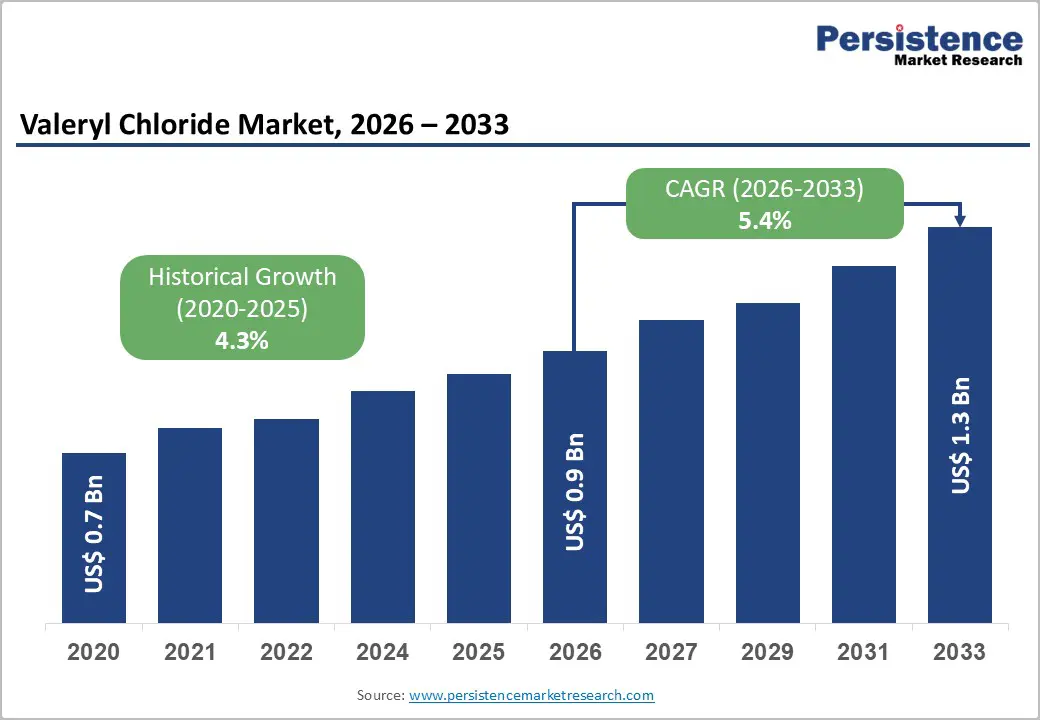
The global valeryl chloride market size is likely to be valued at US$ 0.9 billion in 2026, and is projected to reach US$ 1.3 billion by 2033, growing at a CAGR of 5.4% during the forecast period 2026−2033.
Growth is primarily driven by increasing adoption in pharmaceutical synthesis and agrochemical intermediates, which expands demand for specialty reagents. Technological integration in chemical processing enhances safety, efficiency, and precision, supporting broader industrial utilization. Regulatory frameworks promoting high-purity chemical production incentivize manufacturers to scale operations and standardize product quality. Rising clinical and industrial applications in fragrance and electronic sectors create diverse revenue channels, sustaining long-term growth. Healthcare infrastructure development and industrial investment trends reinforce adoption by enabling reliable supply chains and localized production capabilities. Emerging economies contribute to market expansion through favorable policies and investment incentives, providing new growth pathways and enhancing accessibility to chemical intermediates.
Key Industry Highlights
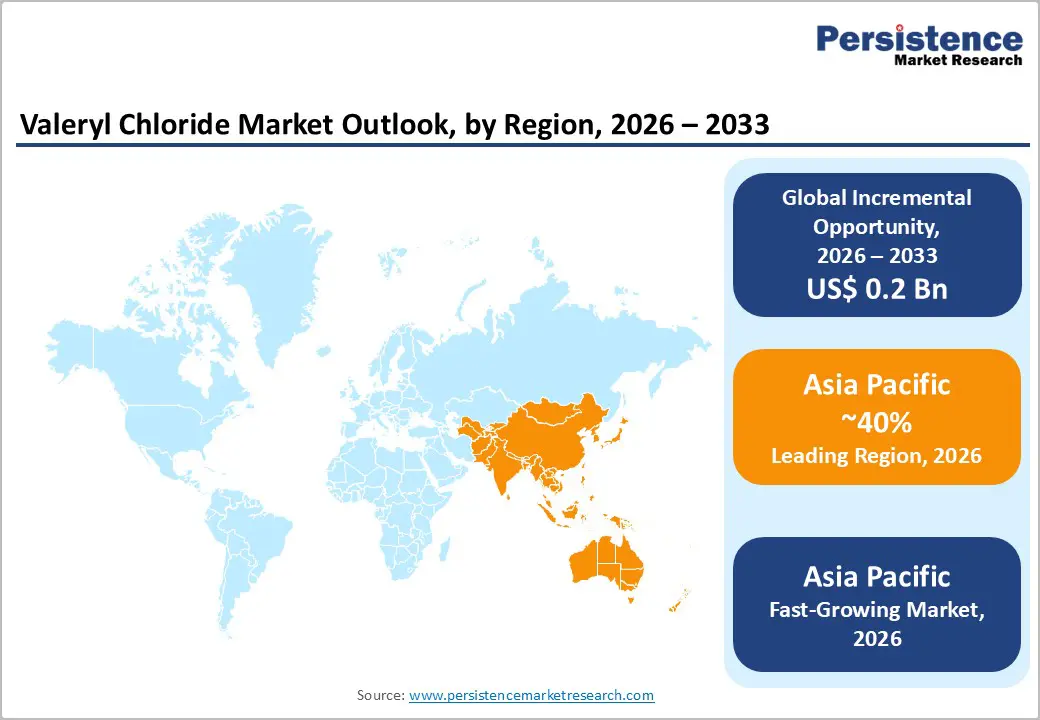
- Dominant Region: Asia Pacific is expected to dominate with about 40% market share in 2026, driven by pharmaceutical and agrochemical demand and industrial expansion.
- Fastest-growing Market: Asia Pacific is forecasted to be the fastest-growing market through 2033, on account of industrial diversification, flexible production, and policy support.
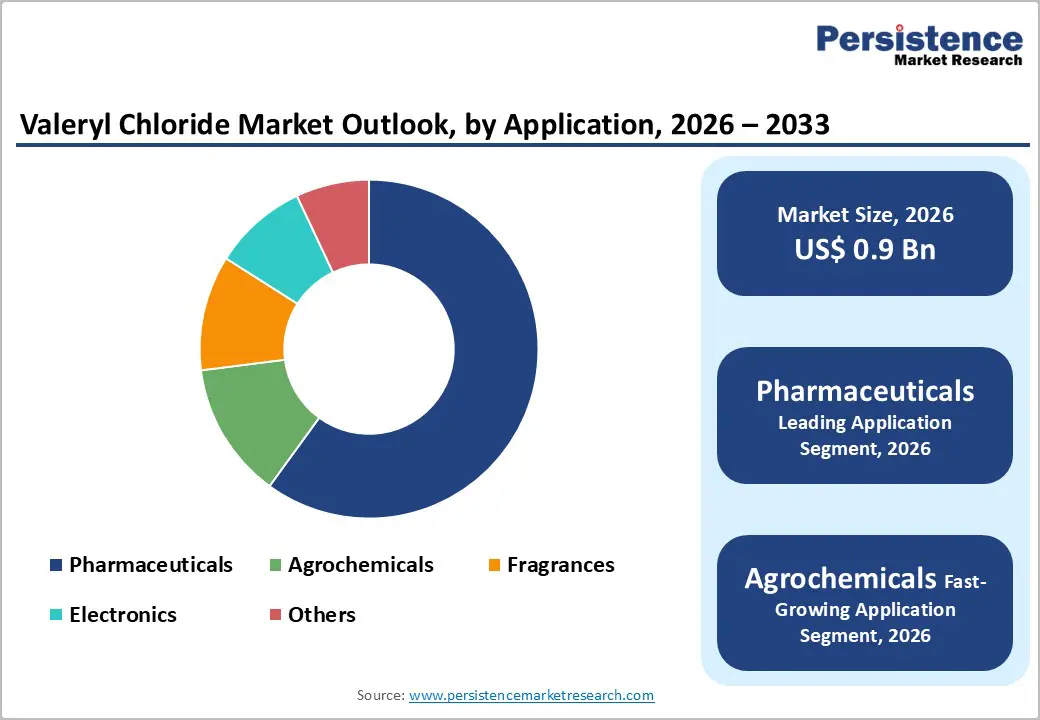
- Leading Application: Pharmaceuticals are expected to hold over 60% of the revenue share in 2026, supported by active compound synthesis, clinical research, and regulatory compliance.
- Fastest-growing Application: Agrochemicals are expected to be the fastest-growing segment between 2026 and 2033, fueled by rising crop protection demand, sustainable farming policies, and precision agriculture.
| Key Insights | Details |
|---|---|
|
Valeryl Chloride Market Size (2026E) |
US$ 0.9 Bn |
|
Market Value Forecast (2033F) |
US$ 1.3 Bn |
|
Projected Growth (CAGR 2026 to 2033) |
5.4% |
|
Historical Market Growth (CAGR 2020 to 2025) |
4.3% |
Market Factors – Growth, Barriers, and Opportunity Analysis
High Pharmaceutical and Agrochemical Demand
Growth in chemical synthesis for drug production drives the demand for valeryl chloride, which functions as a key reagent in the manufacture of active pharmaceutical ingredients and specialty compounds. Expansion of pharmaceutical manufacturing capacity and initiatives to strengthen domestic supply chains increase reliance on intermediates that deliver consistent performance in complex reactions. Regulatory requirements for purity, stability, and reactivity ensure that only high-quality chemical intermediates are suitable for therapeutic applications. The requirement for precise chemical transformations in drug synthesis reinforces the importance of compounds that can reliably participate in multi-step reactions, positioning valeryl chloride as a central input for formulation processes across diverse therapeutic areas.
Agricultural chemical production contributes to demand through the synthesis of herbicides, pesticides, and fungicides. Modernization of crop protection strategies and government programs to enhance food security stimulate the use of intermediates that enable scalable and efficient chemical production. Environmental and safety regulations in agricultural chemical manufacturing create dependence on reactive compounds capable of meeting compliance standards while maintaining performance. The overlap in chemical requirements across pharmaceuticals and agrochemicals, including high reactivity and compatibility with varied synthetic pathways, establishes valeryl chloride as a critical component.
Technological Advancements in Chemical Synthesis
Process innovations in chemical synthesis drive competitiveness by enabling faster reaction pathways, improved yields, and reduced energy consumption in complex organic transformations, creating value across industrial chemicals, pharmaceuticals, and specialty intermediates. Government-supported programs such as the Technology Development Board’s initiatives on sustainable chemical technologies emphasize process efficiency, green chemistry, and real-time process control as national priorities. These initiatives promote advanced catalysts, digital tools like artificial intelligence for predictive control, and waste minimization in manufacturing, all of which enhance operational productivity and reduce cost structures for synthesis operations.
Strengthened domestic capability in advanced chemical synthesis reduces reliance on external suppliers and supports stable supply chains for high-value intermediates and pharmaceutical ingredients. Advanced synthesis technologies shorten reaction sequences, lower raw material consumption, and support environmentally compliant manufacturing practices, improving product consistency and reducing production risks in regulated environments. Focused development in this area aligns technological capability with economic resilience and policy objectives for competitive manufacturing, enabling quicker adaptation to market demand and fostering sustainable growth across chemical-dependent sectors.
Heavy Dependence on Raw Material Availability
Limited access to feedstock and precursor chemicals directly influences production schedules and cost structures in the market. Sourcing intermediates such as valeric acid relies on petrochemical derivatives and specialized organic compounds, which are exposed to global supply chain fluctuations. Price volatility in these inputs increases operational uncertainty, prompting manufacturers to adjust output levels and prioritize higher-margin products. Transportation delays and regional restrictions on chemical shipments further constrain timely availability, impacting both small-scale producers and large industrial players. Companies facing shortages may experience production bottlenecks, leading to potential order backlogs and strained relationships with downstream industries that rely on consistent supply.
Supply chain concentration intensifies the challenge, with a limited number of suppliers controlling key intermediates. Any disruption in these nodes, including regulatory changes, environmental restrictions, or geopolitical tensions, directly affects manufacturing continuity. This concentration discourages aggressive expansion investments and limits geographic diversification strategies. Firms must maintain higher inventory buffers or secure long-term contracts, which increases working capital requirements and operational costs. The reliance on specific raw materials also hinders rapid response to sudden demand spikes in pharmaceuticals, agrochemicals, or specialty chemical segments, restricting flexibility in scaling production efficiently.
Regulatory and Environmental Constraints
Stringent chemical handling and storage requirements significantly limit production and distribution capabilities. Valeryl chloride is classified as a hazardous substance due to its corrosive nature and potential for severe irritation upon exposure. Compliance with workplace safety standards, transportation regulations, and hazardous chemical management protocols increases operational complexity and costs. Production facilities must implement advanced containment systems, ventilation, and monitoring infrastructure, which elevates capital expenditure and maintenance overhead. Strict limits on emissions and chemical discharge enforce adherence to environmental quality standards, affecting throughput and scalability of manufacturing operations.
Government authorities enforce rigorous registration, reporting, and approval processes for chemical intermediates, influencing lead times for new plant commissioning and product commercialization. Any violation of occupational safety or environmental mandates can result in penalties, fines, or temporary shutdowns, disrupting supply chains and revenue streams. International trade restrictions and variations in local chemical legislation create additional barriers to market expansion. Companies must continuously invest in training, safety audits, and environmental management systems to remain compliant, which reduces operational flexibility.
Expansion in Developing Economies
Rapid industrialization and growing chemical manufacturing capacities in developing countries are driving demand for specialty intermediates such as valeryl chloride. Investment in pharmaceutical and agrochemical production facilities is increasing, supported by favorable government policies and incentives that promote local production and reduce reliance on imports. Rising domestic consumption of pharmaceuticals and agricultural chemicals creates a stable demand base, while improvements in infrastructure and logistics enhance the distribution efficiency of chemical raw materials. Local manufacturers are adopting modern synthesis and purification techniques to meet quality standards, enabling competitive production at scale and supporting global supply chains.
Emerging economies are witnessing growth in consumer-driven sectors including cosmetics, personal care, and food additives, which rely on chemical intermediates for product development. Expansion of research and development centers and chemical laboratories in these regions supports innovation and custom synthesis, providing opportunities for intermediates with high purity requirements. Labor cost advantages and proximity to raw material sources reduce production expenses and improve overall profitability, making these regions attractive for investment. Strategic partnerships and collaborations with global chemical suppliers strengthen market access and technical capabilities, enhancing adoption across multiple end-use industries.
Emerging Applications in Specialty Chemicals
Rising demand for advanced chemical intermediates in specialty chemical production is driving significant opportunities. Valeryl chloride functions as a versatile building block in the synthesis of high-value compounds used across coatings, resins, plasticizers, and polymer additives. Its reactivity and compatibility with diverse organic processes allow manufacturers to develop customized formulations with enhanced performance characteristics. Increasing emphasis on lightweight, high-strength materials and functionalized polymers in industrial applications supports the integration of valeryl chloride into new product lines. Growth in sectors such as adhesives, surface treatment chemicals, and specialty coatings fuels consistent demand, creating avenues for product differentiation and process innovation.
Shifts in formulation trends within fine chemicals and electronic-grade compounds are contributing to broader adoption. Research and development efforts focus on optimizing synthetic pathways, reducing impurities, and improving yield efficiency, making valeryl chloride a preferred intermediate. Expansion of regional chemical manufacturing hubs in Asia and Europe stimulates local production and shortens supply chains, enhancing responsiveness to emerging specialty chemical needs. Regulatory compliance for purity and process safety reinforces its selection in critical applications, supporting market penetration across high-performance sectors.
Category-wise Analysis
Purity Insights
99% purity is likely to be the leading segment with 55% of the valeryl chloride market revenue share in 2026, due to its suitability for pharmaceutical synthesis requiring minimal impurities. High-purity valeryl chloride ensures consistent reaction performance, which is critical for producing active pharmaceutical ingredients with stringent quality requirements. Its widespread adoption in laboratories and industrial settings supports large-scale production of research-intensive compounds. Reliable supply through established distribution networks guarantees availability for continuous manufacturing processes. Compliance with global regulatory standards reinforces manufacturer confidence, while ongoing process improvements in reaction efficiency, yield optimization, and safety management further strengthen its position as the preferred choice for high-value applications across multiple sectors.
98% purity is expected to witness the fastest growth between 2026 and 2033, as cost-sensitive industries and emerging chemical manufacturers seek balance between performance and affordability. Its moderate purity provides sufficient reactivity for agrochemical, polymer, and specialty chemical applications without incurring the higher costs associated with ultra-high-purity grades. Lower production complexity allows manufacturers to quickly scale operations in emerging markets. Adoption benefits from growing technical know-how, modular process designs, and flexible manufacturing facilities. Increasing utilization in fragrances, flavor intermediates, and niche specialty chemicals further drives market expansion, supported by evolving industry practices that prioritize cost efficiency and functional performance.
Application Insights
Pharmaceuticals are poised to lead with a forecasted 60% of the valeryl chloride market share in 2026, owing to its extensive use in active compound synthesis. The segment benefits from a growing pipeline of clinical research programs and continuous formulation development, which drives consistent consumption of high-quality intermediates. Regulatory frameworks requiring strict adherence to chemical standards encourage preference for reliable products. High-value applications generate repeat demand, supporting steady production volumes. Integration of automated synthesis processes, strong supply chain networks, and established industry credibility enhances adoption.
Agrochemicals are anticipated to be the fastest-growing segment between 2026 and 2033, driven by intensifying demand for crop protection solutions and high-efficiency intermediates. Industrialization of agriculture, combined with adoption of advanced formulations, accelerates intermediate consumption. Policy initiatives targeting sustainable crop yields and environmentally conscious farming increase reliance on specialty chemicals. Indirectly, digital agriculture platforms and precision farming techniques stimulate demand for tailored intermediates. Growth is further supported by the rise of small- and medium-scale agrochemical producers capable of scaling operations rapidly.
Regional Insights
North America Valeryl Chloride Market Trends
North America holds a substantial position in the market for valeryl chloride, driven by well-developed pharmaceutical and specialty chemical manufacturing industries. Strong demand from active compound synthesis supports consistent consumption of high-purity intermediates. Agrochemical production for large-scale commercial agriculture further contributes to market stability. Advanced research and development initiatives enable adoption in polymers, coatings, and fine chemical applications. Established supply chains, robust logistics infrastructure, and strict quality management protocols ensure uninterrupted availability of raw materials. Focus on regulatory compliance and process safety reinforces confidence among manufacturers, supporting repeat demand and sustaining production volumes across multiple industrial segments. Integration of automated synthesis and continuous flow production enhances efficiency, reduces operational risks, and optimizes yields.
Growth prospects are further strengthened by emerging applications in specialty chemicals and high-performance formulations. Increasing adoption of moderate-purity intermediates in cost-sensitive industrial processes enables manufacturers to balance performance and affordability. Expansion of small- and medium-scale chemical producers allows scalable production, while collaborations with academic and industrial research centers accelerate process optimization and innovation. Rising use in agrochemical formulations, flavor and fragrance intermediates, and electronic-grade chemicals diversifies consumption. Technological advancements in purification, reaction efficiency, and modular manufacturing further enhance operational flexibility.
Europe Valeryl Chloride Market Trends
Europe occupies a central place in the market for valeryl chloride, bolstered by the region’s well-established chemical manufacturing infrastructure and advanced pharmaceutical production capabilities. High demand from pharmaceutical synthesis drives consumption of high-purity intermediates, as manufacturers prioritize reaction consistency and compliance with stringent regulatory standards. Agrochemical production for precision farming contributes to sustained intermediate requirements. Strong emphasis on research and development enables adoption in specialty chemical applications, including polymers, coatings, and fine chemicals. Well-integrated supply chains and established distribution networks ensure reliable raw material availability, facilitating continuous production. Focus on quality management, safety protocols, and process optimization reinforces trust among industrial users and supports steady revenue growth.
Growth in industrial diversification and specialty chemical manufacturing contributes to emerging opportunities. Expansion of small- and medium-scale chemical producers allows agile production of moderate-purity intermediates for cost-sensitive applications. Adoption of advanced synthesis techniques, coupled with increasing automation in chemical processes, enhances operational efficiency and scalability. Policies supporting sustainable production practices and chemical safety standards further encourage industrial uptake. Rising demand for high-performance coatings, flavor and fragrance intermediates, and electronic-grade chemicals drives application breadth. Investments in technical expertise and collaborative initiatives between academic and industrial entities strengthen innovation capabilities.
Asia Pacific Valeryl Chloride Market Trends
Asia Pacific is expected to dominate with an estimated 40% of the valeryl chloride market share in 2026, reflecting strong industrialization and rapid expansion of chemical manufacturing hubs. The surge in pharmaceutical synthesis in emerging economies has increased demand for high-purity intermediates to meet stringent quality standards. Agrochemical production for intensive farming practices further reinforces consumption. Cost-efficient production infrastructure allows both large-scale and small-scale manufacturers to supply diverse industrial segments effectively. Integrated supply chains and modern processing facilities enhance raw material reliability, reducing lead times and operational risks. Advanced research and development capabilities drive adoption in specialty chemical applications, including polymers, coatings, and fragrance intermediates, expanding application breadth and supporting sustained revenue growth.
Asia Pacific is forecasted to be the fastest-growing regional market for valeryl chloride between 2026 and 2033, fueled by increasing industrial diversification and rising demand for functional chemical intermediates. Expansion of polymer, flavor, and fine chemical production supports use of valeryl chloride in applications where reaction consistency and purity are critical. Flexible production processes enable moderate-purity grades to meet cost-sensitive industry requirements while maintaining performance standards. Policy incentives promoting chemical industry development and export-oriented production further accelerate growth. The presence of multinational and local chemical manufacturers facilitates technology transfer, process optimization, and knowledge sharing, boosting production capabilities.
Competitive Landscape
The global valeryl chloride market structure is moderately consolidated, with leading companies controlling approximately 50% of total revenue. Major players such as BASF, Arkema SA, Tokyo Chemical Industry Co., Ltd., Vertellus Holdings LLC, and Alfa Aesar maintain strong market positions through the supply of high-purity valeryl chloride, meeting the stringent requirements of pharmaceutical, agrochemical, and specialty chemical applications. Competitive advantage is reinforced by technological capabilities, including advanced synthesis, purification, and process optimization, which enable consistent product quality and higher yields. Companies invest in research and development to support emerging applications, such as polymers, flavor and fragrance intermediates, and electronic-grade chemicals, enhancing differentiation.
Market positioning is also influenced by regulatory compliance and strategic collaborations. Key players focus on meeting international chemical safety standards, which ensures adoption across highly regulated sectors. Strategic partnerships with regional distributors and specialty chemical manufacturers expand market reach and support tailored solutions for diverse industrial applications. Process innovation, automation, and integration of modular manufacturing approaches improve operational efficiency, reduce production risks, and enable scalability.
Companies Covered in Valeryl Chloride Market
- BASF
- Arkema SA
- Tokyo Chemical Industry Co., Ltd.
- Vertellus Holdings LLC
- Alfa Aesar
- Shiva Pharmachem Ltd.
- Omega Finechem Pvt. Ltd.
Frequently Asked Questions
The global valeryl chloride market is projected to reach US$ 0.9 billion in 2026.
Rising demand for high-purity intermediates in pharmaceuticals, agrochemicals, and specialty chemical applications is driving the market.
The market is poised to witness a CAGR of 5.4% from 2026 to 2033.
Expansion in specialty chemical applications, including polymers, coatings, and flavor and fragrance intermediates presents key market opportunities.
Some of the key market players include BASF, Arkema SA, Tokyo Chemical Industry Co., Ltd., Vertellus Holdings LLC, and Alfa Aesar.


