




- Food Ingredients & Additives
- Sucrose Esters Market
Sucrose Esters Market Size, Share, and Growth Forecast, 2026 – 2033
Sucrose Esters Market by Form Type (Powder, Liquid, Pellets/Granules), Functionality (Aeration, Antimicrobial Property, Controlled Sugar Crystallization, Emulsification, Protein & Starch Interaction), and Regional Analysis for 2026 – 2033

Sucrose Esters Market Size and Trends Analysis
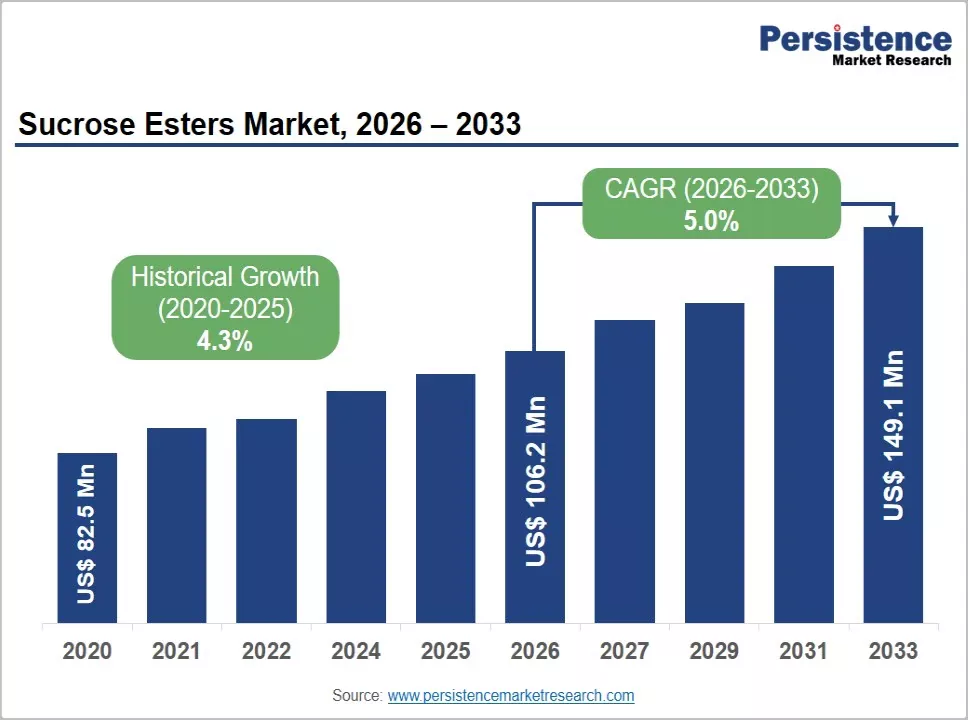
The global sucrose esters market size is likely to be valued at US$106.2 million in 2026 and is expected to reach US$149.1 million by 2033, growing at a CAGR of 5.0% during the forecast period from 2026 to 2033, driven by food manufacturers’ increasing demand for multifunctional emulsifiers that enhance product stability, texture, aeration, and shelf life. Sucrose esters of fatty acids, classified as INS 473, are recognized under the Codex Alimentarius framework for use as food additives in specified applications. In 2025, the Codex General Standard for Food Additives database, maintained by the FAO and WHO, included provisions for sucrose esters in various food categories, including bakery products, dairy-based foods, edible ices, and beverages.
Key Industry Highlights:
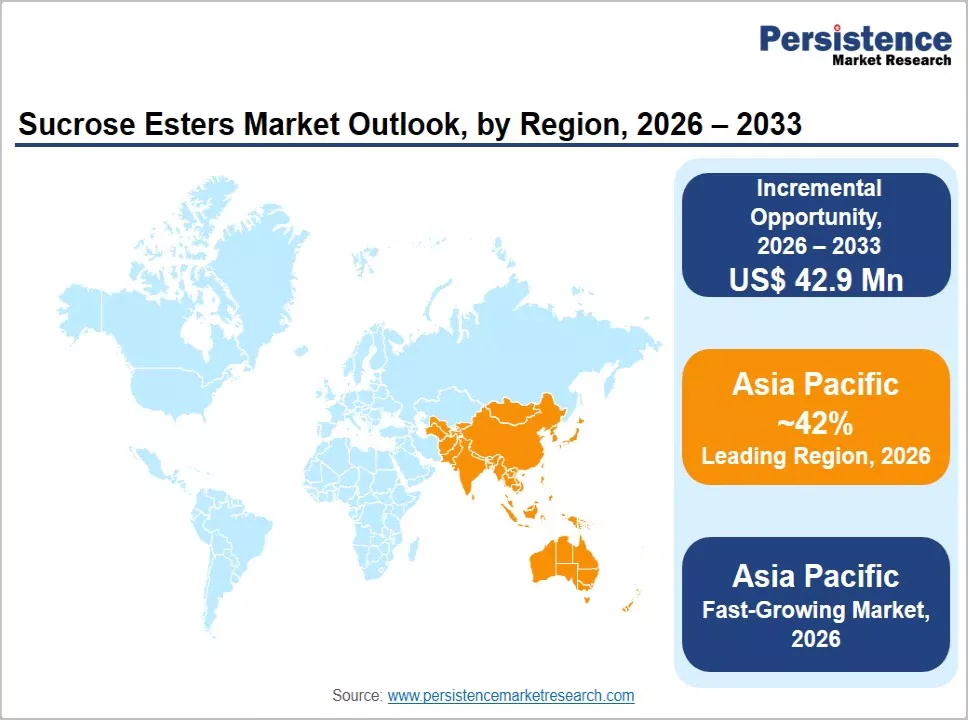
- Leading Region: Asia Pacific is anticipated to be the leading region, accounting for a market share of 42% in 2026, driven by expanding food processing and rising demand for packaged foods.
- Fastest-growing Region: Asia Pacific is likely to be the fastest-growing region, supported by increasing adoption of functional emulsifiers across food and personal care industries.
- Leading Form Type: The powder segment is projected to represent the leading form type in 2026, accounting for 57% of the revenue share, for its storage stability, ease of handling, and suitability for dry-blending applications.
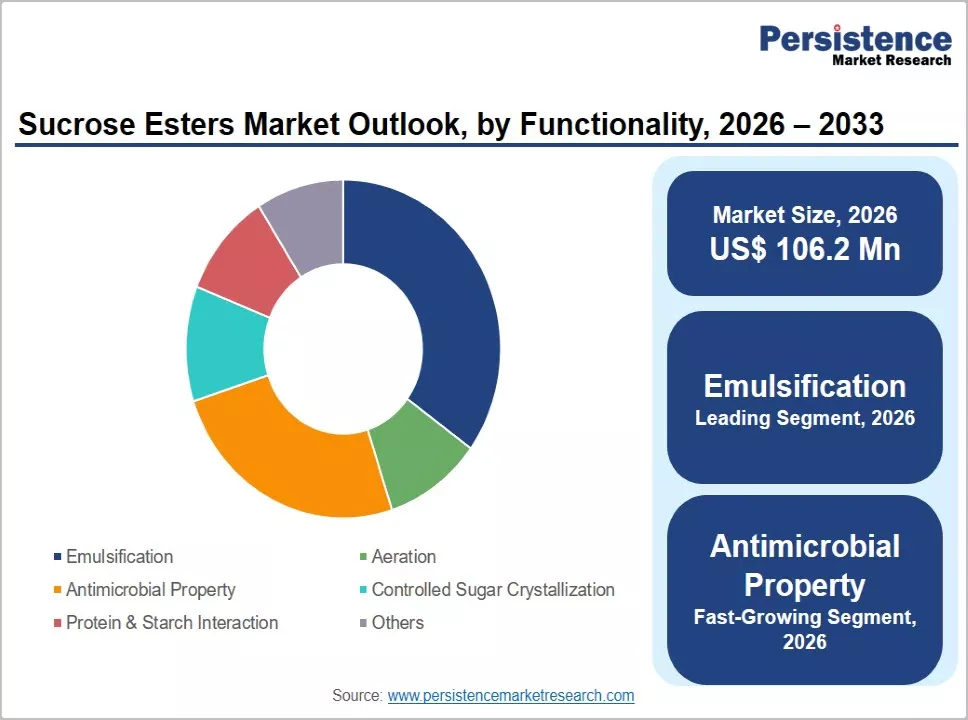
- Leading Functionality: Emulsification is anticipated to be the leading functionality, accounting for over 43% of the revenue share in 2026, supported by its ability to stabilize mixtures and improve texture across food, personal care, and pharmaceutical applications.
- Key Opportunity: The key market opportunity lies in expanding the use of sucrose esters as multifunctional emulsifiers across processed foods, plant-based products, beverages, pharmaceuticals, cosmetics, and personal care formulations, supported by growing demand for improved product stability, texture, and formulation performance.
DRO Analysis
Driver - Rising Demand for Clean-Label and Plant-Based Emulsifiers in Food Processing
Sucrose esters are gaining attention in food processing as manufacturers seek multifunctional emulsifiers that support product stability, texture, and consistency. Derived from sucrose and fatty acids, these ingredients can help stabilize oil-in-water emulsions and improve aeration in applications such as bakery products, confectionery, dairy desserts, and whipped toppings.
Their non-ionic surfactant properties make them useful in formulations requiring controlled emulsification and uniform product quality. Growing interest in plant-derived ingredients and simplified ingredient lists is encouraging food companies to evaluate sucrose esters as alternatives to selected conventional emulsifiers, subject to technical suitability and regulatory requirements.
Demand for clean-label formulations is also influencing product development across packaged foods, where manufacturers balance performance, consumer expectations, and ingredient transparency. Sucrose esters can support reduced-fat or improved-texture formulations by helping disperse fats and maintain consistency, although results depend on the food matrix and ester grade. Their use in confectionery can assist sugar crystallization control, while selected bakery and dairy applications benefit from aeration and emulsion stability.
Restraint - Technical Formulation Challenges and Competitive Alternatives
A key restraint for the sucrose esters market is the technical effort required to achieve reliable performance across different formulations. Functionality varies with fatty-acid composition, esterification level, dosage, processing temperature, pH, and interactions with other ingredients. Manufacturers may need repeated trials to optimize dispersion, emulsification, aeration, or crystallization control without affecting taste, mouthfeel, appearance, or production efficiency. In some applications, these formulation requirements increase development time and costs, particularly for smaller food producers with limited testing resources.
Competition from alternative emulsifiers and stabilizers further constrains sucrose ester adoption. Lecithins, mono- and diglycerides, polysorbates, and other hydrocolloids may offer familiar performance, established supply chains, or lower formulation costs in specific applications. Ingredient selection also depends on label expectations, regional regulations, availability, and compatibility with the final product. Price fluctuations in raw materials, differences in product grades, and the need for reformulation trials can also affect purchasing decisions, limiting penetration in cost-sensitive categories for many buyers.
Opportunity - Broader Food-Category Approvals and Clean-Label Reformulation
An important opportunity lies in expanding the use of sucrose esters across food categories where their emulsifying, aerating, and texture-modifying functions can address formulation needs. As manufacturers reformulate products to meet clean-label objectives, they may assess sucrose esters for bakery fillings, confectionery, dairy desserts, beverages, and other processed foods, provided the ingredient is permitted for the intended category and use level.
Regulatory frameworks differ by market, so suppliers can support adoption through clear technical documentation, application-specific guidance, and compliance assistance. Demonstrating performance in finished products may help formulators identify suitable uses and broaden demand beyond established applications in emerging markets. Clean-label reformulation also creates opportunities for suppliers to develop sucrose ester grades and collaborate with food manufacturers during product development.
Solutions tailored to low-fat recipes, plant-based desserts, aerated confectionery, and stable emulsions may help customers address texture and processing challenges while meeting labeling and regulatory requirements. Growth can be supported by trials that compare performance with incumbent emulsifiers, along with guidance on dosage, handling, and compatibility with other ingredients. Producers that maintain consistent quality and supply may strengthen relationships with food companies and manufacturers.
Category-wise Analysis
Form Type Insights
The powder segment is expected to lead, accounting for 57% of revenue in 2026, due to its storage stability, ease of transportation, convenient handling, and suitability for dry-blending applications. Powdered sucrose esters can be incorporated into bakery premixes, confectionery formulations, and other processed food ingredients requiring consistent emulsification and texture. For example, Mitsubishi Chemical Group Corporation supplies sucrose ester products for specialized formulation applications.
Pellets/granules are likely to represent the fastest-growing segment, supported by demand for improved material flow, convenient handling, and accurate ingredient dosing during industrial production. Compared with fine powders, granulated formats can help reduce airborne dust and simplify transfer and feeding operations, depending on particle size and formulation. Sisterna B.V. offers sucrose ester ingredients for food applications, including bakery, confectionery, and dairy products.
Functionality Type Insights
Emulsification is projected to lead the market, capturing around 43% of the revenue share in 2026, reflecting the central role of sucrose esters in stabilizing mixtures of oil and water. Their non-ionic surfactant properties help reduce interfacial tension and support the formation of stable emulsions, making them useful in bakery products, confectionery, dairy desserts, beverages, and personal care formulations. Performance varies according to fatty-acid composition, hydrophilic-lipophilic balance, concentration, and processing conditions.
Antimicrobial property is likely to be the fastest-growing functionality type as manufacturers explore ingredients that can contribute to microbial control alongside their primary formulation functions. Certain sucrose esters demonstrate selective inhibitory effects against specific microorganisms, creating potential applications in food quality management and personal care formulations. Interest in multifunctional ingredients may encourage evaluation in products where microbial stability and formulation performance are important.
Regional Insights
North America Sucrose Esters Market Trends
North America is likely to be a significant market for sucrose esters in 2026, supported by demand for functional food ingredients, clean-label formulations, and emulsifiers that improve texture, stability, and shelf life. Bakery products, dairy foods, confectionery, beverages, and personal care formulations offer opportunities for specialized sucrose esters. Palsgaard is a relevant industry example, supplying emulsifier solutions for food manufacturers seeking consistent product quality and formulation performance.
U.S. Sucrose Esters Market Trends
The U.S. is expected to dominate the regional market, accounting for approximately 80% of the market share in 2026, driven by its extensive packaged food, bakery, dairy, and beverage manufacturing industries. Demand for convenient foods and improved product consistency supports interest in specialized emulsifiers. Sucrose esters can help stabilize oil-and-water mixtures and improve texture in suitable formulations. Plant-based foods and reduced-fat products also create opportunities for tailored emulsification solutions.
Canada Sucrose Esters Market Trends
Canada is likely to be a significant market for sucrose esters, holding approximately 20% of the market share in 2026, supported by packaged food production, bakery applications, dairy processing, and growing interest in plant-based products. Manufacturers require emulsifiers that deliver consistent texture, stability, and processing performance. Demand for convenient and longer-lasting food products creates opportunities for specialized ingredients. Food additive approvals and permitted conditions of use remain important considerations for suppliers.
Europe Sucrose Esters Market Trends
Europe is likely to be a significant market for sucrose esters in 2026, due to demand for effective emulsifiers in bakery products, confectionery, dairy alternatives, beverages, pharmaceuticals, and personal care products. Food manufacturers are increasingly focused on ingredient functionality, product stability, and compliance with food additive regulations.
U.K. Sucrose Esters Market Trends
The U.K. is likely to be a significant market for sucrose esters, accounting for 15% of Europe market share in 2026, supported by its bakery, confectionery, beverage, and personal care industries. Demand for convenient packaged foods supports the need for ingredients that maintain texture and product consistency. Sucrose esters can be used in suitable emulsification applications, subject to permitted conditions of use. The growing interest in plant-based formulations creates additional opportunities for ingredient suppliers.
Germany Sucrose Esters Market Trends
Germany is anticipated to dominate the regional market, accounting for around 37% of the Europe market share in 2026, due to its strong food processing, bakery, confectionery, and pharmaceutical industries. Demand for high-performance ingredients supports the use of emulsifiers in complex food formulations. Sucrose esters can help improve dispersion, texture, and stability in suitable applications. Manufacturers are also exploring plant-based foods and specialized confectionery products.
Asia Pacific Sucrose Esters Market Trends
The Asia Pacific region is anticipated to be the leading region, accounting for a market share of 42% in 2026, driven by its expanding processed food, bakery, confectionery, beverage, pharmaceutical, and personal care industries. Rising demand for packaged foods and specialized formulations encourages manufacturers to consider emulsifiers that improve stability and texture. Mitsubishi Chemical Group is a relevant regional industry example, with a broad portfolio of chemical and specialty materials businesses.
China Sucrose Esters Market Trends
China is projected to dominate the regional market, holding around a 30% share of the market in 2026, due to its large food manufacturing sector and demand for packaged, convenient, and processed food products. Bakery, confectionery, dairy, beverage, and sauce manufacturers require ingredients that support consistent texture and stability. Sucrose esters offer formulation opportunities where effective emulsification is needed.
India Sucrose Esters Market Trends
India is expected to emerge as a significant market, accounting for approximately a 22% share in 2026, due to growth in packaged foods, bakery products, confectionery, beverages, and processed food manufacturing. Urbanization and changing consumption patterns are encouraging manufacturers to develop convenient products with consistent quality. Sucrose esters can support emulsification and texture control in suitable formulations.
Competitive Landscape
The global sucrose esters market exhibits a moderately fragmented structure, driven by competition among specialty chemical manufacturers and food ingredient suppliers serving food and beverages, cosmetics, pharmaceuticals, and personal care industries. Demand for multifunctional emulsifiers, improved product stability, and clean-label formulations encourages manufacturers to strengthen their product portfolios.
With key leaders including Mitsubishi Chemical Group Corporation, Dai-Ichi Kogyo Seiyaku Co., Ltd. (DKS), and Stearinerie Dubois, the market features established suppliers alongside regional manufacturers competing across diverse applications. These players compete through product innovation, customized sucrose ester grades, application-specific technical support, production efficiency, and distribution network expansion.
Key Industry Developments:
- In January 2026, DKS Co., Ltd. announced halal certification for sucrose ester products, including its DK ESTER and SISTERNA series produced at its Shiga Plant. The certification supports the company's efforts to expand sales in Muslim markets, including Southeast Asia and Türkiye.
- In January 2026, Mitsubishi Chemical Group published an update on its RYOTO™ Sugar Ester business, discussing applications in food quality preservation, confectionery, fermented dairy, and food packaging. The company also outlined the development of high-concentration liquid sugar esters and sugar ester-based water- and oil-resistant coatings as potential alternatives to PFAS-based packaging treatments.
Companies Covered in Sucrose Esters Market
- Mitsubishi Chemical Group Corporation
- Dai-Ichi Kogyo Seiyaku Co., Ltd.
- BASF SE
- Palsgaard A/S
- Croda International Plc
- Stearinerie Dubois
- Sisterna B.V.
- Evonik Industries AG
- Zhejiang Synose Tech Co., Ltd.
- Hangzhou GengYang Chemical Materials Co., Ltd.
Frequently Asked Questions
The global sucrose esters market is projected to reach US$106.2 million in 2026.
Growing demand for functional emulsifiers in processed foods, bakery products, beverages, cosmetics, and pharmaceutical formulations drives the sucrose esters market
The sucrose esters market is expected to grow at a CAGR of 5.0% from 2026 to 2033.
Expanding applications in plant-based foods, clean-label formulations, low-fat products, and advanced pharmaceutical and personal care formulations create key growth opportunities for the sucrose esters market.
Mitsubishi Chemical Group Corporation, Dai-Ichi Kogyo Seiyaku Co., Ltd., and Croda International Plc are the leading players.


