




- Nutraceuticals & Functional Foods
- Spirulina Extract Market
Spirulina Extract Market Size, Share, Growth, and Regional Forecast, 2026 - 2033
Spirulina Extract Market by Nature (Organic, Conventional), by Form (Powder, Liquid, Tablets / Capsules), by End-user (Food & Beverages, Nutraceuticals & Dietary Supplements, Cosmetics & Personal Care, Animal Feed, Others), and Regional Analysis from 2026 - 2033

Spirulina Extract Market Share and Trends Analysis
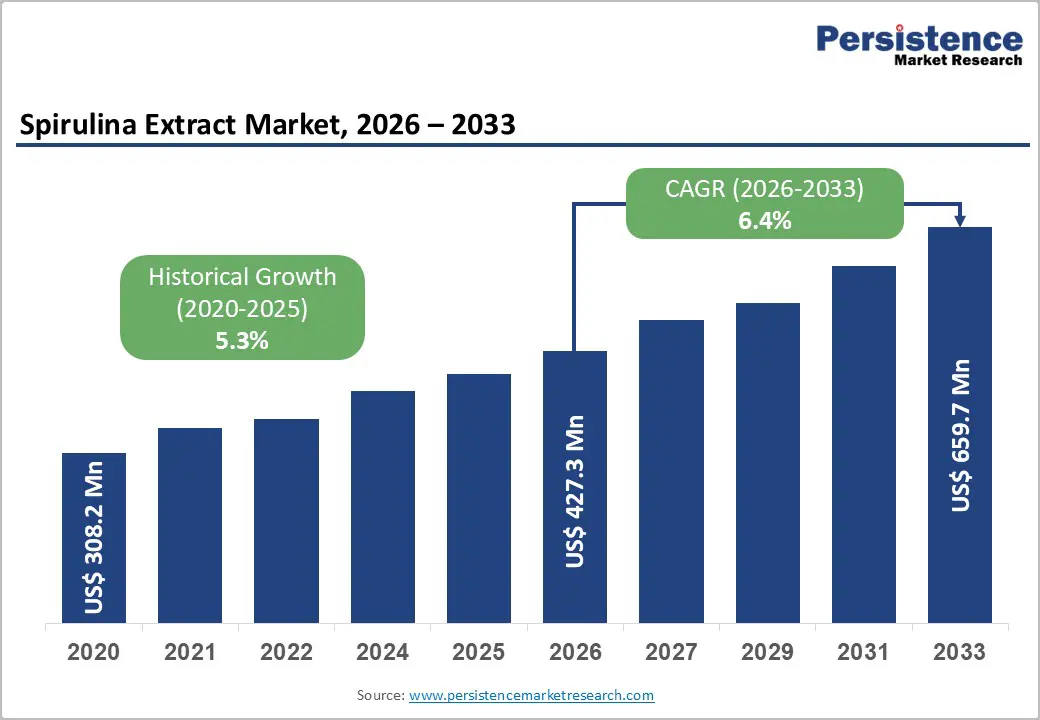
The global spirulina extract market size is estimated to grow from US$ 427.3 million in 2026 to US$ 659.7 million by 2033. The market is projected to record a CAGR of 6.4% during the forecast period from 2026 to 2033. Spirulina extract is emerging as a powerhouse ingredient in nutrition, functional foods, and wellness applications, driven by rising vegan, eco-conscious, and health-aware consumer trends. With its high protein content, antioxidant properties, and sustainable cultivation footprint, spirulina is capturing attention across supplements, beverages, and fortified foods worldwide.
Key Industry Highlights
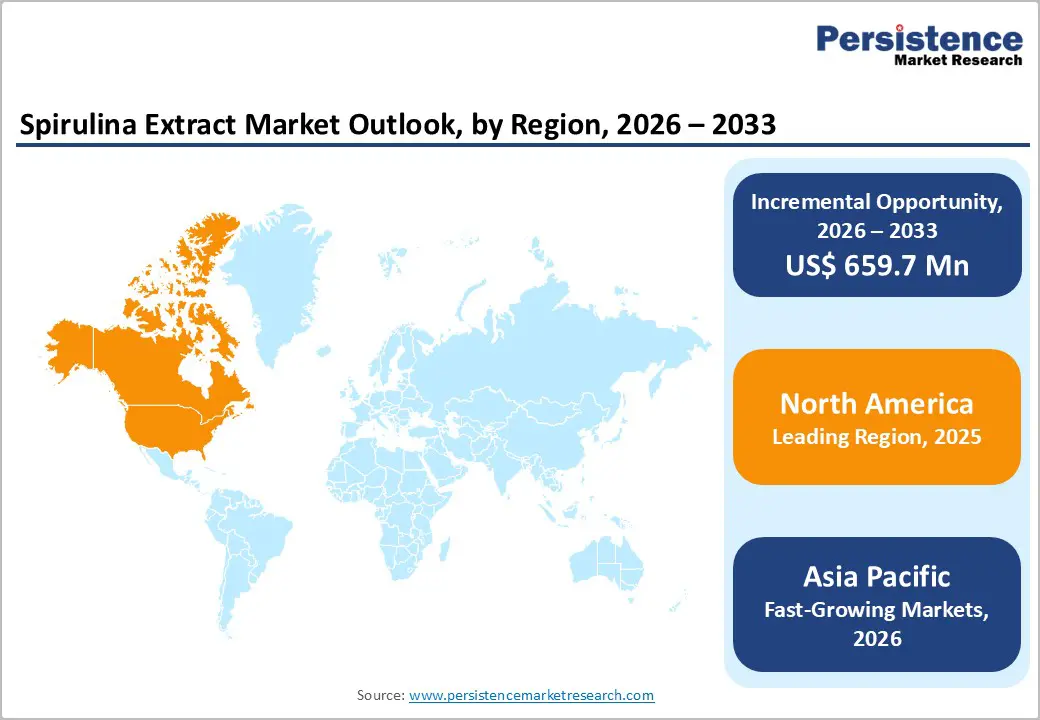
- Leading Region: North America, holding 41% market share, driven by nutrient-dense, sustainable ingredients, transparent sourcing, and adoption of spirulina-based natural colorants in functional beverages and fortified snacks.
- Fastest-Growing Region: Asia Pacific, growing at a CAGR of 8.1%, fueled by urban demand for plant-based protein, functional nutraceutical powders, cosmeceuticals, and government-backed algae farming initiatives.
- Fastest-Growing Product Type Segment: Powder Spirulina Extract, commanding approx. 73% market share, due to adaptability across supplements, beverages, snacks, functional foods, and ease of blending while maintaining shelf stability.
- Market Drivers: Rise of vegan and eco-conscious lifestyles is boosting demand for algae-derived, sustainable nutrition, with consumers valuing low ecological footprint, high nutrient density, and responsible sourcing practices.
- Opportunities: Tech-enabled microalgae farming with automated photobioreactors, AI-driven nutrient monitoring, and modular systems allows new entrants and incumbents to scale production efficiently, penetrate price-sensitive markets, and maintain consistent extract quality.
- Market Restraints: Limited awareness in emerging markets slows adoption of premium spirulina extracts, with knowledge gaps, minimal retail presence, and higher pricing restricting penetration in price-sensitive regions.
- Key Developments: In October 2025, UC Santa Cruz and Global Algae Innovations partnered to test carbon-captured Spirulina as sustainable feed for rainbow trout. In August 2025, TNSCST launched a Spirulina farming initiative at Jamal Mohamed College, Tiruchy, focusing on technical skills, entrepreneurship, and value-added product development.
| Key Insights | Details |
|---|---|
|
Global Spirulina Extract Market Size (2026E) |
US$ 427.3 Mn |
|
Market Value Forecast (2033F) |
US$ 659.7 Mn |
|
Projected Growth (CAGR 2026 to 2033) |
6.4% |
|
Historical Market Growth (CAGR 2020 to 2025) |
5.3% |
Market Dynamics
Driver - Rise of vegan and eco-conscious lifestyles fuels preference for sustainable, algae-derived nutrition
A growing shift toward ethical consumption is pushing consumers to seek nutrient sources that align with vegan and environmentally responsible lifestyles, placing spirulina extract in a favourable position. Its naturally high protein density, antioxidant profile, and low ecological footprint make it an appealing choice for buyers looking to replace animal-derived supplements. Brands tapping into algae-based nutrition are seeing stronger pull from urban, health-aware segments that value transparency, minimal land use, and lower emissions in ingredient production. This shift is driving wider adoption of spirulina extract across supplements, fortified foods, and wellness beverages.
At the same time, eco-conscious shoppers are scrutinizing sourcing practices, rewarding companies that demonstrate responsible cultivation and clean processing methods. Spirulina producers that integrate solar-powered drying, closed-loop water systems, or certified sustainable operations are gaining trust and shelf visibility. As climate concerns grow, algae-derived ingredients benefit from strong alignment with future-forward dietary values, reinforcing spirulina extract as a powerful market driver.
Restraints - Limited awareness in emerging markets slows the adoption of premium spirulina extract products
A noticeable gap in consumer education is slowing the penetration of premium spirulina extract products across emerging markets. Many buyers remain unfamiliar with the functional benefits of spirulina or perceive algae-based ingredients as niche, reducing willingness to pay higher prices. Limited exposure in mainstream retail and minimal promotional activity from regional brands further weaken adoption. This knowledge deficit keeps premium spirulina positioned as a specialty item rather than an everyday nutritional choice.
At the distribution level, smaller retailers often hesitate to stock higher-priced spirulina extracts due to uncertain demand, reinforcing slow market movement. Without strong awareness campaigns, premium variants struggle to compete against widely recognized plant-based supplements. The lack of clear product literacy suppresses trial rates, delaying broader acceptance of value-added spirulina offerings in fast-growing but price-sensitive regions.
Opportunity - Tech-enabled microalgae farming enables new entrants to position with low-cost, high-yield production systems
A new wave of tech-enabled microalgae farming is reshaping the economics of spirulina extract production, creating strong entry points for startups and innovators. Automated photobioreactors, AI-driven nutrient monitoring, and precision light management allow producers to achieve higher yields with fewer inputs. These advancements reduce dependence on large land areas and manual labor, helping new entrants compete with established players through efficient scaling and predictable output quality. Lower production costs strengthen the feasibility of launching premium or value-focused spirulina extracts that meet rising global demand.
For existing companies, integrating digital farming systems opens doors to expand into price-sensitive markets while maintaining consistent purity and potency. Cloud-based monitoring, remote-controlled cultivation, and modular algae farms unlock the ability to operate in diverse geographies with minimal overhead. This technology-driven shift positions spirulina extract as a scalable, future-ready ingredient, inviting a broader participation from agile, innovation-led businesses.
Category-wise Analysis
By Form, powder spirulina extracts dominate the global market
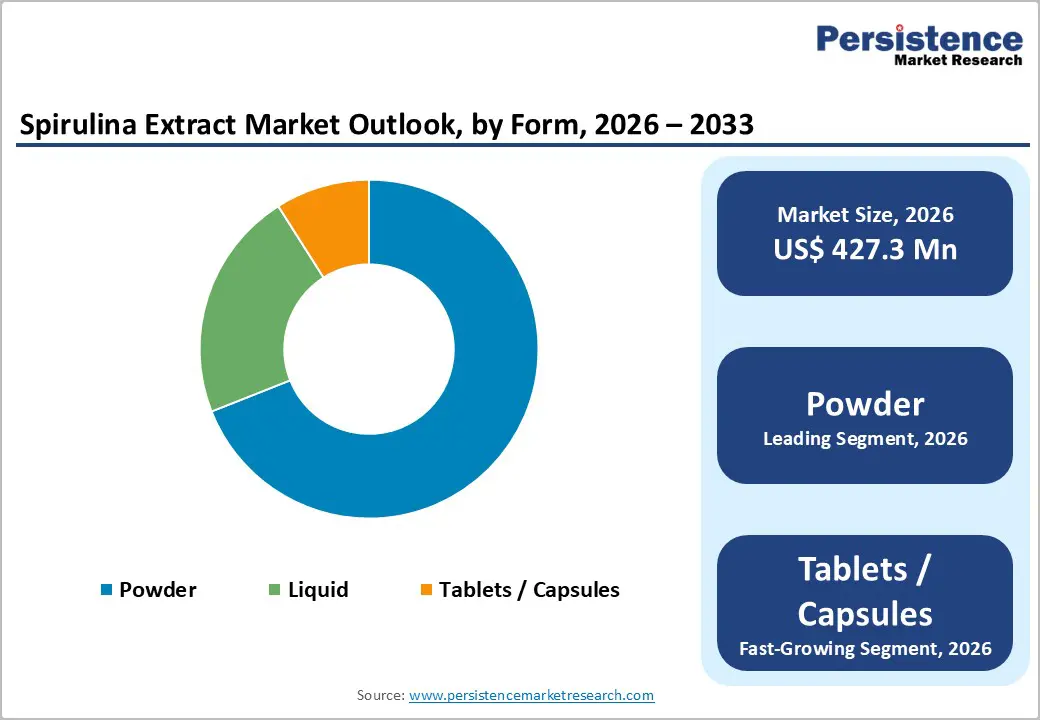
Powder spirulina extract holds approx 73% share as of 2025, supported by its adaptability across supplements, beverages, snacks, and functional food formulations. Its long shelf life, stable nutrient profile, and ease of blending make it the preferred choice for brands aiming to fortify products without compromising flavor or texture. Manufacturers value the format for bulk handling, while consumers appreciate its flexibility in smoothies, wellness drinks, and homemade nutrition mixes.
Liquid spirulina extract is carving out space in concentrated wellness shots and ready-to-drink formulations, appealing to users seeking rapid absorption and smooth dispersion. Tablets and capsules maintain steady traction among consumers who favor structured dosing and convenience-driven formats for daily supplementation, reinforcing a balanced competitive landscape across form factors.
By Nature, organic Spirulina Extracts are expected to show promising growth during the forecast period
Organic Spirulina Extracts are projected to grow at a CAGR of 9.6% during the forecast period in the global Spirulina Extract market, driven by a decisive consumer shift toward cleaner labels and chemical-free nutrition. As buyers scrutinize sourcing practices and production transparency, organically cultivated spirulina stands out for its assured purity, absence of synthetic inputs, and alignment with eco-conscious values. This positioning strengthens trust among health-focused consumers who increasingly associate organic certification with superior safety and nutrient integrity.
Demand is further amplified by food and beverage brands integrating organic spirulina into fortified snacks, natural colorants, and plant-based supplements to secure premium positioning. Regulatory encouragement for organic farming and growing retail shelf space for certified products reinforce momentum, setting the stage for sustained, high-quality expansion.
Region-wise Insights
North America Spirulina Extract Market Trends
North America holds approximately 41% market share in the global Spirulina Extract Market, reflecting the region’s rapid shift toward nutrient-dense, sustainable ingredients. In the US, brands are leaning into spirulina-based natural colorants as synthetic dyes face rising scrutiny from clean-label consumers. Functional beverages incorporating blue spirulina are gaining traction across energy drinks, hydration lines, and wellness shots. The push for transparent sourcing is intensifying, prompting manufacturers to highlight traceable microalgae cultivation and controlled production environments.
Canada is experiencing a sharp rise in spirulina use within plant-forward food categories, especially fortified snacks and alternative dairy lines. Local startups are experimenting with cold-processed extraction to preserve antioxidant potency, giving regional players a competitive edge. Retailers are widening shelf space for premium and sustainably harvested spirulina, strengthening long-term market momentum.
Asia Pacific Spirulina Extract Market Trends
Asia Pacific spirulina extract market is expected to grow at a CAGR of 8.1%, driven by an aggressive shift toward functional, immune-supportive ingredients across major economies. India is witnessing a surge in spirulina-infused nutraceutical powders as urban consumers prioritize plant-based protein sources for daily wellness routines. China’s producers are scaling enclosed photobioreactor systems to achieve consistent pigment quality, catering to food and beverage companies seeking stable natural colorants. Japan is pushing premium-grade spirulina for cosmeceuticals, where anti-aging formulations increasingly feature microalgae-derived antioxidants.
South Korea is amplifying demand through its beauty-through-nutrition movement, with spirulina shots and detox blends gaining wide traction in online and pharmacy channels. Regional governments promoting algae farming as part of blue bioeconomy initiatives are accelerating innovation, enabling startups to commercialize extracts with enhanced phycocyanin concentration. The momentum reflects a broader shift toward high-purity, sustainably cultivated microalgae across APAC.
Market Competitive Landscape
The global spirulina extract market reflects a moderately fragmented structure, creating space for aggressive innovation from incumbents and agile entrants. Leading producers are refining extraction technologies to deliver higher phycocyanin purity, while expanding cultivation footprints across sun-rich regions to stabilize pigment output. Startups are joining the race with modular bioreactor farms that promise year-round yields and faster scalability. Global expansion strategies now center on supplying nutraceutical brands seeking vivid natural colorants and protein-rich concentrates that meet tightening clean-label expectations. Certifications such as USDA Organic, Non-GMO, and allergen-free standards are becoming strategic assets, allowing manufacturers to access premium food, beverage, and wellness channels. The landscape is shifting rapidly as companies invest in sustainable production systems and cross-border distribution.
Key Developments:
- In October 2025, UC Santa Cruz and Global Algae Innovations partnered to test carbon-captured Spirulina as sustainable feed for rainbow trout. The study uses Spirulina cultivated with CO2 captured from power plant emissions.
- In August 2025, TNSCST launched a Spirulina farming initiative at Jamal Mohamed College, Tiruchy, offering technical skills and entrepreneurial training. The programme also emphasizes development of value-added Spirulina products.
Companies Covered in Spirulina Extract Market
- Cyanotech Corporation
- DIC Corporation
- E.I.D.- Parry (India) Limited
- Naturalin Bio-Resources Co , Ltd
- Far East Bio-Tec Co., Ltd.
- Givaudan
- Fraken Biochem Co., Ltd.
- Sun Chemical
- NB Laboratories Pvt Ltd
- Others
Frequently Asked Questions
The global spirulina extract market is projected to be valued at US$ 427.3 Mn in 2026.
Growing adoption of vegan and eco-focused lifestyles is pushing consumers toward sustainable, algae-based nutrition solutions, accelerating demand in the global Spirulina Extract market.
The global Spirulina Extract market is poised to witness a CAGR of 6.4% between 2026 and 2033.
Technology-driven microalgae cultivation is giving new entrants a pathway to operate with efficient, low-cost, high-output production models, creating a significant growth opportunity for players in the Spirulina Extract industry.
Major players in the global Spirulina Extract market include Cyanotech Corporation, DIC Corporation, E.I.D.- Parry (India) Limited, Givaudan, Sun Chemical, and others.


