




- Medical Devices
- Renal Function Test Market
Renal Function Test Market Size, Share, and Growth Forecast 2026 - 2033
Renal Function Test Market by Product Type (Dipsticks & Reagents, Disposables, Instruments, Consumables), Test Type (Serum Creatinine Tests, Blood Urea Nitrogen (BUN) Tests, Glomerular Filtration Rate (GFR) Tests, Urine Protein Tests, Electrolyte Tests, Others), End-user (Hospitals, Diagnostic Laboratories, Clinics, Ambulatory Surgical Centers, Home Care Settings, Research Institutes), and Regional Analysis, 2026 - 2033

Renal Function Test Market Share and Trends Analysis
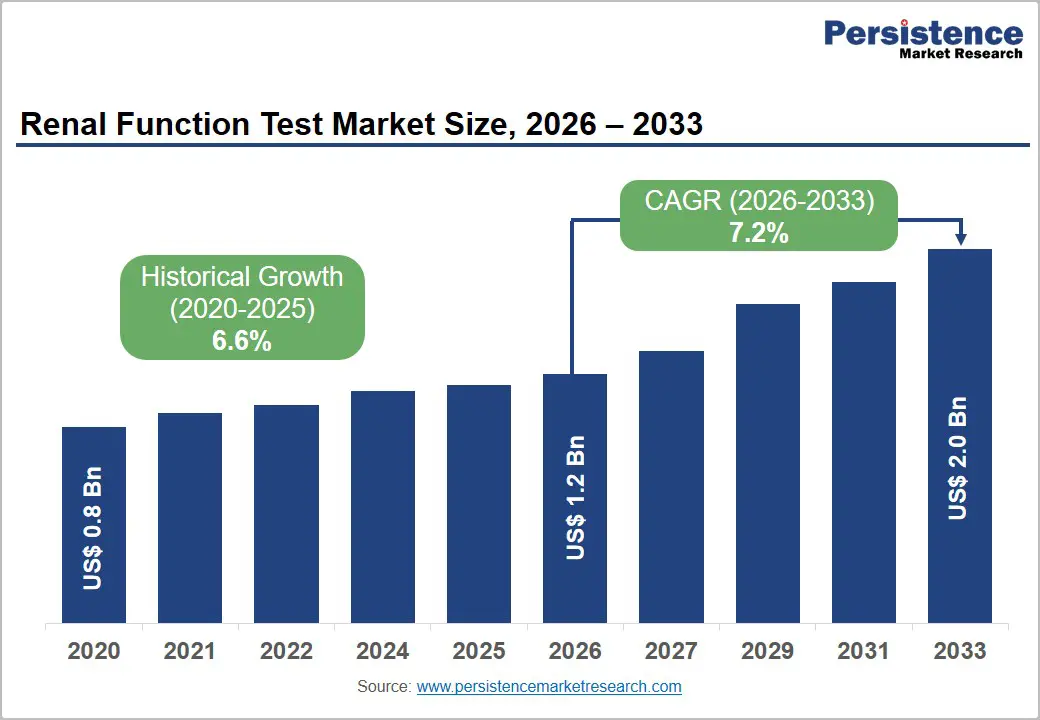
The global renal function test market size is expected to be valued at US$ 1.2 billion in 2026 and projected to reach US$ 2.0 billion by 2033, growing at a CAGR of 7.2% between 2026 and 2033. The renal function test market is experiencing steady growth due to the increasing prevalence of chronic kidney disease, diabetes, hypertension, and other renal disorders worldwide.
Rising awareness regarding early disease diagnosis and preventive healthcare has significantly increased demand for routine kidney function monitoring in hospitals, diagnostic laboratories, and home care settings. Technological advancements in automated analyzers, point-of-care testing devices, and biomarker-based diagnostics are improving testing accuracy and efficiency.
Key Industry Highlights
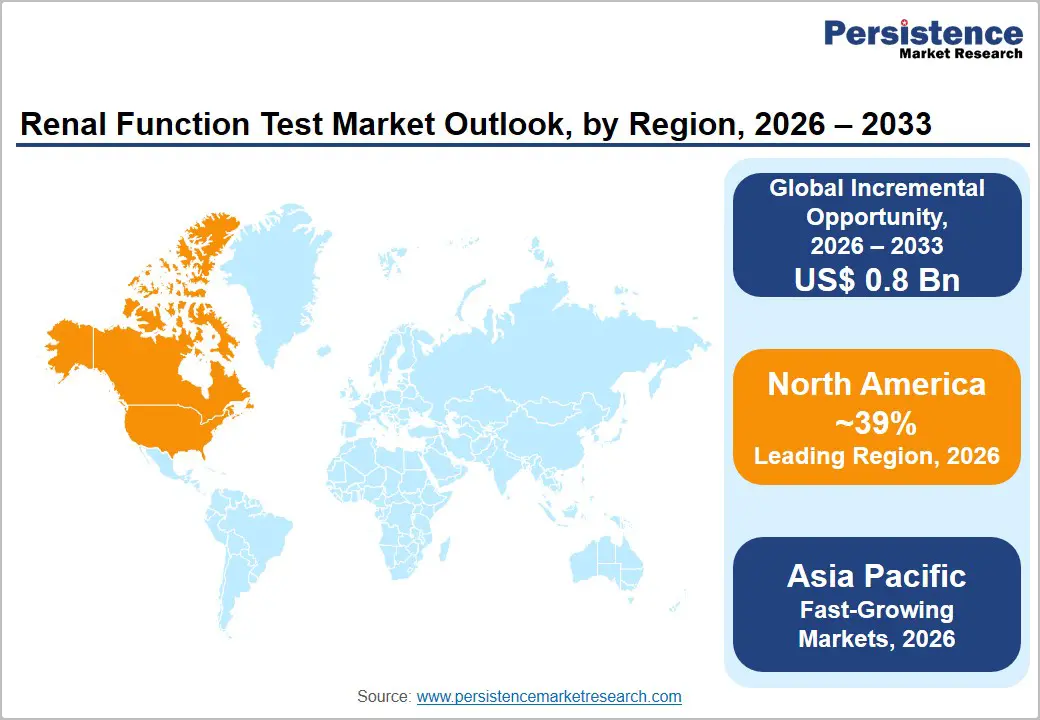
- Leading Region: North America leads the global market with approximately 39% revenue share in 2025, underpinned by 37 million CKD patients in the U.S., universal CMS reimbursement for renal panels, and the dominant installed base of Roche, Siemens, and Beckman Coulter automated analyzers.
- Fast-growing Market: Asia Pacific is the fastest-growing regional market through 2033, driven by China's 140 million and India's 101 million diabetic adults, rapid diagnostic laboratory sector expansion, and government NCD screening programs, including China's Healthy China 2030 initiative.
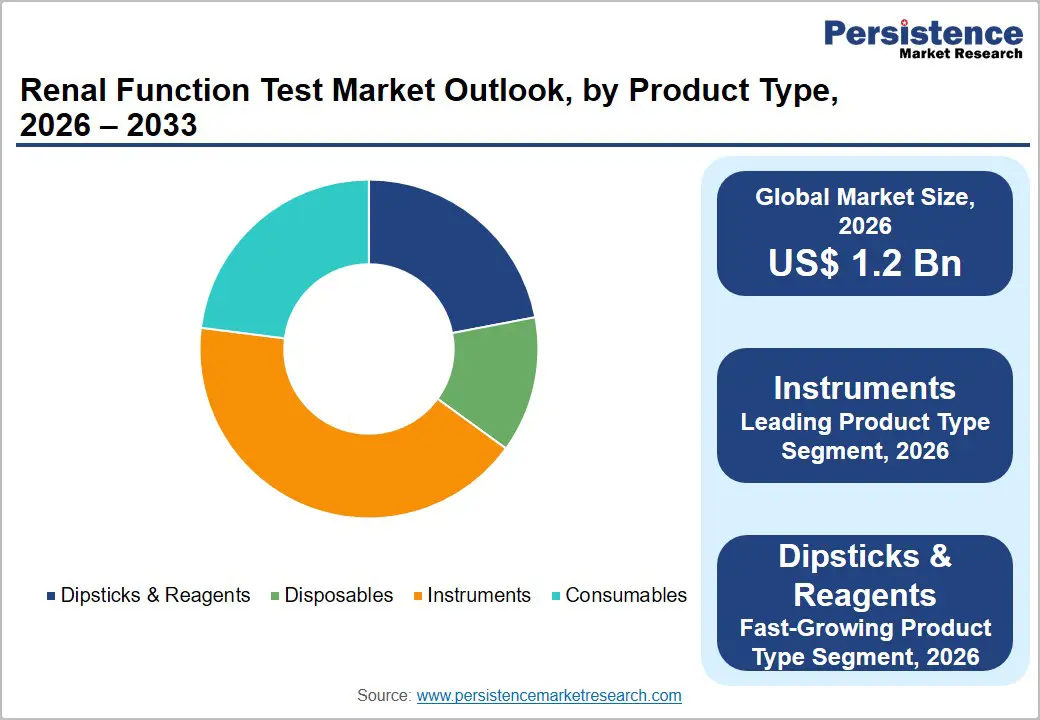
- Dominant Product: The instruments segment dominates the product type category with approximately 42% market share in 2026, anchored by high-throughput automated chemistry analyzer adoption in hospital laboratories and long equipment replacement cycles generating durable recurring reagent revenues.
- Fast-growing Product: Dipsticks & reagents represent the fastest-growing product segment through 2033, driven by accelerating adoption of point-of-care testing, WHO endorsement of POC diagnostics for CKD screening in primary care, and growing demand for decentralized renal monitoring in home care and ambulatory settings.
Market Dynamics
Drivers - Rise in Global Chronic Kidney Disease Burden Amplifying Diagnostic Testing Volumes
Chronic kidney disease has emerged as one of the most pressing global public health challenges of the twenty-first century, directly propelling demand for renal function tests across all care settings. The International Society of Nephrology (ISN) estimates that CKD affects over 850 million individuals worldwide, with the majority remaining undiagnosed due to its asymptomatic early course making proactive screening and routine biomarker testing clinically imperative.
The U.S. Centers for Disease Control and Prevention (CDC) reports that 37 million Americans have CKD, and approximately 9 in 10 are unaware of their condition. National kidney health frameworks in the United States, United Kingdom, Japan, and India increasingly mandate regular serum creatinine, GFR, and urine protein testing as standard chronic disease management protocols, generating large, recurring test volumes that anchor diagnostic laboratory and hospital instrument utilization.
Rising Diabetes and Hypertension Prevalence Driving Nephropathy Screening Demand
Diabetes mellitus and hypertension are the two leading causes of CKD globally, and both conditions are reaching epidemic proportions, structurally expanding the addressable market for renal function diagnostics. The International Diabetes Federation (IDF) reported 537 million adults living with diabetes in 2021, a figure projected to reach 783 million by 2045. Diabetic nephropathy accounts for approximately 30-40% of all end-stage renal disease (ESRD) cases, according to data from the National Kidney Foundation (NKF).
Clinical guidelines from the American Diabetes Association (ADA) and KDIGO (Kidney Disease: Improving Global Outcomes) recommend annual urinary albumin and estimated GFR (eGFR) testing for all patients with diabetes or hypertension, translating directly into high-frequency, protocol-driven renal test demand that is difficult to displace and grows proportionally with disease prevalence.
Restraints - Standardization Gaps Across Reference Intervals and Assay Methodologies
The absence of universal standardization in creatinine and GFR assay methodologies continues to introduce clinically significant inter-laboratory variability in renal function test reporting. Despite the IDMS (Isotope Dilution Mass Spectrometry) reference measurement procedure being established as the gold standard, a substantial proportion of global laboratories still employ non-standardized enzymatic or Jaffe creatinine methods.
Studies published in the Clinical Journal of the American Society of Nephrology show that methodological discordance can produce eGFR differences of 5-15 mL/min/1.73 m², potentially leading to misclassification of CKD stage and inappropriate clinical decisions, undermining test credibility and creating hesitancy among clinicians to rely solely on automated platforms.
Opportunities - Point-of-Care and Dipstick-Based Renal Testing: Accelerating Adoption in Decentralized Settings
The Dipsticks & Reagents segment is the fastest-growing product category in the renal function test market, driven by a decisive industry shift toward point-of-care (POC) and near-patient testing that deliver rapid, actionable kidney function outside traditional laboratory environments. The COVID-19 pandemic catalyzed the global adoption of decentralized diagnostics, normalizing POC testing workflows in clinics, ambulatory centers, and home care settings.
Advanced urine dipstick platforms now enable semi-quantitative protein, creatinine, and albumin-to-creatinine ratio assessments within minutes, supporting nephrology screening in resource-limited settings. The WHO has explicitly prioritized POC diagnostics for CKD screening in its HEARTS technical package for non-communicable disease management, providing a policy-level impetus for the adoption of dipstick-based renal tests across primary healthcare networks in high-burden, low-income countries.
Home Care and Telehealth-Integrated Renal Monitoring: Emerging High-Growth Opportunity
The home care settings end-user segment represents one of the most significant emerging commercial opportunities within the renal function test market. The integration of connected, consumer-grade renal biomarker testing with telehealth platforms and electronic health record systems is enabling nephrologists to manage CKD patients remotely with unprecedented granularity. The U.S. Centers for Medicare & Medicaid Services (CMS) has expanded reimbursement for remote patient monitoring (RPM) services under updated CPT codes, creating a financially viable pathway for home-based prescription and reimbursement of renal function test kits.
Companies developing FDA-cleared or CE-marked home-use creatinine and albumin test kits integrated with companion smartphone applications are positioned to capture significant premium revenue from the growing population of CKD patients seeking convenient, telehealth-compatible monitoring solutions.
Category-wise Analysis
Product Type Insights
The instruments segment dominates the renal function test market by product type, commanding approximately 42% of global market share in 2026. This leadership is structurally anchored by the widespread adoption of automated clinical chemistry analyzers in hospital laboratories and reference diagnostic facilities, which process the overwhelming majority of high-volume serum creatinine, BUN, and electrolyte test panels.
Leading platforms including Roche Diagnostics' cobas series, Siemens Healthineers' ADVIA chemistry systems, and Beckman Coulter's AU analyzers dominate installed bases in tertiary care hospitals globally, generating substantial recurring reagent and calibrator revenue streams. The high capital cost and long replacement cycles of laboratory instruments, typically 7 to 10 years, create durable competitive moats for established instrument manufacturers and reinforce the segment's revenue leadership through the forecast period.
Test Type Insights
Serum creatinine tests account for the leading position within the test type segmentation, accounting for approximately 35% of global renal function test revenues in 2026. Serum creatinine measurement is the foundational biomarker for kidney function assessment, forming the basis for eGFR calculation using equations including the CKD-EPI (Chronic Kidney Disease Epidemiology Collaboration) formula-the current standard recommended by KDIGO guidelines.
The test's universal inclusion in routine metabolic panels, pre-surgical assessments, drug dosing protocols, and chronic disease monitoring programs generates an extraordinarily high and stable test volume base. The American Society of Nephrology (ASN) and KDIGO jointly recommend serum creatinine and urine albumin as the two primary CKD screening biomarkers, ensuring that serum creatinine testing remains the most frequent renal diagnostic procedure across all care settings globally.
End-user Insights
Hospitals are the leading end-user segment for renal function tests, accounting for approximately 44% of global market revenues in 2026. Hospitals operate the highest-volume, highest-complexity renal diagnostic workflows, encompassing routine inpatient metabolic monitoring, acute kidney injury (AKI) detection in intensive care units, pre- and post-operative renal function assessment, and CKD management within nephrology departments.
The Global Burden of Disease (GBD) study estimates that AKI affects approximately 13.3 million patients annually worldwide, with the vast majority managed in hospital settings requiring intensive, repeated renal function testing. Additionally, hospital-based automated chemistry analyzer platforms enable high-throughput batch processing of renal panels, with rapid turnaround times that are critical for acute care decision-making, reinforcing hospitals as the structurally dominant volume and revenue channel for renal function test manufacturers.
Regional Insights
North America Renal Function Test Market Trends and Insights
North America leads the global renal function test market with approximately 39% revenue share in 2026, driven by the United States' high prevalence of CKD, diabetes, and hypertension, a mature clinical laboratory infrastructure, robust CMS reimbursement frameworks covering routine renal panels, and the presence of leading diagnostic instrument manufacturers. Adoption of IDMS-standardized creatinine assays and CKD-EPI eGFR reporting is near-universal across accredited U.S. laboratories.
U.S. Renal Function Test Market Size
The United States accounts for approximately 84% of North American revenues, anchored by over 250,000 clinical laboratories that report renal function data annually, according to CMS data. High CKD prevalence (37 million affected), mandatory annual renal screening under ADA and ACC guidelines, and expanding RPM reimbursement for home-based monitoring collectively sustain the U.S. as the world's single largest national renal function test market.
Europe Renal Function Test Market Trends and Insights
Europe is the second-largest regional market, supported by universal healthcare coverage providing broad reimbursement for routine renal function testing, strong laboratory accreditation standards under ISO 15189, and active national CKD awareness programs. The European Renal Association (ERA) guidelines drive standardized testing protocols across member states, supporting consistent test volume growth. Aging population demographics across Germany, France, and the U.K. are structurally expanding CKD prevalence and diagnostic demand.
Germany Renal Function Test Market Size
Germany accounts for approximately 23% of European revenues, reflecting its large elderly population and comprehensive statutory health insurance (GKV) coverage of renal biomarker panels. The Deutsche Gesellschaft für Nephrologie (DGfN) promotes widespread CKD screening, and Germany's dense network of accredited medical laboratories sustains high per-capita renal test volumes among European nations.
U.K. Renal Function Test Market Size
The United Kingdom accounts for approximately 19% of European revenues, underpinned by the NHS Quality and Outcomes Framework (QOF), which incentivizes annual eGFR and urine albumin testing for diabetic and hypertensive patients in primary care. The UK Kidney Association (UKKA) CKD guidelines align closely with KDIGO standards, supporting high-frequency testing of serum creatinine and eGFR across NHS laboratory networks.
France Renal Function Test Market Size
France accounts for approximately 16% of European market revenues, driven by the Haute Autorité de Santé (HAS) mandating the inclusion of a regular renal function panel in chronic disease management protocols for patients with diabetes and cardiovascular disease. France's well-developed public hospital laboratory network and strong clinical biochemistry reagent distribution infrastructure support consistent test volume throughput and instrument utilization.
Asia Pacific Renal Function Test Market Trends and Insights
Asia-Pacific is the fastest-growing regional market for renal function tests, propelled by the world's largest diabetic population base-with China alone accounting for approximately 140 million diabetic adults per the Chinese Diabetes Society-rapidly expanding diagnostic laboratory infrastructure, and government initiatives including China's Healthy China 2030 plan promoting chronic disease screening. Rising private healthcare investment across India, Japan, and ASEAN markets is accelerating the adoption of analyzers.
India Renal Function Test Market Size
India accounts for approximately 17% of Asia-Pacific revenues and is the region's highest-growth national market, driven by 101 million diabetic adults (per IDF 2021 data), a rapidly expanding chain diagnostics laboratory sector led by Dr. Lal PathLabs and Metropolis Healthcare, and the National Program for Non-Communicable Diseases (NPNCD) prioritizing kidney health screening at district hospital level.
Competitive Landscape
The renal function test market is highly competitive, characterized by the presence of global diagnostics manufacturers, clinical laboratory service providers, and specialized reagent developers focusing on innovation, automation, and accuracy enhancement. Companies are actively investing in advanced biomarkers, automated analyzers, and point-of-care renal testing solutions to strengthen their market position. Strategic collaborations with hospitals, research institutes, and diagnostic laboratories are expanding product penetration worldwide.
The market is also witnessing increasing emphasis on rapid testing technologies, AI-integrated diagnostic platforms, and cost-effective consumables. Rising chronic kidney disease prevalence and growing preventive healthcare awareness continue to intensify competition among established players and emerging regional participants.
Key Developments:
- In April 2026, Abbott Laboratories launched the Integrated Cardio Renal Assessment (ICRAS) tool to help physicians evaluate combined heart and kidney disease risks in diabetes patients.
- In October 2025, Roche announced that data from its sixth-generation Troponin-T test demonstrated significantly improved accuracy for rapid heart attack diagnosis. The newly CE-marked test enhanced sensitivity and precision, enabling clinicians to identify myocardial infarction faster and more reliably in emergency settings while also helping exclude non-cardiac causes.
- In September 2025, Renalytix announced a collaboration with Tempus AI to expand access to its FDA-approved and Medicare-reimbursed kidneyintelX.dkd prognostic blood test across Tempus’ U.S. healthcare network. The partnership was aimed at improving intelligent risk assessment for patients with type 2 diabetes and chronic kidney disease by integrating AI-enabled diagnostics into existing clinical workflows.
Companies Covered in Renal Function Test Market
- F. Hoffmann-La Roche Ltd
- Danaher Corporation
- Abbott Laboratories
- Siemens Healthineers AG
- Thermo Fisher Scientific Inc.
- Sysmex Corporation
- Beckman Coulter, Inc.
- Bio-Rad Laboratories, Inc.
- Nova Biomedical
- Randox Laboratories Ltd.
- Quest Diagnostics Incorporated
- Acon Laboratories, Inc.
- Arkray, Inc.
Frequently Asked Questions
The global Renal Function Test market is estimated to be valued at US$ 1.2 billion in 2026.
Expanding adoption of automated diagnostic analyzers and point-of-care renal testing technologies is improving accessibility and testing efficiency.
North America leads the global market with approximately 39% revenue share in 2025, with the United States as the dominant national market.
Increasing integration of AI-driven diagnostics, digital health platforms, and advanced biomarkers for early chronic kidney disease detection is creating significant opportunities for market expansion.
The leading companies in the global Renal Function Test market include F. Hoffmann-La Roche Ltd, Danaher Corporation (through Beckman Coulter), Abbott Laboratories, Siemens Healthineers AG, Thermo Fisher Scientific Inc., Sysmex Corporation, Bio-Rad Laboratories, Inc.


