




- Beauty & Personal Care
- Percussion Massage Gun Market
Percussion Massage Gun Market Size, Share, and Growth Forecast, 2026 – 2033
Percussion Massage Gun Market by Size (Small Size, Mid-Size, Large Size), Battery Type (Rechargeable, Replaceable), Sales Channel (Direct Sales, Indirect Sales), End-user (Fitness Enthusiasts, General Home Users, Others), and Regional Analysis 2026 – 2033
Percussion Massage Gun Market Size and Trends Analysis
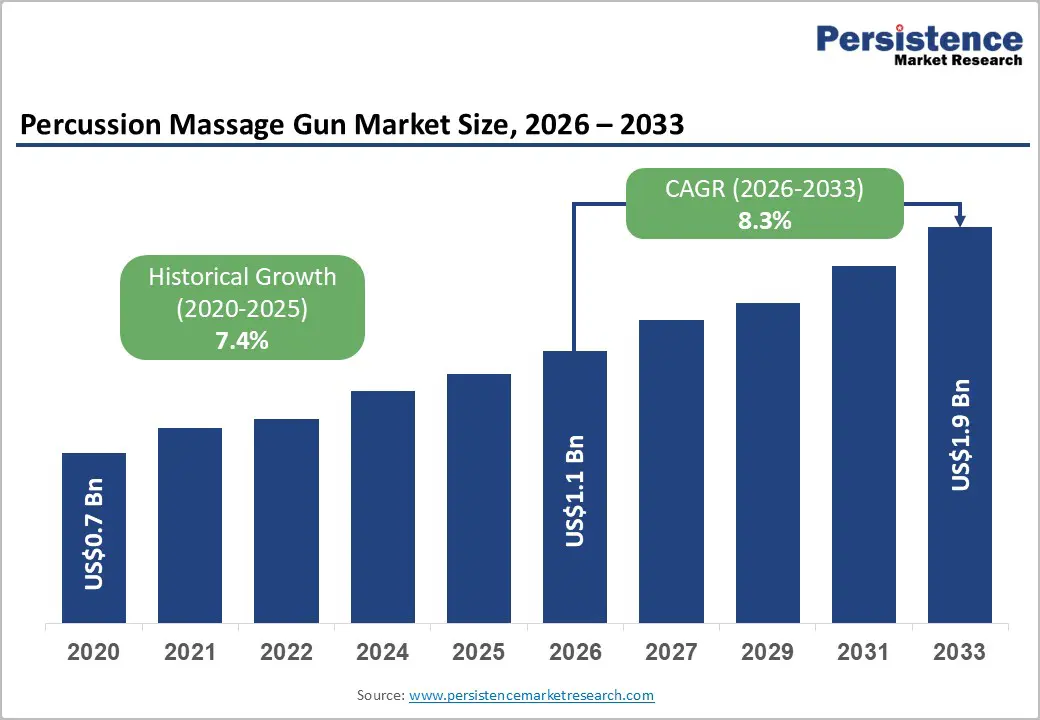
The global percussion massage gun market size is likely to be valued at US$1.1 billion in 2026 and is expected to reach US$1.9 billion by 2033, growing at a CAGR of 8.3% during the forecast period from 2026 to 2033, driven by the integration of smart percussion technologies and the escalating shift toward proactive musculoskeletal self-care among urban populations.
As consumers transition from reactive physical therapy to preventive daily wellness routines, the demand for portable, high-torque recovery tools is projected to accelerate. The convergence of brushless motor efficiency and long-range lithium-ion battery life is expected to catalyze broader adoption across diverse demographic groups, including aging populations and remote workers.
Key Industry Highlights:
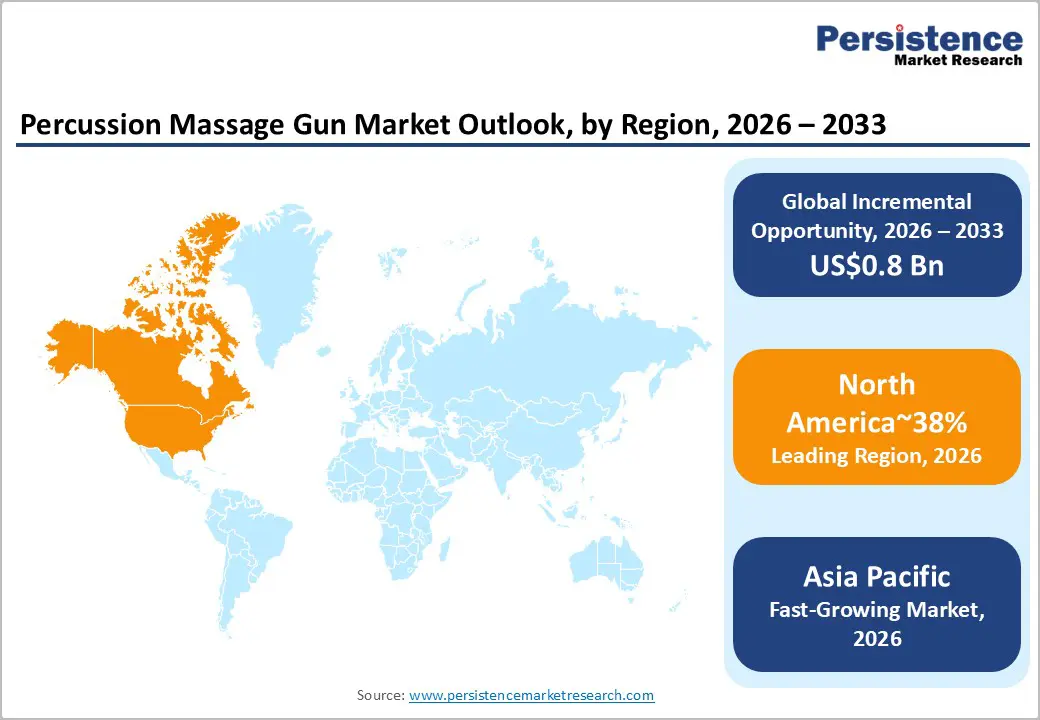
- Leading Region: North America is projected to lead due to strong consumer adoption of recovery technologies, mature wellness ecosystems, and advanced digital health infrastructure, accounting for approximately 38% share in 2026, supported by premium device innovation, strong purchasing power, and established fitness culture integration.
- Fastest Growing Region: Asia Pacific is anticipated to grow fastest due to expanding wellness awareness, large-scale consumer electronics manufacturing capacity, and rapid adoption of connected fitness technologies across emerging urban populations.
- Leading Size Segment: Mid-size models are expected to lead, accounting for approximately 46% share in 2026, through widespread adoption among athletes and everyday fitness users, supported by balanced stall force performance, ergonomic design, and advanced digital recovery integration.
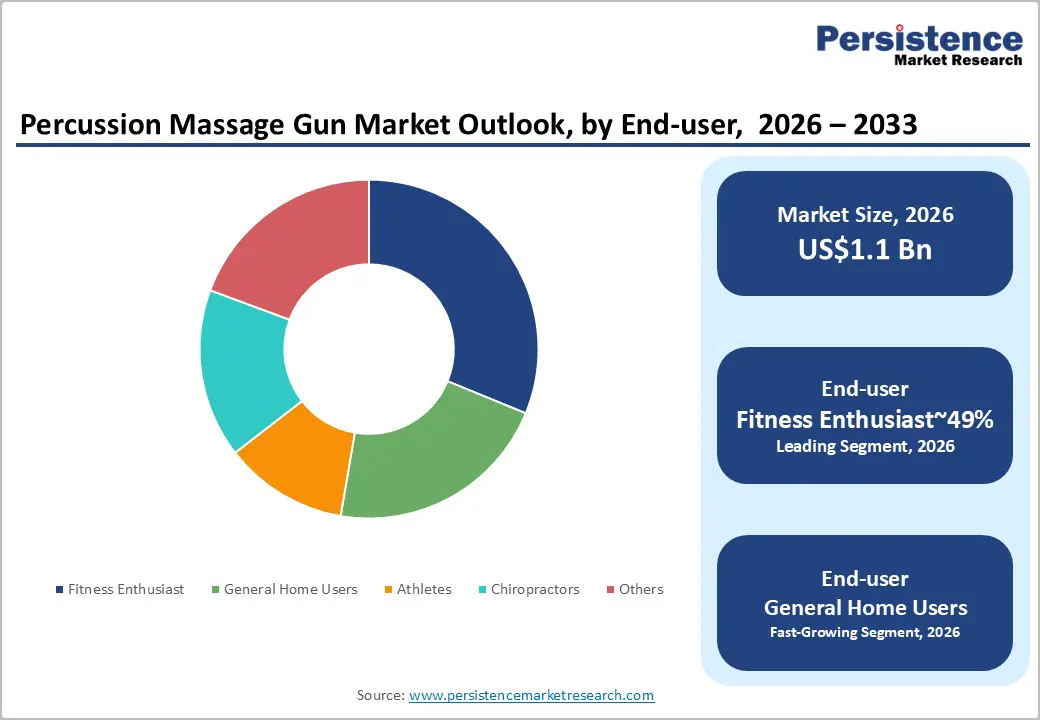
- Leading End-user: Fitness enthusiasts are projected to dominate for strong recovery awareness, frequent workout routines, and integration of percussive therapy within structured training programs, holding approximately 49% share in 2026 across the global percussion massage gun market.
| Key Insights | Details |
|---|---|
| Percussion Massage Gun Market Size (2026E) | US$1.1 Bn |
| Market Value Forecast (2033F) | US$1.9 Bn |
| Projected Growth (CAGR 2026 to 2033) | 8.3% |
| Historical Market Growth (CAGR 2020 to 2025) | 7.4% |
Market Factors – Growth, Barriers, and Opportunity Analysis
Growth Analysis – Rising Health Awareness and Post-Pandemic Fitness Engagement Stimulating Demand for Recovery Devices
Growing health consciousness worldwide is strengthening consumer commitment toward structured exercise and physical recovery practices. This behavioral shift intensifies demand for noninvasive solutions addressing muscle fatigue and post-workout soreness. Fitness communities increasingly emphasize recovery management alongside training intensity and performance optimization strategies. Percussion massage devices provide convenient myofascial stimulation, supporting circulation improvement and muscular relaxation.
The expansion of boutique fitness studios further amplifies exposure to advanced recovery technologies. Trainers frequently integrate recovery tools within structured routines, shaping broader consumer familiarity with percussion therapy.
Post-pandemic lifestyle adjustments significantly expanded participation in home-based training and digital fitness programs. Individuals undertaking high-intensity exercise often experience muscle stiffness requiring consistent recovery interventions. Portable massage technologies provide accessible relief without clinical supervision or pharmaceutical dependence. Regulatory acceptance of wellness devices within personal health ecosystems strengthens consumer confidence toward therapeutic equipment.
Expanding e-commerce distribution channels simplifies device accessibility across diverse consumer segments. These structural shifts collectively reinforce sustained market demand for percussion massage recovery solutions.
Advancements in Quiet Motor Engineering and Smart Connectivity Enhancing Device Differentiation
Rapid advancements in brushless motor engineering are improving percussion intensity while significantly reducing acoustic output. Lower operational noise enhances user comfort across residential environments and shared fitness spaces. These refinements expand the applicability of percussion devices beyond professional training settings. Engineering improvements in stall force performance also enable deeper muscle stimulation without excessive vibration dispersion.
Compact structural design allows manufacturers to deliver high-performance functionality within portable ergonomic devices. These innovations strengthen product differentiation across increasingly competitive personal recovery equipment markets.
Parallel progress in digital connectivity is transforming percussion massage devices into intelligent recovery platforms. Bluetooth-enabled applications facilitate personalized massage routines aligned with individual biomechanics and training intensity. Data integration allows adaptive guidance that adjusts percussion patterns according to recovery requirements. Smart ecosystems reinforce long-term consumer engagement while strengthening brand ecosystem loyalty. Regulatory acceptance of connected wellness devices further legitimizes digital-assisted recovery technologies. Collectively, these technological shifts elevate percussion devices from simple tools into integrated recovery solutions.
Barrier Analysis – Restraint – Proliferation of Low-Quality Imitations and Absence of Consistent Safety Certification Frameworks
The proliferation of low-quality imitation devices is undermining structural confidence within the percussion massage equipment market. Numerous unregulated products enter distribution channels without adherence to established electrical and safety certification frameworks. Inferior battery components increase the likelihood of overheating, compromising operational reliability and consumer safety expectations. Inconsistent motor torque generation reduces therapeutic effectiveness and accelerates premature mechanical failure.
Such product variability complicates quality benchmarking across competing manufacturers and distribution platforms. These deficiencies collectively weaken category credibility among cautious consumers seeking dependable recovery technologies.
The absence of harmonized safety compliance standards further complicates regulatory oversight within the expanding device ecosystem. Retail platforms frequently distribute uncertified devices through fragmented supply networks and informal import channels. Inadequate product testing elevates the probability of malfunction under sustained high-amplitude percussion operation.
Medical and rehabilitation professionals remain hesitant to recommend devices lacking verified engineering and safety validation. This hesitation constrains institutional adoption across physiotherapy and chiropractic recovery environments. The resulting credibility challenges moderate broader consumer acceptance despite increasing awareness of percussion therapy benefits.
Elevated Component Costs and Supply Volatility Constraining Market Affordability
High production costs associated with premium components significantly constrain affordability across the percussion massage device market. Lithium-ion battery systems and precision-engineered quiet motors represent substantial contributors to manufacturing expenditure. These components require advanced material sourcing and specialized assembly processes within consumer wellness device production. Supply volatility across electronic component markets further amplifies procurement uncertainty for manufacturers.
Fluctuating input availability complicates production planning and increases inventory management risks across device manufacturers. As a result, pricing structures remain elevated relative to mass market consumer purchasing capacity.
Cost pressures limit device penetration within price-sensitive consumer segments across emerging and developing economies. Manufacturers frequently confront tradeoffs between maintaining performance specifications and preserving competitive retail pricing.
Reducing component quality to achieve lower price points risks compromising operational reliability and device lifespan. Conversely, maintaining premium engineering standards narrows accessibility for mid-tier consumers seeking recovery solutions. These structural tensions influence product portfolio strategies and segment positioning within the broader wellness device ecosystem. Consequently, affordability barriers continue to moderate adoption across value-oriented consumer demographics.
Opportunity Analysis – Clinical Validation and Expansion into Geriatric Rehabilitation Applications
Growing clinical recognition of percussive therapy is expanding the functional scope of massage devices within rehabilitation settings. Physical therapists and chiropractors increasingly incorporate controlled vibration therapy for muscle recovery and circulation support. This professional acceptance strengthens the therapeutic legitimacy of percussion devices beyond conventional fitness applications. Medical device classification frameworks enable manufacturers to position advanced models within regulated therapeutic equipment categories.
Compliance with clinical safety and efficacy standards enhances institutional trust across rehabilitation centers. These dynamics gradually reposition percussion technology within broader musculoskeletal recovery and physical therapy ecosystems.
Demographic aging trends further expand the relevance of percussion therapy across geriatric rehabilitation and mobility maintenance programs. Older populations frequently require noninvasive interventions supporting circulation improvement and joint flexibility. Home-based therapeutic devices align with healthcare systems emphasizing decentralized recovery and patient-managed rehabilitation. Post-surgical recovery protocols increasingly incorporate supportive technologies that improve muscle activation and localized tissue stimulation.
Regulatory recognition of therapeutic vibration equipment strengthens the integration of percussion devices within structured care pathways. This transition elevates percussion massage devices from athletic tools toward clinically aligned recovery technologies.
Integration of Percussion Devices within Connected Smart Wellness Ecosystems
The emergence of interconnected wellness platforms is reshaping product positioning within the percussion massage device market. Integration with smart gym equipment and wearable health monitoring technologies expands functional capabilities beyond standalone recovery tools. Data synchronization between biometric trackers and massage devices enables responsive adjustment of percussion intensity. This connectivity supports personalized recovery protocols aligned with physiological indicators such as heart rate variability.
Digital integration encourages continuous engagement through application-based recovery monitoring and performance tracking. Such ecosystem compatibility strengthens product differentiation across increasingly competitive consumer wellness technology markets.
Smart ecosystem participation also restructures competitive dynamics by increasing reliance on digital infrastructure and analytics capabilities. Manufacturers investing in application platforms and muscle mapping technologies strengthen long-term consumer engagement. Data-driven recovery guidance supports customized routines addressing diverse user needs across global fitness communities. The rapid growth of e-commerce channels further accelerates the distribution of connected recovery technologies.
Public health policies supporting preventive wellness and digital health adoption reinforce ecosystem expansion in major markets. These developments strengthen the role of connected percussion devices in smart wellness ecosystems.
Category–wise Analysis
Size Insights
Mid-Size models are anticipated to lead the market, accounting for approximately 46% share, driven by their balanced combination of stall force, amplitude, and ergonomic usability across fitness and recovery routines. These models deliver versatile performance suitable for both professional athletes and everyday fitness users seeking consistent deep tissue relief. Multi-speed brushless motors and interchangeable head attachments expand functionality across diverse muscle groups and recovery scenarios.
Product innovation from Therabody through the Theragun PRO Plus and Hyperice through the Hypervolt 2 Pro illustrates the segment’s technology leadership. Intelligent pressure sensing, biometric feedback integration, and quieter motor architecture strengthen the operational maturity of mid-size units. This convergence of ergonomic optimization, digital integration, and performance versatility reinforces their role as the core revenue engine across the percussion recovery device ecosystem.
Small and mini models are expected to be the fastest growing segment in the Percussion Massage Gun market, driven by accelerating demand for portable recovery devices supporting mobile and urban lifestyles. Lightweight construction and compact form factors enable users to incorporate therapy sessions into travel, commuting, and workplace environments. Innovations such as USB-C universal charging and aerospace-grade aluminum housings strengthen device portability and durability.
Leading products, including the Theragun Mini from Therabody and the Hypervolt Go series from Hyperice, exemplify this portability-focused design evolution. App-synchronized recovery routines and Bluetooth connectivity enhance user engagement by enabling personalized travel or commuter recovery programs. Expanding e-commerce distribution and the rising popularity of micro recovery habits continue to accelerate adoption among convenience-focused wellness consumers.
End-user Insights
Fitness enthusiasts are expected to lead, accounting for approximately 49% share in 2026, reflecting the sustained integration of percussive therapy within routine training and recovery practices among recreational athletes and dedicated gym participants. This segment’s dominance stems from the growing perception of recovery management as an essential component of consistent performance and injury prevention. Devices featuring variable amplitude settings, adjustable speed controls, and quiet brushless motors support personalized recovery across diverse workout intensities.
Therabody’s Theragun PRO Plus and Hyperice’s Hypervolt 2 Pro illustrate how premium recovery ecosystems integrate biometric feedback, pressure sensing, and application connectivity. Fitness communities increasingly adopt guided recovery routines through mobile platforms that synchronize training and muscle rehabilitation. This convergence of digital integration, performance tracking, and ecosystem engagement reinforces the segment’s sustained leadership in the consumer recovery technology landscape.
General home users are expected to be the fastest-growing segment in the market, reflecting expanding consumer interest in non-pharmaceutical wellness solutions for daily physical discomfort and stress management. Growing awareness of percussive therapy benefits for sedentary fatigue, lower back stiffness, and circulation support is broadening the device’s appeal beyond athletic performance. Manufacturers increasingly design entry-level models prioritizing affordability, ergonomic simplicity, and quieter motor architecture suitable for domestic environments.
Brands such as Renpho, Caresmith, and Bob and Brad actively position products for everyday relaxation and mobility support. Social media wellness narratives and digital self-care trends further normalize massage devices as household wellness tools. Expanding e-commerce availability and gift-oriented purchasing behavior continue to accelerate adoption across mainstream consumer households.
Regional Insights
North America Percussion Massage Gun Market Trends
North America is expected to remain the leading regional market, accounting for approximately 38% of the global share in 2026, supported by deep consumer adoption of advanced recovery technologies and a highly mature wellness technology ecosystem. The region’s structural dominance is anchored in strong alignment between digital health culture, premium consumer purchasing capacity, and the concentration of leading recovery technology manufacturers. Innovation cycles are reinforced by continuous integration of biometric sensing.
Retail channel evolution is further strengthening demand visibility as wellness technology categories expand within large consumer electronics outlets and health-focused retail environments. A robust direct-to-consumer e-commerce infrastructure combined with influencer-driven wellness culture is expected to continue reinforcing high penetration of premium recovery devices across professional sports communities and mainstream fitness users.
The U.S. is expected to function as the primary anchor shaping North American market momentum, reflecting its concentration of global recovery technology innovators and extensive professional sports ecosystem. Industry leaders such as Therabody with Theragun PRO Plus and Hyperice with Hypervolt 2 Pro are positioned to continue defining technological benchmarks through intelligent pressure sensing, biometric feedback integration, and application-driven recovery platforms.
Regulatory alignment under the Quality Management System Regulation framework is expected to reinforce manufacturing quality and risk management documentation across device categories, strengthening trust in clinically oriented recovery technologies. These developments position the U.S. to continue shaping innovation pathways, enterprise partnerships, and premium product adoption across the broader North American percussion recovery technology landscape.
Asia Pacific Percussion Massage Gun Market Trends
Asia Pacific is expected to register the fastest growth trajectory, as expanding consumer wellness awareness and deep regional manufacturing capacity accelerate device adoption across diverse income segments. The region’s market structure is positioned to benefit from its dual role as the global production center for electronic wellness devices and one of the fastest-expanding consumer markets for personal recovery technologies. Price accessibility enabled by localized manufacturing and component sourcing is expected to broaden the addressable user base beyond professional athletes toward mass-market wellness consumers.
Rapid urbanization and the expansion of sedentary digital work environments are anticipated to strengthen demand for convenient home-based musculoskeletal relief solutions. Mobile-first commerce ecosystems and super-app retail integration are positioned to reinforce high-velocity device distribution, enabling wellness technology vendors to rapidly scale product penetration across densely populated metropolitan regions.
China is expected to function as the principal anchor shaping Asia Pacific market momentum, supported by its manufacturing depth, advanced consumer electronics supply chains, and expanding domestic wellness technology ecosystem. Regional brands such as Caresmith with Charge Sport Professional, Yunmai with Yunmai Pro Design, SKG, Breo, and Philips are positioned to expand market influence through competitively priced, technologically capable recovery devices tailored for high-volume consumer markets.
Vendor strategies are anticipated to emphasize localized software ecosystems, multilingual recovery guidance, and integration with dominant digital commerce platforms. Manufacturing innovation across brushless motor technology, compact device engineering, and universal USB-C charging standards is expected to further improve product accessibility across urban households. These structural dynamics position China to continue shaping regional production scale, consumer adoption trends, and technology development pathways.
Europe Percussion Massage Gun Market Trends
Europe is expected to remain a mature and structurally stable regional market, supported by a strong emphasis on regulatory compliance, product durability, and integration with clinical wellness practices. The region’s demand structure is anticipated to be anchored in replacement cycles and premiumization rather than rapid consumer expansion. Strict enforcement of the European Medical Device Regulation framework is expected to reinforce product quality thresholds, favoring manufacturers capable of meeting stringent safety and clinical validation standards.
Consumer purchasing behavior across the region is likely to prioritize long device lifecycles, warranty assurance, and medically oriented recovery benefits over low-cost alternatives. Environmental sustainability considerations are also expected to influence product development, with modular construction, recyclable materials, and reduced packaging footprints becoming central procurement factors across.
Germany is expected to function as the primary anchor shaping regional market dynamics, reflecting its strong healthcare infrastructure, advanced physiotherapy ecosystem, and concentration of wellness technology distribution networks. Leading manufacturers, including Therabody with Theragun PRO Plus, Hyperice with Hypervolt 2 Pro, and Germany-based Beurer, are positioned to reinforce Europe’s emphasis on medically aligned recovery technologies and durable product engineering.
Vendor strategies are anticipated to evolve toward modular product designs that support battery replacement, extended device lifespan, and compliance with circular economy directives shaping electronic consumer goods markets. Clinical adoption within physiotherapy clinics and rehabilitation centers is expected to strengthen the positioning of percussive therapy as a complementary musculoskeletal treatment tool. These dynamics position Germany to continue influencing product certification pathways, distribution partnerships, and technology adoption patterns across the broader European percussion recovery device landscape.
Competitive Landscape
The percussion massage gun market is moderately fragmented, with leadership concentrated among global wellness technology suppliers such as Therabody, Hyperice, Caresmith, Yunmai, and Philips. These leading vendors exert strong functional influence by establishing engineering benchmarks in motor efficiency, stall force performance, and device ergonomics that shape product expectations across the broader industry. Their technological footprint is reinforced through proprietary brushless motor architectures, intelligent pressure-sensing systems, and integrated mobile recovery platforms that elevate percussion therapy beyond simple mechanical stimulation.
Established brands also influence procurement behavior through extensive global distribution networks, professional sports partnerships, and clinically oriented product validation.
Competitive positioning is increasingly defined by ecosystem development rather than standalone hardware performance. Premium innovators such as Therabody with Theragun PRO Plus and Hyperice with Hypervolt 2 Pro emphasize vertically integrated recovery platforms that combine connected hardware, application-guided therapy routines, and biometric data synchronization. Meanwhile, companies such as Caresmith, Yunmai, and SKG pursue horizontal differentiation through pricing accessibility, compact portability, and region-specific wellness design features.
Industry dynamics are anticipated to continue evolving toward service-led models, where software-enabled recovery guidance, athlete partnerships, and digital wellness subscriptions strengthen brand ecosystems and long-term consumer engagement.
Key Industry Developments:
- In June 2025, Rally launched the Orbital Massager, debuting a new oscillating therapy method as an alternative to standard percussion. This represents a significant product differentiation effort, moving away from the standard "pistol grip" to attract users who find traditional percussion guns too aggressive. By ditching the industrial "pistol grip" for a luxury-focused design, the device successfully shifts massage therapy from a rugged athletic tool into a high-end wellness product suitable for sensitive recovery and lymphatic drainage.
- In January 2025, Therabody announced a strategic collaboration with Garmin to integrate real-time biometric data into recovery routines. This partnership allows devices to automatically adjust massage intensity based on a user's workout data, providing a more personalized and effective recovery experience than standalone tools. By creating a connected, proprietary ecosystem, the partnership differentiates high-end devices from budget alternatives, making connected Theragun products a more attractive, data-integrated option for Garmin users.
Companies Covered in Percussion Massage Gun Market
- Therabody Inc.
- Hyperice Inc.
- Renpho Health
- Philips
- HoMedics Inc.
- Ekrin Athletics
- TimTam
- LifePro Fitness
- OPOVE
- Xiaomi (Mijia)
- Achedaway
- Sportneer
- Bob and Brad
- Beurer GmbH
- Rapid Release
- Mebak
Frequently Asked Questions
The global percussion massage gun market is projected to be valued at US$1.1 billion in 2026 and is expected to reach US$1.9 billion by 2033, supported by rising adoption of at-home recovery technologies and increasing consumer focus on musculoskeletal self-care.
Rising global health awareness is encouraging consumers to adopt preventive wellness routines that integrate recovery alongside exercise and physical performance. Percussion massage devices provide non-invasive muscle relaxation, improved circulation, and convenient recovery solutions, making them increasingly popular among fitness communities and home wellness users.
The percussion massage gun market is forecast to grow at a CAGR of 8.3% from 2026 to 2033, reflecting expanding adoption across fitness enthusiasts, general consumers, and rehabilitation applications.
North America is the leading regional market, accounting for approximately 38% share in 2026, supported by strong consumer adoption of advanced recovery technologies, a mature wellness ecosystem, and the presence of leading innovation-driven brands.
The market is moderately fragmented, with key players including Therabody, Hyperice, Caresmith, Yunmai, Philips, Renpho, Bob and Brad, SKG, and Breo. Competition centers on motor engineering, smart connectivity, ergonomic design, and integrated recovery ecosystems.


