




- Semiconductor Materials & Components
- Multilayer Ceramic Capacitor Market
Multilayer Ceramic Capacitor Market (MLCC) Market Size, Share, and Growth Forecast 2026 - 2033
Multilayer Ceramic Capacitor (MLCC) Market by Product Type (General Capacitor, Array, Serial Construction, Mega Cap, Others), by Rated Voltage Range (Low range, Mid-range, High range), by Dielectric Type (X7R, X5R, C0G, Y5V, Others), by Industry (Industrial, Electronics, Automotive, Telecommunications, Others), by Regional Analysis, 2026 - 2033

Multilayer Ceramic Capacitor (MLCC) Market Size and Trend Analysis
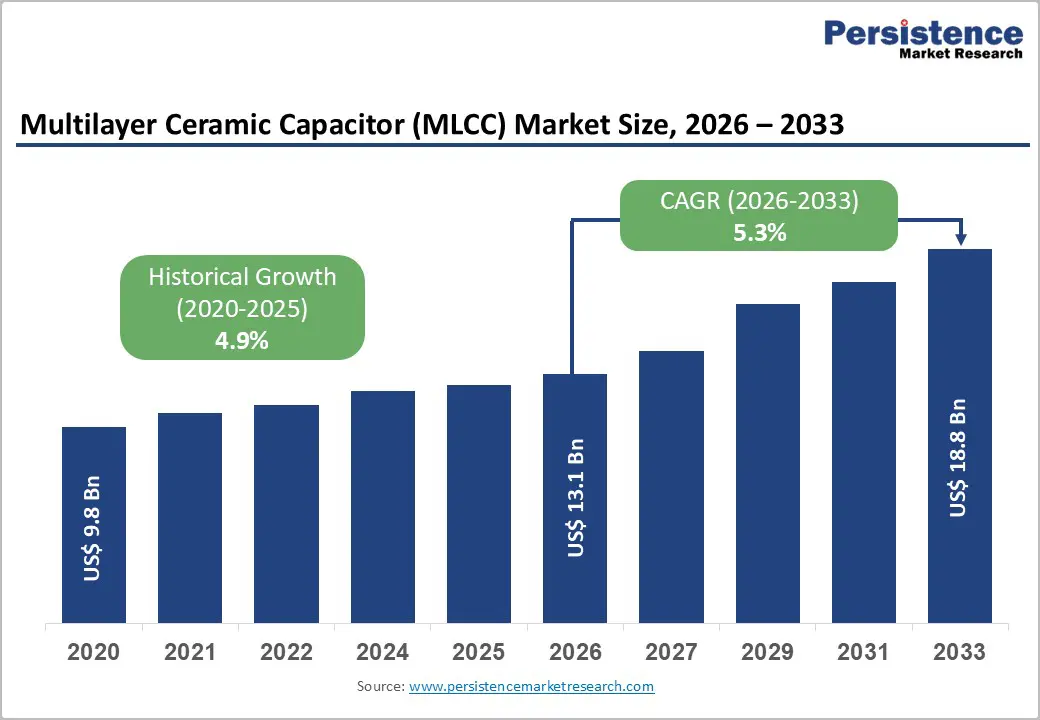
The global Multilayer Ceramic Capacitor (MLCC) market size is expected to reach US$ 13.1 billion in 2026 and is projected to reach US$ 18.8 billion by 2033, growing at a CAGR of 5.3% between 2026 and 2033. Market expansion is primarily driven by accelerating electrification in the automotive sector and rapid deployment of 5G infrastructure worldwide.
Electric vehicle production is increasing significantly, with 14 million units sold globally in 2024, necessitating high-reliability MLCCs for powertrain, ADAS, and battery management systems. Simultaneously, rising 5G connections are driving demand for high-frequency, miniaturized capacitors in telecom equipment and advanced consumer electronics.
Key Industry Highlights:
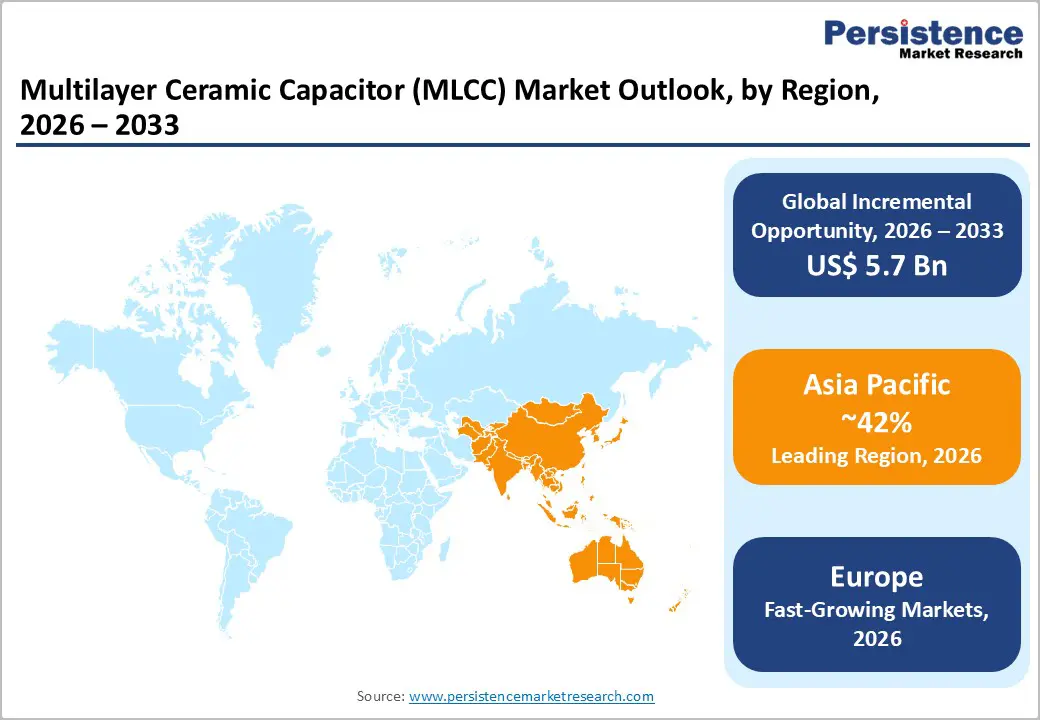
- Leading Region: Asia Pacific leads the global MLCC market with a 42% share in 2025, supported by its strong electronics manufacturing ecosystem and vertically integrated supply chains.
- Fastest Growing Region: Europe is projected to be the fastest-growing regional market with a CAGR of 5.8%, driven by EV adoption and industrial electrification initiatives.
- Leading Product Category: General-purpose MLCCs dominate the product segment with a 45% share in 2025 due to their broad application across consumer electronics and industrial devices.
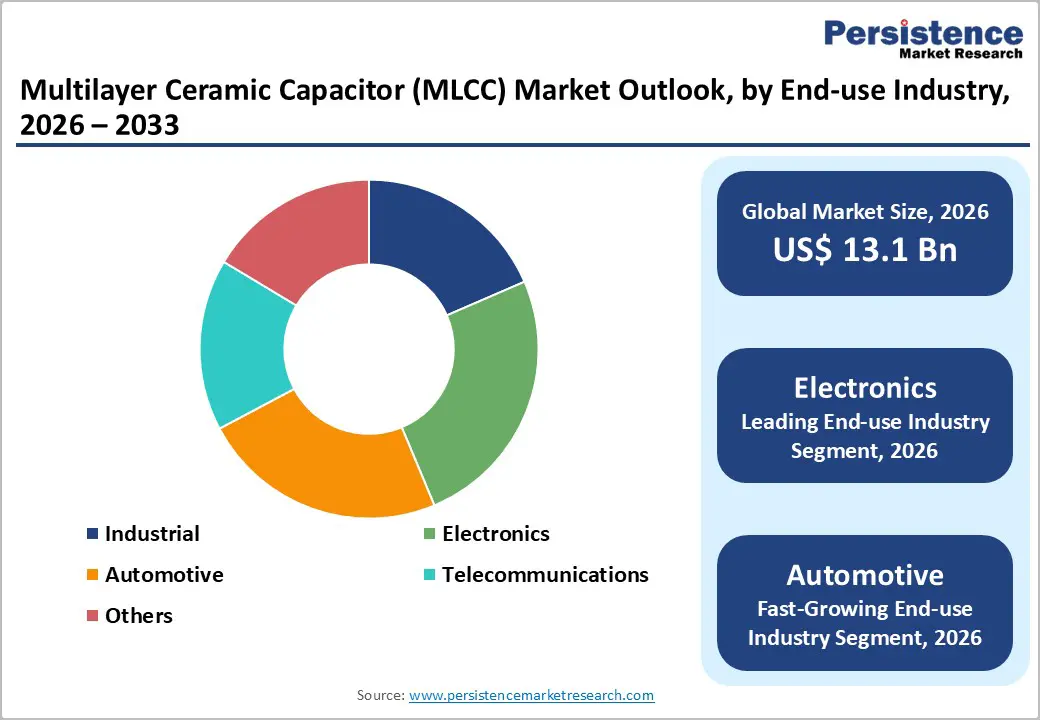
- Leading Industry: The electronics segment leads with 38% share in 2025, supported by sustained global smartphone and computing device production.
- Key Opportunity: High-voltage and high-capacitance MLCCs for electric vehicles present a major opportunity, driven by increasing adoption of advanced 400V and 800V EV architectures.
| Key Insights | Details |
|---|---|
|
MLCC Size (2026E) |
US$ 13.1 billion |
|
Market Value Forecast (2033F) |
US$ 18.8 billion |
|
Projected Growth CAGR(2026-2033) |
5.3% |
|
Historical Market Growth (2020-2025) |
4.9% |
Market Dynamics
Drivers - Accelerating Automotive Electrification and Rising Integration of Advanced Electronics in Vehicles
Automotive electrification is driving significant demand for MLCCs, as electric and hybrid vehicles require high-reliability capacitors for inverters, onboard chargers, ADAS, and battery management systems. Global EV sales reached 14 million units in 2024, reflecting strong annual growth, with each vehicle incorporating thousands of MLCCs to support power conversion and control functions.
As electrification deepens, higher voltage architectures and advanced safety systems are increasing capacitor density per vehicle. Expanding EV penetration, projected to capture a notable share of total vehicle sales by 2030, is stimulating double-digit growth in automotive-grade MLCC demand, particularly for high-temperature and high-capacitance variants designed for harsh operating environments.
Rapid Expansion of 5G Networks and Proliferation of IoT-Connected Devices Worldwide
The global rollout of 5G infrastructure and the rapid proliferation of IoT devices are accelerating demand for miniaturized, high-frequency MLCCs. 5G base stations, small cells, smartphones, and networking equipment require thousands of capacitors to ensure signal stability, filtering, and power management in high-speed communication systems.
At the same time, the growing installed base of connected sensors and smart devices is driving high-volume consumption of MLCCs. With billions of IoT devices and expanding 5G connections worldwide, manufacturers are focusing on ultra-compact, high-density MLCC designs to support sustained annual shipment growth across the telecom and consumer electronics segments.
Restraints - Significant Fluctuations in Rare Earth and Ceramic Raw Material Prices Increasing Cost Pressures Across MLCC Manufacturing Value Chains
Volatility in the prices of critical raw materials such as barium titanate and nickel is creating cost uncertainty for MLCC manufacturers. These materials are essential for dielectric layers and internal electrodes, and recent price fluctuations have substantially increased production costs, directly impacting profitability across the supply chain.
Rising input costs particularly strain mid-tier and smaller producers that operate with limited pricing power and thinner margins. As material costs rise, manufacturers face challenges maintaining competitive pricing while investing in R&D and capacity expansion, thereby constraining overall market stability and affecting long-term procurement strategies.
Ongoing Supply Chain Disruptions and Geopolitical Tensions Extending Lead Times and Production Cycles
Persistent geopolitical tensions and semiconductor supply shortages have disrupted the electronics supply chain, significantly lengthening component lead times. Delays in upstream material sourcing and logistics bottlenecks have created production uncertainties for MLCC manufacturers, especially those serving automotive and industrial sectors.
Extended lead times, often increasing by 30–50% during peak disruption periods, have affected automotive output and electronics assembly schedules. These supply constraints complicate inventory management and long-term contracts, forcing OEMs to diversify sourcing strategies while limiting short-term shipment growth in the MLCC market.
Opportunity - Rising Demand for High-Capacitance and High-Voltage MLCCs Supporting Next-Generation EV Platforms and AI Infrastructure
The transition toward 800V electric vehicle architectures is creating strong opportunities for high-capacitance, high-voltage MLCCs capable of handling greater power density and thermal stress. Advanced EV platforms require greater reliability from inverters, DC-DC converters, and battery management systems, thereby significantly increasing the capacitor value per vehicle.
Simultaneously, the rapid expansion of AI servers and high-performance computing infrastructure is boosting demand for high-capacitance MLCCs in power regulation modules. Leading manufacturers are investing aggressively in advanced ceramic formulations and multilayer stacking technologies to capture growing requirements for compact, high-efficiency components.
Expanding Adoption of Advanced Dielectric Materials and MLCC Arrays for 5G Network Infrastructure
The rollout of 5G networks presents substantial growth potential for advanced dielectric MLCCs such as X7R and high-density array configurations. These components are essential for signal filtering, impedance matching, and stable power delivery in base stations and small-cell infrastructure operating at higher frequencies.
Ongoing telecom infrastructure expansion, particularly in major Asian markets, is accelerating deployment volumes. As network densification intensifies and data consumption rises, demand for temperature-stable, miniaturized MLCC arrays is expected to strengthen, encouraging continued innovation in dielectric performance and multilayer design efficiency.
Category-wise Analysis
Product Type Insights
General-purpose MLCCs lead the product type segment, accounting for approximately 45% market share in 2025 due to their broad applicability in decoupling, filtering, and bypass functions across consumer electronics and industrial devices. Their cost efficiency, standardized designs, and high-volume production capabilities contribute to nearly 60% dominance in shipment volumes, supported by large-scale electronics manufacturing globally.
High-capacitance and automotive-grade MLCCs are emerging as the fastest-growing product categories. The increasing integration of advanced driver-assistance systems (ADAS), electric powertrains, and high-performance computing modules is accelerating demand for specialized capacitors with enhanced reliability, thermal endurance, and voltage-handling capabilities, encouraging manufacturers to prioritize performance-oriented product innovation.
Rated Voltage Range Insights
Mid-range voltage MLCCs command nearly 50% of the market share in 2025, driven by their suitability for smartphones, automotive electronics, industrial controls, and networking equipment. These capacitors provide balanced performance in ripple current handling and voltage stability, making them ideal for mainstream electronic circuit designs requiring dependable and compact solutions.
High-voltage MLCCs are the fastest-growing voltage category as electric vehicles, renewable energy systems, and industrial automation platforms adopt higher-power architectures. Increasing use of 400V and 800V systems in automotive and energy applications is accelerating development of robust MLCCs capable of operating under elevated electrical and thermal stresses.
Dielectric Type Insights
X7R dielectric MLCCs hold approximately 42% of the market share, favored for their stable capacitance over a wide temperature range and strong performance in automotive and industrial environments. Their reliability, balanced electrical characteristics, and compliance with industry standards make them the preferred choice for applications requiring durability and consistent functionality.
Advanced dielectric materials, including enhanced Class 2 and emerging high-performance ceramic compositions, are witnessing the fastest growth. These materials support higher capacitance in smaller form factors while maintaining improved thermal stability, aligning with the miniaturization and power density demands of 5G infrastructure, EV platforms, and compact consumer electronics.
Industry Insights
The electronics segment leads the MLCC market with approximately 38% share, driven by strong demand from smartphones, tablets, wearables, and computing devices. Global smartphone shipments exceeding one billion units annually contribute significantly to overall volume, as each device integrates numerous MLCCs for signal filtering, decoupling, and power management.
The automotive sector is emerging as the fastest-growing Industry due to rapid electrification and increasing electronic content per vehicle. Growth in electric vehicles, advanced safety systems, infotainment, and connectivity features is expanding MLCC adoption, particularly for high-reliability and high-voltage applications within modern automotive architectures.
Regional Insights
North America MLCC Market Trends
North America accounts for approximately 32% of the global MLCC market share in 2025, driven primarily by strong demand from automotive electrification, aerospace, and advanced computing applications. The United States leads regional consumption, supported by semiconductor and electronics investments under the CHIPS and Science Act, which allocates over $50 billion to strengthen domestic manufacturing and supply chain resilience.
The region is witnessing rising MLCC demand from electric vehicle adoption, with over one million new EV registrations annually, alongside increasing integration of advanced electronics in aerospace and defense systems. Growth in AI data centers, industrial automation, and renewable energy infrastructure is further reinforcing steady demand for high-reliability and high-voltage MLCC solutions.
Europe MLCC Market Trends
Europe represents a significant share of the global MLCC market, supported by strong automotive manufacturing and industrial automation sectors. The region is projected to grow at a CAGR of approximately 5.8% during the forecast period, driven by accelerating electrification initiatives and sustainability-focused policies across the European Union.
Germany leads regional demand, benefiting from robust automotive production and EV transition strategies aligned with the EU Green Deal, which aims to deploy tens of millions of electric vehicles by 2030. Additionally, harmonized regulatory frameworks such as RoHS compliance standards are encouraging the adoption of high-quality, environmentally compliant MLCCs across automotive, industrial, and renewable energy applications.
Asia Pacific MLCC Market Trends
Asia Pacific dominates the global MLCC market with approximately 42% share in 2025, supported by its strong electronics manufacturing base and vertically integrated supply chains. Countries such as Japan, China, and South Korea serve as major production hubs, collectively accounting for a substantial portion of global MLCC output and exports.
The region is also the fastest-growing market, driven by expanding consumer electronics production, rapid EV adoption, and 5G infrastructure deployment. Government-led incentives in emerging economies, including semiconductor and electronics manufacturing subsidies, are strengthening domestic production capabilities and encouraging investments in advanced MLCC technologies and capacity expansion.
Competitive Landscape
The global MLCC market is highly consolidated, with a small group of leading manufacturers accounting for a dominant portion of total revenue. These companies benefit from large-scale production capacity, advanced material expertise, and long-standing relationships with major OEMs in automotive, telecom, and consumer electronics sectors. Continuous capacity expansions across Asia and strategic vertical integration strengthen supply reliability and cost efficiency.
Competition is increasingly centered on technological innovation, particularly in high-capacitance, high-voltage, and miniaturized MLCC designs. Market leaders are intensifying investments in R&D, automation, and next-generation dielectric materials to enhance performance, improve durability, and secure long-term supply agreements with global electronics manufacturers.
Key Developments:
- In March 2025, Samsung Electro-Mechanics increased its MLCC production capacity by 20% to address rising demand from electric vehicle manufacturers, particularly for high-voltage and automotive-grade capacitors used in advanced powertrain and battery management systems.
- In July 2024, TDK Corporation introduced new ultra-miniature 0201-size MLCCs designed for 5G smartphones and compact communication modules, enhancing capacitance density while supporting high-frequency performance and space-constrained circuit board designs.
- In November 2024, Kyocera Corporation announced a US$150 million investment to establish a new MLCC manufacturing facility in Vietnam, aimed at expanding production capacity and strengthening supply chain resilience across Southeast Asia.
Companies Covered in Multilayer Ceramic Capacitor Market
- Murata Manufacturing Co., Ltd.
- Samsung Electro‑Mechanics Co., Ltd.
- TDK Corporation
- Taiyo Yuden Co., Ltd.
- Yageo Corporation
- Kyocera AVX Components
- Vishay Intertechnology, Inc.
- Walsin Technology Corporation
- KEMET Corporation
- Holy Stone Enterprise Co., Ltd.
- Samwha Capacitor Group
- Johanson Dielectrics
- Darfon Electronics Corp.
- Guangdong Fenghua Advanced Technology
- Eyang Technology Development Co., Ltd.
Frequently Asked Questions
The global MLCC market is valued at US$ 13.1 billion in 2026, driven primarily by strong demand from electronics (38% share) and expanding EV applications.
MLCC demand is driven by rising EV adoption (14 million global sales) and 5G expansion, alongside strong electronics consumption holding 38% end-use share.
Asia Pacific leads the MLCC market with a 42% share in 2025, supported by its dominant electronics manufacturing base.
High-voltage and high-capacitance MLCCs for EV platforms present a major opportunity, aligned with increasing electrification and advanced power architectures.
The MLCC market is highly consolidated, with leading global manufacturers including Murata Manufacturing Co., Ltd., Samsung Electro‑Mechanics Co., Ltd., TDK Corporation, Taiyo Yuden Co., Ltd., and Yageo Corporation.


