




- Medical Devices
- Medical Infrared Thermometer Market
Medical Infrared Thermometer Market Size, Share, Growth, and Regional Forecast, 2026 to 2033
Medical Infrared Thermometer Market by Measurement Points Type (Ear, Forehead, Multifunction), Application (Medical, Veterinary), Distribution Channel (Hospital Pharmacies, Retail Pharmacies, Online Sales), and Regional Analysis from 2026 to 2033

Medical Infrared Thermometer Market Size and Share Analysis
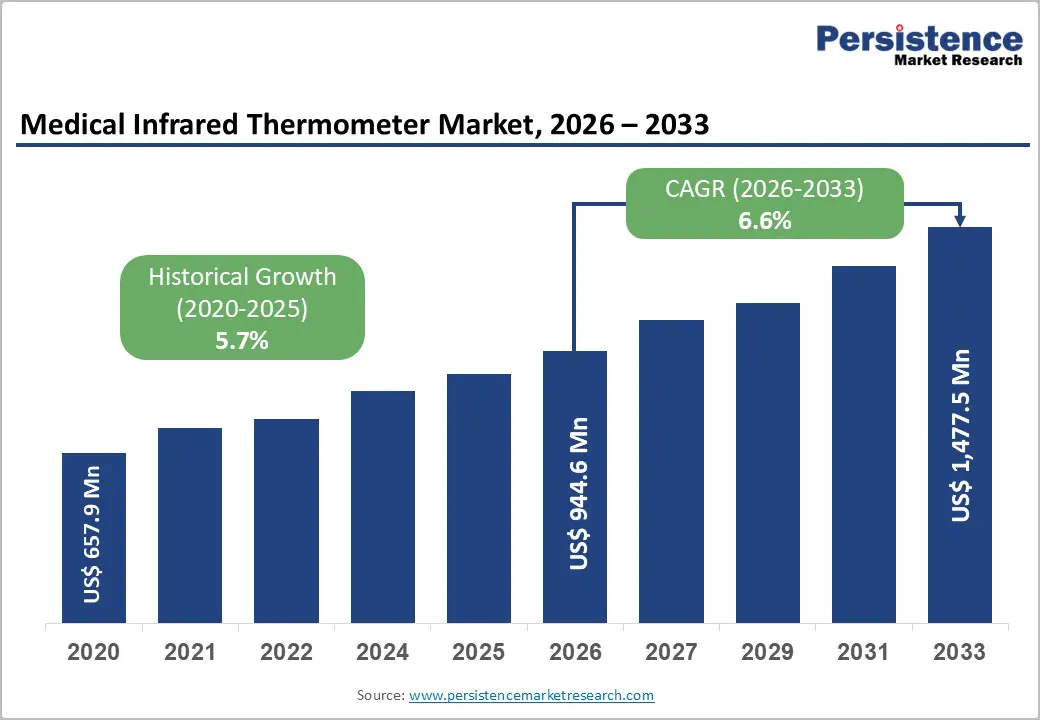
The global medical infrared thermometer market is estimated to grow from US$ 944.6 Mn in 2026 to US$ 1,477.5 Mn by 2033. The market is projected to record a CAGR of 6.6% during the forecast period from 2026 to 2033.
The global medical infrared thermometer market is growing steadily, fueled by aging populations, rising healthcare needs, and demand for quick, non-contact temperature measurement. North America leads with advanced healthcare infrastructure and high adoption, while Asia-Pacific is the fastest-growing region, driven by expanding healthcare access, government initiatives, manufacturing scale, and increasing investments in medical technologies.
Key Industry Highlights
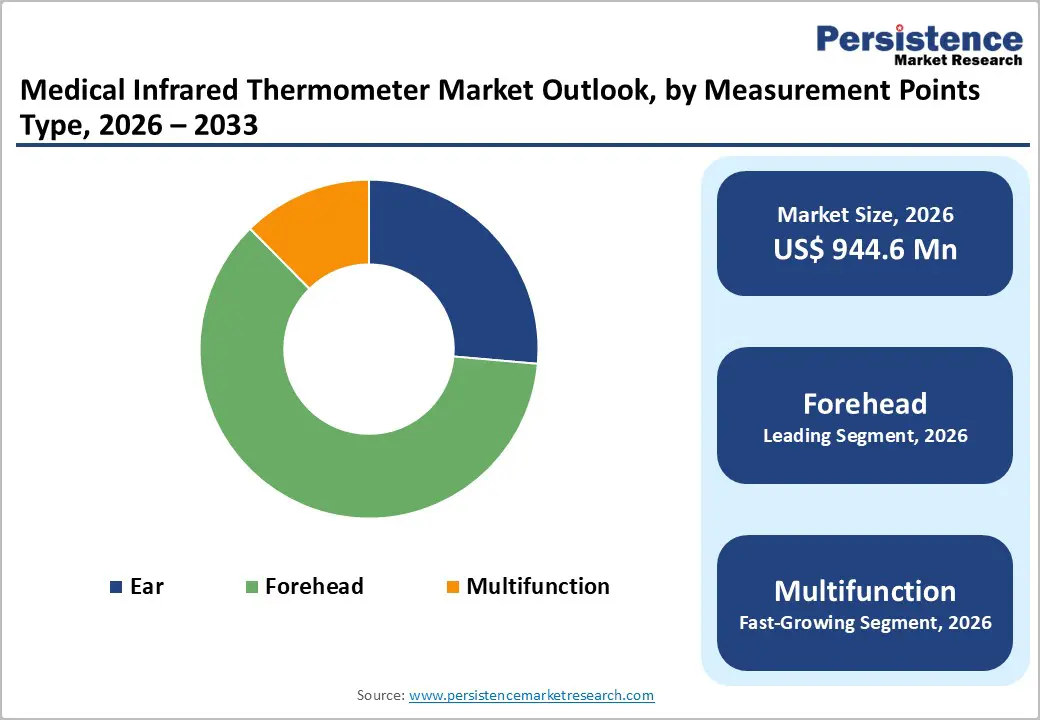
- Dominant Segment: Forehead thermometers hold 61.2% share in 2025, driven by widespread use in hospitals, clinics, and households due to their non-contact design, rapid readings, and ease of use across medical, veterinary, and home healthcare applications.
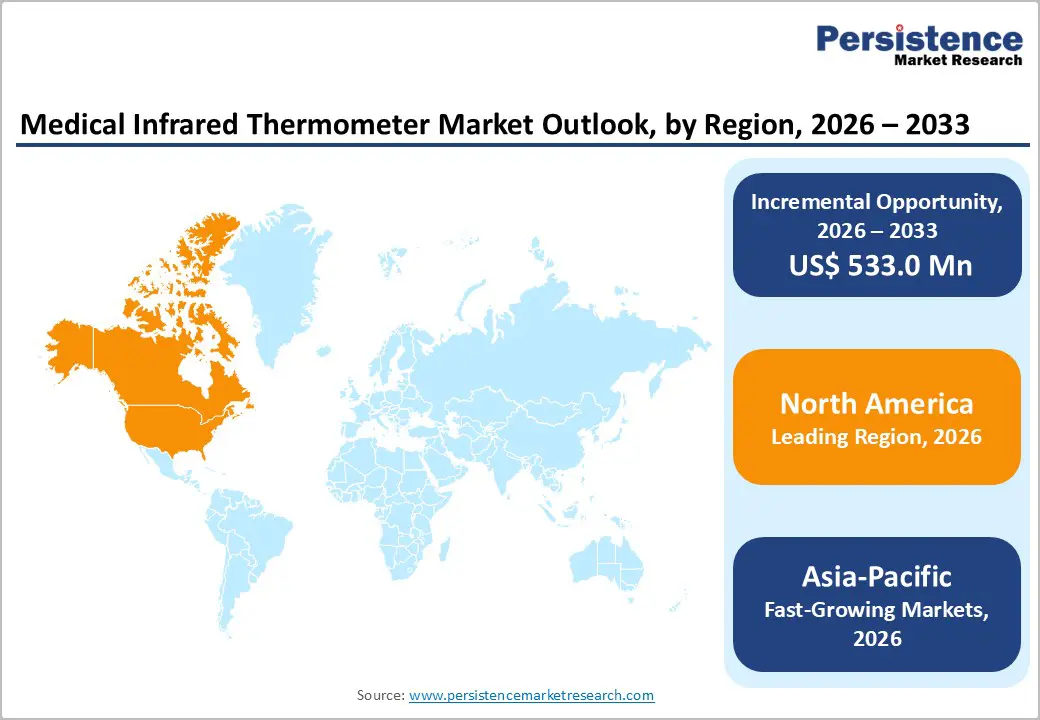
- Dominant Region: North America leads in 2025 with 38.0% share, supported by advanced healthcare infrastructure, high adoption of diagnostic devices, and strong regulatory standards. Asia-Pacific is the fastest-growing region, fueled by expanding healthcare access, government initiatives, rising patient awareness, and increasing investments in medical diagnostics.
- Market Drivers: Growth is driven by rising healthcare needs, non-invasive temperature monitoring demand, pandemic preparedness, increasing patient awareness, and adoption of advanced medical diagnostic tools.
- Market Opportunity: Key opportunities include expansion of non-contact thermometers in hospitals and homes, integration with digital health systems, growth in veterinary applications, adoption in emerging economies, and development of multifunctional devices combining accuracy, speed, and convenience.
| Global Market Attributes | Key Insights |
|---|---|
| Global Medical Infrared Thermometer Market Size (2026E) | US$ 944.6 Mn |
| Market Value Forecast (2033F) | US$ 1,477.5 Mn |
| Projected Growth (CAGR 2026 to 2033) | 6.6% |
| Historical Market Growth (CAGR 2020 to 2025) | 5.7% |
Market Dynamics
Driver: Evolution of Pediatric Healthcare to Boost Utilization of Touchless Thermometers
The need for non-invasive temperature measuring devices, especially infrared thermometers, has surged dramatically due to the restructuring of the pediatric healthcare industry. For instance,
- In March 2024, the American Academy of Pediatrics released new guidelines recommending contactless temperature measurement as the primary method for children.
Infrared thermometer devices are becoming increasingly popular, according to recent data from leading children's hospitals. Manufacturers have responded to this change by creating child-friendly equipment. One example is Philips' PlayTemp line, which uses entertaining game components to encourage kids to participate in regular temperature checks. For instance,
- The first quarter of 2024 saw a noteworthy 35% increase in sales of pediatric infrared thermometers, which is consistent with this innovative method that also makes the process more fun for young patients.
Restraints: Lack of Accurate Crowd Scanning Feature May Impact Product Penetration
It might be difficult to scan a large patient pool in public places with the help of infrared thermometers. Consumer-grade infrared thermometers differ significantly from clinical standards in terms of accuracy, according to research published in the Journal of Medical Devices.
New recommendations from the FDA resulted in a 25% increase in production costs. Small-scale firms are finding it difficult to fulfill the new criteria, which has resulted in market concentration.
Sales of consumer-grade devices have decreased by 30% as the post-pandemic sector became saturated. Price pressure resulted from key merchants reporting surplus inventories. To preserve profit margins, manufacturers are increasingly concentrating on high-end features and medical-grade equipment.
Opportunity: Regulations on Public Health Checkup to Provide Detailed Oversight
Healthcare product makers are set to benefit from government measures that promote public health infrastructure growth. Strong institutional demand is maintained by ongoing requirements for public health surveillance. For example,
- Rapid temperature screening capabilities were stressed in the WHO's February 2024 recommendation on global health monitoring systems.
Public buildings and leading transit hubs made investments in cutting-edge infrared scanning technology. For instance,
- In April 2023, Delta Airlines invested US$ 100 Mn in public health infrastructure by installing next-generation thermal scanning stations in 50 main airports. By updating their facilities with such stations, the public places are estimated to provide an additional precaution for public health.
Category-wise Analysis
By Product Type, Wearable Devices Dominates the Medical Infrared Thermometer Market
In 2025, forehead-type infrared thermometers are set to dominate the global market, accounting for 61.2% share. This is owing to their rapid and reliable body temperature readings, which are critical for identifying diseases. The low handling costs and non-invasive nature of these devices make these a valuable tool for healthcare professionals. Leading manufacturers have contributed to this trend by introducing innovative products. For instance,
- In January 2025, Braun launched the ThermoScan 8, featuring unique sensor technology for improved accuracy.
- Omron Healthcare introduced the GentleTemp 720, a forehead thermometer with enhanced user-friendly features.
Such developments reflect the ongoing efforts by companies to meet the rising demand for efficient and reliable temperature measurement solutions in healthcare settings.
Improvements in Medical Devices to Forge New Avenues
In 2025, the medical application segment is anticipated to hold a dominant global share of 64.5%, driven by focus on infection control measures and rising prevalence of infectious diseases. For ins
- According to the World Health Organization (WHO) report, in 2021, infectious diseases accounted for a significant portion of global mortality, with lower respiratory infections being the leading cause.
The COVID-19 pandemic highlighted the need for non-contact temperature assessment tools in medical facilities. Manufacturers are estimated to develop novel products for accurate scanning. For example,
- In January 2025, Braun launched the ThermoScan 8, featuring enhanced accuracy and connectivity options.
- Omron Healthcare introduced the GentleTemp Pro, designed for rapid, precise measurements in clinical settings.
The industry's dedication to meeting the urgent demand for precise diagnostics and efficient infection control in healthcare settings is reflected in such developments.
Regional Insights
North America Medical Infrared Thermometer Market Trends
North America, including the U.S., Canada, and Mexico, is set to account for 38.0% of the global medical infrared thermometer market share in 2025, despite its mature status. Infrared thermometers are widely used in manufacturing and construction due to their non-contact temperature measurement, which is crucial for safety and efficiency. Demand for smart thermometers in North America is estimated to record a CAGR of 8.3% from 2025 to 2032. For example,
- Leading companies such as Fluke Corporation and FLIR Systems, both headquartered in the U.S., have been instrumental in innovating infrared thermometer technology.
- In January 2025, Fluke introduced the Fluke 67 MAX, a handheld infrared thermometer designed for industrial use, featuring enhanced accuracy and durability.
- The FLIR TG165-X, which FLIR Systems has released, improves thermal imaging capabilities for accurate temperature measurement and emphasizes North America's position in the infrared thermometer industry due to technical innovation.
Europe Medical Infrared Thermometer Market Trends
Europe is a key region in the medical infrared thermometer market because of its substantial and well?developed healthcare ecosystem and demographic pressures that drive demand for reliable diagnostic tools. In the European Union, healthcare expenditure accounts for around 10% of GDP, reflecting significant public and private investment in health services and medical products. Per capita healthcare spending has risen to about €3?685, indicating strong funding for prevention and early detection measures across member states. Europe also has a rapidly aging population, with over 21.6% of the EU aged 65 or older, which increases the need for routine health monitoring and fever detection at home and in clinical settings. The region’s extensive healthcare systems, high per capita spending, and growing preventive care focus make it both a large and sophisticated market for infrared thermometry.
Asia-Pacific Medical Infrared Thermometer Market Trends
Asia Pacific is the fastest growing region in the medical infrared thermometer market due to strong demographic, economic, and healthcare trends. The region has around 630 million people aged 60 and above, accounting for 60% of the world’s geriatric population, increasing demand for health monitoring tools. Governments and consumers are placing greater emphasis on health services as health spending per capita in many Asia Pacific countries has been rising faster than GDP, particularly in middle income nations. Rapid economic growth and rising disposable incomes, for example an increase in GDP per capita from USD 5,000 to USD 5,500 between 2022–23, support greater healthcare access and device adoption. Additionally, healthcare systems are expanding to address chronic diseases and aging populations, driving uptake of non invasive tools like infrared thermometers.
Market Competitive Landscape
The medical infrared thermometer market is competitive, driven by global and regional players offering portable, non-contact, and stationary devices. Innovation in AI, connectivity, and measurement accuracy, along with regulatory compliance, shapes competition. Strategic partnerships, R&D, and regional expansion enhance differentiation, fueling market intensity and growth across healthcare, veterinary, and home-use applications worldwide.
Key Industry Developments:
- In January 2026, Exergen showcases its award winning Temporal Artery Thermometers at the World Health Expo in Dubai, exhibiting at booth H4S.B74 during the event scheduled for February 9,12, 2026. The company demonstrates its FDA and CE?approved temporal artery models, including the TAT 5000S and TAT 2000 series, highlighting their clinical accuracy, non invasive operation, and connected functionality for healthcare professionals.
Companies Covered in Medical Infrared Thermometer Market
- Welch Allyn – A Hill-Rom Inc. Company
- Exergen
- Geratherm Medical AG
- Thermomedics, Inc. (A subsidiary of PositiveID Corporation)
- Microlife Corporation
- PAUL HARTMANN AG
- BPL Medical Technologies
- Contec, Medical Systems Co.Ltd.
- Cardinal Health (Medtronic)
- OMRON Corporation
- Braun GmbH
- Thermo Fisher Scientific Inc.
- OMEGA Engineering inc.
- HORIBA, Ltd.
- PCE Deutschland GmbH
Frequently Asked Questions
The global medical infrared thermometer market is projected to be valued at US$ 944.6 Mn in 2026.
Rising healthcare demand, aging populations, non-contact monitoring, pandemic preparedness, and technological advancements drive growth.
The global medical infrared thermometer market is poised to witness a CAGR of 6.6% between 2026 and 2033.
Expansion in hospitals, home care, veterinary use, digital integration, multifunction devices, and emerging economies.
Welch Allyn – A Hill-Rom Inc. Company, Exergen, Geratherm Medical AG, Thermomedics, Inc. (A subsidiary of PositiveID Corporation), Microlife Corporation, PAUL HARTMANN AG.


