




- Smart Packaging
- Holographic Film Market
Holographic Film Market Size, Share, and Growth Forecast, 2025 - 2032
Holographic Film Market By Material Type (BOPET, BOPP), Product Type (Lamination films, Seamless and wide-web films), End-user, and Regional Analysis for 2025 - 2032

Holographic Film Market Size and Trends Analysis
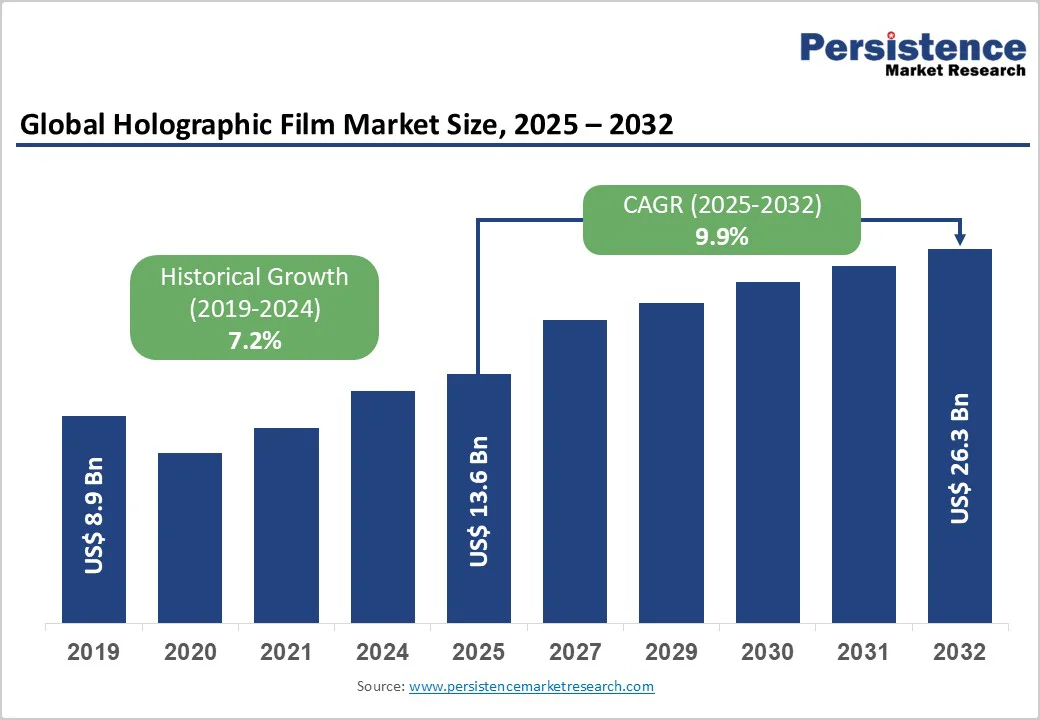
The global holographic film market size was valued at US$13.6 Billion in 2025 and is projected to reach US$26.3 Billion by 2032, growing at a CAGR of 9.9% during the forecast period from 2025 to 2032, driven by the rising adoption of thin, micro-embossed polymer films that create diffraction and optical-variable effects, increasingly used in packaging, brand security, decorative laminates, and display applications.
Rising anti-counterfeit adoption, packaging differentiation, and capacity expansion in Asia Pacific are driving growth, supported by supply chain investments and product innovation.
Key Industry Highlights
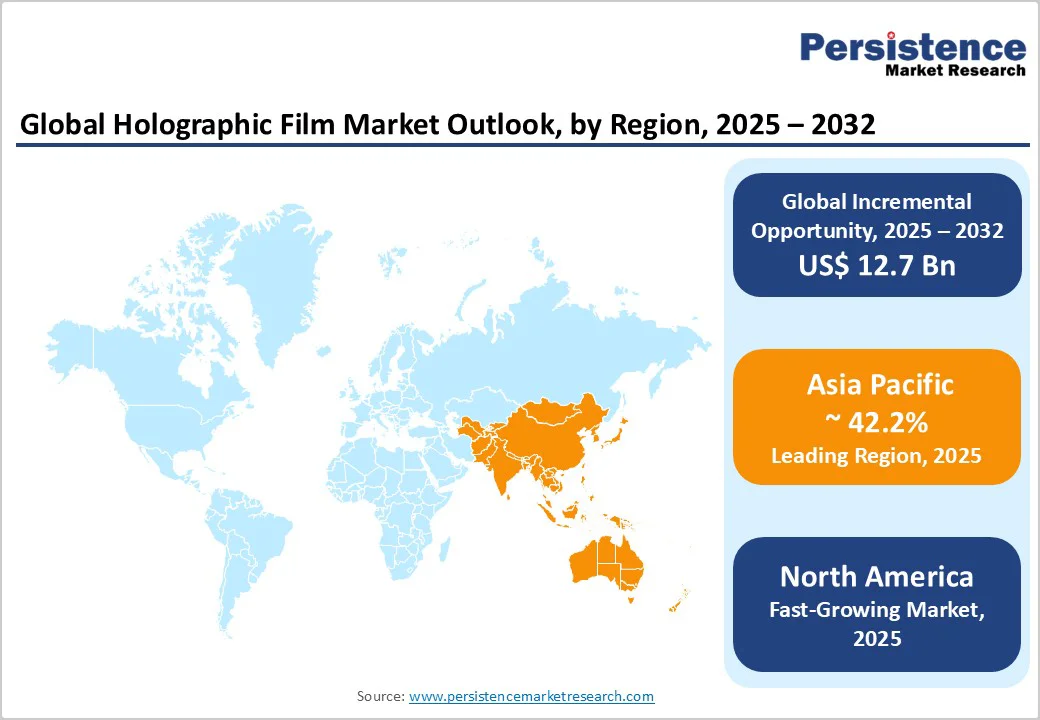
- Leading Region: Asia Pacific holds the largest share of the market at approximately 42.2%, driven by China’s production scale and growing demand in India and ASEAN countries.
- Fastest-growing Region: North America is the fastest-growing region, expanding at a CAGR of 10.2%, owing to pharmaceutical serialization, luxury packaging demand, and adoption of hybrid authentication technologies.
- Investment Plans: Manufacturers are investing in wide-web embossing lines, R&D for recyclable mono-polymer films, and capacity expansions in Asia Pacific and North America to meet increasing global demand.
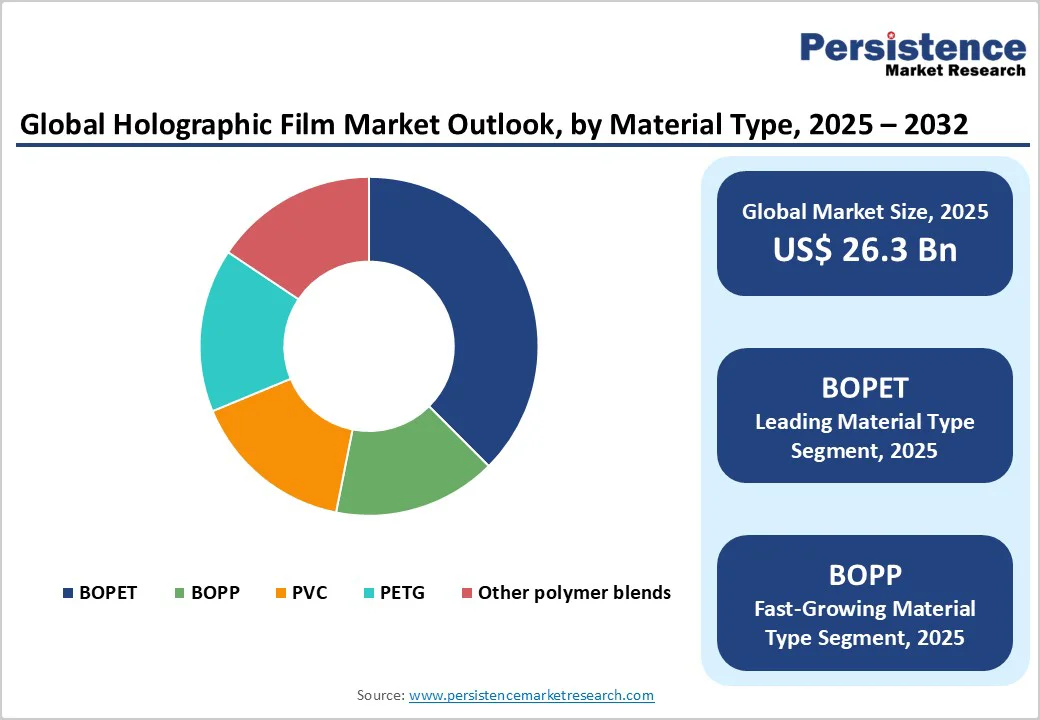
- Dominant Material Type: BOPET dominates the material segment with a market share of around 48%, valued for its dimensional stability, optical clarity, and compatibility with metallization processes.
- Leading End-user: Security and authentication applications lead the market with a share of 40%, driven by anti-counterfeit measures in pharmaceuticals, banknotes, and luxury goods.
| Key Insights | Details |
|---|---|
| Holographic Film Market Size (2025E) | US$13.6 Bn |
| Market Value Forecast (2032F) | US$26.3 Bn |
| Projected Growth (CAGR 2025 to 2032) | 9.9% |
| Historical Market Growth (CAGR 2019 to 2024) | 7.2% |
Market Factors - Growth, Barriers, and Opportunity Analysis
Anti-Counterfeit and Authentication Demand Packaging Differentiation in FMCG and E-Commerce
Governments and brand owners are expanding the use of optical variable devices (OVDs) to protect against counterfeit goods, especially in pharmaceuticals, banknotes, and luxury packaging. This has created consistent demand for holographic films that deliver tamper-proof features and traceability. Such applications command premium pricing and generate recurring orders, making them a major revenue driver.
Consumer brands increasingly use holographic finishes to boost shelf appeal, differentiate products, and combat theft. High-growth categories such as cosmetics, beverages, and confectionery are adopting holographic laminates, while e-commerce packaging integrates these films for both branding and tamper evidence. This trend broadens the holographic film market beyond security into mainstream packaging.
New wide-web embossing equipment and advances in substrates such as BOPET and BOPP have lowered production costs. Process automation has also expanded the range of possible visual effects, including seamless and cold-foil compatible films. These improvements reduce unit costs, making holographic films accessible for price-sensitive packaging while still supporting premium security applications.
Raw Material Volatility, Supply Concentration, and Sustainability Pressures
Holographic films rely on substrates such as BOPET, BOPP, and PVC, along with metallization layers. Price fluctuations in petrochemical feedstocks and capacity bottlenecks often raise input costs, leading to squeezed margins. Shortages or delays in these raw materials can disrupt just-in-time packaging supply chains, forcing brands to consider alternative finishes.
Strict packaging and sustainability regulations, especially in Europe, are challenging for multi-layer holographic laminates that hinder recyclability. Many brand owners demand recyclable or mono-polymer solutions, but shifting production to these formats requires new R&D and higher capital investments.
Recyclable and Compostable Film Development and Digital Authentication Solutions
The shift toward recyclable packaging creates opportunities for mono-polymer holographic films. If recyclable options capture just 10-15% of the global demand by 2028, this represents a multi-billion-dollar revenue opportunity. Collaboration with recyclers and certification bodies will be critical for market acceptance.
Coupling holographic OVDs with QR codes, NFC tags, or blockchain platforms offers traceable and interactive product authentication. Pharmaceutical and luxury brands stand to benefit most, with hybrid solutions potentially generating hundreds of millions in additional revenue streams by 2030.
Advanced holographic films are finding applications in automotive interiors, architectural décor, and electronic displays such as head-up systems. Though these segments are smaller in volume, they carry higher profit margins. Even modest adoption by automotive or electronics OEMs can significantly lift overall industry revenues.
Category-wise Analysis
Material Type Insights
BOPET (biaxially oriented polyethylene terephthalate) dominates the market with a share of around 48% in 2025, due to its exceptional dimensional stability, optical clarity, and embossing capability. Its smooth surface and uniform thickness make it highly compatible with metallization, hot-stamping, and lamination processes, which are essential for producing high-quality holographic effects.
BOPET is widely used in security applications such as banknotes and pharmaceutical packaging, as well as premium FMCG products where visual appeal is critical. Its ability to maintain optical precision over large areas ensures minimal distortion, a key requirement for anti-counterfeit and decorative films.
BOPP (biaxially oriented polypropylene) and emerging mono-polymer solutions are rapidly gaining market share, driven by cost-effectiveness, lighter weight, and recyclability advantages. BOPP is less expensive than BOPET, making it attractive for high-volume packaging segments such as confectionery, beverages, and e-commerce shipments.
Mono-polymer holographic films, designed to meet stringent recycling and circular economy requirements, are increasingly adopted in Europe and North America, where regulatory pressure favors environmentally friendly materials. Manufacturers investing in these substrates can target premium brand differentiation while complying with sustainability mandates, creating a high-growth opportunity in regions with strict environmental policies.
Product Type Insights
Lamination holographic films maintain the largest market share owing to their versatility and wide applicability. They can be applied over printed substrates for decorative packaging, security, and branding purposes, combining both visual enhancement and protection.
Lamination films are extensively used in pharmaceutical blister packs, luxury cosmetic boxes, and beverage cartons, where maintaining the integrity of the printed content is crucial. Their high durability and resistance to scratching or fading allow brands to preserve long-lasting holographic effects, contributing to sustained premium pricing and recurring procurement from large brands.
Seamless holographic films, especially wide-web formats, are experiencing the fastest growth due to their ability to cover larger surfaces without visible repeats or joins, enhancing aesthetic appeal. They are particularly favored in luxury packaging, premium gift items, and large-format decorative laminates.
This segment also benefits from technological advancements, such as high-speed embossing and improved slitting capabilities, which allow manufacturers to meet increasing demand for visually striking packaging at scale. The combination of aesthetic superiority and premium positioning ensures higher growth rates compared to traditional hot-stamping or printed holographic foils.
End-user Insights
Security and authentication continue to be the largest end-user segment due to the critical need for counterfeit prevention in industries such as pharmaceuticals, government documents, banknotes, and luxury goods.
These applications command higher margins owing to their specialized technical requirements, including micro-embossing, tamper-evident seals, and high-resolution diffraction patterns. Governments and brand owners often enter long-term contracts with holographic film suppliers to ensure an uninterrupted supply of certified products, further solidifying the segment’s dominance.
Packaging and labeling, particularly in FMCG, e-commerce, and luxury consumer goods, is emerging as the fastest-growing end-user segment. Brands are increasingly investing in holographic features to differentiate products on crowded shelves and provide tamper evidence, driven by rising online retail returns and counterfeiting concerns.
Decorative holographic films also improve brand perception and unboxing experiences, encouraging repeated consumer engagement. The growth of premium packaged foods, beverages, cosmetics, and electronics accessories is further accelerating adoption, creating substantial incremental demand for holographic films globally.
Regional Insights
Asia Pacific Holographic Film Market Trends - High-Volume Production and Anti-Counterfeit Demand Fuel APAC Leadership
Asia Pacific is the largest producer and consumer of holographic films, accounting for 42.2% of the market share. China leads in production scale, with well-integrated film and metallization supply chains enabling cost-effective, high-volume outputs. India, Japan, and ASEAN countries are experiencing strong demand growth in both security and decorative packaging applications.
The region benefits from lower manufacturing costs, rising consumer markets, and government-backed anti-counterfeit initiatives, making it a hotspot for both domestic and export-oriented sales. Although environmental regulations are tightening, they are less restrictive than in Europe, allowing manufacturers to expand capacity quickly. Investment trends include new wide-web embossing lines, local R&D for advanced effects, and pilot programs to serve growing e-commerce and luxury packaging markets.
North America Holographic Film Market Trends - Security-Driven Demand and Hybrid Authentication Propel U.S. Growth
North America represents a high-value segment of the market, with the U.S. as the primary contributor. The region’s growth is supported by stringent pharmaceutical serialization regulations, anti-counterfeit measures, and the presence of luxury consumer brands. Security-oriented applications dominate in the U.S., with films used extensively in banknotes, medical packaging, and government documents.
Collaborations between film manufacturers and digital authentication providers are increasingly common, offering hybrid solutions that combine physical holographic security with QR or NFC-based verification. Investment activity in the region focuses on expanding embossing capacity, pilot projects for sustainable mono-polymer films, and advanced hybrid authentication technologies, ensuring continued adoption in regulated industries.
Europe Holographic Film Market Trends - Sustainability and Luxury Packaging Drive Innovation across the EU
Europe is a strategically important market, driven by its concentration of luxury goods, fashion, and automotive industries. Germany serves as the regional manufacturing hub, providing machinery and a high-quality substrate supply, while France, the U.K., and Spain are key consumers of luxury packaging. EU regulations regarding recyclability and environmental compliance are pushing suppliers to innovate mono-polymer and recyclable holographic films.
Although sustainability requirements temporarily restrain growth for traditional multi-layer laminates, they create new opportunities for eco-friendly solutions. Investment in Europe focuses on R&D for sustainable films, partnerships with recycling stakeholders, and validation programs with luxury brand owners. Decorative and packaging applications are expanding rapidly, complementing the region’s traditional dominance in security and authentication.
Competitive Landscape
The global holographic film market is moderately fragmented, with global leaders such as Toray Industries, Cosmo Films, and Avery Dennison dominating high-quality, security-grade films through advanced embossing, metallization, and R&D integration. These firms hold strong positions in pharmaceuticals, banknotes, and luxury packaging.
Regional players compete in decorative and mid-tier packaging, serving FMCG and e-commerce with cost-effective solutions. This hybrid structure sustains premium margins for leaders while driving broader market penetration. Key strategies include product differentiation, recyclable film development, digital authentication partnerships, and wide-web production investments to balance premium innovation with mass-market cost efficiency.
Key Industry Developments
- In March 2025, Cosmo Films announced new BOPP and specialty film capacity to support growing packaging demand in India and North America, enhancing both domestic and export capabilities.
- In June 2024, Toray Industries introduced advanced nano-multilayer films for head-up displays and premium optics, signaling expansion into automotive and high-tech display applications.
Companies Covered in Holographic Film Market
- Toray Industries, Inc.
- Avery Dennison Corporation
- Cosmo Films/Cosmo First Ltd.
- Uflex Limited
- SRF Limited
- Jindal Poly Films
- Jinjia Group
- Holostik India Ltd.
- LEONHARD KURZ
- Polinas Plastik Sanayi ve Ticaret A.S.
- K Laser Technology
- Konica Minolta / DNP
- 3M Company
- Mitsubishi Chemical Corporation
- Printpack Inc.
- Flex Films Ltd.
- Treofan Group
- Huhtamaki PPL Ltd.
- Lintec Corporation
- Multi-Pack Films Pvt. Ltd.
Frequently Asked Questions
The holographic film market size in 2025 is US$13.6 Billion.
By 2032, the holographic film market is projected to reach US$26.3 Billion.
Key trends include rising use of holographic films in anti-counterfeit and security applications, growing demand for recyclable materials, premium packaging in FMCG and luxury goods, and advancements in seamless wide-web technologies with integrated digital authentication.
BOPET dominates the material segment, while lamination films are the leading product type, and the security and authentication segment remains the largest end-user.
The holographic film market is projected to grow at a CAGR of 9.9% between 2025 and 2032.
The key players include Toray Industries, Inc., Avery Dennison Corporation, Cosmo Films/Cosmo First Ltd., Uflex Limited, and Holostik India Ltd.


