




- Specialty & Fine Chemicals
- Guerbet Alcohol Market
Guerbet Alcohol Market Size, Trends, Share, and Growth Forecast 2026 - 2033
Guerbet Alcohol Market by Product Type (2-Butyl Octanol, 2-Hexyl Decanol, 2-Octyl Dodecanol, 2-Decyl Tetradecanol, 2-tetradecyloctadecanol, Other), Source (Natural, Synthetic), Application (Personal Care & Cosmetics, Detergents & Cleaners, Industrial & Lubricants, Pharmaceutical & Healthcare, Others), and Regional Analysis for 2026 - 2033

Guerbet Alcohol Market Size and Trend Analysis
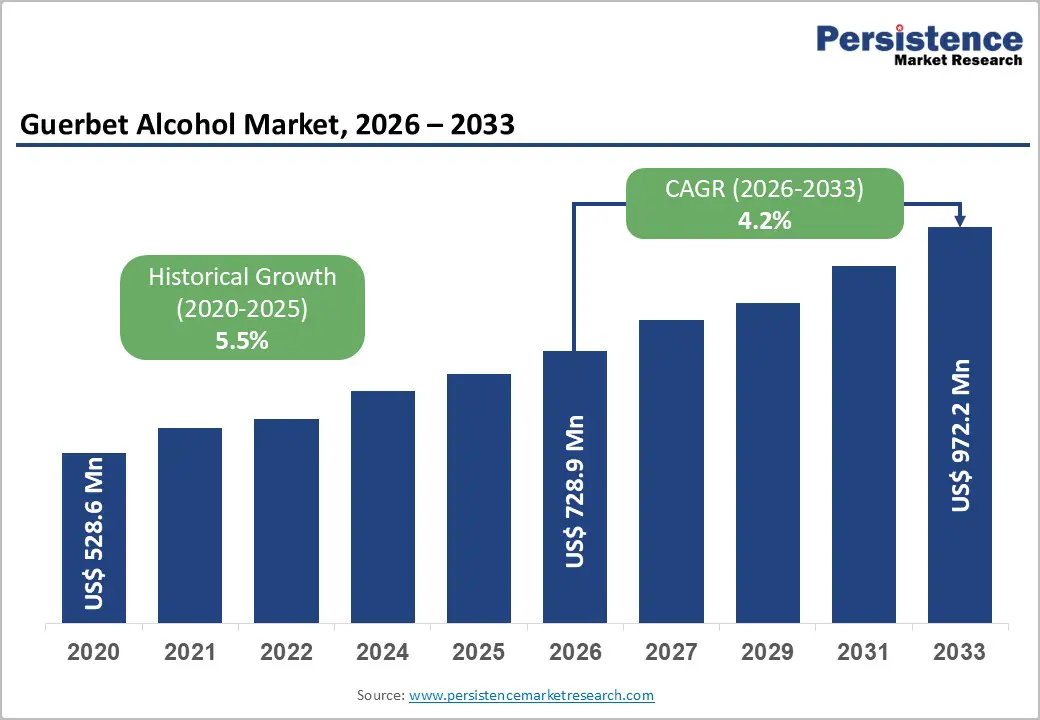
The global guerbet alcohol market size is likely to be valued at US$ 728.9 million in 2026 and is projected to reach US$ 972.2 million by 2033, growing at a CAGR of 4.2% between 2026 and 2033.
The sustained expansion of the guerbet alcohol market is primarily driven by the rising demand for high-performance emollients and solubilizers within the global cosmetic ingredients market. As consumers increasingly prioritize multifunctional personal care products that offer superior spreadability and skin feel without greasiness, manufacturers are turning to branched-chain alcohols like 2-Octyl Dodecanol for their unique physicochemical properties.
Key Industry Highlights:
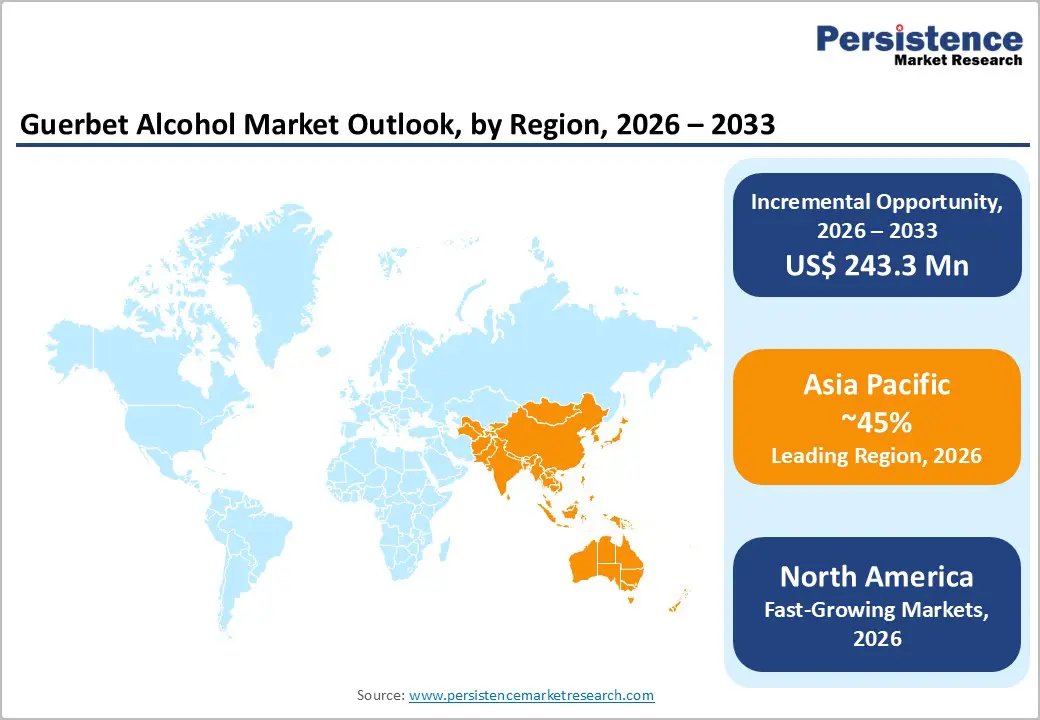
- Leading Region: Asia Pacific dominates the global Guerbet alcohol market with approximately 45% share in 2025, driven by extensive manufacturing capabilities in China, Japan, and India, abundant natural feedstock availability, and a rapidly growing middle-class consumer base, adding 180 million cosmetic users by 2030.
- Fastest Growing Region: North America is the fastest-growing region, propelled by stringent FDA cosmetic ingredient safety standards and rising demands for cosmetic products.
- Dominant Segment: The 2-Octyldodecanol product type segment commands 41.3% market share in 2025, favored for its exceptional multifunctional properties as emollient, thickener, and stabilizer in premium skincare formulations requiring superior spreadability and thermal stability.
- Fastest Growing Segment: The Personal Care & Cosmetics application segment represents the fastest-growing category at CAGR 5.1%, driven by 600 million new middle-class beauty consumers globally by 2030, 18% rise in natural cosmetics sales, and clean beauty trends favoring biodegradable emollients.
- Key Market Opportunity: Pharmaceutical sector expansion supported by WHO TRS 1060 regulatory validation in April 2025, India's USD 2.04 billion PLI scheme investment through 2028-29, and growing adoption of low-toxicity Guerbet alcohols as excipients in topical formulations meeting FDA USP/NF standards.
| Key Insights | Details |
|---|---|
|
Guerbet Alcohol Market Size (2026E) |
US$ 728.9 Mn |
|
Market Value Forecast (2033F) |
US$ 972.2 Mn |
|
Projected Growth CAGR (2026-2033) |
4.2% |
|
Historical Market Growth (2020-2025) |
5.5% |
Market Dynamics
Drivers
Surge in Global Middle-Class Consumers Reshapes Beauty and Personal Care Demand
The escalating global middle class represents a pivotal driver for the Cosmetic Ingredients Market expansion, fundamentally reshaping Guerbet alcohol consumption patterns. Between 2022 and 2030, approximately 600 million new middle- and upper-middle-class consumers are projected to enter cosmetic markets, with the SAPMENA region contributing 280 million consumers, establishing itself as the dominant growth engine. This demographic transition is disproportionately concentrated in emerging economies, where rising disposable incomes enable greater accessibility to premium beauty products previously confined to affluent Western markets.
North Asia, driven by China's young, beauty-conscious population, is projected to add 180 million consumers, establishing a secondary growth pillar. The Natural Products Association reported an 18% rise in natural cosmetics sales between 2023 and 2025, highlighting accelerating consumer preference for bio-based formulations where guerbet alcohols serve as primary emollients. This consolidated global consumer base expansion directly accelerates guerbet alcohol demand across premium cosmetic formulations requiring multifunctional ingredients with superior sensory profiles and sustainability credentials.
Regulatory Shift Toward Biodegradable Surfactants Supports Market Expansion
Innovation in regulatory frameworks promoting biodegradable surfactants represents a transformative growth driver for the Guerbet alcohol market. The U.S. EPA's Safer Choice programme had 1,724 certified products as of FY 2024, with performance measures targeting 2,300 products by September 2026, driving significant adoption of environmentally compliant detergents. The U.S. Bureau of Labor Statistics reported average annual expenditure on soaps and detergents increased from USD 75.53 per consumer unit in 2020 to USD 85.37 in 2022, demonstrating sustained consumer spending momentum that benefits Guerbet alcohol-based formulations meeting eco-compliance standards.
The EU approved a new detergents and surfactants regulation in December 2025, imposing stricter requirements on ultimate biodegradability and expanding the scope to microbial and refill products while providing a 3.5-year transition period for industry adaptation. The European Union's Detergents Regulation (EC No 648/2004) mandates that all surfactants in detergents achieve ultimate aerobic biodegradability of 60% within 28 days, establishing stringent quality standards that support specialty alcohol adoption over conventional alternatives.
Restraints
Higher Prices Associated with Guerbet Alcohols Limit Market Penetration
Higher prices for Guerbet alcohols and their derivatives significantly restrain market growth, limiting adoption in cost-sensitive sectors despite their advanced properties. Guerbet alcohols are expensive compared to other aliphatic variants due to a complex multi-step dimerization process, which includes oxidation, aldol condensation, dehydration, hydrogenation, and purification, inflating production costs by approximately 40-50% over conventional fatty alcohols.
In 2025, the U.S. effective tariff rate on chemical imports reached 28%, pushing fatty alcohol prices to USD 2,157 per metric ton, a 5.61% quarterly increase amid feedstock volatility. India's Wholesale Price Index for fatty alcohols showed a 10-12% annual increase, driven by import duties and raw material costs, deterring budget-conscious consumers in emerging markets. These elevated prices confine Guerbet alcohol use primarily to premium niches in Personal Care Chemicals Ingredients Market segments where performance justifies cost premiums, while industrial applications continue relying on cheaper linear alcohol alternatives.
Synthetic Alternatives and Performance Limitations Restrict Bio-Based Product Adoption
Synthetic alternatives and performance limitations hinder the adoption of bio-based Guerbet alcohols, slowing the transition to sustainable options despite environmental pressures. Bio-based Guerbet alcohols, sourced from renewable materials like vegetable oils, often lack the oxidative stability and viscosity ranges of their synthetic counterparts, which deliver consistent quality and superior emulsification in industrial applications.
Despite alignment with global net-zero goals, performance gaps in foaming efficiency and formulation stability hinder wider bio-based adoption, leading to hybrids or synthetics dominating approximately 70% of fatty alcohol applications in the Specialty Chemicals Market. Recent initiatives, such as Dow's upcoming synthetic Guerbet-like surfactants and BASF's hybrid blends, aim to address performance issues but maintain synthetic dominance in performance-critical applications.
Opportunities
Government Initiatives Accelerate Specialty Alcohol Adoption in Pharmaceutical Applications
The pharmaceutical and healthcare sectors present substantial market opportunities for Guerbet alcohol manufacturers, driven by regulatory standardization and strategic government investments. India's Ministry of Chemicals and Fertilizers identifies the pharmaceutical market valued at USD 50 billion in FY 2023-24, positioning India as the world's third-largest pharmaceutical producer by volume, with significant excipient manufacturing expansion potential. India's Union Budget 2025-26 allocated USD 602 million to the Department of Pharmaceuticals, representing a 28.8% budget increase, with specific prioritization for pharmaceutical excipients and bio-based chemical innovation.
The WHO's publication of WHO TRS 1060 in April 2025 established comprehensive Good Manufacturing Practices for pharmaceutical excipients, fundamentally validating specialty chemical applications, including Guerbet alcohols in regulated pharmaceutical formulations. The FDA enforces quality standards through USP and NF monograph compliance requirements, mandating rigorous supplier testing and certificates of analysis, creating structured pathways for Guerbet alcohol integration into pharmaceutical applications.
Advancements in Sustainable Manufacturing Technologies Propel Market Expansion
Innovation in sustainable production technologies and green chemistry methodologies represents a transformative opportunity for Guerbet alcohol market expansion. The U.S. EPA's 2024 Green Chemistry Challenge Awards recognized pioneering innovations, including Merck Co.'s continuous manufacturing process for pharmaceuticals, reducing energy consumption by 4.5-fold and water usage by 4-fold, demonstrating scalable green chemistry benefits.
The Government of India's BioE3 Policy, approved in August 2024, establishes biomanufacturing frameworks promoting bio-based chemicals production through biofoundries and bio-AI hubs across the country. India's bioeconomy has grown from USD 10 billion in 2014 to USD 165.7 billion in 2024, with the government targeting USD 300 billion by 2030. Adoption of enzymatic and catalytic processes lowers energy use by 15% and enhances yield for branched Guerbet structures, with R&D spending rising 10% annually to improve sustainability and purity for pharmaceutical grades.
Category-wise Analysis
Product Type Insights
The 2-Octyldodecanol segment dominates the global Guerbet alcohol market by product type, commanding approximately 41.3% market share in 2025. This leadership position is attributed to 2-Octyldodecanol's exceptional multifunctional properties as a thickener, emollient, and stabilizer in premium skincare formulations, where its branched C20 structure provides superior spreadability and skin-feel compared to shorter-chain variants.
2-Octyldodecanol finds extensive application in high-end cosmetics, sunscreens, and anti-aging creams where its low volatility and excellent lubricity meet demanding performance standards. Its compatibility with both water-based and oil-based formulations makes it indispensable for creating stable emulsions in the Personal Care Chemicals Ingredients Market. The segment benefits from increasing consumer demand for texture-rich, non-greasy cosmetic products, particularly in premium beauty segments across Europe and North America, where product differentiation through superior sensory attributes drives purchasing decisions.
Source Insights
Natural-sourced Guerbet alcohol dominates the market, accounting for approximately 69.8% of total demand in 2025, driven by extensive preference in the beauty and personal care industry. This commanding market share reflects the convergence of regulatory pressures, consumer sustainability consciousness, and superior ingredient positioning in clean beauty formulations. Natural Guerbet alcohols, primarily derived from coconut oil and palm oil, produce mild branched alcohols for biodegradable emollients meeting RSPO certification standards.
The EU Green Deal projects a 15-20% increase in bio-based material usage by 2030, fundamentally reshaping chemical composition standards across Europe. The USDA BioPreferred Program now covers 97 product categories encompassing approximately 14,000 products, driving federal procurement mandates toward bio-based materials. The U.S. Department of Energy projects bio-based chemicals reaching USD 25 billion globally by 2025, with surfactants comprising 15% of this market, positioning natural Guerbet alcohols as premium, eco-compliant alternatives.
Application Insights
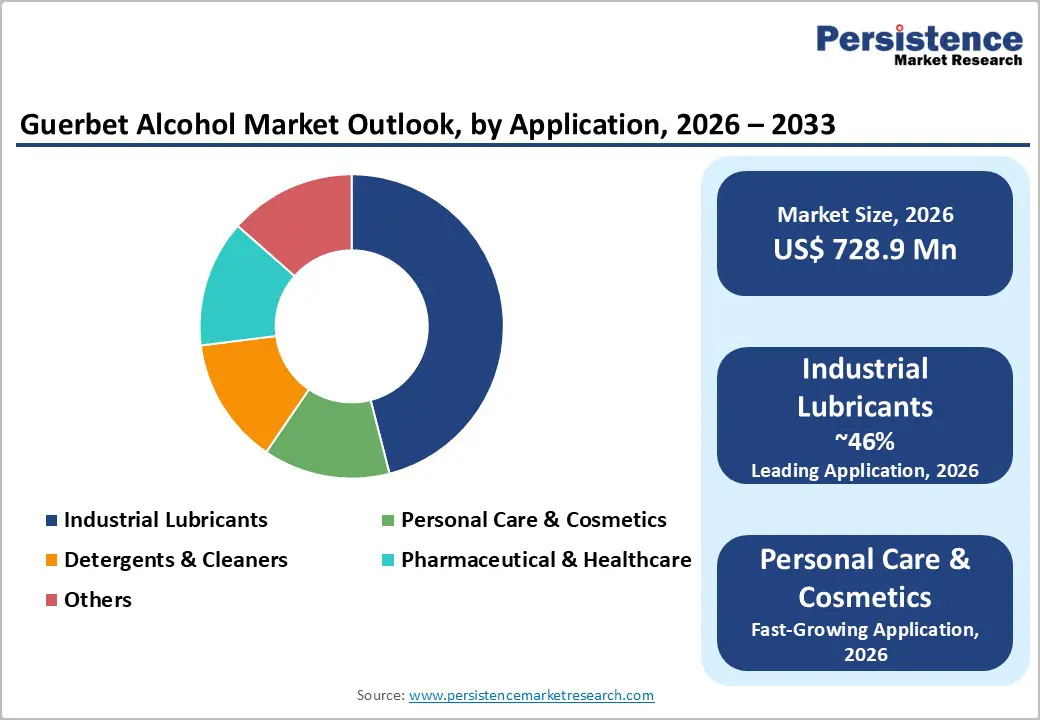
The Industrial & Lubricants segment emerges as the leading application category in the Guerbet alcohol market, capturing approximately 46% market share in 2025, driven by superior performance characteristics in high-temperature metalworking environments. Guerbet alcohols function as high-stability additives in metalworking fluids, rolling oils, and synthetic lubricants, where their branched structure reduces friction, enhances lubricity, and withstands temperatures exceeding 200°C for efficient machinery operation and extended tool life.
The Personal Care & Cosmetics segment follows closely, propelled by surging demand for multifunctional emollients in premium skincare, haircare, and color cosmetics. Guerbet alcohols serve as solubilizers, viscosity enhancers, and texture improvers in foundations, sunscreens, and anti-aging formulations where their non-greasy feel and skin compatibility meet evolving consumer expectations in the Cosmetic Ingredients Market.
Regional Insights
North America Guerbet Alcohol Market Trends
North America accounts for approximately 22% of the global guerbet alcohol market in 2025, with the U.S. maintaining market leadership through advanced regulatory frameworks and robust innovation ecosystems. The region benefits from stringent FDA cosmetic ingredient safety standards and EPA Safer Choice program certifications that favor high-purity, biodegradable Guerbet alcohols in personal care and cleaning products. American consumers increasingly prioritize clean beauty products with transparent ingredient sourcing, aligning with natural Guerbet alcohol positioning in the personal Care Chemicals Ingredients market.
The U.S. EPA's Safer Choice programme expansion, targeting 2,300 certified products by September 2026, creates structured growth pathways for guerbet alcohol-based detergent formulations meeting biodegradability requirements. Leading manufacturers, including BASF and Dow, maintain significant R&D facilities in North America, focusing on bio-based specialty alcohol development through fermentation technologies and renewable feedstock integration.
Europe Guerbet Alcohol Market Trends
Europe represents approximately 25% of the global guerbet alcohol market in 2025, driven by stringent REACH regulations and leadership in sustainable chemistry innovation. Germany, France, U.K., and Spain collectively account for 68% of regional demand, reflecting mature cosmetics industries and advanced manufacturing capabilities. The European Union's approval of new detergents and surfactants regulation in December 2025 imposes stricter biodegradability requirements, explicitly prohibiting animal testing and introducing digital product passports.
Germany's strong chemical manufacturing base, led by BASF and Sasol Germany GmbH, positions the country as a key production hub with advanced Guerbet synthesis capabilities and sustainability certifications. The EU Green Deal's projection of 15-20% increase in bio-based material usage by 2030 creates compelling opportunities for natural-sourced Guerbet alcohols derived from RSPO-certified palm and coconut oils. European manufacturers increasingly adopt enzymatic catalysis and continuous-flow hydrogenation technologies that reduce energy consumption by 15% while improving carbon-chain distribution precision for high-end cosmetic applications.
Asia Pacific Guerbet Alcohol Market Trends
Asia Pacific emerges as the largest regional market, commanding approximately 45% of global Guerbet alcohol demand in 2025, with East Asia and South Asia & Oceania together representing the manufacturing powerhouse. China leads regional consumption, driven by extensive industrial manufacturing bases, high-volume personal care production, and government support for oleochemical sector development. China's young, beauty-conscious population, contributing 180 million new middle-class cosmetic consumers by 2030, drives substantial growth in premium skincare formulations requiring multifunctional emollients.
India's rapid pharmaceutical expansion under the PLI scheme, with INR 4,570 crore cumulative investment by 2025 and capacity creation for 25 APIs/KSMs/DIs, positions the country as an emerging hub for excipient-grade Guerbet alcohol manufacturing. The region's oleochemical manufacturers, including Ecogreen Oleochemicals in Indonesia and Godrej Industries in India, invest in sustainable production technologies and capacity expansions to meet growing regional and export demand in the Specialty Chemicals Market.
Competitive Landscape
The global guerbet alcohol market exhibits a consolidated market structure, where a small number of multinational chemical corporations and specialized regional players control a majority of the market share. Leading manufacturers differentiate through sustainable bio-based sourcing, advanced catalytic technologies achieving higher purity levels exceeding 98%, and customized formulation development for premium cosmetic and pharmaceutical applications. Companies increasingly pursue strategic partnerships for technological innovation, with BASF collaborating with Acies Bio for fermentation-based production and manufacturers securing RSPO certifications for palm-derived variants. Strategic expansion in this market is largely driven by capacity increases in the Asia Pacific region and mergers and acquisitions aimed at consolidating portfolios of specialty ingredients. Companies are increasingly differentiating themselves through "green" branding and technical support services that help formulators integrate these alcohols into complex new products.
Key Market Developments:
- November 2024: BASF partnered with Acies Bio to scale fermentation-based production of fatty alcohols from renewable methanol, leveraging synthetic biology platforms for sustainable ingredient manufacturing targeting cosmetic and pharmaceutical applications.
- November 2024: Sasol launched a new palm-free, bio-based stearyl alcohol solution based on rapeseed oil, NACOL 18-98, providing high-performance alternatives addressing environmental concerns associated with palm oil production.
- March 2023: Vertellus, a leading provider of specialty ingredients, completed its rebranding to Aurorium. The company, which had previously acquired Jarchem Industries (a supplier of Jarcol Guerbet Alcohols), stated the rebrand reflects its broader growth strategy in personal care and industrial markets.
Top Companies in the Guerbet Alcohol Market
Sasol Germany GmbH (Germany) is a global leader in the production of surfactants and specialty alcohols, including a comprehensive range of Guerbet Alcohols marketed under the ISOFOL brand. With a strong focus on backward integration and technical expertise, Sasol supplies high-purity single-isomer alcohols that are critical for sensitive applications in cosmetics and industrial formulations. Their operational excellence and global distribution network make them a pivotal influencer in market pricing and standards.
BASF SE (Germany) stands as the world's largest chemical producer and a key player in the Guerbet Alcohol sector, offering products like Eutanol G (Octyldodecanol). The company leverages its massive R&D capabilities to drive innovation in sustainable personal care ingredients. BASF's strong emphasis on bio-based solutions and regulatory compliance positions it as a preferred partner for multinational cosmetic brands seeking reliable and safe ingredients.
New Japan Chemical Co., Ltd. (Japan) is a prominent Asian manufacturer known for its NJCOL series of higher alcohols. The company specializes in producing high-quality, branched alcohols derived from natural fatty acids, catering specifically to the demanding standards of the Japanese cosmetic and industrial markets. Their reputation for rigorous quality control and specialized grades allows them to command a strong position in the high-end segment of the market.
Companies Covered in Guerbet Alcohol Market
- Sasol Germany GmbH
- Kokura Gosei Kogyo. Ltd.
- BASF SE
- KOKYU ALCOHOL KOGYO CO., LTD.
- Dowpol Chemical International Corp.
- Oleon Health and Beauty
- Daisankasei Co., Ltd.
- New Japan Chemical Co., Ltd.
- Kao Corporation
- SABO S.p.A.
- Ecogreen Oleochemicals
- ALZO International Inc.
- Aurorium
Frequently Asked Questions
The global guerbet alcohol market is projected to reach US$ 972.2 million by 2033, expanding at a CAGR of 4.2% from 2026 to 2033, driven by increasing demand for bio-based emollients in personal care and biodegradable surfactants in detergent applications.
The global surge in middle-income groups, with approximately 600 million new beauty product users expected by 2030, and regulatory mandates such as the EU Detergents Regulation requiring 60% aerobic biodegradability within 28 days, drive substantial market growth across cosmetic and cleaning applications.
The 2-Octyldodecanol segment dominates with approximately 41% market share in 2025, favored for exceptional multifunctional properties including superior spreadability, thermal stability, and compatibility in premium skincare formulations meeting stringent performance standards.
Asia Pacific leads the global market with approximately 45% share in 2025, driven by extensive manufacturing capabilities in China, Japan, and India, abundant natural feedstock availability, and a rapidly expanding middle-class consumer base.


