




- Industrial Machinery
- Grout Pump Market
Grout Pump Market Size, Share, and Growth Forecast, 2026 – 2033
Grout Pump Market by Product Type (Piston Grout Pumps, Plunger Grout Pumps, Diaphragm Grout Pumps, Peristaltic Grout Pumps), Power Source (Electric, Hydraulic, Pneumatic, Diesel), Application (Soil Stabilization, Foundation Reinforcement, Tunnel Construction, Concrete Repair, Dam & Bridge Construction, Waterproofing), and Regional Analysis for 2026-2033

Grout Pump Market Share and Trends Analysis
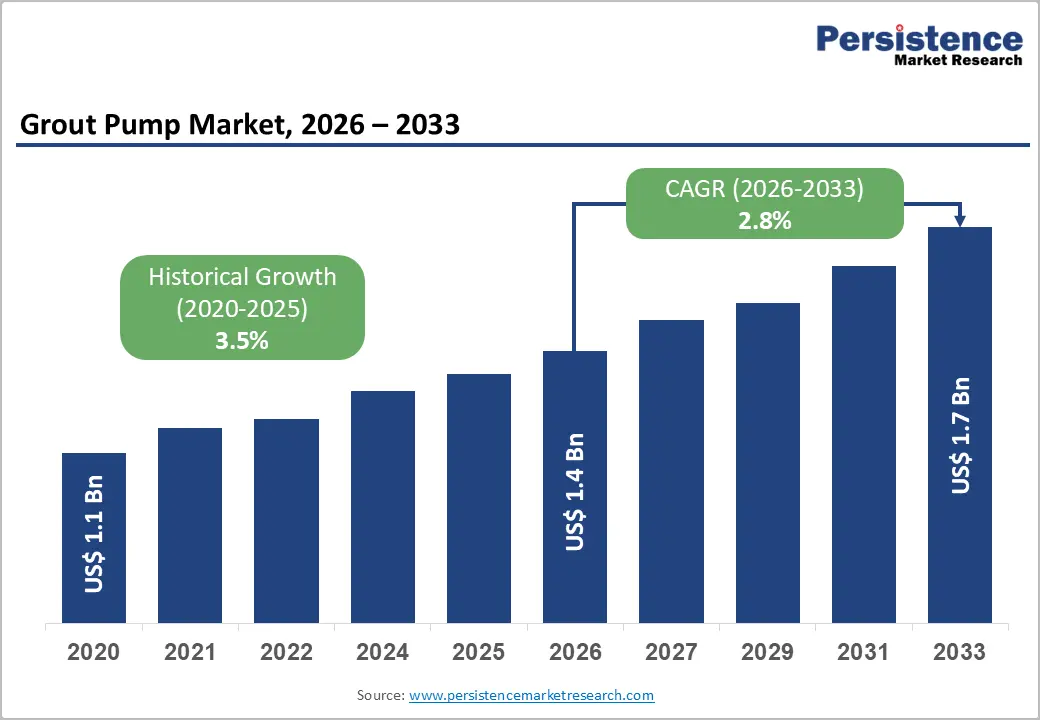
The global grout pump market size is likely to be valued at US$ 1.4 billion in 2026, and is projected to reach US$ 1.7 billion by 2033, growing at a CAGR of 2.8% during the forecast period 2026−2033.
Market expansion is supported by infrastructure modernization, rapid urbanization, and increasing structural rehabilitation activities. Expansion of transportation networks, underground construction, and water infrastructure projects generates consistent demand for high-precision grout injection systems applied in soil stabilization and structural reinforcement. Civil engineering projects require controlled material injection technologies capable of ensuring structural integrity and long-term durability. Continuous advancement in construction technologies strengthens equipment adoption across commercial and industrial engineering projects.
Modern grout pumps incorporate automated pressure control, improved pumping accuracy, and durable component design that enhances operational efficiency during tunnel construction, foundation reinforcement, and dam stabilization activities. Precision injection capability supports effective void filling and ground consolidation across complex geological conditions. Equipment reliability and stable pressure delivery increase contractor confidence in mechanized grouting systems, supporting wider integration across large-scale infrastructure and structural maintenance projects.
Key Industry Highlights
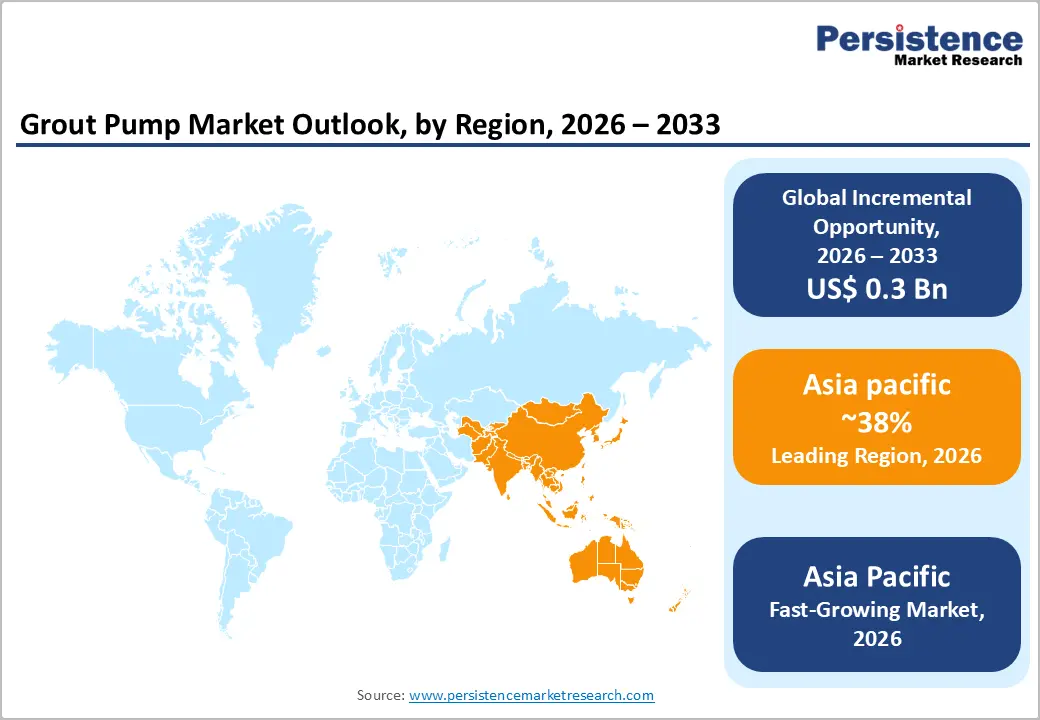
- Dominant Region: Asia Pacific is projected to hold an estimated 38% market share in 2026, driven by infrastructure development and high-precision grouting demand.
- Fastest-growing Regional Market: Asia Pacific is projected to become the fastest-growing market from 2026 to 2033, owing to smart construction and mechanized grouting.
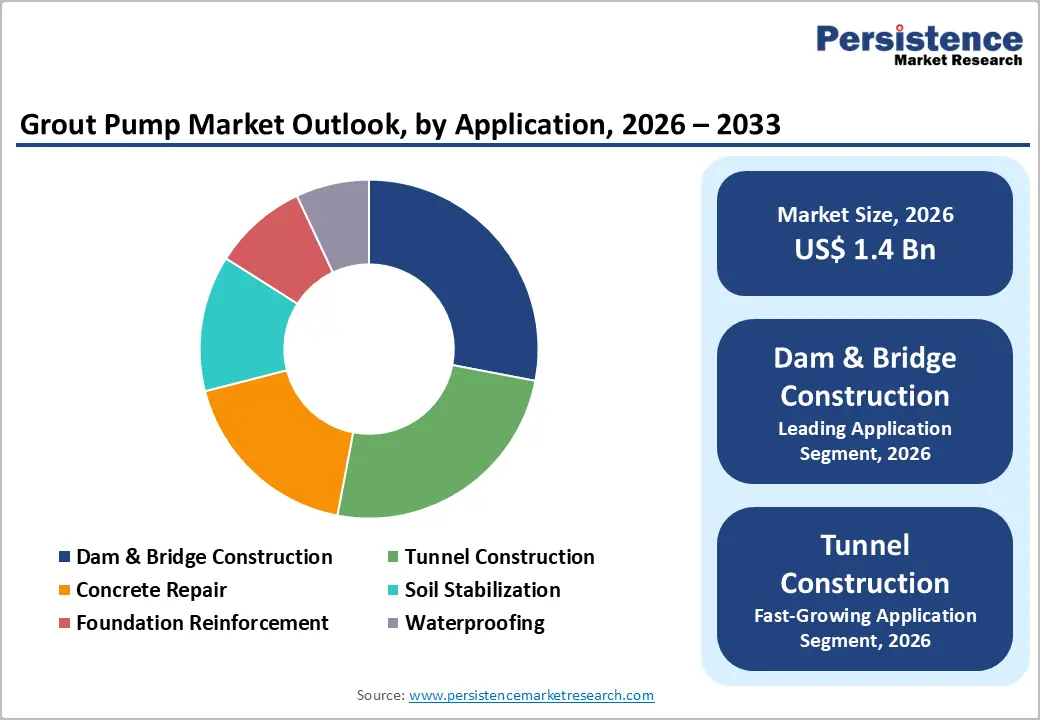
- Leading Application: Dam and bridge construction is slated to capture 28% of the 2026 revenue share, supported by high-volume injections, digital modeling, and cost-effective portable pumps.
- Fastest-growing Application: Tunnel construction is set to be the fastest-growing application from through 2033, fueled by annular grouting and automated modular systems.
| Key Insights | Details |
|---|---|
|
Grout Pump Market Size (2026E) |
US$ 1.4 Bn |
|
Market Value Forecast (2033F) |
US$ 1.7 Bn |
|
Projected Growth (CAGR 2026 to 2033) |
2.8% |
|
Historical Market Growth (CAGR 2020 to 2025) |
3.5% |
Market Factors – Growth, Barriers, and Opportunity Analysis
Technological Advancements in Construction Equipment
Continuous improvement in construction equipment technology strengthens efficiency, precision, and operational reliability across infrastructure development activities. Modern machines integrate digital pressure control systems, automated sensors, and real-time monitoring tools that enable accurate material delivery during ground stabilization and structural reinforcement operations. Such capabilities support consistent injection control, reduced material waste, and improved construction quality in complex engineering environments such as tunnels, bridges, and underground utilities. Advanced sensing and monitoring technologies improve safety, productivity, and quality management across construction sites through automated data collection and performance tracking.
Integration of automation, Internet of Things (IoT), and artificial intelligence (AI) technologies strengthens equipment performance and project execution efficiency. Intelligent machinery equipped with sensors and predictive maintenance tools enables continuous equipment monitoring and optimized operational control during construction processes. Data-driven systems support accurate pressure regulation and consistent material flow during injection activities, improving structural reinforcement accuracy in large infrastructure projects. Digital equipment management platforms further support project coordination, equipment diagnostics, and operational transparency across large civil engineering environments where precise material placement and structural stability remain critical project requirements.
Growth of Underground Construction and Geotechnical Engineering Activities
Underground infrastructure expansion across transportation, hydropower, and urban transit systems increases demand for advanced ground stabilization technologies. Tunnel construction, metro rail networks, and subsurface utility corridors require precise injection of cementitious or chemical materials to strengthen surrounding soil formations and control groundwater movement. Geotechnical engineering practices depend on pressure-controlled injection systems that stabilize fractured rock layers, fill underground voids, and reinforce excavation zones before and during tunneling operations. Government infrastructure programs illustrate this trend; for instance, around 75 tunnel projects covering 146 km remained under construction in India during 2025 under national highway infrastructure programs, reflecting strong public investment in subsurface transport corridors.
Geotechnical engineering applications further strengthen equipment demand through ground improvement, foundation reinforcement, and seepage control during deep excavation projects. Urban land constraints drive adoption of underground transit systems, basements, and utility tunnels, creating technically challenging ground conditions that require controlled material injection to maintain structural stability. Engineering contractors deploy pressure-regulated pumping systems to deliver cement grout or microfine materials into soil layers that support tunnel linings, retaining walls, and foundation piles.
Maintenance and Equipment Downtime Concerns
Operational reliability of grouting equipment remains a critical concern across infrastructure and underground construction activities. Continuous pumping of abrasive cementitious materials accelerates wear in key components such as pistons, valves, seals, and hoses, leading to frequent servicing requirements and unexpected equipment stoppages. High-pressure injection operations further increase mechanical stress on pumping systems, particularly during tunnel stabilization, mining reinforcement, and dam curtain grouting projects, where long operating cycles remain common. Equipment interruption during these operations directly halts ground stabilization activities, forcing contractors to pause excavation, reinforcement, and structural sealing processes.
Financial and operational consequences of downtime create a major barrier for contractors managing large infrastructure programs. Equipment failure during grouting tasks often requires specialized technicians, replacement components, and extended repair periods, raising project expenditure and delaying completion schedules. High-pressure pumping systems operate in demanding environments such as underground tunnels, deep foundations, and mining shafts where dust, moisture, and abrasive slurry accelerate mechanical degradation. Extended repair cycles increase idle labor time, disrupt project sequencing, and reduce equipment utilization efficiency. Procurement of spare parts and qualified service personnel further increases operational complexity, particularly across remote infrastructure locations.
Fluctuations in Construction Sector Investment
Investment instability across the construction sector creates uncertainty for equipment procurement associated with ground stabilization and structural reinforcement activities. Infrastructure development, transportation networks, tunneling projects, and building construction represent major operational environments where grouting systems support foundation strengthening and soil consolidation. Financial constraints, shifting government infrastructure priorities, and private sector budget adjustments frequently slow project approvals and reduce construction activity levels. Delayed project initiation directly influences machinery purchasing decisions within contractor organizations.
Construction industry investment cycles strongly influence capital expenditure strategies among infrastructure contractors and civil engineering firms. Limited project visibility and unpredictable funding conditions encourage firms to prioritize equipment utilization optimization rather than fleet expansion. Operational planning during uncertain investment periods typically emphasizes equipment leasing, refurbishment of existing machinery, and cost-control measures instead of new equipment procurement. This environment reduces consistent demand for specialized construction machinery applied in foundation reinforcement, tunnel stabilization, and underground sealing operations.
Expansion of Smart City and Urban Infrastructure Projects
Rapid development of smart cities and urban infrastructure projects drives demand for precision construction equipment, creating significant growth potential. Urbanization requires complex underground utilities, high-rise foundations, and transportation networks that depend on stable soil and reinforced structures. Grout pumps enable controlled injection of cementitious or chemical grouts, ensuring soil stabilization, void filling, and structural integrity in dense urban environments. Integration of automated pressure control and digital monitoring in modern pumps supports efficient operation in projects with tight schedules and high accuracy requirements. Municipal and private sector investments in smart infrastructure increase project scale and frequency, creating a sustained requirement for reliable grouting solutions.
Urban infrastructure development emphasizes long-term durability and structural resilience, increasing the adoption of mechanized grouting systems. Tunnel construction, foundation reinforcement, and water management systems in urban areas require consistent and precise material application to prevent settlement or leakage issues. Equipment with advanced pumping accuracy and durable components provides contractors the capability to manage complex soil conditions and confined working spaces. The need for efficient construction practices in densely populated regions accelerates the deployment of automated and semi-automated grouting solutions.
Growing Mining and Resource Extraction Industry
Expansion of mining and resource extraction activities drives demand for high-precision grouting solutions essential for operational safety and structural stability. Underground mining operations require extensive tunnel networks, shafts, and chambers that must maintain integrity under variable geological conditions. Grout pumps provide controlled material injection into voids, fractures, and weak soil zones, ensuring ground consolidation and reducing the risk of subsidence. In open-pit and deep mining sites, grouting supports slope stabilization and water ingress prevention, enabling continuous extraction while minimizing operational disruptions. The ability to deliver high-pressure, consistent, and accurate grout placement enhances project efficiency and reduces labor-intensive manual interventions, making mechanized grouting equipment an integral part of modern mining infrastructure.
Resource extraction projects, including oil, gas, and mineral processing facilities, rely on stable foundations and reinforced structural elements to sustain heavy operational loads. Grout pumps facilitate reinforcement of dams, containment structures, and tailing storage areas, mitigating leakage and environmental hazards. Adoption of advanced pumping technologies with automated pressure control and durable components ensures precise application even in remote or challenging locations. This capability improves safety standards, optimizes construction timelines, and supports compliance with regulatory requirements for structural reliability.
Category-wise Analysis
Product Type Insights
Piston grout pumps are poised to lead with a forecasted 35% of the grout pump market revenue share in 2026, owing to their robust pressure capabilities that ensure deep penetration in dense soils, a critical factor in foundation and dam projects where reliability trumps variability. Contractor preference leans toward this type for its straightforward maintenance, allowing quick field repairs that sustain project momentum without specialized tools. Accessibility improves through widespread availability of spare parts, reducing lead times in remote deployments. Innovation in seal materials enhances durability against abrasive grouts, aligning with industry shifts toward extended service intervals. Adherence to operational protocols benefits from intuitive controls, minimizing errors in high-stakes applications like tunnel linings.
Peristaltic grout pumps are anticipated to be the fastest-growing segment between 2026 and 2033, fueled by their gentle handling of sensitive mixtures that preserves material integrity, particularly in waterproofing tasks requiring uniform distribution. Effectiveness stems from hose-based designs that eliminate contamination risks, appealing to providers focused on quality assurance in regulated environments. Preference grows among engineers valuing shear-sensitive performance, as these pumps adapt seamlessly to varying viscosities without pulsation. Accessibility expands via compact footprints suitable for confined spaces, broadening use in urban retrofits. Innovations like reinforced tubing boost throughput, supporting adherence in continuous operations.
Application Insights
Dam and bridge construction is expected to hold a dominant position, accounting for an anticipated 28% of the grout pump market share in 2026, driven by the need for high-volume injections to seal joints and reinforce abutments against hydraulic loads. Credibility in this domain arises from proven track records in load-transfer efficiency, endorsed by engineering consortia for longevity in water-exposed environments. Provider referrals increase as specifications prioritize pumps that handle cementitious mixes under sustained pressure. Digitalization aids through BIM integrations that model grout paths, optimizing material use. Accessibility improves with portable units for site-specific adaptations, while cost efficiency manifests in reduced rework from uniform fills.
Tunnel construction is forecasted to be the fastest-growing application segment between 2026 and 2033, boosted by escalating subterranean projects that demand annular grouting for ground support in soft rock formations. Credibility solidifies via case studies demonstrating void minimization, which referrals amplify among geotechnical firms. Digital tools like laser scanning guide precise placements, enhancing efficiency. Accessibility via modular pumps suits linear progressions, cutting mobilization costs. Efficiency gains from automated dosing systems lower per-meter expenses, with tech integrations like remote controls streamlining delivery in ventilated shafts.
Regional Insights
North America Grout Pump Market Trends
North America maintains a significant position in the market for grout pumps, driven by extensive infrastructure modernization and aging transportation networks requiring reinforcement. In the United States, investment in highway renovation, tunnel construction, and dam maintenance fuels demand for high-precision grouting equipment capable of delivering consistent pressure and accurate material placement. Canada focuses on underground transit expansion and urban redevelopment projects, which necessitate advanced pumping systems for soil stabilization and foundation strengthening. Increasing use of automated and digital monitoring technologies in grouting operations enhances operational efficiency and reduces labor-intensive processes. Industrial construction, including energy facilities and commercial complexes, contributes to steady equipment adoption as contractors prioritize reliability, precision, and long-term structural durability.
North America is expected to exhibit moderate growth, stimulated by adoption of innovative grouting solutions and regulatory emphasis on safety and environmental compliance. In the United States, underground utility networks and metro expansion projects require equipment capable of handling challenging geological conditions and variable grout mixtures. Canada emphasizes large-scale hydropower and dam reinforcement projects, increasing demand for automated pressure-controlled grout pumps. Rising infrastructure spending on airport expansion and high-rise construction supports adoption of mechanized grouting systems, while digital integration and remote-controlled operations provide improved process accuracy and monitoring capabilities.
Europe Grout Pump Market Trends
Europe is positioned as a mature market for grout pumps, characterized by steady demand driven by infrastructure renovation and modernization projects. Countries such as Germany and France prioritize upgrading transportation networks, including railways, bridges, and highways, requiring precision grouting systems for foundation reinforcement and soil stabilization. The United Kingdom and Italy focus on retrofitting aging public infrastructure, including tunnels and dams, with advanced automated grout pumps to ensure structural integrity and long-term durability. Central European nations including Poland and Czechia invest in industrial construction and commercial complexes, generating demand for high-capacity pumping equipment capable of handling continuous operations with improved accuracy.
Europe is also experiencing a gradual shift toward specialized applications of grouting technologies, with Switzerland and Austria leveraging automated pumps in hydroelectric and water management projects to control seepage and reinforce containment structures. Spain and the Netherlands implement advanced grouting techniques in flood defense and coastal reinforcement initiatives, ensuring stability under challenging geological and hydrological conditions. Scandinavian countries including Sweden and Norway focus on sustainable construction practices, integrating precise grouting equipment for energy infrastructure and underground utilities. Industrial contractors increasingly adopt high-durability pumps with remote monitoring capabilities to reduce operational downtime and ensure compliance with stringent regulatory standards.
Asia Pacific Grout Pump Market Trends
Asia Pacific is expected to dominate with an estimated 38% of the grout pump market value in 2026, reflecting extensive infrastructure investments and large-scale urbanization initiatives. In China and India, accelerated construction of high-speed rail networks, metro systems, and highway expansions generates consistent demand for high-precision grout injection systems applied in tunnel reinforcement, soil stabilization, and foundation strengthening. Japan and South Korea focus on modernization and maintenance of aging transportation and water infrastructure, driving adoption of automated and digitally controlled grouting equipment. Southeast Asian countries such as Thailand, Malaysia, and Indonesia are witnessing rapid commercial and industrial construction, which requires advanced pumping systems for reliable structural reinforcement.
Asia Pacific is forecasted to be the fastest-growing market for grout pump between 2026 and 2033, stimulated by rising adoption of smart construction technologies and mechanized grouting solutions. China and India lead in deployment of precision grouting systems for large-scale hydropower and metro tunnel projects, enhancing operational efficiency and reducing downtime. Japan and South Korea emphasize seismic reinforcement and durability-focused retrofitting, which drives demand for automated pressure-controlled equipment capable of high-accuracy material placement. Emerging nations including Vietnam, Philippines, and Indonesia are investing in urban redevelopment and underground utility networks, creating opportunities for advanced grouting solutions
Competitive Landscape
The global grout pump industry demonstrates a moderately fragmented structure, with a mix of global construction equipment manufacturers and specialized geotechnical machinery producers competing across multiple markets. Key players, including Sika, Atlas Copco, Graco, ChemGrout, Cemen Tech, and Putzmeister Holding, capture a substantial portion of industry revenue through diversified product portfolios that cater to commercial, industrial, and civil engineering projects. Competitive differentiation among these companies centers on equipment durability, pumping efficiency, and technological innovation, with an increasing emphasis on automated pressure control, digital monitoring systems, and precision material placement.
Regional manufacturers contribute to the industry by offering cost-competitive machinery designed to meet local construction demands, such as small-scale urban development, foundation repair, and tunnel stabilization projects. These manufacturers focus on affordability and ease of operation while gradually incorporating advanced features to align with global standards. The presence of both global and regional suppliers encourages competitive pricing and fosters innovation, as companies continuously enhance pumping mechanisms, material handling capabilities, and operational efficiency.
Key Industry Developments
- In December 2025, Henan Wode Heavy Industry unveiled its new HWGP440/50PI-22E high-pressure compact jet grout pump with a 22 kW motor, intelligent pressure control and enhanced efficiency that successfully supported foundation reinforcement work on major infrastructure projects including a Singapore highway expansion.
- In September 2025, SupAnchor’s SupPump SDA grout pump series (Sup2000 and Sup5000) strengthened efficiency in major global construction projects such as Alpine tunnel reinforcement by delivering high-performance grouting solutions capable of tackling complex geological challenges with robust design and advanced capabilities.
- In July 2025, Häny introduced the INJECTO-COMPACT IC-310, a compact and efficient grout plant designed for versatile injection applications such as consolidation grouting, contact grouting, and tunneling, combining high-shear mixing, reliable agitation, and powerful grout pumping in a space-saving layout ideal for mobile and confined job sites.
Companies Covered in Grout Pump Market
- Sika AG
- Atlas Copco AB
- Graco Inc.
- ChemGrout Inc.
- Cemen Tech Inc.
- Putzmeister Holding GmbH
- Flowcrete Group Ltd.
- Wyo-Ben, Inc.
- Bekaert Maccaferri Underground Solutions
Frequently Asked Questions
The global grout pump market is projected to reach US$ 1.4 billion in 2026.
Rapid infrastructure development, urbanization, underground construction, and technological advancements in grouting equipment are driving the market.
The grout pump market is poised to witness a CAGR of 2.8% from 2026 to 2033.
Expansion of smart city projects, renewable energy infrastructure, mining operations, and adoption of automated grouting technologies present key market opportunities.
Some of the key market players include Sika AG, Atlas Copco AB, Graco Inc., ChemGrout Inc., Cemen Tech Inc., Putzmeister Holding GmbH, and Flowcrete Group Ltd.


