




- Specialty & Fine Chemicals
- Epoxy Grout Market
Epoxy Grout Market Size, Share, and Growth Forecast, 2026 – 2033
Epoxy Grout Market by Industry Type (Mining Industry, Water Conservancy Industry, Construction Industry), Application (General, New Construction, Improvements and Repairs of Existing Construction, Others), and Regional Analysis for 2026 – 2033

Epoxy Grout Market Size and Trends Analysis
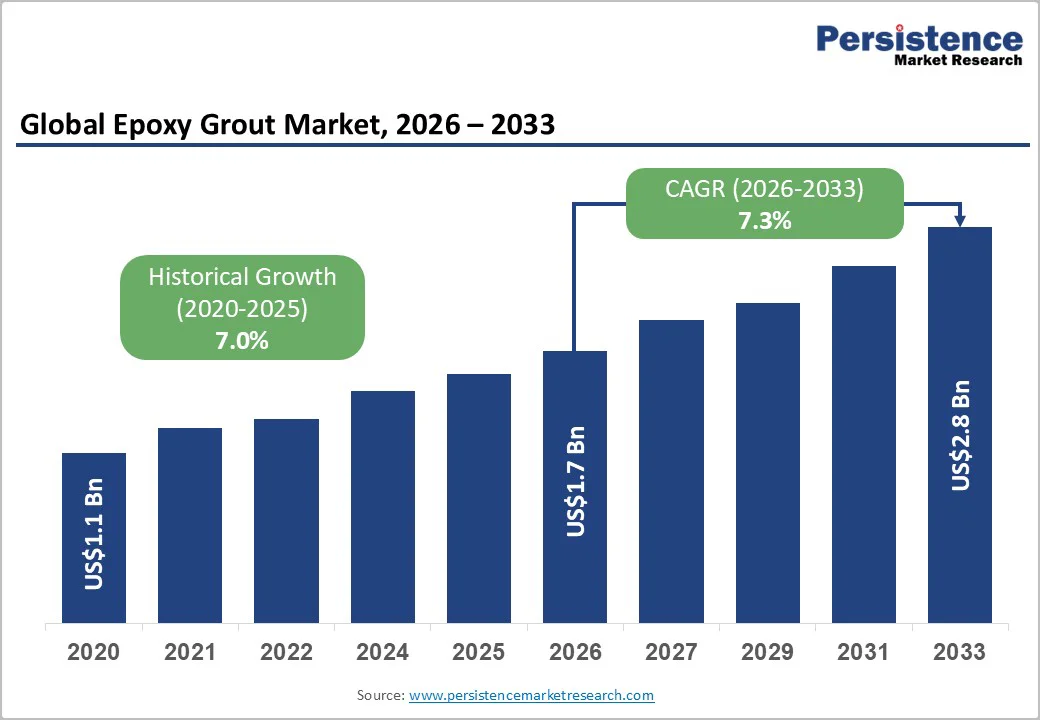
The global epoxy grout market size is likely to be valued at US$1.7 billion in 2026 and is expected to reach US$2.8 billion by 2033, growing at a CAGR of 7.3% during the forecast period from 2026 to 2033, driven by the superior performance characteristics of epoxy grout including high chemical resistance, exceptional durability, stain-proofing, and superior bonding strength making it increasingly preferred over cementitious grout in industrial, commercial, and high-moisture environments. Rising construction activities across residential, commercial, and infrastructure sectors, particularly in Asia Pacific and the Middle East, continue to fuel demand.
Key Industry Highlights:
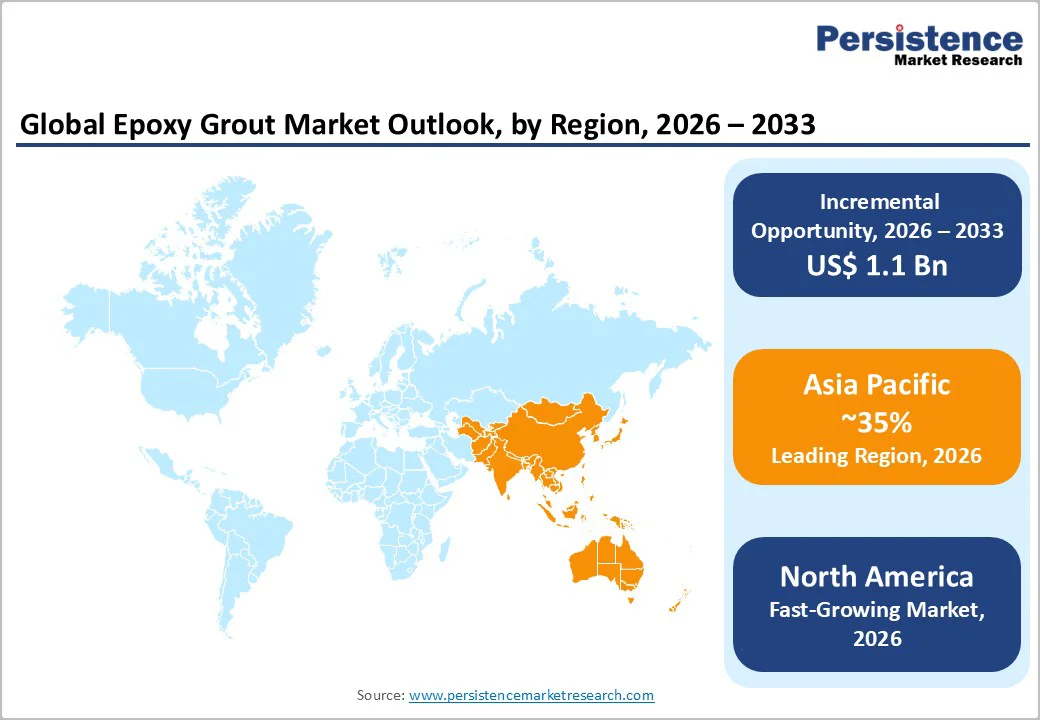
- Leading Region: Asia Pacific is anticipated to be the leading region, accounting for a market share of 35% in 2026, driven by rapid urbanization, manufacturing expansion, infrastructure development, and increasing demand from industrial and commercial sectors.
- Fastest-growing Region: North America is likely to be the fastest-growing region in the market, fueled by infrastructure renewal, mining revival, low-VOC epoxy adoption, and strong U.S. market leadership.
- Leading Industry Type: The construction industry is projected to represent the leading segment in 2026, accounting for 60% of the market share, driven by urbanization and high demand for durable flooring in commercial projects.
- Fastest-growing Industry Type: The mining industry is likely to be the fastest-growing, driven by the rising mineral demand and usage in harsh applications.
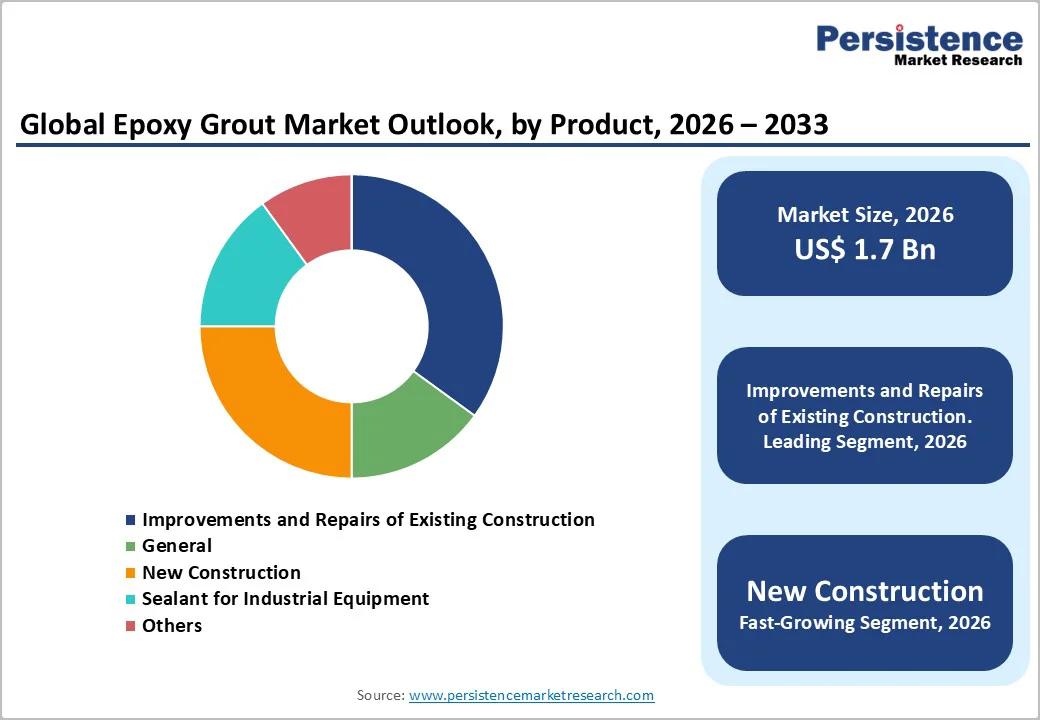
- Leading Application: The improvements and repairs segment is anticipated to dominate, accounting for over 35% of the revenue share in 2026, preferred for cost-effective retrofits and maintenance projects.
| Key Insights | Details |
|---|---|
|
Epoxy Grout Market Size (2026E) |
US$1.7 Bn |
|
Market Value Forecast (2033F) |
US$2.8 Bn |
|
Projected Growth (CAGR 2026 to 2033) |
7.3% |
|
Historical Market Growth (CAGR 2020 to 2025) |
7.0% |
Market Factors – Growth, Barriers, and Opportunity Analysis
Mining Sector Growth Driving Demand for High-Performance Grouts and Sealants
The expansion of the mining sector, especially the growing demand for critical minerals such as lithium, copper, nickel, and other raw materials, is fueling a surge in mining operations worldwide. This is driven by the rising need for metals in renewable energy infrastructure, electric vehicles, clean energy storage, and large scale industrial manufacturing. As mining companies ramp up both openpit and underground mining and invest heavily in modern equipment and chemicals for ore recovery and stabilization, the volume of extraction, processing, and associated civil engineering works grows significantly.
Demand rises for robust grouting materials, sealants, foundation mortars, and chemical resistant solutions applications where high performance products such as epoxy grout are vital. As mining operations often involve harsh conditions, heavy loads, moisture, chemicals, and vibration, there is increased preference for durable, chemical and moisture resistant grouts and adhesives to support equipment bases, structural reinforcement, tunnel sealing, water inflow control, and long term stability.
High Material Costs Limit Epoxy Grout Adoption
The market faces a significant restraint due to high material costs, which can impact adoption across price-sensitive segments. Epoxy resins and associated hardeners, the core components of epoxy grout, are derived from petroleum-based chemicals whose prices fluctuate with global oil markets. Specialty additives for enhanced chemical resistance, color stability, and fast-curing properties further increase production costs. High raw material costs make epoxy grouts more expensive than traditional grouts, limiting their use in small-scale or cost-sensitive construction projects.
Supply chain constraints and geopolitical factors can exacerbate price volatility, particularly for regions dependent on imports for chemical raw materials. Manufacturers are also investing in R&D to produce high-performance, low-VOC, and sustainable formulations, which adds to production expenses. While epoxy grouts provide long-term durability and reduced maintenance, the upfront investment remains a barrier, particularly in emerging markets, restraining the overall market growth despite rising demand from industrial and commercial sectors.
Sustainable Epoxy Grouts Drive Market Opportunities
The epoxy grout market presents a significant opportunity through the development and adoption of sustainable formulations. Manufacturers are increasingly focusing on low-VOC volatile organic compounds, eco-friendly, and bio-based epoxy systems to meet rising environmental regulations and growing demand for green construction materials. These sustainable products reduce environmental impact, improve indoor air quality, and comply with stricter building codes in regions such as North America and Europe, where sustainability certifications such as LEED and BREEAM are highly valued.
The push for circular economy practices in construction and infrastructure projects is driving innovation in recyclable and low-carbon epoxy resins. Sustainable formulations also appeal to emerging markets where governments are incentivizing green construction through subsidies and tax benefits. By offering strong performance alongside environmental compliance, sustainable epoxy grouts are well-positioned to gain share from traditional systems. The rise of smart homes is further supporting their adoption and market growth.
Category-wise Analysis
Industry Type Insights
The construction industry is expected to dominate the epoxy grout market, accounting for approximately 60% of the total revenue in 2026, driven by rapid urbanization, increasing commercial and residential projects, and the demand for durable and chemical-resistant flooring. Epoxy grouts are preferred in high-traffic areas, such as malls, airports, hospitals, and office complexes, due to their superior adhesion, stain resistance, and long-term durability compared to traditional cementitious grouts. For example, in the renovation of Singapore’s Changi Airport Terminal, epoxy grouts were used extensively in flooring and walls to ensure chemical resistance, ease of cleaning, and aesthetic appeal, demonstrating their suitability in high-performance commercial environments.
The mining industry is likely to represent the fastest-growing industry type in 2026, due to increasing mineral extraction and industrial development worldwide. Mining operations demand durable, chemical- and moisture-resistant materials to protect tunnels, floors, and equipment foundations against harsh conditions. For example, in the copper mining facilities in Chile’s Atacama Desert, epoxy grouts are applied for sealing flooring and structural bases to withstand chemical exposure, heavy machinery, and extreme environmental conditions. The growth is further fueled by rising global demand for lithium, copper, nickel, and other minerals essential for electric vehicles, renewable energy storage, and industrial manufacturing.
Application Type Insights
The improvements and repairs segment is projected to lead the epoxy grout market, capturing around 35% of the total revenue share in 2026, driven by cost-effectiveness and superior performance in retrofitting existing structures. Epoxy grouts are widely used to repair damaged tiles, seal joints, and restore flooring in commercial and industrial facilities, providing long-lasting durability and chemical resistance. For example, during the renovation of industrial warehouses in North America, epoxy grout was applied to repair worn-out flooring. The market is supported by the aging infrastructure, growing refurbishment projects, and the need for sustainable repair solutions that extend the service life of existing buildings.
New construction is likely to be the fastest-growing industry type in 2026, due to the global rise in high-rise residential, commercial, and industrial projects. Epoxy grouts are increasingly chosen for new flooring, walls, and structural bases in modern constructions, offering durability, chemical resistance, and aesthetic flexibility. For example, in the development of smart cities in India, epoxy grouts have been used extensively in public infrastructure, commercial complexes, and high-rise apartments to ensure long-lasting flooring solutions that require minimal maintenance. The growth is driven by global urbanization trends, increasing construction activities in emerging economies, and rising awareness of high-performance building materials.
Regional Insights
North America Epoxy Grout Market Trends
North America is anticipated to be the fastest-growing region, driven by robust infrastructure renovation and modernization projects, commercial and industrial construction, and rising awareness of the performance benefits of epoxy-based systems over traditional grout. Regulatory pressure on building standards and a growing emphasis on long-term durability, chemical resistance, and low maintenance flooring solutions have boosted adoption in commercial buildings, healthcare facilities, and industrial plants.
There is growing demand from rehabilitation and retrofit projects, as aging infrastructure, including bridges, water systems, industrial floors, and institutional buildings, undergoes upgrades that rely heavily on durable, long-lasting sealing and grout solutions. This renovation-driven demand supports steady growth, especially due to epoxy grout’s resistance to chemicals, moisture, heavy loads, and wear, making it ideal for heavy-duty floors, industrial facilities, and infrastructure under constant stress.
Europe Epoxy Grout Market Trends
Europe is likely to be a significant market for epoxy grout in 2026, due to renovation, refurbishment, and premium construction projects. Strict environmental and building regulations across the European Union encourage the adoption of low VOC, eco friendly epoxy grouts, especially in countries such as Germany, France, and the U.K. In both residential and commercial sectors, there is an increasing preference for high performance, durable grout solutions, for example, in flooring and industrial interiors that offer chemical resistance, moisture protection, and long-term durability, supporting sustained consumption of epoxy-based products.
Europe is witnessing a strong shift toward sustainable and specialized epoxy grout formulations. Manufacturers are introducing eco-friendly, low-emission products to meet strict environmental regulations, driving adoption across public infrastructure, healthcare facilities, hospitality spaces, and premium residential projects. Growing demand also stems from extensive renovation and retrofit activities, as aging buildings, transport hubs, and older infrastructure undergo upgrades that require durable, low-maintenance, and wear-resistant grout solutions.
Asia Pacific Epoxy Grout Market Trends
The Asia Pacific region is anticipated to be the leading region in the epoxy grout market, accounting for a 35% share in 2026, driven by rapid urbanization, large scale infrastructure and transit projects, and robust industrial expansion in countries such as China, India, Japan, and Southeast Asia. Government backed investments in rail, metro, highways, airports, and commercial complexes have significantly increased demand for high performance grouts, especially epoxy-based systems, as they offer superior chemical and moisture resistance, durability, and long-term structural integrity compared with conventional grout solutions.
Asia Pacific is witnessing a rise in demand from industrial, institutional, and high end residential sectors, where performance, hygiene, and decorative finishes matter. The growth in manufacturing zones, data center construction, heavy duty industrial floors, and modern commercial buildings is driving the adoption of epoxy grouts with resin-based formulations that meet stringent durability and load-bearing requirements. Low VOC and sustainable epoxy grouts are driving APAC’s strong market growth in environmentally compliant, durable urban projects.
Competitive Landscape
The global epoxy grout market exhibits a moderately fragmented structure, driven by steady infrastructure upgrades, growing commercial construction, and rising demand for high-performance flooring and heavy-equipment anchoring solutions; specialty industrial applications, e.g., chemical plants, power, and mining, also sustain demand for durable, chemical-resistant grouts. With key leaders including Sika AG, LATICRETE International, MAPEI S.p.A., BASF SE, Five Star Products, and Hexion, the market balances large multinationals’ reach with nimble regional manufacturers offering localized technical support and formulations.
These players compete through continual product innovation, fast-set, high-temperature, antimicrobial grades, robust distribution and dealer networks, technical services on-site grout specification and training, and sustainability credentials, low emissions, and longer service life. Competitive moves also include broader construction-chemical portfolios, M&A to scale manufacturing and geographic reach, and partnerships with EPC contractors and OEMs to secure project pipelines. Price pressure from commodity competitors and the need to comply with tightening building standards push vendors to emphasize certification, supply-chain reliability, and value-added services to win long-term contracts.
Key Industry Developments:
- In February 2025, Saint-Gobain \completed its acquisition of FOSROC, strengthening its presence in the global construction chemicals market. The deal expanded the company’s reach across key high-growth regions, including India, the Middle East, and Asia-Pacific, supported by FOSROC’s strong portfolio in waterproofing, concrete repair, admixtures, flooring, and sealants.
- In March 2025, BASF and Sika jointly introduced a new epoxy hardener, Baxxodur EC 151, designed to advance sustainable construction solutions. The hardener enhances epoxy resin flooring systems by delivering lower viscosity and improved flow properties, supporting more efficient application and higher-performance coatings aligned with evolving environmental standards.
Companies Covered in Epoxy Grout Market
- Sika AG
- LATICRETE International, Inc.
- Five Star Products, Inc.
- Hexion
- Atul Ltd.
- New Japan Chemical Co., Ltd.
- Aditya Birla Chemicals
- Kukdo Chemicals Co., Ltd.
- Anhui Xinyuan Chemical Co., Ltd.
- SIR Industriale
- The Euclid Chemical Company
- Bostik
- Saint-Gobain
- Henkel AG
Frequently Asked Questions
The global epoxy grout market is projected to reach US$1.7 billion in 2026.
Rising demand for durable, chemical-resistant, and low-maintenance flooring and tiling solutions in industrial, commercial, and infrastructure applications.
The epoxy grout market is expected to grow at a CAGR of 7.3% from 2026 to 2033.
Rising adoption of sustainable, low-VOC epoxy formulations and expanding use in high-performance sectors such as healthcare, food processing, and infrastructure renovation.
Sika AG, LATICRETE International, Inc., Five Star Products, Inc., Hexion, Atul Ltd, New Japan Chemical Co. Ltd., Aditya Birla Chemicals, and Kukdo Chemicals Co. Ltd. are the leading players.


