




- Non-food Packaging
- Garment Packaging Machine Market
Garment Packaging Machine Market Size, Share, and Growth Forecast 2026 - 2033
Garment Packaging Machine Market by Machine Type (Standalone Systems, Integrated-Line Systems), Packaging Technology (Vacuum Packaging Machines, Heat Shrink Packaging Machines, Poly Bag/Poly Wrap Packaging Machines, Zipper/Resealable Bag Packaging Machines, Stretch Film Packaging Machines), Output Capacity (Up to 500 pcs/hour, 501-1,000 pcs/hour, 1,001-2,000 pcs/hour, Above 2,000 pcs/hour), Application, and Regional Analysis, 2026 - 2033

Garment Packaging Machine Market Size and Trend Analysis
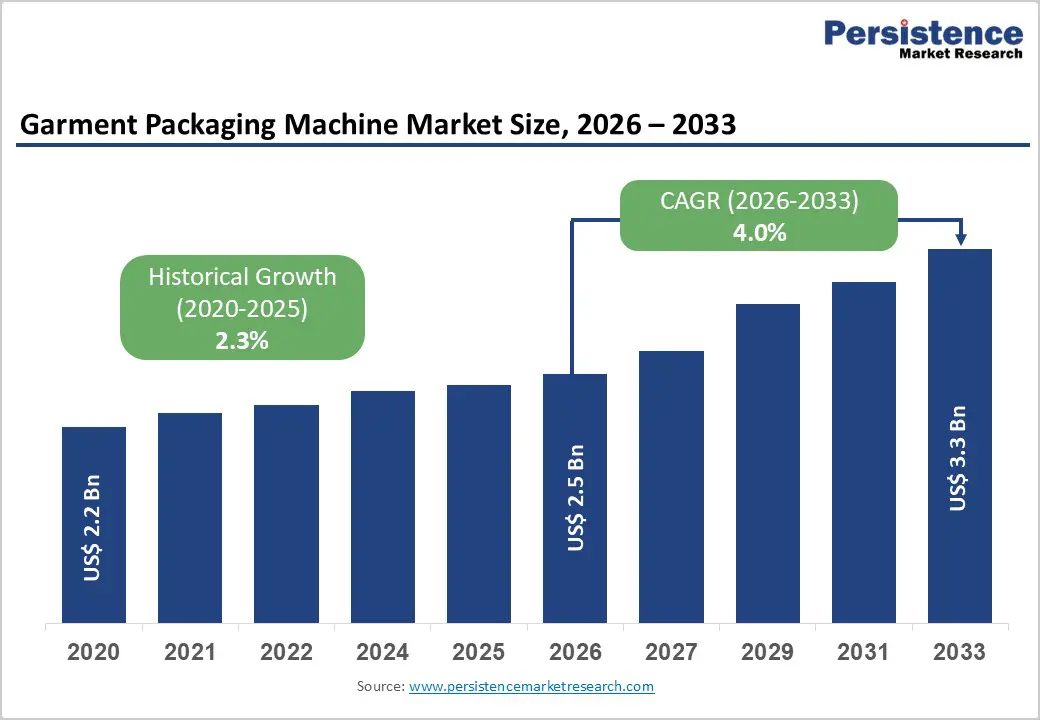
The global garment packaging machine market size is expected to be valued at US$ 2.5 billion in 2026 and projected to reach US$ 3.3 billion by 2033, growing at a CAGR of 4.0% between 2026 and 2033. This accelerating growth trajectory advancing from a historical CAGR of 2.3% during 2020 - 2025 is primarily driven by the rapid expansion of global apparel trade, surging e-commerce-driven fashion retail, and the widespread adoption of automated packaging technologies across garment manufacturing hubs in Asia Pacific and emerging markets.
Rising retailer demands for presentation-ready, shelf-optimized packaging, coupled with labor cost pressures in key garment-producing nations and increasing deployment of integrated packaging lines in large-scale apparel factories, are collectively reinforcing robust investment in advanced garment packaging machinery throughout the forecast period.
Key Industry Highlights:
- Leading Region: Asia Pacific leads the global garment packaging machine market with approximately 45% revenue share in 2025, driven by its role as the world’s dominant apparel manufacturing hub across China, Bangladesh, Vietnam, and India, sustaining massive ongoing packaging equipment demand.
- Fastest Growing Region: Asia Pacific is simultaneously the fastest growing regional market for the 2026 - 2033 forecast period, accelerated by garment factory modernization investments, government PLI schemes, expanding free trade agreements, and rising labor costs compelling automation adoption across the region.
- Dominant Segment: Poly Bag/Poly Wrap Packaging Machines dominate the packaging technology segment with approximately 38% market share in 2025, driven by their universal adoption as the global garment packaging standard specified by major international retail buyers and compliance manuals worldwide.
- Fastest Growing Segment: Vacuum Packaging Machines are the fastest growing technology segment, gaining accelerating traction in premium apparel, direct-to-consumer sportswear, and high-value export packaging applications that demand superior product presentation and space-efficient transit formats.
- Key Opportunity: The integration of Industry 4.0 technologies including IoT monitoring, AI quality inspection, and robotic automation into garment packaging lines represents the most significant value-creation opportunity for equipment manufacturers seeking premium contracts with global apparel brands and large-scale export factories.
| Key Insights | Details |
|---|---|
| Garment Packaging Machine Market Size (2026E) | US$ 2.5 Billion |
| Market Value Forecast (2033F) | US$ 3.3 Billion |
| Projected Growth CAGR (2026 - 2033) | 4.0% |
| Historical Market Growth (2020 - 2025) | 2.3% |
Market Dynamics
Drivers - Booming Global Apparel Trade and E-Commerce Fashion Retail Driving Packaging Equipment Demand
The sustained expansion of the global apparel and textile industry is one of the most direct and consequential demand catalysts for garment packaging machines. According to the World Trade Organization (WTO), global clothing exports exceeded US$ 500 billion in 2022, reflecting the enormous volume of garments moving through manufacturing, warehousing, and retail distribution channels each stage requiring consistent, high-throughput packaging. The rise of online fashion retail has amplified packaging requirements further the United Nations Conference on Trade and Development (UNCTAD) reports that fashion and apparel consistently rank among the top-selling categories in global e-commerce, compelling garment producers and fulfillment operators to invest in reliable, scalable packaging machinery capable of handling diverse garment types, sizes, and presentation formats with speed and minimal product damage. This dynamic is especially pronounced in high-volume export markets such as Bangladesh, Vietnam, India, and China.
Rising Labor Costs in Garment Manufacturing Hubs Accelerating Automation Adoption
Labor cost escalation in traditionally low-cost garment manufacturing economies is emerging as a powerful structural catalyst for the adoption of automated garment packaging machines. In Bangladesh the world’s second-largest garment exporter the government raised the minimum wage for garment workers by 56.25% in late 2023 to BDT 12,500 per month, according to official notifications from the Bangladesh Gazette. Similar wage increases have been recorded in Vietnam and India, where state-level minimum wage revisions are progressively narrowing the labor cost advantage that underpinned manual packaging operations. The International Labour Organization (ILO) projects continued upward pressure on manufacturing wages across South and Southeast Asia through the decade. These dynamics are compelling factory operators to substitute labor-intensive manual packaging steps with automated and semi-automated garment packaging systems, driving capital investment into the machinery market throughout the forecast period.
Restraints - High Initial Capital Investment Limiting Adoption Among Small-Scale Garment Manufacturers
Automated garment packaging machines, particularly integrated-line systems capable of handling multiple packaging formats, represent significant capital expenditure, often ranging from US$ 50,000 to over US$ 500,000 per production line, depending on throughput capacity and technology complexity. For the large proportion of the global garment industry comprised of small and medium-sized manufacturers who, according to the International Trade Centre (ITC), account for over 60% of garment production enterprises in South Asia and Sub-Saharan Africa this upfront cost creates a substantial adoption barrier. Limited access to equipment financing, leasing programs, and technology subsidies in developing markets further compounds this challenge, slowing market penetration in price-sensitive segments.
Complexity of Managing Multi-Garment Product Variability on Packaging Lines
The garment industry’s inherent diversity spanning vastly different product sizes, fabric types, folding requirements, and packaging specifications across product categories such as innerwear, outerwear, and sportswear poses significant technical challenges for packaging machinery standardization. Unlike rigid consumer goods, garments require frequent machine reconfiguration, tooling changes, and software reprogramming to accommodate seasonal SKU transitions and fast-fashion product cycles. The Apparel, Footwear and Textile Technology (AFTT) sector consistently identifies machine flexibility and changeover downtime as operational pain points that increase total cost of ownership, reducing the return on investment appeal of automated packaging systems for smaller, more agile garment operations.
Opportunity - Rapid Growth of Sportswear and Activewear Segment Creating High-Value Packaging Equipment Demand
The global sportswear and activewear segment is among the fastest-growing categories within the broader apparel industry, and its expansion is creating a compelling and sustained demand opportunity for specialized garment packaging machine manufacturers. According to the World Federation of the Sporting Goods Industry (WFSGI), the global sporting goods market has demonstrated consistent annual growth, with athleisure and performance apparel being among the most dynamic categories. Major brands, including Nike, Adidas, and Under Armour have significantly expanded their direct-to-consumer and e-commerce fulfillment operations, requiring high-speed, presentation-quality packaging lines capable of handling diverse activewear formats. The technical demands of sportswear packaging, including compression packaging for space efficiency, vacuum packaging for premium product presentation, and resealable formats for multi-piece sets create an opportunity for equipment manufacturers to develop specialized, application-specific packaging solutions commanding premium pricing and higher margins.
Integration of Industry 4.0 Technologies Enabling Smart Garment Packaging Lines
The convergence of Industry 4.0 technologies including IoT-enabled machine monitoring, AI-driven quality inspection, robotic pick-and-place systems, and cloud-based production management platforms is transforming the garment packaging machinery landscape and creating significant value-creation opportunities for forward-looking equipment manufacturers. The International Federation of Robotics (IFR) reported a record 553,052 industrial robots installed globally in 2022, with textile and apparel manufacturing among growing adopter segments. Smart packaging lines capable of real-time defect detection, automated label verification, predictive maintenance alerts, and seamless ERP system integration are increasingly specified by large apparel exporters and brand-owned manufacturing facilities seeking to reduce packaging error rates, improve traceability, and achieve compliance with retailer packaging mandates from global buyers such as H&M, Zara (Inditex), and PVH Corp. Manufacturers offering digitally integrated packaging solutions stand to capture premium contracts and build durable technology-led competitive moats.
Category-wise Analysis
Machine Type Insights
Standalone systems represent the leading segment within the machine type category, accounting for approximately 62% of total market share in 2025. This dominance is rooted in their widespread deployment across small to mid-sized garment manufacturing operations which constitute the majority of the global garment producer base where the flexibility to independently operate and reposition individual packaging stations is operationally valued over the higher-throughput but less flexible integrated-line configurations. Standalone systems require lower upfront investment, offer simpler installation and maintenance protocols, and can be more readily integrated into existing factory floor layouts without major infrastructure modifications. In markets like India, Bangladesh, and Indonesia, where garment factories frequently handle mixed product ranges and smaller order batches, standalone packaging machines provide the versatility that underpins their market leadership. The fastest growing segment is Integrated-Line Systems, driven by large-scale apparel exporters investing in end-to-end factory automation.
Packaging Technology Insights
Poly bag and poly wrap packaging machines dominate the packaging technology category, commanding an estimated 38% market share in 2025. Their leading position reflects the near-universal adoption of polybag packaging as the global standard for garment shipping, retail display, and inventory protection across virtually all apparel product categories. The American Apparel & Footwear Association (AAFA) and major retail compliance manuals from buyers including Walmart, Target, and Gap Inc. specify polybag packaging across the vast majority of garment categories from basic tees and undergarments to formal wear establishing polybag machinery as the default procurement choice for garment manufacturers worldwide. The format’s cost efficiency, compatibility with diverse garment sizes, and ability to accommodate barcode labeling, hangers, and header cards further reinforce its dominance. The fastest growing technology segment is Vacuum Packaging Machines, gaining traction particularly in premium apparel, sportswear, and direct-to-consumer export packaging applications.
Output Capacity Insights
The 501-1,000 pcs/hour output capacity segment leads the garment packaging machine market, holding approximately 35% market share in 2025. This mid-range throughput tier represents the operational sweet spot for a large proportion of mid-sized garment manufacturing facilities and export-oriented factories, providing a balance between processing speed and equipment cost accessibility. Factories operating in this capacity range typically produce order quantities of 10,000 to 100,000 pieces per run which is representative of the bulk of export orders placed by mid-tier international retailers and brand sourcing offices. Industry bodies such as the Bangladesh Garment Manufacturers and Exporters Association (BGMEA) report that the majority of their member factories, numbering over 4,500, operate in production scales that align with this mid-throughput packaging machinery tier. The fastest growing segment is above 2,000 pcs/hour, fueled by mega-factory investments and large-scale brand-owned manufacturing complexes.
Application Insights
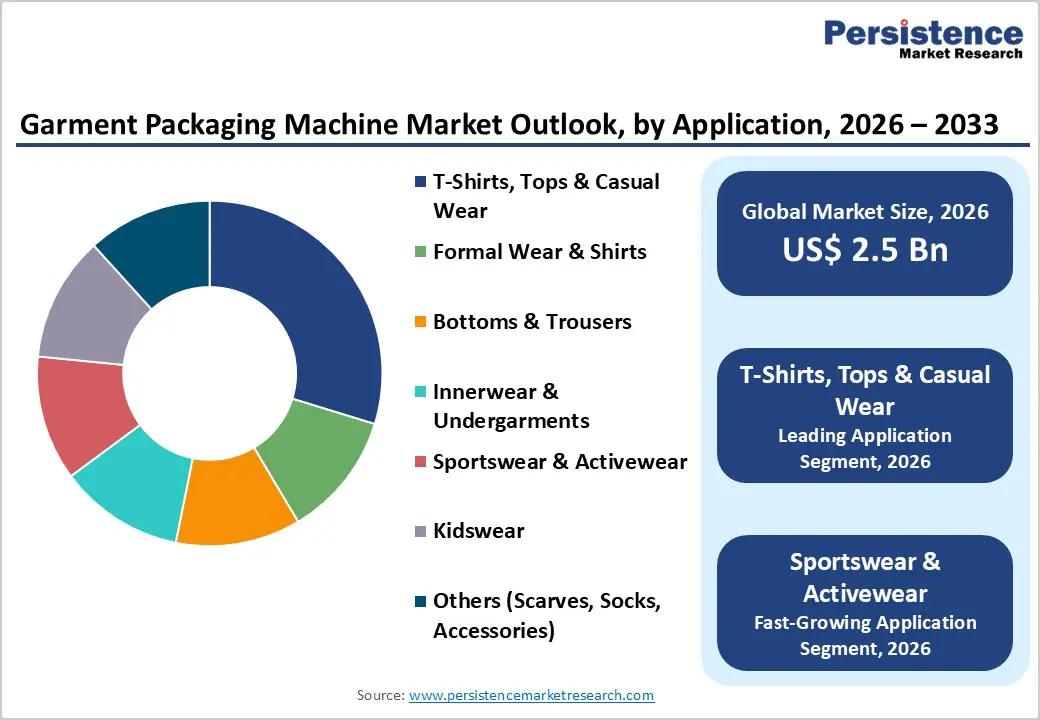
T-shirts, tops, and casual wear represent the dominant application segment in the garment packaging machine market, holding approximately 32% of total market share in 2025. This leadership reflects the category’s position as the world’s highest-volume garment type by unit production, driven by its universal consumer appeal, rapid inventory turnover, and dominance in both fast-fashion and value retail segments. According to Euromonitor International’s apparel data, basic tops and T-shirts consistently rank as the highest unit-volume clothing category globally, making it the primary application driver for packaging machine investment at garment manufacturers and fulfillment centers. The category’s standardized folding dimensions and packaging specifications also make it the most amenable to automated packaging line deployment, reinforcing machinery procurement in this segment. The fastest growing application is Sportswear & Activewear, propelled by the global athleisure boom.
Regional Insights
North America Garment Packaging Machine Market Trends and Insights
North America holds a significant position in the global garment packaging machine market, accounting for approximately 22% of total revenue share in 2025, led primarily by the United States. The U.S. market is distinguished by its high technology adoption rate, strong presence of advanced packaging equipment distributors and integrators, and the growing reshoring and nearshoring trend in apparel manufacturing driven by supply chain resilience priorities post-COVID-19. The American Apparel & Footwear Association (AAFA) reports that U.S. apparel and footwear brands collectively generate retail revenues exceeding US$ 380 billion annually, sustaining a large and active supplier ecosystem that regularly upgrades packaging equipment to meet evolving retailer compliance requirements.
The U.S. also benefits from a robust innovation ecosystem with companies such as PAC Machinery Group and Frain Industries Inc. contributing to the development of advanced flexible packaging solutions tailored to apparel applications. The integration of RFID tagging, automated barcode label application, and smart inspection systems into packaging lines is gaining traction among premium and mid-market U.S. apparel brands seeking enhanced supply chain traceability and retail floor readiness, reinforcing consistent capital investment in upgraded garment packaging machinery.
Europe Garment Packaging Machine Market Trends and Insights
Europe represents the second-largest regional market for garment packaging machines, with Germany, the United Kingdom, Italy, and France being the key contributing economies. Germany’s highly developed mechanical engineering and automation industry positions it as both a significant market for garment packaging technology and a leading machinery manufacturing and exporter. Italian packaging machinery manufacturers, clustered particularly in the Emilia-Romagna region, are internationally recognized for precision engineering and have a long-standing export presence in Asian and Latin American garment markets. The European Packaging Machinery Manufacturers Association (EUROMAP) identifies textile and apparel packaging as a growing application vertical for European machinery exports.
Regulatory drivers are also reshaping the European garment packaging machinery landscape. The EU Strategy for Sustainable and Circular Textiles (2022) and the EU Packaging and Packaging Waste Regulation (PPWR) revisions are compelling apparel brands operating in the region including Zara (Inditex), H&M, and Bestseller to transition toward reduced-plastic, recyclable, and minimized-material packaging formats. This regulatory momentum is generating replacement demand cycles for newer, sustainability-compatible garment packaging machines capable of processing paper-based, compostable, and reduced-gauge plastic materials, creating an equipment upgrade opportunity across European garment supply chains.
Asia Pacific Garment Packaging Machine Market Trends and Insights
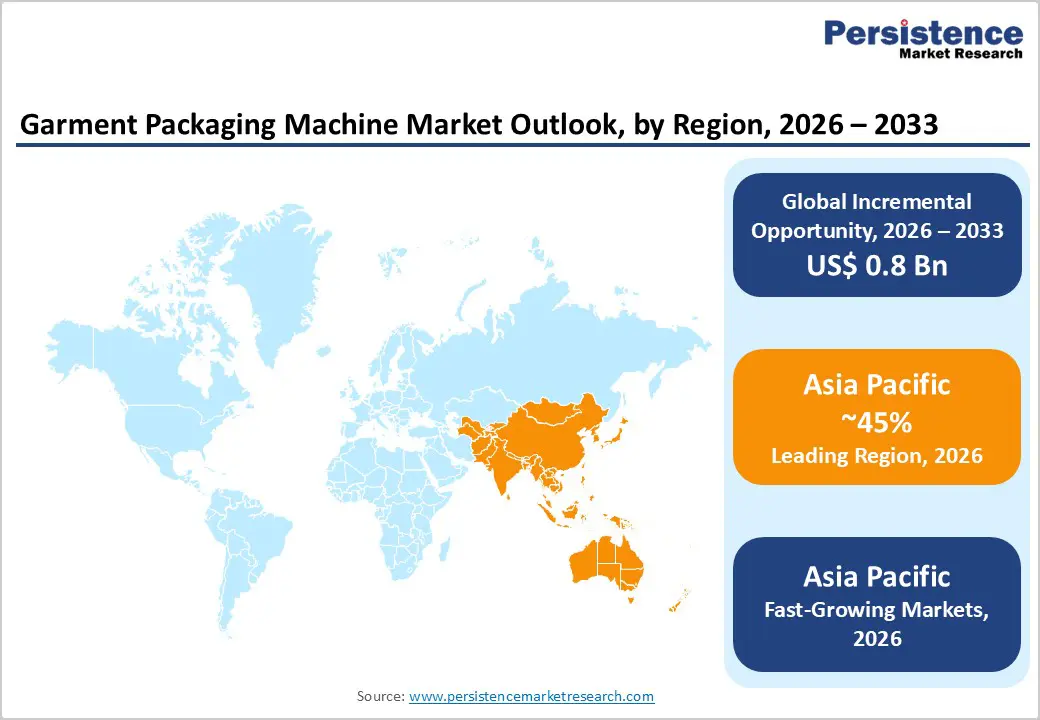
Asia Pacific dominates the global garment packaging machine market as both the largest and fastest growing regional market, accounting for approximately 45% of total revenue share in 2025 and projected to record the highest regional CAGR during 2026-2033. The region’s dominance is structurally anchored in its role as the world’s preeminent garment manufacturing hub: China, Bangladesh, Vietnam, India, and Indonesia collectively account for over 60% of global apparel exports, according to WTO trade statistics. This concentration of manufacturing activity generates an immense and continuous base demand for garment packaging machinery at every production scale. Chinese domestic manufacturers, including U-Pack Machinery Technology Co. Ltd. and Hangzhou Youngsun Intelligent Equipment Co. Ltd., benefit from both domestic demand and cost-competitive export positioning across emerging markets.
India is witnessing accelerating packaging machinery investment, propelled by the government’s Production Linked Incentive (PLI) scheme for Textiles, attracting INR 10,683 crore (US$ 1.25 billion) in investments and significant export capacity in technical and man-made fiber textiles. STEFAB India Ltd. and other domestic machinery suppliers are scaling to meet growing local factory automation needs. In Vietnam and Bangladesh, rising export ambitions backed by competitive free trade agreements, including Bangladesh’s EU Everything But Arms (EBA) preferential access, are driving factory modernization investments, with garment packaging machinery procurement representing a key component of production line upgrades aimed at meeting international buyer compliance standards.
Competitive Landscape
The global garment packaging machine market exhibits a fragmented competitive structure, featuring a blend of established multinational machinery manufacturers, specialized regional players, and a growing cohort of technology-forward entrants offering smart packaging solutions. Market leaders such as KHS Group, PAC Machinery Group, and CMC Packaging Automation differentiate through broad technology portfolios, global service networks, and deep application expertise across diverse garment categories. Key strategic imperatives include geographic expansion into high-growth Asia Pacific manufacturing markets, development of flexible multi-format machines adaptable to fast-fashion SKU variability, and integration of IoT and AI-powered quality inspection capabilities. Emerging players are increasingly offering modular, subscription-based equipment service models to lower SME adoption barriers and build recurring revenue streams.
Key Developments:
- October, 2025: Yash Textile Machines will unveil its Fully Automatic Roll Packing Machine at ITMA Asia 2025 in Singapore, showcasing next-generation packing automation designed for enhanced efficiency and intelligent fabric handling in modern textile mills.
- May, 2025: Yixun Machinery showcased its latest high-performance warp knitting machines at ITMA 2025, highlighting innovation and advanced textile automation designed to enhance productivity and technical fabric manufacturing.
Companies Covered in Garment Packaging Machine Market
- Neumann Packaging Services LLC.
- U-Pack Machinery Technology Co. Ltd.
- PAC Machinery Group
- KHS Group
- KETE Group Limited & Zhejiang KETE Machinery Co., Ltd.
- Mollers North America Inc.
- Hangzhou Youngsun Intelligent Equipment Co. Ltd.
- STEFAB India Ltd.
- CMC Packaging Automation
- Frain Industries Inc.
- Suntech Industries Inc.
- Vijay Pack Group
- Nexgen Packaging LLC.
- Harry Rosen Inc.
- Audion Elektro BV
- SIPA Packaging Solutions
- Minipack-Torre S.p.A.
- Robopac S.p.A. (Aetna Group)
- Coesia Group (IMA Group)
Frequently Asked Questions
The market is projected to reach US$ 2.5 billion in 2026, driven by global apparel trade growth, automation investments, and rising e-commerce packaging demand.
Growth is fueled by expanding apparel exports, rising labor costs in manufacturing hubs, and increasing automation in response to e-commerce-driven packaging needs.
Asia Pacific leads the market due to its dominance in global garment manufacturing and apparel exports.
Opportunities lie in Industry 4.0 integration, IoT-enabled automation, AI-based inspection, and specialized packaging for sportswear and premium apparel.
The global garment packaging machine market features PAC Machinery Group, KHS Group, CMC Packaging Automation, Hangzhou Youngsun Intelligent Equipment Co. Ltd., U-Pack Machinery Technology Co. Ltd., STEFAB India Ltd., Neumann Packaging Services LLC., Mollers North America Inc.


