




- Medical Devices
- Fertility and Pregnancy Rapid Test Kit Market
Fertility and Pregnancy Rapid Test Kit Market Size, Share, and Growth Forecast 2026 - 2033
Fertility and Pregnancy Rapid Test Kit Market by Product (Pregnancy Rapid Tests, Fertility Rapid Tests), Test Type (LH Urine, FSH Urine, hCG Blood, hCG Urine), Distribution Channel (Pharmacy, Drugstore, Gynecology/Fertility Clinics, E-commerce, Hypermarkets & Supermarkets), and Regional Analysis, 20262033

Fertility and Pregnancy Rapid Test Kit Market Share and Trends Analysis
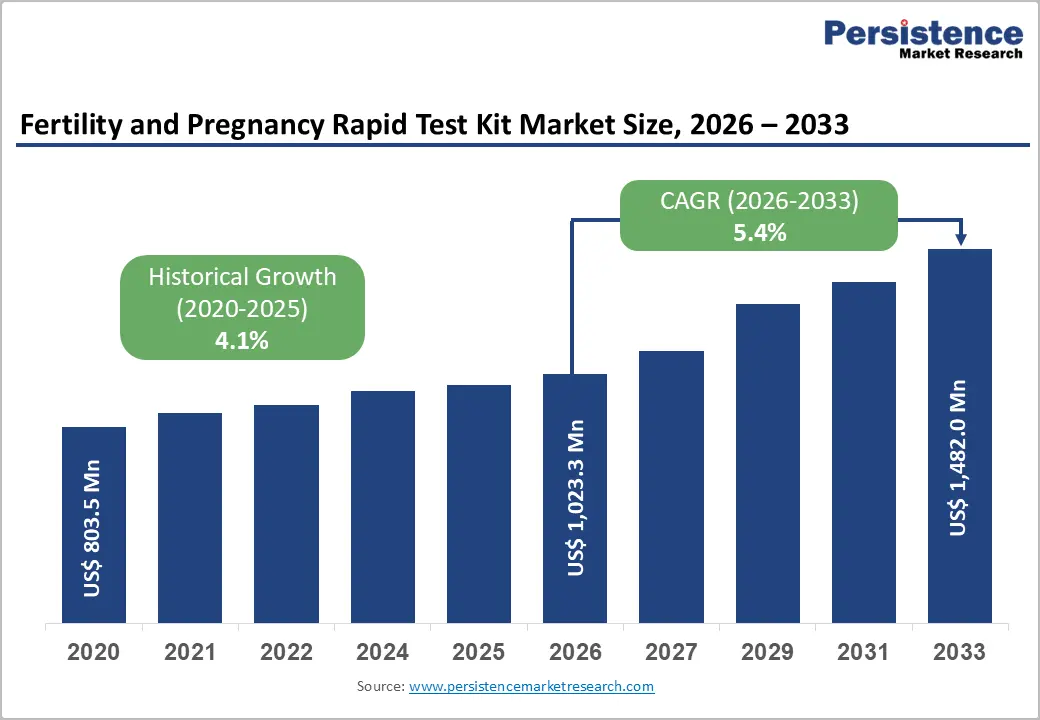
The global fertility and pregnancy rapid test kit market is expected to be valued at US$ 1,023.3 million in 2026 and projected to reach US$ 1,482.0 million by 2033, growing at a CAGR of 5.4% between 2026 and 2033. The market expansion is predominantly driven by escalating delayed pregnancies due to career prioritization and lifestyle changes, coupled with heightened awareness of reproductive health management.
Rising disposable incomes in emerging economies, particularly across Asia Pacific such as India, China, and Japan, are facilitating increased accessibility to fertility testing solutions. Additionally, supportive regulatory frameworks from agencies like the U.S. Food and Drug Administration (FDA) and the European Medicines Agency (EMA) have streamlined device approvals, with the FDA having cleared over 500 CLIA-waived urine hCG devices, significantly reducing market entry barriers and accelerating product innovation cycles for both established players and emerging market participants.
Key Market Highlights
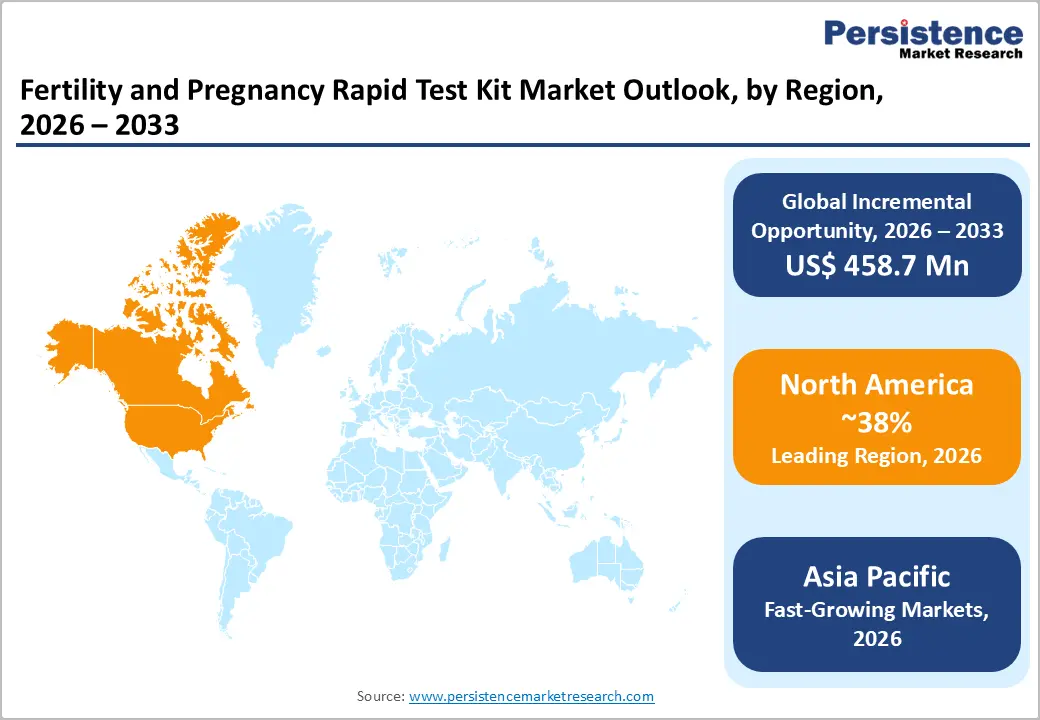
- North America led the market with 38% share in 2025, supported by advanced healthcare infrastructure, strong regulatory support, high reproductive health awareness, and adoption of premium fertility products.
- Asia Pacific is the fastest-growing region, registering 6.17% CAGR through 2030, driven by rising middle-class populations, increasing healthcare spending, government fertility initiatives, and expanding e-commerce access.
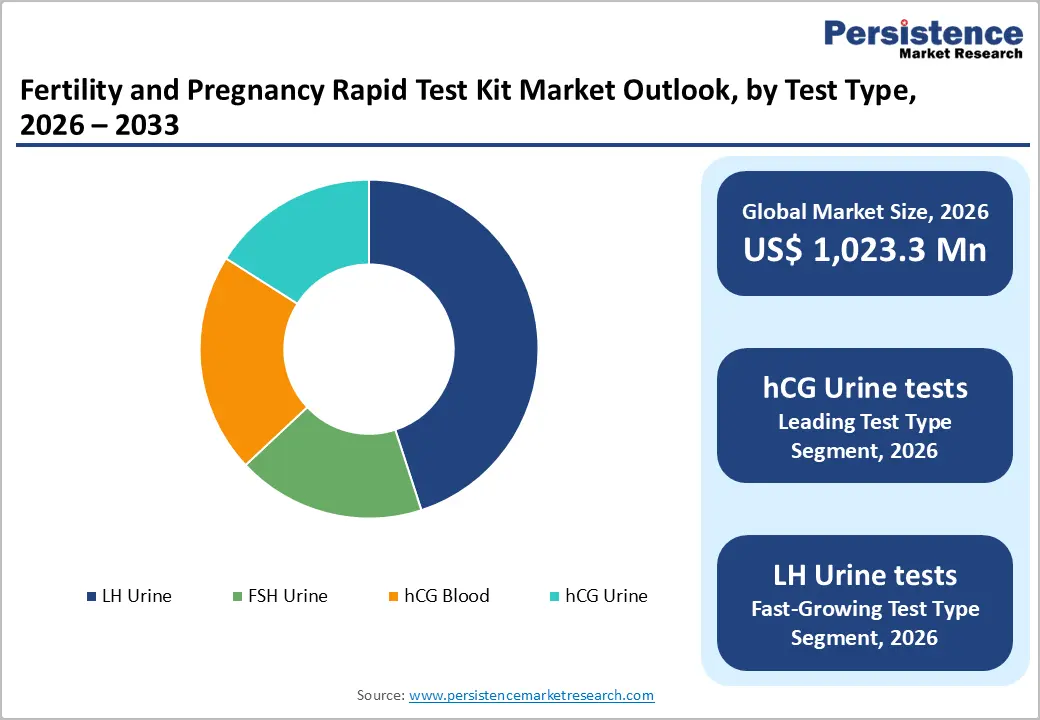
- hCG Urine tests dominated the market by test type with 45% share in 2025, due to high accuracy, ease of use, and widespread regulatory approvals.
- Blood-based hCG rapid tests are the fastest-growing segment, expanding at 5.84% CAGR through 2030, supported by earlier pregnancy detection and recent regulatory advancements.
- Key growth opportunity lies in blood-based rapid tests and digitally integrated fertility solutions offering early detection and personalized cycle tracking.
| Key Insights | Details |
|---|---|
|
Fertility and Pregnancy Rapid Test Kit Market Size (2026E) |
US$ 1,023.3 million |
|
Market Value Forecast (2033F) |
US$ 1,482.0 million |
|
Projected Growth CAGR (2026-2033) |
5.4% |
|
Historical Market Growth (2020-2025) |
4.1% |
Market Dynamics
Drivers - Increasing Delayed Pregnancies and Lifestyle-Driven Fertility Awareness
The demographic shift toward delayed family planning, attributed to career advancement priorities and educational pursuits, has substantially elevated demand for rapid fertility assessment tools. Contemporary women increasingly pursue professional milestones before parenthood, necessitating reliable early-stage fertility testing solutions. According to reproductive health research, this shift has catalyzed heightened interest in ovulation prediction kits and pregnancy detection tests, with FSH urine tests and LH urine tests emerging as critical early-detection instruments capable of identifying fertile windows 1-1.5 days before ovulation. This trend reflects broader societal transformation across developed and developing economies, particularly evident in North American and European markets where delayed first pregnancies have become normative. The convergence of career development aspirations with reproductive autonomy has positioned rapid testing kits as essential wellness tools, expanding market penetration across diverse consumer demographics and driving consistent growth trajectories across multiple distribution channels.
Supportive Regulatory Frameworks and Clinical Validation Advancement
Regulatory harmonization across major markets has emerged as a critical growth catalyst, with government bodies implementing streamlined approval pathways for diagnostic devices. The FDA's classification of hCG test systems as Class II devices requiring 510(k) clearance has accelerated product development cycles, while the European In Vitro Diagnostic Regulation (IVD Regulation) framework actively encourages home-use diagnostic solutions. Clinical validation studies demonstrating accuracy rates exceeding 99% for urine-based hCG tests have strengthened clinician confidence and consumer adoption rates globally. The FDA has documented approvals for over 500 CLIA-waived urine hCG devices, indicating robust regulatory confidence in home-based diagnostics. Furthermore, China's National Health Commission, through targeted healthcare initiatives and investment in reproductive health infrastructure, has expanded accessibility to fertility testing technologies, while India's growing fertility clinic network continues incorporating rapid diagnostic testing into clinical protocols, establishing supportive ecosystems for sustained market growth.
Restraints - Cost Sensitivity and Access Disparities in Emerging Markets
Despite market expansion potential, significant affordability constraints persist in lower-income populations across Latin America, the Middle East & Africa, and South Asia regions. While urine-based hCG tests maintain relatively affordable pricing structures, premium alternatives including blood-based rapid tests and digital ovulation monitors with Bluetooth connectivity and smartphone app integration command substantially higher price points, limiting market penetration in cost-conscious segments. Regulatory compliance requirements and quality assurance standards necessitate significant capital investments, creating barriers for smaller manufacturers and constraining product affordability in emerging markets. Healthcare infrastructure deficiencies in certain regions limit the distribution of specialized fertility clinics, forcing reliance on pharmacy and drugstore channels that may not provide adequate consumer education or proper use guidance to ensure optimal test accuracy and reliability.
Supply Chain Vulnerabilities and Manufacturing Complexities
Supply chain disruptions arising from geopolitical tensions and tariff-induced pressures present substantial operational challenges for rapid test kit manufacturers. The U.S.-China tensions have incentivized manufacturing capacity buildout in alternative regions, while India and Taiwan are enhancing cross-border collaborations to mitigate supply chain vulnerabilities.
Complex manufacturing processes for blood-based rapid tests, requiring specialized biohazard handling protocols and regulatory compliance with clinical laboratory standards, have constrained production scalability. Additionally, biosimilar HCG development faces regulatory approval pathways that are 3-5 years longer than those for conventional diagnostics, creating substantial time-to-market delays and innovation bottlenecks that restrict the competitiveness of new entrants and market diversification.
Opportunity - Blood-Based Rapid Testing and Early Detection Technologies
Blood-based hCG rapid tests represent the fastest-growing segment within the market, expanding at a 5.84% CAGR through 2030, driven by superior early-detection capabilities enabling pregnancy identification 6-10 days prior to conventional urine-based methods. Recent developments including Atomo Diagnostics and NG Biotech's CE-marked blood-based kit (2024), targeting professional and subsequent home-use markets, demonstrate expanding commercialization momentum.
Finger-stick blood collection technologies, while currently facing regulatory scrutiny and consumer comfort barriers, position blood-based solutions as complementary diagnostic tools rather than replacements, thereby expanding the clinical toolkit for obstetricians and telefertility platforms. FDA clearance, anticipated following successful clinical validation studies, could catalyze substantial market share migration from the urine hCG oligopoly, with early-detection benefits resonating particularly among fertility-focused couples pursuing assisted reproductive technologies. Market penetration in professional settings (fertility clinics, gynecology clinics) represents an immediate opportunity, with subsequent scaling toward home-use applications as consumer acceptance and regulatory clarity expand.
Digital Integration and Smartphone-Connected Fertility Monitoring
Technological convergence, integrating Bluetooth connectivity, smartphone app integration, and cycle tracking functionality represents a significant growth frontier, particularly within North American and European markets demonstrating robust digital health adoption. The FDA's 2024 approval of the AVA fertility tracking wearable device and subsequent authorization of Inito Fertility Monitor (November 2024), featuring smartphone connectivity and dual-hormone measurement (estrogen and luteinizing hormone), exemplify accelerating innovation in digital reproductive health solutions. These technologically advanced platforms enable identification of an extended fertility window and personalized cycle analytics, appealing to digitally native consumer segments and healthcare providers who are integrating digital biomarkers into clinical protocols.
Asia Pacific is projected as the fastest-growing region, driven by rising disposable incomes and e-commerce logistics expansion alongside high internet penetration, positions digital-enabled solutions as critical market differentiation strategies. Strategic partnerships between diagnostic manufacturers and digital health platforms, coupled with healthcare system integration initiatives, create sustained revenue opportunities and competitive moats for innovation leaders.
Category-wise Analysis
Pregnancy Rapid Tests Insights
Pregnancy rapid tests command the dominant market position, capturing approximately 60% market share in 2025, establishing these products as the category-leading segment. The prevalence of home pregnancy testing reflects consumer preference for privacy, convenience, and rapid results availability without clinical intervention requirements. Urine-based hCG pregnancy tests represent the foundational technology, with clinical validation studies confirming accuracy rates exceeding 99% when properly utilized, meeting WHO International Standards and regulatory requirements.
The market dominance reflects several interconnected factors: widespread availability across pharmacy, drugstore, and e-commerce channels; established consumer familiarity spanning decades since FDA-approved commercial introduction in the 1980s; economies of scale maintaining affordability; and CLIA-waiver status eliminating technical expertise requirements. Prestige and ease of use have positioned over-the-counter pregnancy tests as standard reproductive health management tools, with market penetration extending across diverse socioeconomic strata within developed markets and expanding rapidly within emerging economies, driven by rising healthcare awareness and educational attainment among women consumers.
Test Type Insights
hCG Urine tests represent the market-leading segment by test type, commanding 45% market share in 2025, as documented in regulatory and clinical literature. The urine immunoassay methodology provides optimal balance between diagnostic accuracy, operational simplicity, and consumer accessibility, forming the technological foundation upon which rapid pregnancy detection solutions are constructed. Urine-based hCG tests have demonstrated consistent performance across independent clinical validation studies, with sensitivity and specificity parameters meeting FDA regulatory standards for Class II device classification.
Market dominance derives from multiple validated advantages: CLIA-waiver certification eliminating laboratory processing requirements; minimal sample preparation procedures requiring only in-stream collection capability; stable reagent formulations supporting extended shelf-life and room-temperature storage; and demonstrated user-accuracy rates exceeding 95% in prospective clinical studies.
Quantitative hCG measurement capability enables gestational age estimation, providing supplementary clinical information supporting obstetrician management protocols. The established technology platform, coupled with regulatory clearance for over 500 distinct urine hCG devices, has created substantial competitive barriers while establishing urine-based testing as the categorical standard against which emerging alternative methodologies are evaluated for clinical utility and patient outcomes optimization.
Distribution Channel Insights
Pharmacy and drugstore channels constitute the market-leading distribution segment, commanding 55% share in 2025, reflecting consumer preference for accessible, convenient acquisition points within established healthcare retail environments. Pharmacist consultation availability provides critical consumer education regarding proper test utilization protocols, timing optimization, and result interpretation guidance, addressing significant user-accuracy variables in home-based diagnostic applications. Strategic shelf placement within pharmacy feminine health sections, coupled with over-the-counter availability eliminating prescription requirements, maximizes consumer accessibility while reducing friction within purchase decision processes.
Drugstore networks including major retailers such as CVS, Walgreens, and international pharmacy chains provide nationwide distribution infrastructure supporting consistent product availability across geographic regions. Pharmacist recommendations carry substantial weight within consumer decision-making frameworks, with healthcare provider endorsement serving as critical trust-building mechanisms. E-commerce channels demonstrate rapid expansion at 7.2% CAGR through 2032, driven by millennial and Gen-Z consumer preferences for home delivery and discreet packaging, though pharmacy and drugstore channels maintain category dominance reflecting established retail infrastructure and professional advisory availability.
Regional Insights
North America Fertility and Pregnancy Rapid Test Kit Market Trends and Insights
North America maintains dominant regional positioning, commanding 38% global market share in 2025, anchored by advanced healthcare infrastructure, heightened reproductive health awareness, and substantial consumer spending capacity. The United States market demonstrates particular maturity, with established diagnostic testing culture and widespread over-the-counter hCG test availability reflecting decades of consumer normalization since initial FDA approvals.
Regulatory leadership from the FDA, establishing stringent performance standards and maintaining Class II device classification pathways supporting rapid innovation cycles, has created compelling market entry incentives for diagnostic manufacturers. The Canadian market, governed by Health Canada regulatory frameworks, demonstrates analogous market characteristics with regulatory harmonization supporting cross-border product distribution and streamlined regulatory processes.
Asia Pacific Fertility and Pregnancy Rapid Test Kit Market Trends and Insights
Asia Pacific emerges as the fastest-growing regional market, demonstrating CAGR of 6.17% through 2033, driven by interconnected demographic, economic, and healthcare infrastructure developments. China maintains substantial market volume attributed to the National Health Commission's strategic initiatives addressing declining birth rates through expanded fertility services access and government-sponsored reproductive health awareness programs. The Beijing municipal government decision (June 2023) to include 16 assisted reproductive technology categories within healthcare reimbursement systems has substantially expanded fertility testing service accessibility and demand generation.
Competitive Landscape
The fertility and pregnancy rapid test kit market is moderately competitive and driven by product accuracy, ease of use, pricing, and distribution reach. Market participants focus on improving test sensitivity, reducing result time, and enhancing user-friendly formats such as midstream and strip-based kits. Innovation is centered on early detection capability and multi-hormone testing to support fertility planning. Competition is further shaped by strong private-label presence, wide retail and e-commerce availability, and regulatory compliance requirements. Pricing pressure is evident due to low product differentiation, while brand trust, packaging, and consumer education play important roles in influencing purchasing decisions across both developed and emerging markets.
Key Developments:
- In October 2025, Sapyen launched an at-home male fertility testing kit in the United Kingdom, enabling men to collect a sample at home and send it to a laboratory for analysis. The Australia-based company used its proprietary SPX72 medium to preserve sperm viability for up to 72 hours during transit, allowing accurate testing. Test results were delivered within a few days, improving convenience and access to male fertility assessment.
Companies Covered in Fertility and Pregnancy Rapid Test Kit Market
- Alere Inc.
- Quidel Corporation
- Prestige Brands Holdings, Inc.
- Church & Dwight Co., Inc.
- bioMérieux SA
- Geratherm Medical AG
- Abbott Laboratories
- Procter & Gamble Co.
- DCC Plc.
- Swiss Precision Diagnostics GmbH
Frequently Asked Questions
The global Fertility and Pregnancy Rapid Test Kit market is expected to be valued at US$ 1,023.3 million in 2026.
Primary market demand drivers encompass escalating delayed pregnancies due to career prioritization and lifestyle modifications, heightened awareness of reproductive health management, supportive regulatory frameworks from FDA and EMA, increasing government initiatives promoting fertility services accessibility, and rising disposable incomes in emerging economies facilitating expanded consumer healthcare spending on reproductive diagnostics.
North America maintains the leading regional position, commanding 38% global market share in 2025, driven by advanced healthcare infrastructure, regulatory leadership supporting rapid innovation cycles, heightened reproductive health consumer awareness, and substantial disposable income availability enabling premium product adoption across diverse consumer segments.
Blood-based hCG rapid tests represent the most significant market opportunity, expanding at 5.84% CAGR through 2030, offering superior early-detection capabilities enabling pregnancy identification 6-10 days prior to conventional urine-based methods. Recent CE-marked launches and anticipated FDA clearance, combined with digital integration and smartphone connectivity, position these technologies as primary revenue growth drivers for market participants through 2033.
Leading market participants include Alere Inc., Quidel Corporation, Prestige Brands Holdings Inc., Church & Dwight Co. Inc., Abbott Laboratories, Swiss Precision Diagnostics GmbH, Procter & Gamble Co., bioMérieux SA, DCC Plc., and Geratherm Medical AG.


