




- Animal Feed & Additives
- Aquaponics Market
Aquaponics Market Size, Share, Growth, and Regional Forecast, 2026 to 2033
Aquaponics Market is segmented by Product Type (Vegetables & Fruits, Fish, Herbs, Others), by System (Media-Filled Grow Beds, Nutrient Film Technique, Deep Water Culture, Vertical Aquaponics), by Application (Commercial Farming, Home Production, Research & Education, Others), and by Regional Analysis, 2026 - 2033

Aquaponics Market Share and Trends Analysis
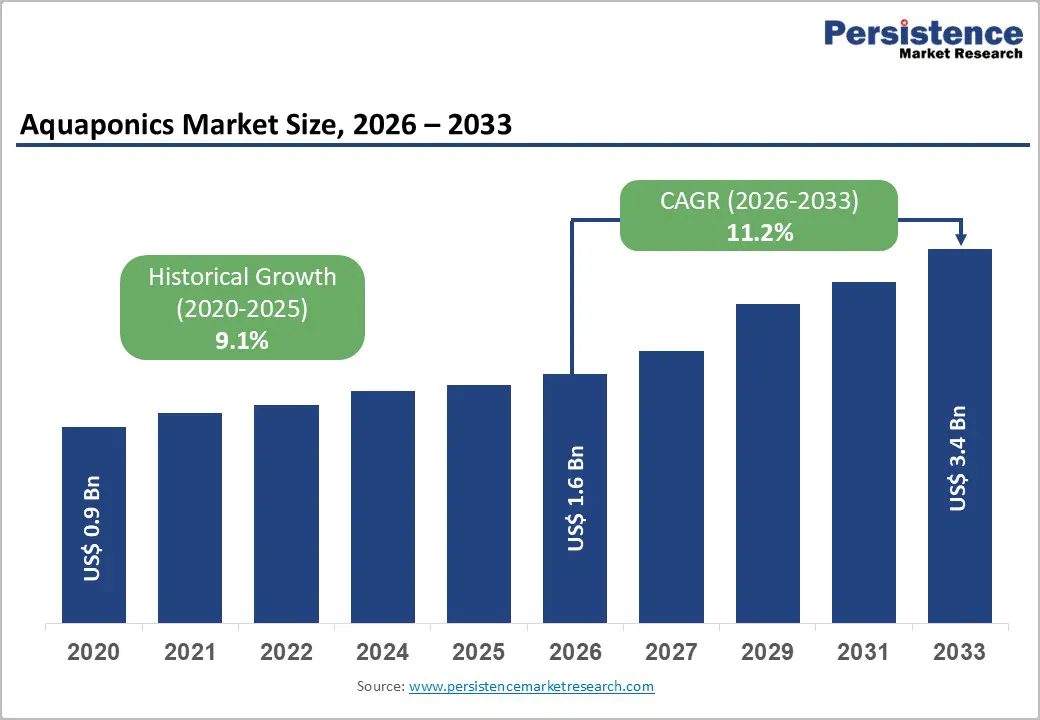
The global aquaponics market size is expected to be valued at US$ 1.6 billion in 2026 and projected to reach US$ 3.4 billion by 2033, growing at a CAGR of 11.2% between 2026 and 2033.
The global market is transitioning from a niche sustainable concept to a scalable agricultural solution driven by resource constraints and technological innovation. As water scarcity, urbanization, and food security concerns intensify, aquaponics is gaining traction as a viable alternative to traditional farming. The convergence of smart farming technologies, controlled environment agriculture, and premium organic demand is reshaping the competitive landscape. With increasing institutional support and private investment, the market is evolving toward efficiency, automation, and commercialization. This transformation is positioning aquaponics as a critical pillar in the future of resilient food systems.
Key Industry Highlights:
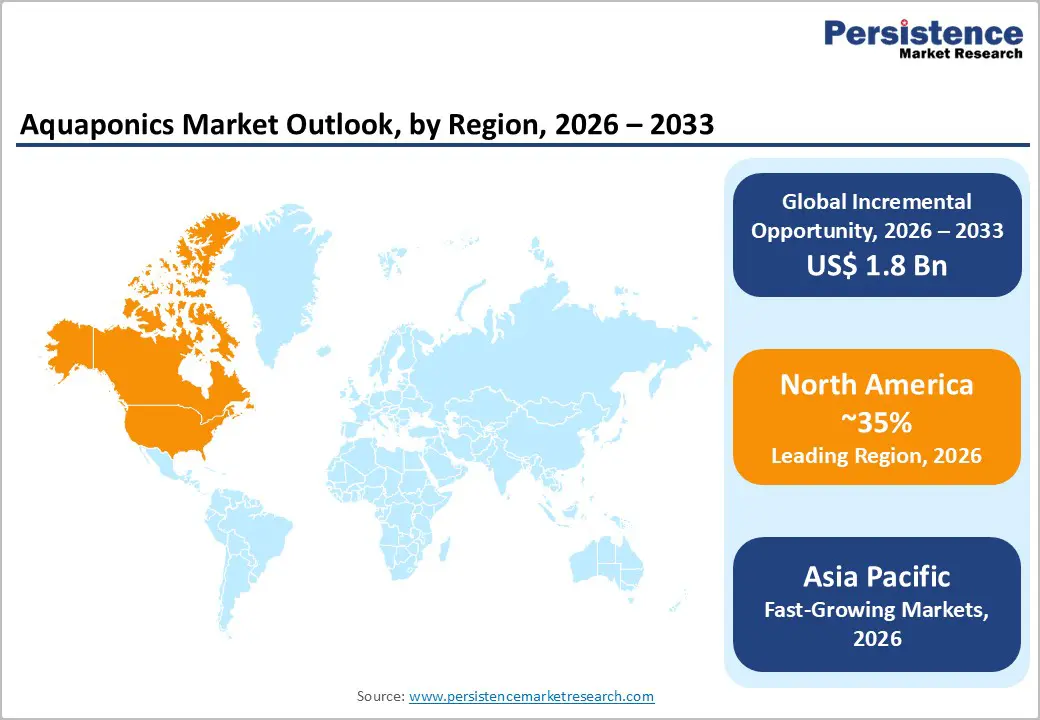
- Leading Region: North America, holding ~35% market share, driven by advanced agri-tech infrastructure, strong consumer demand for organic produce, and increasing adoption of controlled environment agriculture
- Fastest-Growing Region: Asia Pacific, fueled by rising food safety concerns, increasing water scarcity, and rapid adoption of sustainable farming practices in countries like China and India
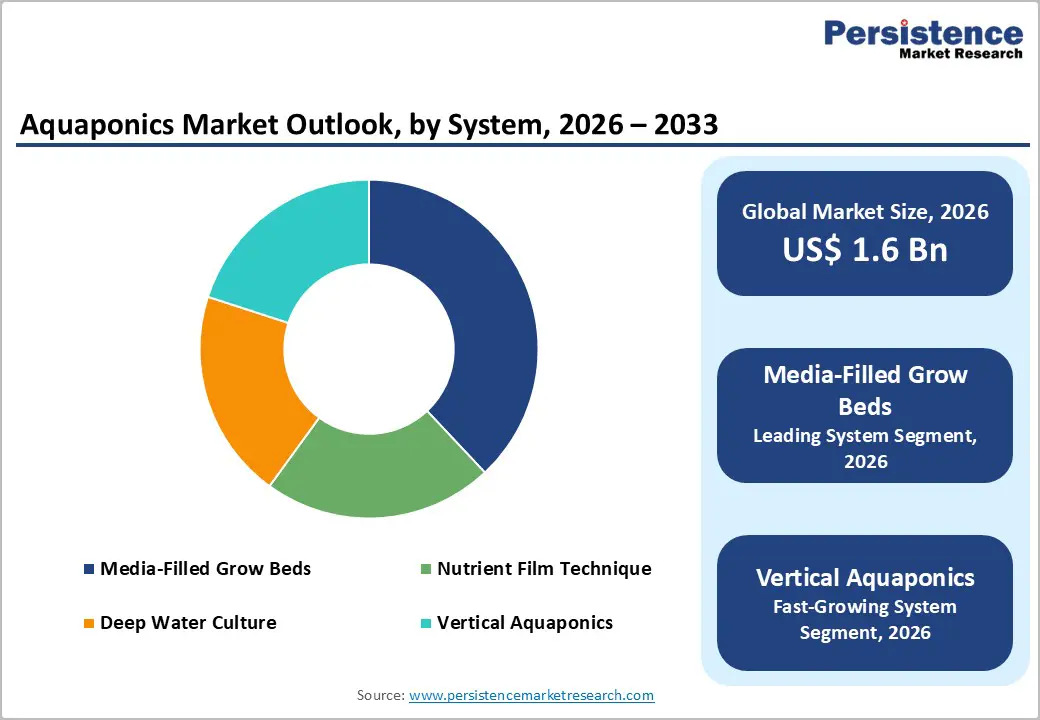
- Leading Product Type Segment: Vegetables & Fruits, driven by high demand for leafy greens and fast-growing crops with efficient nutrient absorption in aquaponic systems
- Growth Indicator: Rising demand for water-efficient and sustainable farming solutions, with aquaponics enabling closed-loop production and reduced dependence on conventional agricultural inputs
- Opportunities: Integration of IoT and AI-driven smart aquaponics systems, enhancing real-time monitoring, automation, and yield optimization for commercial-scale operations
- Consumer Trends: Growing preference for chemical-free, locally grown, and traceable food products, driving demand for aquaponics-based produce in urban markets
- Key Developments: In February 2026, Aquaponics Association partnered with Indoor Ag-Con for a knowledge-focused workshop. In March 2026, HydrOccitanie acquired BiOPONi’s activities, strengthening engineering and training capabilities in sustainable aquaculture systems
| Key Insights | Details |
|---|---|
| Global Aquaponics Market Size (2026E) | US$ 1.6 Bn |
| Market Value Forecast (2033F) | US$ 3.4 Bn |
| Projected Growth (CAGR 2026 to 2033) | 11.2% |
| Historical Market Growth (CAGR 2020 to 2025) | 9.1% |
Market Dynamics
Driver - Rising Demand for Sustainable and Water-Efficient Farming Solutions
The global aquaponics market is primarily driven by the accelerating shift toward resource-efficient agricultural systems amid climate stress and water scarcity. Conventional farming methods are increasingly challenged by declining water availability, pushing growers to adopt integrated solutions that optimize resource utilization. Aquaponics stands out by significantly reducing water consumption through recirculating systems, making it highly suitable for arid and drought-prone regions. This approach supports sustainable food production while minimizing environmental impact, aligning with global priorities around conservation and climate resilience.
Beyond water efficiency, aquaponics offers a closed-loop ecosystem where fish and plant cultivation mutually reinforce productivity. Nutrient-rich fish waste naturally fertilizes crops, eliminating the need for synthetic inputs, while plants help maintain water quality. This synergy enhances yield efficiency and operational sustainability. Companies such as Pentair plc and Nelson and Pade Inc. are advancing scalable commercial solutions, accelerating adoption across large-scale farming operations.
Restraints - High Initial Capital Expenditure and Operational Complexity
A major constraint in the global aquaponics market is the substantial upfront investment and technical complexity associated with system setup and maintenance. Establishing a fully functional aquaponics unit requires capital-intensive infrastructure, including tanks, pumps, filtration systems, climate control units, and monitoring technologies. Unlike conventional farming, these systems demand precise calibration of water quality parameters such as pH, ammonia, and oxygen levels, requiring skilled expertise and continuous oversight. Operational risks, including system failures or disease outbreaks, can disrupt the delicate biological balance, leading to potential losses. This combination of high capital requirements and specialized knowledge creates entry barriers, particularly for small-scale farmers and emerging market participants, slowing widespread adoption.
Opportunity - Expansion of Vertical Aquaponics in Urban and Industrial Environments
The integration of advanced digital technologies is creating a high-value opportunity in the global aquaponics market. IoT-enabled sensors allow continuous monitoring of critical parameters such as water temperature, pH levels, dissolved oxygen, and nutrient concentration, enabling real-time decision-making. When combined with artificial intelligence, these systems can predict fluctuations, optimize feeding cycles, and automate water circulation, significantly improving operational efficiency. This data-driven approach minimizes human intervention while enhancing system stability, making aquaponics more scalable and commercially viable.
Beyond efficiency gains, smart aquaponics systems are unlocking new business models centered on precision agriculture and remote farm management. AI-powered analytics can identify patterns, reduce resource wastage, and improve yield consistency across production cycles. This is particularly valuable for large-scale commercial farms seeking to standardize output quality. As technology costs gradually decline, the adoption of intelligent farming solutions is expected to expand, allowing producers to achieve higher productivity, lower operational risks, and stronger returns on investment.
Category-wise Analysis
Product Type Insights
The Vegetables & Fruits segment currently holds the dominant position in the market, as leafy greens and tomatoes are the most grown crops due to their rapid nutrient absorption. However, the Fish segment is a vital component, with species like Tilapia, Trout, and Catfish being primary drivers for commercial revenue. Meanwhile, the Herbs segment is experiencing rapid adoption in the HoReCa (Hotel, Restaurant, Cafe) sector, where chefs utilize small-scale aquaponics to ensure a fresh, year-round supply of basil, mint, and cilantro. The diversification into high-value specialty crops, such as medicinal herbs and exotic fruits, is expected to enhance the profitability of aquaponics systems over the forecast period.
Application Insights
The Commercial Farming segment stands as the leading application for aquaponics, as large-scale operators seek to capitalize on the premium market for organic produce. These facilities utilize industrial automation to compete with traditional agriculture on volume and consistency. On the other hand, the Research & Education sector is emerging as a critical growth area. Universities and governmental organizations are increasingly utilizing aquaponics to study sustainable ecosystems and teach biology and chemistry in schools. The Home Production segment also remains a massive volume mover, supported by the rising popularity of hobbyist kits and the trend toward household self-sufficiency and food security.
Region-wise Insights
North America Aquaponics Market Trends and Insights
North America leads the global aquaponics market with an estimated 35% share in 2025, supported by advanced technological capabilities and strong consumer preference for fresh, locally produced food. The United States remains the dominant contributor, driven by high awareness of sustainable agriculture and increasing demand for organic produce. The presence of key players such as Hydrofarm Holdings Group and The Scotts Miracle-Gro Company fosters continuous innovation and investment in controlled environment agriculture systems.
Innovation trends in the region are centered on integrating renewable energy sources, including solar-powered systems, to reduce operational costs. Urban farming models are gaining traction in cities like New York and Chicago, while academic institutions are increasingly adopting aquaponics for research and training. In Canada, growth is supported by government-backed sustainability initiatives, rising interest in indoor farming, and increasing demand for pesticide-free food products.
Asia Pacific Aquaponics Market Trends and Insights
Asia Pacific is emerging as the fastest-growing region in the aquaponics market through 2033, driven by expanding middle-class populations across China, India, and Southeast Asia. Increasing concerns around food safety, pesticide residues, and heavy metal contamination are accelerating the shift toward controlled-environment agriculture. At the same time, rising water scarcity across the region is pushing adoption of recirculating farming systems that maximize resource efficiency and ensure sustainable food production.
The region also benefits from cost-effective manufacturing and favorable government support for agricultural modernization. In China, large-scale urban farming initiatives are gaining momentum, while digital platforms like Alibaba Group are expanding market access for premium produce. Japan continues to lead in precision farming technologies and high-quality production standards, while India is witnessing growing adoption through startups and pilot-scale commercial farms focused on sustainable agriculture.
Competitive Landscape
The aquaponics market shows a moderately consolidated structure at the top, with established players like Pentair plc, Hydrofarm Holdings Group, and Nelson and Pade Inc. holding significant influence through robust distribution networks and advanced R&D capabilities. These companies focus on expanding geographically, improving sensor-based technologies, and acquiring niche urban farming firms to strengthen their market position.
At the regional level, the market remains highly dynamic, supported by emerging startups such as Gotham Greens and Aponic Ltd. that target urban agriculture. Competitive differentiation is driven by energy-efficient system design, precise monitoring technologies, and adherence to organic and safety standards. Additionally, evolving models like Farm-as-a-Service (FaaS) are gaining momentum, enabling companies to provide managed aquaponics solutions to commercial and institutional clients.
Key Developments:
- In March 2026, HydrOccitanie announced the acquisition of BiOPONi’s activities, including its engineering and training services, strengthening its capabilities in sustainable aquaculture systems.
- In February 2026, Aquaponics Association partnered with Indoor Ag-Con 2026 to host a pre-conference workshop, aimed at advancing knowledge-sharing and innovation in controlled environment agriculture and aquaponics.
- In September 2025, Innovasea announced its ongoing collaboration with Forever Young Aquaponics, strengthening efforts to advance sustainable aquaculture systems and integrated fish-plant production solutions.
- In November 2024, Nelson and Pade launched advanced aquaponic systems aimed at simplifying the process of starting aquaponic farms. These systems come with a lower base price and include key components that are often difficult to source, along with detailed assembly and operational manuals, making it easier for new farmers to establish and operate their aquaponic farms.
Companies Covered in Aquaponics Market
- Pentair plc
- Nelson and Pade Inc.
- Hydrofarm Holdings Group
- Village Farms International
- GrowGeneration Corp.
- The Scotts Miracle-Gro Company
- Urban-gro Inc.
- AquaBounty Technologies
- Local Bounti Corporation
- Nature's Miracle Holding
- CubicFarm Systems Corp.
- Gotham Greens Holdings
- Aponic Ltd.
- Others
Frequently Asked Questions
The global aquaponics market is projected to be valued at US$ 0.9 Bn in 2026.
Rising Demand for Sustainable and Water-Efficient Farming Solutions is a major driver of the global Aquaponics market.
The global Aquaponics market is poised to witness a CAGR of 11.2% between 2026 and 2033.
Expansion of Vertical Aquaponics in Urban and Industrial Environments is a significant opportunity in the Aquaponics market.
Major players in the global Aquaponics market include Pentair plc, Nelson and Pade Inc., Hydrofarm Holdings Group, Village Farms International, GrowGeneration Corp., The Scotts Miracle-Gro Company, and others.


