




- Hardware & Software IT Services
- Accounting Educational System Market
Accounting Educational System Market Size, Share, Trends, Growth, Regional Forecasts, 2026 to 2033
Accounting Educational System Market by Educational Model (Financial Accounting, Managerial Accounting, Tax Accounting, Auditing), End-User (Universities & Colleges, Vocational Schools, Continuing Education Institutes, Corporate Training Programs), Technology (Online Learning Platforms, Virtual Classrooms, Interactive Software), and Regional Analysis for 2026-2033

Accounting Educational System Market Share and Trends Analysis
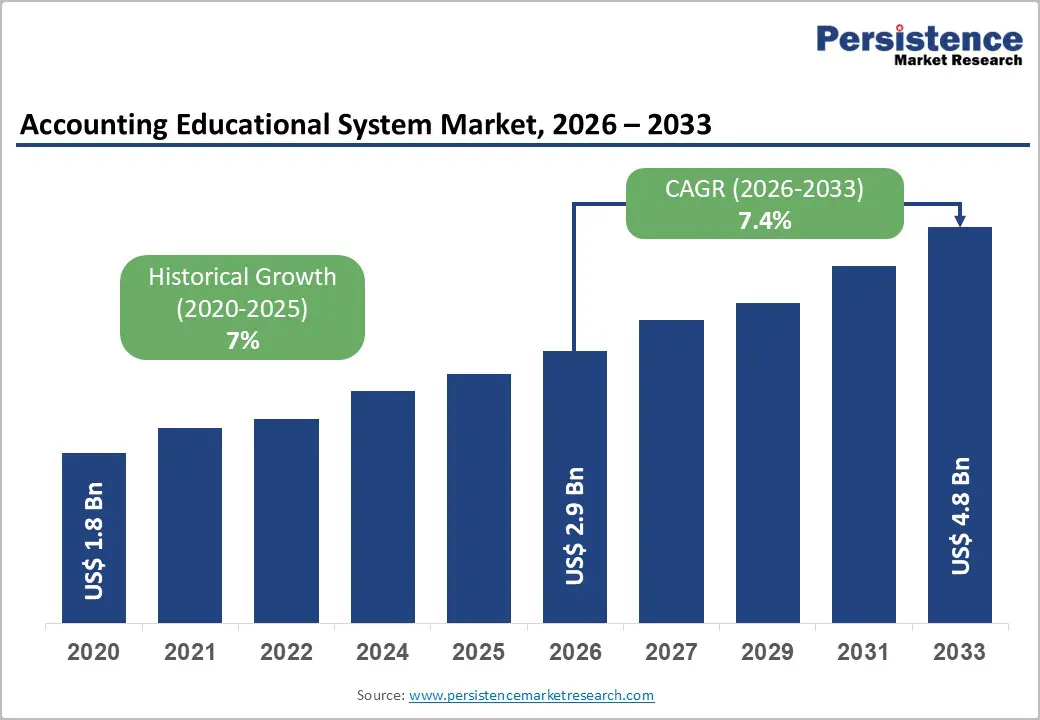
The global accounting educational system market size is likely to be valued at US$ 2.9 billion in 2026, and is projected to reach US$ 4.8 billion by 2033, growing at a CAGR of 7.4% during the forecast period 2026−2033.
The market is a segment of the broader education industry that focuses on delivering specialized learning resources related to accounting concepts, standards, and professional practices. It serves a diverse audience that includes students, working professionals, educational institutions, and organizations seeking to strengthen their accounting knowledge and financial management skills. As financial regulations continue to evolve and financial literacy becomes increasingly important, the demand for structured and comprehensive accounting education is steadily rising. This growing demand is encouraging innovation and increasing competition among providers in the market.
Key Industry Highlights
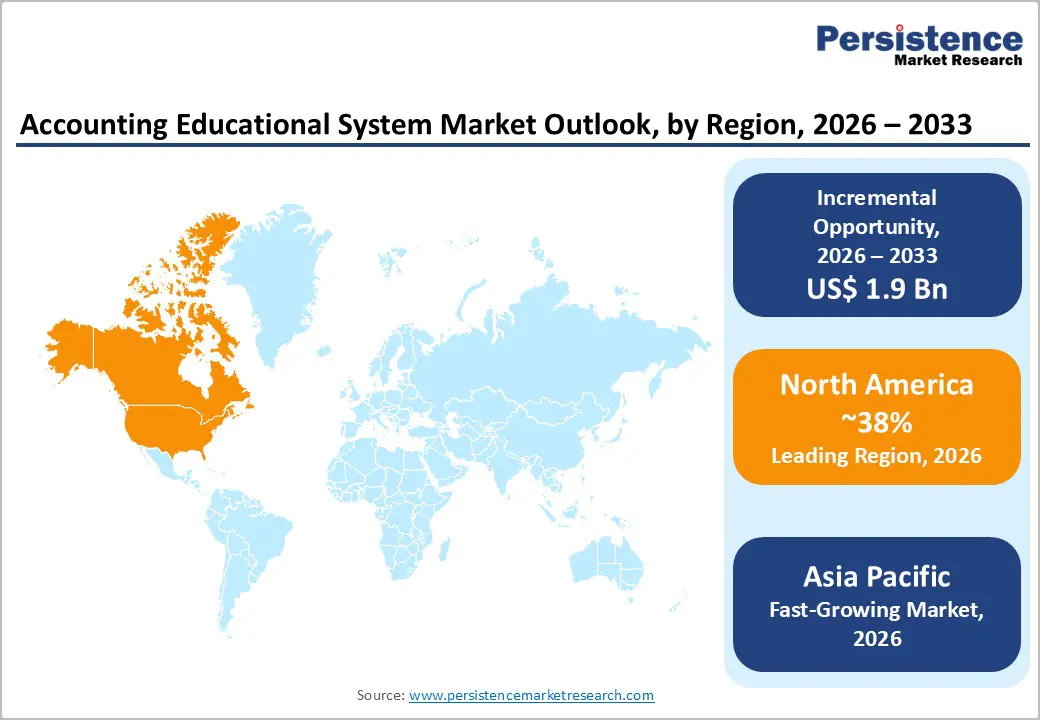
- Dominant Region: North America is expected to command roughly 38% market share in 2026, supported by well-established ecosystem of Certified Public Accountant (CPA) exam preparation providers.
- Fastest-growing Region: The Asia Pacific market is likely to be the fastest-growing during the forecast period, due to the expanding student populations, supportive government policies, and rapid adoption of digital learning tools.
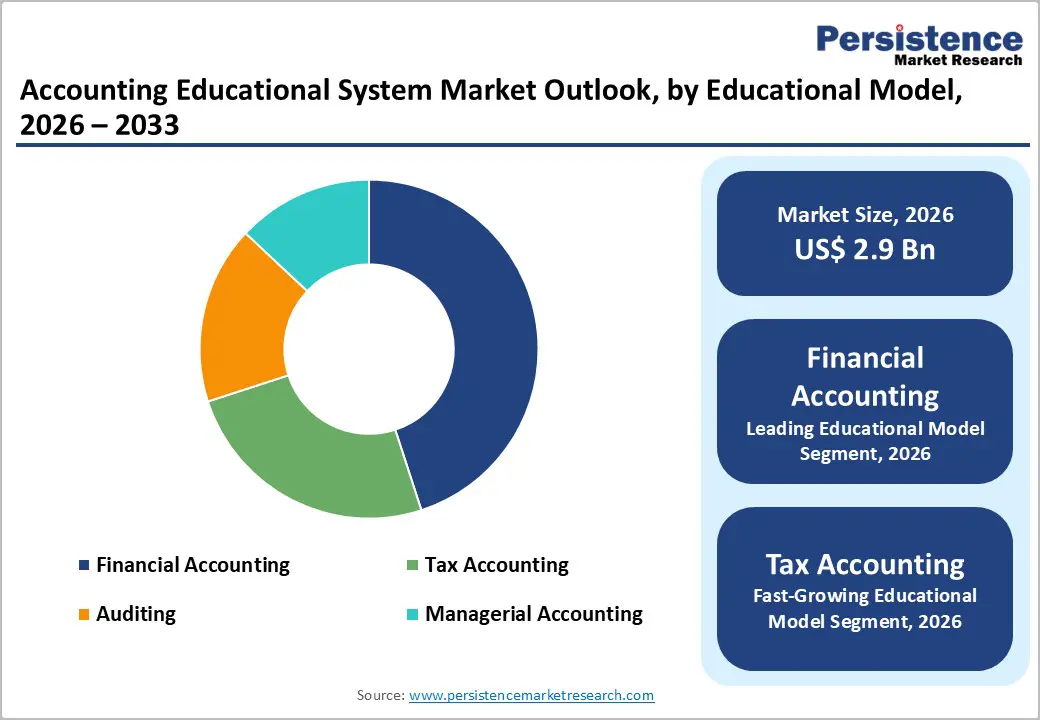
- Leading & Fastest-growing Educational Model: Financial accounting currently dominate the segment, commanding approximately 42% of total market revenue, while tax accounting is set to be the fastest-growing segment during the 2026-2033 forecast period.
- Leading & Fastest-growing End-User: Universities & colleges represent the dominant end-user segment, capturing approximately 48% of market revenue share in 2026, whereas corporate training programs are expected to be the fastest-growing segment over the 2026-2033 forecast period.
- March 2026: Edraak officially debuted a new course, "Accounting Essentials for Non-Accountants," supported by the GSR Foundation, to equip non-specialists with core accounting knowledge and strengthen financial literacy across the Arab world.
| Key Insights | Details |
|---|---|
|
Accounting Educational System Market Size (2026E) |
US$ 2.9 Bn |
|
Market Value Forecast (2033F) |
US$ 4.8 Bn |
|
Projected Growth (CAGR 2026 to 2033) |
7.4% |
|
Historical Market Growth (CAGR 2020 to 2025) |
7% |
DRO Analysis
Accelerating Digital Transformation in Education
Global investment in education technology is continuing to reshape the learning ecosystem. Institutions across the world are increasingly integrating digital tools into academic delivery to improve accessibility, engagement, and learning outcomes. Universities and professional training providers are expanding online and hybrid learning environments that allow students to access accounting education through flexible and technology-driven platforms. This shift is strengthening the role of digital infrastructure in curriculum design and is encouraging institutions to modernize teaching methods. Educational organizations are adopting interactive learning solutions such as virtual classrooms, cloud-based collaboration platforms, and adaptive learning systems to support continuous skill development. Policymakers and regulators are also supporting this transformation by promoting digital literacy initiatives and workforce development programs.
Government agencies are funding programs that are encouraging universities and training providers to align accounting education with evolving professional requirements. These initiatives are strengthening the integration of technology into professional education and are improving access to advanced learning resources across both developed and emerging economies. Professional bodies are collaborating with technology companies to build platforms that replicate real financial environments and regulatory frameworks. As these collaborations continue expanding, accounting education providers will have strengthened their ability to deliver experiential learning and career-oriented training. This transformation is steadily preparing future accountants to operate within complex financial systems while improving analytical capability, regulatory awareness, and technology readiness.
AI and Adaptive Learning Technologies
Growing investment in artificial intelligence (AI) technologies is accelerating innovation in digital learning environments across the education sector. Developers are actively designing intelligent educational platforms that are improving how students interact with complex subjects. In accounting education, artificial intelligence driven systems are enabling personalized instruction that adapts to the progress, strengths, and weaknesses of individual learners. These platforms are continuously analyzing student performance data and are adjusting learning pathways to improve concept retention and comprehension. Adaptive learning tools are presenting customized practice questions, targeted feedback, and structured learning modules that are supporting efficient knowledge development. Universities and professional training organizations are adopting these technologies to strengthen curriculum effectiveness and improve learning outcomes.
Major educational publishers and professional training providers are actively embedding intelligent automation within accounting learning solutions. Companies are incorporating artificial intelligence-based question banks, predictive analytics systems, and automated assessment grading tools to improve training efficiency and evaluation accuracy. AI-enabled systems are supporting instructors by simplifying assessment processes while also generating detailed insights into learner performance. These capabilities are helping institutions maintain consistent academic standards while reducing administrative workload for educators.
Shortage of Qualified Instructional Designers and EdTech Talent
Developing and maintaining high quality accounting education content is requiring a combination of specialized skills that are not widely available in the workforce. Effective learning materials are demanding deep knowledge of accounting standards, strong instructional design capability, and the technical expertise required to integrate content into digital learning platforms. Instructional designers are working closely with subject matter experts, software developers, and academic institutions to create structured learning programs that are supporting both conceptual understanding and practical skill development. When institutions are unable to refresh learning resources quickly, students and professionals risk studying outdated practices that do not fully reflect current financial compliance requirements.
The shortage of interdisciplinary talent is also limiting the global scalability of accounting education platforms. Vendors are attempting to expand their reach into diverse international markets, but effective localization is requiring more than direct translation. Content developers are needing to adapt training materials to different accounting standards, regulatory systems, and cultural learning preferences. For example, educational modules are needing alignment with frameworks such as International Financial Reporting Standards (IFRS) and region-specific taxation guidelines. Digital platforms are requiring technical customization to support multilingual interfaces and regionally relevant case studies. Without sufficient skilled professionals, many providers are struggling to build localized content at the pace required for international growth.
High Implementation and Licensing Costs
Enterprise grade accounting education platforms are requiring significant financial investment from educational institutions. Licensing agreements for advanced digital learning systems are often placing heavy pressure on institutional budgets, especially for smaller colleges and universities operating with limited funding. Many institutions are attempting to modernize their accounting programs by adopting digital learning environments, but the high cost of enterprise software solutions is slowing adoption. Institutions in emerging economies are facing the greatest challenges because their education budgets are often focused on basic infrastructure and faculty development. Administrators are carefully evaluating the return on investment before committing to long term technology contracts. This financial barrier is limiting the speed at which many institutions are transitioning toward technology enabled accounting education models.
Beyond licensing expenses, the total cost of ownership is continuing to rise due to supporting infrastructure requirements. Modern accounting learning platforms are requiring stable high bandwidth internet connectivity, updated computer systems, and dedicated technical personnel to manage system integration and maintenance. Many institutions are currently upgrading digital infrastructure to support these advanced platforms, but progress is uneven across regions. Universities in large metropolitan areas are gradually building the required technology ecosystems, while institutions in secondary and tertiary cities are still addressing fundamental connectivity and hardware limitations. These constraints are restricting market penetration for accounting education technology providers and are slowing the expansion of digital learning systems into developing academic markets.
Corporate Learning and CPD Platforms
The global shift toward mandatory continuing professional development (CPD) frameworks is creating consistent, subscription-based revenue opportunities for accounting education providers. Organizations in more than forty jurisdictions are requiring accountants to complete ongoing professional training to maintain licensure and certification. Education companies are designing scalable learning solutions that ensure compliance with these regulatory standards while supporting skill development in areas such as financial reporting, auditing, and taxation. Corporations are also prioritizing internal training programs for accounting professionals, recognizing that well trained staff improve operational efficiency and regulatory adherence. Firms such as Deloitte, KPMG, and PwC are increasingly investing in branded accounting education for employees, creating high demand for platforms that can deliver structured, enterprise level learning experiences.
The corporate learning management system sub segment is continuing to grow faster than broader accounting education markets because organizations are seeking customizable, compliance focused modules that can be deployed at scale. Providers are integrating features such as automated tracking of course completion, performance analytics, and adaptive learning pathways to meet enterprise needs. These capabilities are allowing companies to manage workforce training efficiently while ensuring adherence to regulatory requirements. Education technology firms that will have developed flexible, enterprise ready platforms will be strengthening their ability to capture long term, high margin contracts and deliver measurable impact for corporate clients, making them preferred partners for large organizations investing in professional development.
Micro-Credential and Short-Course Proliferation
The global adoption of micro-credentials in professional education is driving significant innovation in accounting training. Providers are designing short, focused learning programs that deliver specific skills and knowledge in areas such as IFRS, forensic accounting, sustainability accounting, and digital finance. These programs are allowing learners to acquire targeted expertise without committing to full degree programs, making accounting education more accessible and flexible. Platforms offering stackable, employer recognized badges are enabling students to build cumulative credentials over time, demonstrating competency to employers in a clear and verifiable format.
This approach is expanding the reach of accounting education beyond traditional institutional channels and is attracting a growing audience of non-traditional learners, including career changers, small and medium enterprise (SME) owners, and gig economy professionals seeking specialized skills. Accounting micro-credentials are also creating new opportunities for providers to capture previously untapped retail learner segments. Institutions are developing modular curricula that allow students to combine multiple badges into a coherent learning pathway, supporting continuous professional development and career advancement. Technology platforms are integrating features such as interactive exercises, digital assessments, and personalized progress tracking to enhance engagement and learning outcomes. Employers are increasingly recognizing these credentials as credible indicators of applied accounting knowledge, which is encouraging more professionals to pursue them.
Category-wise Analysis
Educational Model Insights
Financial Accounting currently dominate the segment, commanding approximately 42% of total market revenue, due to its foundational role in preparing students and professionals for reporting, compliance, and auditing functions. It forms the core of most undergraduate and professional accounting programs, covering principles of recording, summarizing, and presenting financial information. Institutions and training providers continue prioritizing financial accounting courses because regulatory bodies and employers require strong proficiency in this area. The segment is benefiting from digital tools, but its growth rate is stable as it already represents the largest share of accounting education offerings.
Tax accounting is likely to be the fastest-growing segment during the 2026-2033 forecast period, driven by increasingly complex domestic and international tax regulations. Professionals and learners are seeking specialized knowledge to manage corporate and individual tax obligations, optimize planning, and comply with regulatory frameworks. Online platforms and micro-credential programs are accelerating adoption, offering flexible and targeted modules covering tax law updates, digital tax tools, and jurisdiction-specific requirements. The segment is expanding rapidly because both corporations and individual learners recognize the direct financial impact of tax expertise and the high demand for certified, skilled tax professionals.
End-User Insights
Universities & colleges represent the dominant end-user segment, capturing approximately 48% of market revenue share in 2026, because they provide the foundational and professional pathways for students pursuing accounting careers. They offer degree programs covering financial accounting, managerial accounting, auditing, and taxation, forming the core curriculum for future professionals. These institutions are continuing to adopt digital learning platforms, hybrid programs, and AI-assisted tools to enhance teaching efficiency and learning outcomes. Their established reputation, accreditation, and structured programs ensure sustained enrollment, making this segment the largest and most stable in the accounting education market.
Corporate training programs are expected to be the fastest-growing segment over the 2026-2033 forecast period. Organizations are investing in upskilling employees in areas such as compliance, financial analysis, auditing, and tax management. The demand for CPD and customized learning modules is driving growth, with companies seeking AI-assisted, simulation-based, and micro-credential programs for workforce training. Digital learning platforms and enterprise learning management systems are enabling scalable delivery, making corporate programs more efficient and measurable. As businesses prioritize regulatory compliance and talent development, this segment is expanding rapidly and capturing new high-margin opportunities for providers.
Regional Insights
North America Accounting Educational System Market Trends
North America is set to command a significant portion of the accounting educational system market share at approximately 38% in 2026. The region is benefiting from a well-established ecosystem of CPA exam preparation providers, accredited accounting programs, and corporate training infrastructure that is supporting workforce skill development. Accounting education providers are actively enhancing digital learning platforms, offering hybrid and online courses to improve accessibility and engagement. The market is being strengthened by ongoing regulatory and professional developments, including the implementation of the revised CPA Evolution exam. These changes are compelling CPA prep providers to continuously update course content, technology platforms, and assessment tools. At the same time, employers are increasingly investing in workforce upskilling programs to address emerging reporting standards, including environmental, social, and governance (ESG) requirements and cryptocurrency disclosures.
The competitive landscape in North America is moderately consolidated, with established players such as Becker Professional Education, Wiley CPA, and Gleim Exam Prep maintaining leading positions. These providers are leveraging their brand recognition and technological investments to deliver high quality, scalable learning solutions. Private equity investment is sustaining mergers, acquisitions, and platform development, enabling new entrants to innovate and offering advanced tools such as adaptive learning systems and AI assisted assessment platforms. As the market continues expanding, providers that will have combined regulatory expertise, technological capability, and flexible delivery models will be strengthening their competitive advantage.
Europe Accounting Educational System Market Trends
Europe is maintaining a strong position in the global accounting education market, driven by established professional qualification frameworks and structured learning pathways. The United Kingdom is emerging as the largest market in the region, supported by globally recognized organizations such as the Association of Chartered Certified Accountants (ACCA), the Institute of Chartered Accountants in England and Wales (ICAEW), and the Chartered Institute of Management Accountants (CIMA). These institutions are creating consistent demand for structured exam preparation systems and CPD programs. Germany and France are also strengthening the market, with Germany integrating digital accounting modules into its dual education system (Berufsausbildung) and France encouraging professional training through frameworks such as the Compte Personnel de Formation (CPF).
Regulatory and policy initiatives are further accelerating digital adoption in accounting education across Europe. The European Union’s Digital Education Action Plan is funding cross-border e-learning infrastructure, supporting institutions in creating interoperable, scalable digital programs. Spanish and Iberian markets are growing rapidly, fueled by fintech employment and demand for practical financial skills. Providers are navigating data privacy regulations such as the General Data Protection Regulation (GDPR), ensuring secure management of learner information while enhancing platform credibility.
Asia Pacific Accounting Educational System Market Trends
Asia Pacific is anticipated to emerge as the fastest-growing accounting educational system market, driven by expanding student populations, supportive government policies, and rapid adoption of digital learning tools. China is accelerating digital transformation in accounting education, with the Ministry of Education integrating digital literacy into all tertiary programs under its 14th Five-Year Education Plan. Universities and training providers are adopting learning management systems (LMS) and simulation platforms at scale to meet new curriculum requirements. India is strengthening blended and online learning pathways for professional courses, supported by the Institute of Chartered Accountants of India (ICAI) and the government’s National Education Policy 2020.
Japan, while mature, is investing in accounting education technology to support International Financial Reporting Standards (IFRS) adoption among listed companies. Providers are leveraging these initiatives to develop adaptive learning platforms, interactive assessments, and AI-assisted analytics that improve skill acquisition and professional readiness. Emerging ASEAN economies such as Vietnam, Indonesia, and the Philippines are rapidly expanding due to young demographics, rising graduate populations, and growing professional services sectors. Regional vendors are using cost advantages and strong local developer ecosystems to create competitively priced, culturally adapted platforms that can scale across multiple countries. These platforms are combining mobile learning, asynchronous modules, and micro-credential programs to broaden accessibility for non-traditional learners.
Competitive Landscape
The global accounting educational system market structure is moderately consolidated, dominated by leading players such as Becker Professional Education, Wiley (CPAexcel), Pearson, Kaplan Financial, and Wolters Kluwer. These players collectively capture 35-40% of the market share. The accounting education market is most concentrated in the CPA and ACCA exam preparation sub-segments, where a few leading providers dominate.
In contrast, the corporate LMS and academic platform segments are more fragmented, with numerous smaller players operating regionally or in niche areas. These segments are currently experiencing active consolidation as mergers and acquisitions (M&A) enable companies to expand their offerings, scale technology platforms, and strengthen competitive positioning. This dynamic is reshaping the overall market structure.
Key Industry Developments
- In March 2026, the ICAI, in collaboration with other professional bodies, announced plans to launch short-term, modular courses to train “Corporate Mitras” as para-professionals supporting micro, small, and medium enterprises (MSMEs) with compliance and financial tasks. These courses will focus on practical, hands-on skills and aim to build a workforce in Tier-II and Tier-III cities.
- In June 2025, the ACCA announced a major redesign of its qualification to align with the evolving role of accountants, emphasizing technology, sustainability, and ethical leadership. The updated structure will introduce fewer exams, integrated employability modules, and stronger focus on digital, data, and strategic skills, with full implementation planned from 2027.
- In June 2025, Becker Professional Education, partnering with the University of Missouri, expanded its Becker Academy with new courses focused on foundational accounting topics, including Financial Accounting Foundations 2 and Individual Tax Foundations. The initiative also introduced a dedicated learning management system with free diagnostic assessments and personalized learning paths, aimed at improving CPA exam readiness and addressing knowledge gaps among candidates.
Companies Covered in Accounting Educational System Market
- Becker Professional Education
- Wiley Efficient Learning
- Pearson PLC
- Kaplan Financial
- Wolters Kluwer CCH Learning
- ACCA Direct Learning
- Thomson Reuters Checkpoint Learning
- Gleim Exam Prep
- Intuit QuickBooks Training
- Sage Group Sage University
- edX 2U Accounting Courses
- Coursera Finance/Accounting
- FutureLearn ICAEW Partnership
- Aptech Limited
- EduPristine Imarticus Learning
Frequently Asked Questions
The global accounting educational system market is projected to reach US$ 2.9 billion in 2026.
Rising demand for skilled accountants amid complex regulations and financial literacy needs is fueling market growth.
The market is poised to witness a CAGR of 7.4% from 2026 to 2033.The market is poised to witness a CAGR of 7.4% from 2026 to 2033.
Expansion into emerging markets via affordable online programs and integration of AI/data analytics into curricula offer high potential, as corporate upskilling and hybrid models gain traction globally.
Becker Professional Education, Wiley (CPAexcel), Pearson, Kaplan Financial, and Wolters Kluwer are some of the key players in the market.


