




- Metalworking & Fabrication
- Servo Press Market
Servo Press Market Size, Share, and Growth Forecast, 2025- 2032
Servo Press Market By Product Type (Crank and Screw), Capacity (Medium (100-500 tons), Large (>500 tons), and Small (<100 tons), End-user Industry (Automotive, Electrical and Electronics, Aerospace, and Others), and Regional Analysis for 2025 - 2032

Servo Press Market Size and Trends Analysis
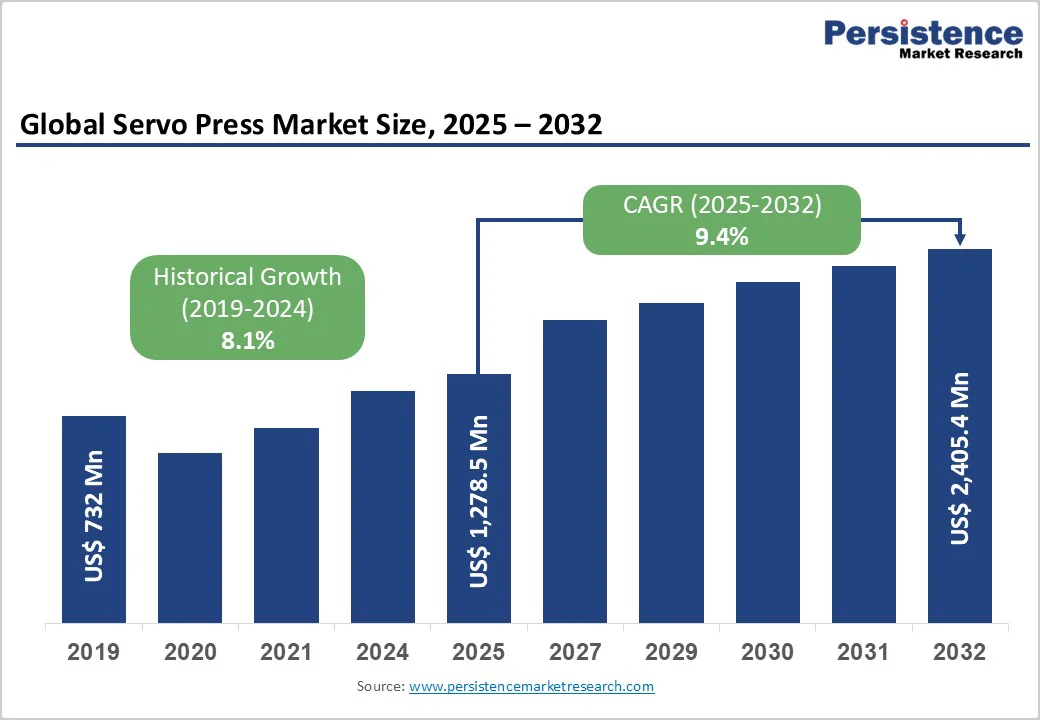
The global servo press market size was valued at US$1,278.5 Million in 2025 and is projected to reach US$2,405.3 Million by 2032, growing at a CAGR of 9.4% between 2025 and 2032, driven by rising demand for lightweight vehicle components, technological advances in industrial automation, and increasing investments in automotive manufacturing across emerging economies.
Automotive and electrical & electronics sectors are driving high-value adoption, supported by Asia Pacific’s robust production ecosystem and global shifts toward energy-efficient, high-precision manufacturing.
Key Industry Highlights:
- Driver: Integration of servo-driven precision, adaptive force control, and Industry 4.0 connectivity is transforming modern manufacturing by enhancing productivity, accuracy, and energy efficiency.
- Opportunities: Rising foreign and domestic investments in automotive and electronics manufacturing, particularly across the Asia Pacific and North America, are fueling large-scale plant expansions and the adoption of advanced forming systems.
- Product Type: Crank-type servo presses account for over 60% of market revenue in 2025 due to their robustness and reliability, while screw-type presses are the fastest-growing segment in precision electronics and medical device manufacturing.
- Capacity Type: Medium-capacity servo presses (100-500 tons) dominate with over 45% share, while large-capacity (>500 tons) presses record the highest growth rate, driven by aerospace and heavy industrial applications.
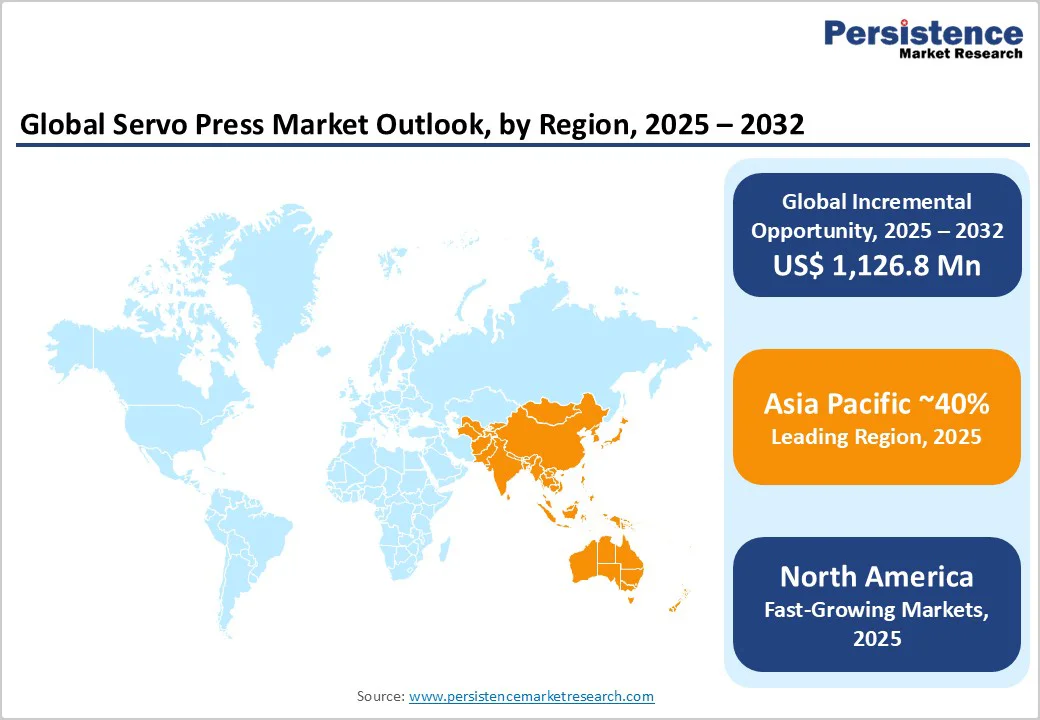
- Leading and the Fastest-growing Region: Asia Pacific leads the global market with over 40% share, driven by strong manufacturing bases in China, Japan, and India, whereas Europe is among the fastest-growing regions, supported by automation, sustainability, and Industry 4.0 initiatives.
- Trends: The servo press market is moderately consolidated, with the top five players accounting for over 60% of revenue. Key leaders such as AIDA Engineering and Schuler AG are advancing through IoT-enabled, energy-efficient presses and smart manufacturing technologies.
| Key Insights | Details |
|---|---|
| Servo Press Market Size (2025E) | US$1,278.5 Mn |
| Market Value Forecast (2032F) | US$2,405.3 Mn |
| Projected Growth (CAGR 2025 to 2032) | 9.4% |
| Historical Market Growth (CAGR 2019 to 2024) | 8.1% |
Market Factors - Growth, Barriers, and Opportunity Analysis
Growth Analysis - Rising Demand for Lightweight Components in Automotive Production
OEMs worldwide are intensifying efforts to reduce vehicle weight to enhance fuel efficiency and comply with stringent emission standards. According to the U.S. Department of Energy, advanced materials are essential for boosting the fuel economy of modern automobiles while maintaining safety and performance.
Lightweight materials such as high-strength steel, magnesium and aluminum alloys, carbon fiber, and polymer composites can cut vehicles’ body and chassis weight by up to 50%, leading to a 6-8% improvement in fuel economy for every 10% reduction in weight.
Using lightweight components and high-efficiency engines enabled by advanced materials could save over 5 billion gallons of fuel annually in one quarter of the U.S. fleet by 2030. Servo presses, offering high precision and energy control, are vital in forming these advanced materials, supporting quality assemblies, and driving the automotive sector’s 45% market share in 2025.
Barrier Analysis: Technological Advancements, Process Optimization, and FDI Growth
Servo press technology is transforming modern manufacturing through precise force control, reduced energy use, and adaptive capabilities aligned with Industry 4.0. Supported by initiatives such as the U.S. Department of Energy’s Advanced Manufacturing Office and Japan’s “Connected Industries,” the adoption of servomotor-driven equipment is accelerating globally. Research from ISO and IEC underscores their advantages in accuracy, speed, and shorter cycle times, fostering widespread adoption across industries.
Rising local and foreign direct investments in manufacturing, particularly in the automotive and electronics sectors across the Asia Pacific and North America, are fueling large-scale plant expansions. Reports by UNCTAD and Invest India highlight multi-billion-dollar inflows into precision stamping and sheet-forming facilities, positioning servo presses as key productivity enablers for high-volume, high-quality production environments.
High Capital Costs and Workforce Shortages Limiting Servo Press Adoption
The market faces notable challenges stemming from high initial investment requirements and supply chain constraints. Servo presses demand substantially higher upfront costs than conventional mechanical or hydraulic models, with unit prices averaging 30-50% higher, according to industrial equipment financing data. These premium limits adoption among small and medium manufacturers that struggle with capital allocation and uncertain return on investment.
Global supply chain disruptions, triggered by U.S.-China trade tensions, semiconductor shortages, and lingering effects of the COVID-19 pandemic, have hindered the timely availability of key components, extending machinery delivery timelines. Compounding this issue is the shortage of skilled professionals in advanced mechatronics, installation, and system maintenance.
Reports from the International Federation of Industrial Associations (IFIA) and the U.S. Census Bureau indicate persistent workforce gaps, making it difficult for manufacturers to implement and operate servo press technologies efficiently. These combined cost and labor challenges continue to restrict wider market penetration despite the technology’s superior precision and energy efficiency.
Opportunity Analysis - Technological Advancements and Sectoral Expansion
The servo press market is witnessing robust expansion driven by rapid industrial digitalization and sectoral diversification across the Asia Pacific, aerospace, and electrical industries.
In the Asia Pacific, surging electronics manufacturing, particularly in consumer electronics and PCB assembly under initiatives such as China’s “Made in China 2025” and India’s Production Linked Incentive (PLI) scheme, is projected to push the market for electronics beyond US$500 million by 2025, with a sustained CAGR above 10% through 2032.
Large-capacity servo presses (>500 tons) are gaining traction in aerospace and electrical sectors due to superior precision and energy efficiency, aligning with IATA and FAA-backed modernization of next-generation aircraft and devices.
The integration with IoT-enabled smart factories is accelerating, enabling predictive maintenance, real-time monitoring, and closed-loop optimization. Supported by programs such as the EU Horizon 2020 and the U.S. NIST smart manufacturing frameworks, digital transformation initiatives are expected to generate over US$300 million in annual revenue by 2032.
Category-wise Analysis
Product Type Insights
Crank-type servo presses dominate the global market in 2025, accounting for over 60% of total revenue share. Their robust structure, consistent force delivery, and superior reliability make them the preferred choice for high-volume automotive manufacturing and strip metal forming applications. Continuous product innovations, improved cycle rates, and global adoption by leading OEMs further reinforce their leadership position across industrial sectors.
In contrast, screw servo presses represent the fastest-growing product segment, projected to record a double-digit CAGR post-2025. Their rise is driven by the increasing need for precision forming in electronics and medical device manufacturing, where lower force requirements and force-controlled operations are essential.
Equipped with advanced technologies such as real-time feedback systems and force sensors, screw servo presses offer enhanced accuracy and process flexibility. This strong performance trajectory highlights an industry shift toward intelligent, application-specific forming solutions that combine speed, control, and energy efficiency across diverse manufacturing domains.
Capacity Insights
Medium-capacity servo presses (100-500 tons) dominate the market, accounting for over 45% of the market share, serving as the backbone of automotive, electronics, and appliance production. Their balanced combination of throughput, flexibility, and cost efficiency makes them the preferred choice for mid-sized manufacturers. Continuous retrofits and technological upgrades further sustain their demand, ensuring optimal productivity across diverse industrial applications.
In contrast, large-capacity presses (>500 tons) represent the fastest-growing segment, expanding at a CAGR exceeding 10%. Their rapid adoption in aerospace, heavy electrical, and large die-stamping operations highlights the industry’s shift toward high-force, precision-intensive forming processes. Significant facility expansions across Asia and North America further accelerate this growth.
Small-capacity presses (<100 tons) occupy a niche but essential role, addressing specialized manufacturing needs in medical devices, jewelry, and precision instruments. Although their market share remains modest, consistent innovation and advancements in compact forming technologies continue to enhance their performance, precision, and operational value across specialized production environments.
End-user Industry Insights
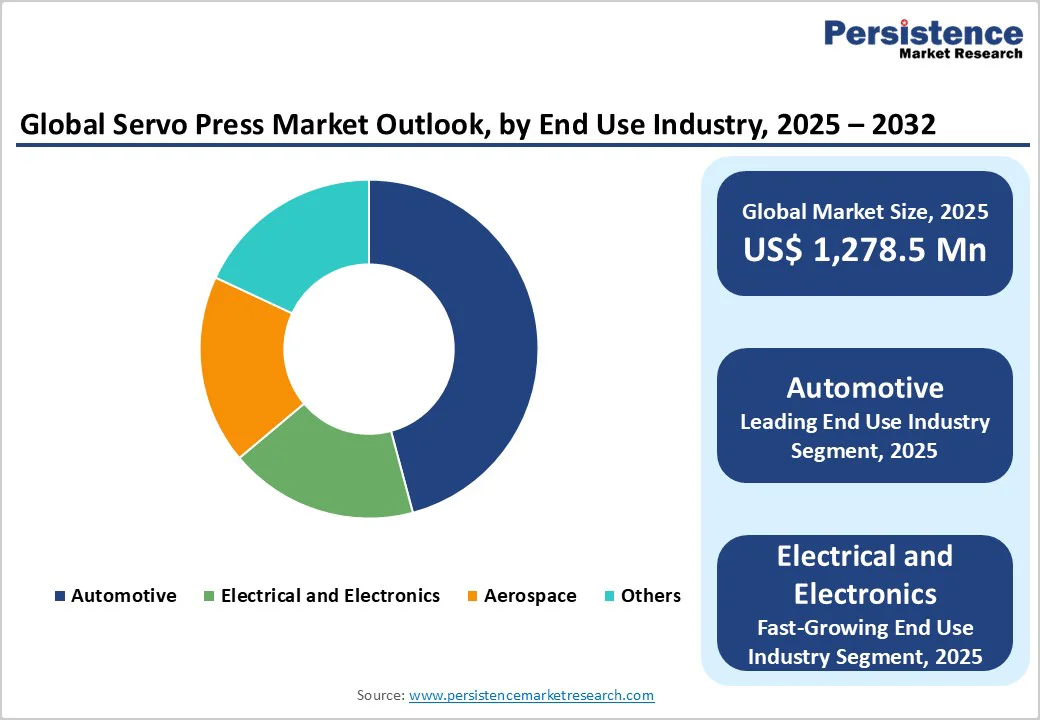
The automotive industry remains the leading end-use sector for servo presses, accounting for over 45% of total market share in 2025. Its dominance is reinforced by the industry’s emphasis on precision forming, lightweighting, and compliance with emission mandates. Continuous demand from new vehicle model launches and shifting consumer preferences further sustain servo press adoption across automotive manufacturing lines.
Meanwhile, the electrical and electronics segment represents the fastest-growing application, fueled by miniaturization, innovation in consumer electronics, and expanding use in precision forming for connectors, enclosures, and PCB assemblies. The segment is anticipated to surpass US$500 million by 2025, reflecting its accelerating momentum.
The aerospace and other industries, including medical, jewelry, and specialty manufacturing, are gradually adopting servo presses for high-precision forming of intricate components. Although their market share remains modest, technological advancements and specialized applications continue to drive steady growth in these niche sectors.
Regional Insights
Asia Pacific Servo Press Market Trends
Asia Pacific is the dominant region, accounting for more than 40% of the global market in 2025, propelled by formidable manufacturing hubs in China, Japan, and India. Outstanding manufacturing advantages, low-cost labor, and regional policy support contribute to sustained growth and the expansion of innovative capacity. China leads sectoral volume, with major investments in electronics and automotive, supported by industry clusters and incentives targeted at precision-forming equipment.
Japan maintains high-quality standards and continuous improvement cycles, leveraging advanced servo-press technology in automotive and electronics component manufacturing. India’s market is rapidly expanding under the “Make in India” initiative and government-backed electronics manufacturing schemes; demand is further bolstered by rising auto production and infrastructure growth. ASEAN nations are accelerating the adoption of appliance and electronics assembly, creating diversified opportunities across micro-assembly presses.
Regulatory landscape in Asia supports rapid adoption, with relatively streamlined certification and incentives (tax breaks, grants) for energy-efficient equipment. Asia Pacific’s competitive landscape is diversified, with domestic manufacturers playing significant roles alongside global leaders. Investment trends reveal ongoing expansions of production capacities, new manufacturing plants, technological upgrades, and international partnerships supporting high growth rates and increasing market penetration.
Europe Servo Press Market Trends
Europe is one of the fastest-growing regions in the market, supported by high automation adoption rates, regulatory harmonization, and a strong focus on sustainable industrial transformation. Growth is underpinned by steady demand in automotive and aerospace manufacturing, combined with strict EU directives that emphasize energy efficiency, safety, and eco-design compliance.
Germany continues to lead regional development, driven by its advanced automotive and machinery sectors, extensive Industry 4.0 integration, and continuous process optimization. The U.K. and France maintain solid growth, supported by electronics and appliance manufacturing, while Spain benefits from an expanding auto component and export-oriented ecosystem.
Public-private R&D collaborations, government incentives, and rising investment in automation retrofits reinforce the regional outlook. European and multinational firms are accelerating technology upgrades, sustainability initiatives, and workforce training, positioning the region as a dynamic hub for high-precision and energy-efficient servo press production.
Competitive Landscape
The global servo press market is moderately consolidated, with the top five players accounting for over 60% of total revenue. Leading manufacturers sustain their dominance through technological differentiation, extensive product portfolios, and strategic alliances across major industrial regions. The competitive landscape comprises both multinational corporations and regional specialists, with success driven by vertical integration, innovation, and superior after-sales support.
Core strategic themes revolve around product innovation, precision engineering, and cost competitiveness. Market leaders are increasingly expanding their range of smart, energy-efficient servo presses, capitalizing on digitalization and cross-industry collaborations to enhance market reach and adoption.
Emerging business models, including subscription-based service platforms and integrated manufacturing analytics solutions, are reshaping competitive dynamics, reinforcing the industry’s transition toward data-driven, sustainable, and high-performance production ecosystems.
Key Industry Developments
- In 2024, AIDA Engineering, Ltd. launched a next-generation servo press system integrated with IoT-based analytics, enhancing remote diagnostics and predictive maintenance capabilities for automotive and electronics applications. The system, introduced through AIDA’s new Data Analytics Platform, leverages cloud-based monitoring and generative AI to optimize performance in real time, with initial adoption reported in Japan and Germany.
- In 2024, Schuler AG advanced its digitalization initiatives by upgrading servo press lines with Industry 4.0-enabled analytics, including IIoT connectivity, drive analytics, and remote process monitoring tools. These upgrades support predictive maintenance and improved energy management across aerospace and automotive manufacturing environments, strengthening Schuler’s automation and control capabilities in Europe.
Companies Covered in Servo Press Market
- AIDA ENGINEERING, LTD.
- Fagor Arrasate
- SIMPAC Corp.
- Chin Fong Machine Industrial Co., Ltd.
- Promess Incorporated
- Nidec-Shimpo Corporation
- Shieh Yih Machinery Industry Co., Ltd.
- Schuler AG
- Komatsu Ltd.
- ISGEC Heavy Engineering Ltd.
- Japan Automatic Machine Co., Ltd.
- Hoden Seimitsu Kenkyusho Co., Ltd.
- Hitachi Zosen Fukui Corporation
- Amino Corporation
- Tox Pressotechnik GmbH & Co. KG.
Frequently Asked Questions
The servo press market is estimated at US$1,278.5 Million in 2025.
The key demand driver for the servo press market is the rising adoption of precision-forming technologies across automotive, electronics, and aerospace industries, driven by the need for high accuracy, energy efficiency, and production flexibility.
In 2025, the Asia Pacific region will dominate the market with an exceeding 40% revenue share in the servo press market.
The crank servo press segment is anticipated to hold the highest preference, capturing over 60% of the market revenue share in 2025.
AIDA ENGINEERING, LTD., Fagor Arrasate, SIMPAC Corp., Chin Fong Machine, Industrial Co., Ltd., and Promess Incorporated are a few leading players.


