




- Retail
- Premium Cigarette Market
Premium Cigarette Market Size, Share, and Growth Forecast, 2026 – 2033
Premium Cigarette Market by Product Type (Flavored, Non-Flavored), Size (Slim, Super Slim, King Size, Regular), Sales Channel (Specialty Stores, Multi-brand Stores, Independent Tobacco Shops, Online Retailers, Others), and Regional Analysis for 2026-2033

Premium Cigarette Market Share and Trends Analysis
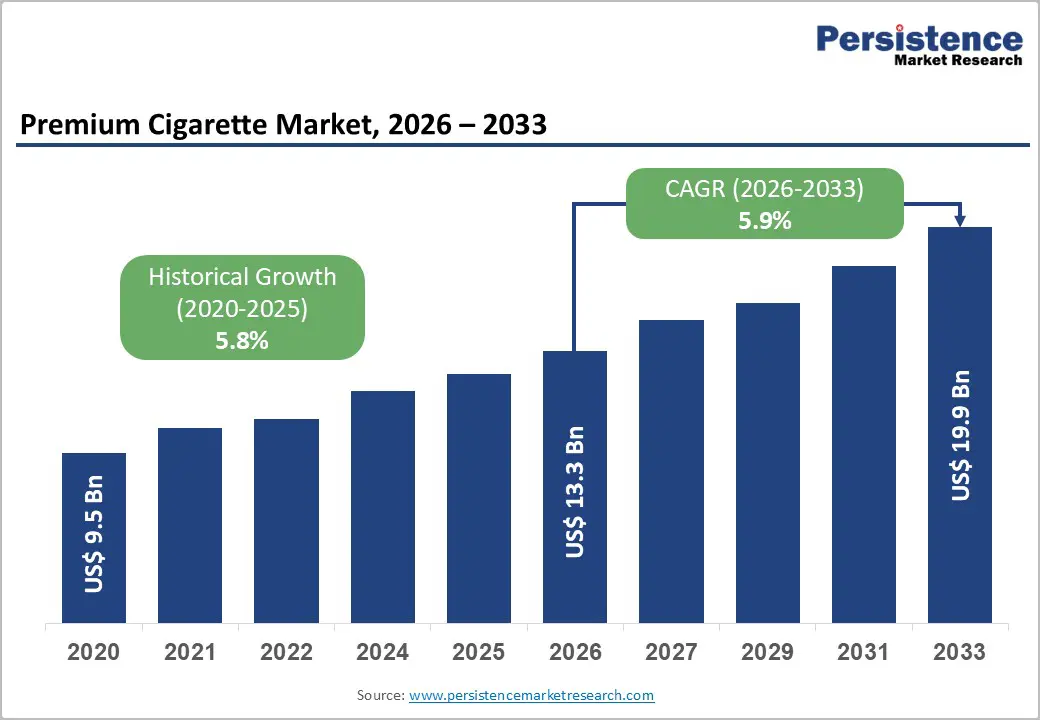
The global premium cigarette market size is likely to be valued at US$ 13.3 billion in 2026, and is projected to reach US$ 19.9 billion by 2033, growing at a CAGR of 5.9% during the forecast period 2026−2033. Market expansion is primarily driven by demographic trends indicating rising adult smoker populations in urban regions, creating a sustained consumer base.
Shifts in consumer preferences toward premium and lifestyle-oriented tobacco products have encouraged manufacturers to introduce innovative product offerings, enhancing adoption rates. Technological integration in manufacturing processes, including precision rolling and flavor infusion, supports consistent product quality, reducing defect rates and increasing consumer trust. Regulatory frameworks in several markets are evolving, allowing controlled premium product marketing, which facilitates retail penetration and brand differentiation. Increased clinical awareness and research on consumer preferences guide companies in optimizing product features and targeted campaigns. Furthermore, robust distribution networks across online and specialty channels enable accessibility to affluent consumers, expanding market reach.
Key Industry Highlights
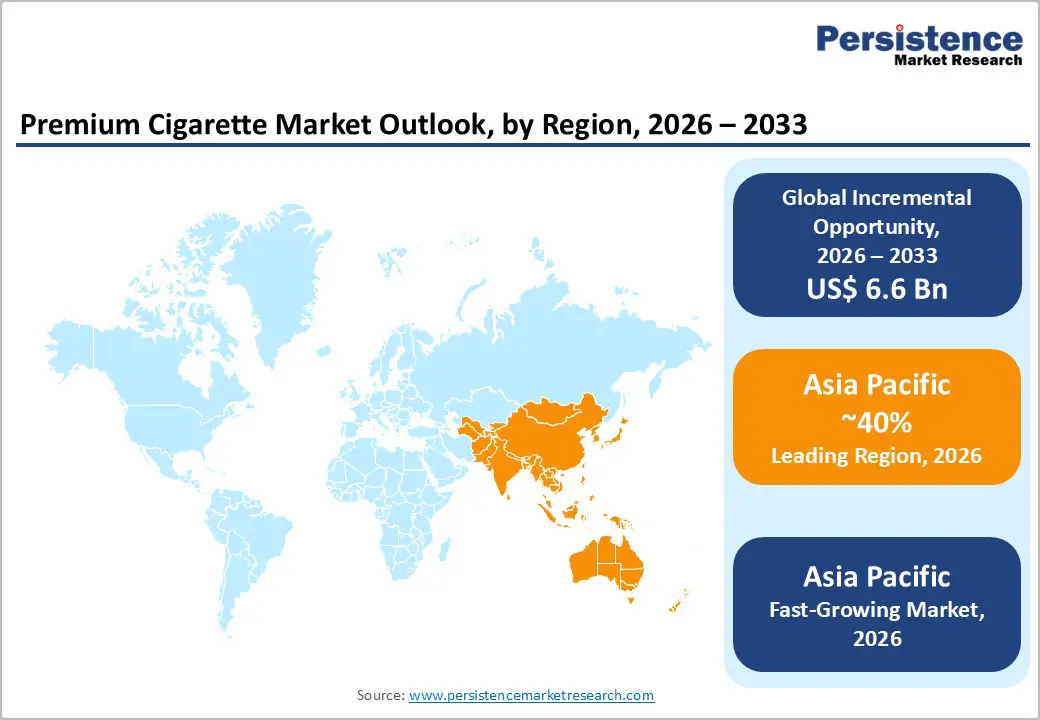
- Dominant Region: Asia Pacific is projected to hold nearly 40% of the market value in 2026, driven by strong tobacco demand, cultural acceptance, and robust retail networks.
- Fastest-growing Market: Asia Pacific is projected to be the fastest-growing market between 2026 and 2033, powered by production efficiencies and widespread adult smoking prevalence.
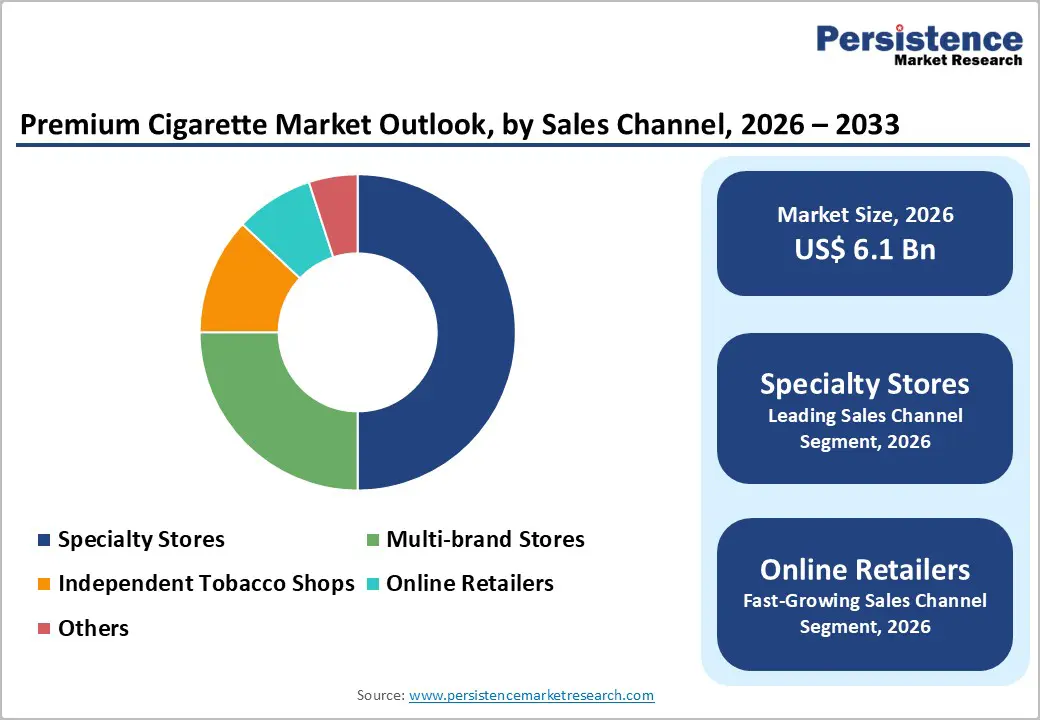
- Leading Sales Channel: Specialty stores are set to lead with nearly 50% market share in 2026, offering curated products, premium shopping experience, and exclusive offerings.
- Fastest-growing Sales Channel: Online retailers are slated to register the highest 2026-2033 CAGR, fueled by expanding e-commerce access, personalized recommendations, and subscription models.
| Key Insights | Details |
|---|---|
|
Premium Cigarette Market Size (2026E) |
US$ 13.3 Bn |
|
Market Value Forecast (2033F) |
US$ 19.9 Bn |
|
Projected Growth (CAGR 2026 to 2033) |
5.9% |
|
Historical Market Growth (CAGR 2020 to 2025) |
5.8% |
Market Factors – Growth, Barriers, and Opportunity Analysis
Urban Affluence and Lifestyle-Oriented Consumption
Affluent consumers display higher discretionary spending, allowing them to allocate a greater portion of income towards non-necessity items that signal status and personal identity. Official health data from the Organisation for Economic Co-operation and Development (OECD) shows that tobacco use remains significant even in high-income countries where daily smoking persists alongside rising living standards, indicating that smoking behaviour is intertwined with lifestyle choices in wealthier segments of the population. Individuals with greater purchasing power have more flexibility to trade up from basic products to premium alternatives that promise perceived quality, exclusivity, or a lifestyle association that aligns with social aspirations.
Higher income also correlates with diversified consumption patterns that go beyond basic needs, allowing affluent groups to indulge in premium and luxury goods as expressions of lifestyle and identity. Economic theory around Veblen goods explains why certain high-end consumer goods, including premium tobacco products, maintain strong demand among wealthier consumers even as average smoking rates decline. Premium cigarette products are often marketed with branding, packaging, and positioning that appeal to these aspirational and image-oriented drivers, making consumption a statement about personal taste rather than a simple habit.
Rising Disposable Incomes and Urbanization
Higher disposable income frees budgetary resources for discretionary purchases that are not strictly essential. Cigarette products, especially higher priced variants, fall into this category since consumers with greater earnings can allocate a portion of income toward lifestyle and brandled purchases instead of prioritizing basic needs such as food and housing. In urban environments where retail access is dense and premium brands are highly visible, this enhanced purchasing capacity translates into a willingness to trade up to products perceived to offer better quality or status. Urban consumers encounter more points of sale, social venues and peer influences that normalize experiential consumption, reinforcing demand for products that signal lifestyle preferences.
Urbanization creates concentrated markets of economic activity, higher wage jobs and diversified retail ecosystems. Cities attract working professionals who typically experience faster income growth and have greater exposure to advertising and global trends, shaping consumption aspirations. Larger urban populations also support a wider retail network and product availability, lowering logistical barriers for premium offerings. As more people live and work in cities with sustained income growth, the intersection of enhanced spending power and lifestyle influences supports elevated demand for higher tier consumer goods among these cohorts.
Stringent Regulatory Frameworks and Taxation
Heavy regulatory frameworks and high taxation directly reduce the affordability and consumption of cigarettes, which in turn restrains demand for premium segments. Governments impose layered taxes such as Goods and Services Tax (GST) plus central excise duties that can push the overall tax burden well above standard levels. In India, from February 1, 2026, cigarettes now attract a minimum 40% GST plus additional excise duty ranging from INR 2,050 to INR 8,500 per 1,000 sticks depending on length, leading to retail price increases of up to INR 50–55 per pack for premium variants. This makes premium cigarettes less financially attractive to smokers compared with lower cost alternatives or reduced risk products, which weakens sales growth and profit margins for manufacturers targeting high end consumers.
Regulations also extend beyond taxation to include mandated health warnings, packaging restrictions and limitations on advertising and point of sale promotions, all designed to discourage tobacco use by informing consumers of health risks. Tight enforcement of these rules raises compliance costs for manufacturers and often requires redesign of product packs and supply processes, which adds operational complexity and expense. Many governments use tax policy as a public health tool, explicitly aiming to lower smoking prevalence by making cigarettes progressively more expensive relative to incomes and other goods.
Public Health Campaigns and Social Stigma
Government-led awareness initiatives and changing societal perceptions have significantly influenced consumer behavior in the adult smoking segment. Health-focused campaigns highlighting the risks of tobacco consumption have altered purchasing patterns, leading to a reduction in the target consumer base. These initiatives emphasize the long-term implications of smoking, including chronic diseases and reduced life expectancy, which impact the willingness of adult smokers to invest in higher-end products. Targeted messaging in media and community programs creates a negative association with smoking, discouraging adoption and affecting demand for premium options. The effectiveness of these campaigns is enhanced by widespread accessibility through digital and traditional channels, increasing reach and reinforcing behavioral change.
Societal perceptions regarding smoking have evolved, creating a cultural environment where tobacco consumption is increasingly viewed as undesirable. Social disapproval from peer groups, workplaces, and public spaces influences consumer decisions, particularly among younger adult segments who are more image-conscious. Stigmatization impacts brand appeal, with premium offerings facing resistance due to their higher visibility and perceived endorsement of smoking as a lifestyle choice. Retailers also respond to changing attitudes by limiting product availability and promotional activities.
Rising Disposable Income and Increasing Urbanization Driving Demand for Luxury Products
Higher disposable income and urbanization drive affluent consumer spending patterns, creating strong spending capacity and urban lifestyle influences that support adult demand for more premium choices. Government data shows average monthly per capita consumption expenditure (MPCE) in urban India reaching INR 6,996 in 2023-24, compared to INR 4,122 in rural areas, reflecting greater disposable spending power in cities as non food discretionary outlays increase relative to essentials. Urban consumers with higher MPCE levels are more likely to allocate a portion of their income toward higher value lifestyle products that signal status and quality. This shift in consumption composition arises as basic needs take a smaller share of total household expenditure, leaving room for discretionary purchases of products perceived as luxury or experiential.
Urbanization concentrates population in metropolitan areas where exposure to global brands, modern retail environments, and social norms that favor premium consumption are more prevalent than in rural regions. As people migrate to cities for work and opportunities, they adopt urban lifestyles shaped by exposure to modern retail and advertising, peer influence, and diverse product availability. Government consumption data also highlights a narrowing gap between rural and urban spending, suggesting broader uptake of non essential spending categories, yet urban centers remain pivotal in setting preferences for premium goods. Greater concentration of income in urban labor markets leads to higher discretionary budgets, enabling consumers to make trade offs that favor premium variants over basic alternatives.
Expansion of Adult Smoker Base in Emerging Markets Offering Growth Potential
Demographic shifts in emerging economies have created a substantive and expanding cohort of adult smokers, which underpins growth potential for premium tobacco products. In countries such as India, official data show adult smoking prevalence at 9.3% in 2024 with over 100 million smokers, reflecting an increase from previous years and underscoring sustained demand among adults aged 15 and above. With population growth and rising urbanization across South and Southeast Asia, Africa, and parts of Latin America, the absolute number of adult smokers continues to expand even as global tobacco use declines overall.
From a commercial perspective, adult smokers in these regions increasingly exhibit greater brand awareness and willingness to pay for differentiated attributes such as quality of tobacco, flavor profiles, and packaging. Rising disposable income levels in many emerging markets elevate consumer expectations and expenditure capacity, making premium segments more attractive relative to value tiers. Distinct consumption patterns and cultural acceptance of smoking in certain demographics further reinforce consistent purchasing behavior.
Category-wise Analysis
Product Type Insights
Non-flavored varieties are likely to be the leading segment with an estimated 60% of the premium cigarette market revenue share in 2026, due to established consumer trust and widespread cultural acceptance. Mature consumer bases demonstrate preference for classic taste profiles, reinforcing stable adoption across North America and Europe. Non-flavored offerings benefit from consistent manufacturing standards, regulatory compliance, and predictable retail distribution, facilitating efficient market penetration. Urban affluence and lifestyle-oriented consumption encourage retention of traditional preferences, while retailers prioritize stocking reliable, high-demand products. Supply chain efficiencies, including sourcing of standard tobacco blends and streamlined packaging processes, further reduce operational overhead, supporting competitive pricing strategies. Strong brand heritage and familiarity foster consumer loyalty, which mitigates adoption risks associated with new entrants or experimental products.
Flavored cigarettes are expected to witness the fastest growth between 2026 and 2033, as manufacturers introduce innovation-driven variants that cater to younger adult smokers seeking differentiated experiences. Flavor infusion technologies, including menthol, vanilla, and fruit variants, enhance sensory satisfaction and attract experimentation. Digital marketing campaigns, targeted e-commerce availability, and social media engagement facilitate rapid consumer exposure and adoption. Premium positioning combined with controlled regulatory compliance allows for strategic product rollout, particularly in urban markets with high disposable income. Flavor-driven differentiation enables higher pricing potential, supporting margin expansion. Moreover, emerging markets demonstrate growing acceptance of flavored offerings as part of lifestyle-oriented consumption patterns.
Sales Channel Insights
Specialty stores are positioned to dominate in 2026, capturing roughly 50% revenue share in 2026, supported by curated product selection and premium shopping experience. Dedicated retail environments allow manufacturers to showcase the full spectrum of product craftsmanship, flavor diversity, and packaging excellence, strengthening brand perception and consumer trust. Highly trained staff provide tailored guidance, explaining subtle differences in blends and product characteristics, which positively influences purchasing decisions. Urban affluence, lifestyle-driven preferences, and elevated disposable income contribute to sustained foot traffic. Exclusive offerings, limited editions, and in-store promotions encourage repeated engagement, while controlled distribution channels reduce the risk of counterfeiting and ensure full adherence to regulatory frameworks, safeguarding brand integrity.
Online retailers are expected to emerge as the fastest-growing segment between 2026 and 2033, driven by expanding e-commerce adoption and convenience-focused consumer behavior. Digital platforms enable manufacturers to engage affluent, tech-savvy adult smokers with personalized product recommendations, subscription models, and exclusive limited-edition releases. Data-driven marketing allows precise targeting of consumer preferences, streamlining inventory management and optimizing logistics. Regulatory-compliant sales channels maintain controlled access while extending geographic reach beyond traditional urban centers. Rising digital literacy, widespread smartphone adoption, and alignment with lifestyle trends stimulate rapid online adoption, providing scalable growth potential and enhancing long-term consumer engagement strategies for premium offerings.
Regional Insights
North America Premium Cigarette Market Trends
North America maintains a well-established market for premium cigarettes, underpinned by high brand loyalty and mature consumer segments. Consumption is concentrated in urban and suburban centers where adult smokers exhibit strong preference for quality, craftsmanship, and curated product experiences. Extensive retail networks, including specialty stores, tobacco shops, and duty-free outlets, provide controlled distribution and consistent brand visibility. Regulatory frameworks are stringent, with clear labeling requirements, excise taxes, and marketing restrictions, which influence pricing strategies and product positioning. Tobacco manufacturers leverage long-standing brand heritage and product innovation to sustain engagement, focusing on differentiated flavor profiles and packaging that reinforce premium perception.
Growth is increasingly influenced by digital commerce adoption, allowing direct engagement with affluent, tech-oriented adult smokers. Online platforms provide access to curated collections, limited-edition offerings, and subscription models that enhance convenience and stimulate premium uptake. Shifts in disposable income and lifestyle preferences encourage experimentation with high-end products, particularly among younger adult smokers seeking aspirational experiences. Production efficiencies, logistics optimization, and targeted marketing improve supply chain responsiveness and cost management, supporting sustained margin capture. Despite market maturity, selective expansion into underserved urban clusters and refined product positioning continues to create revenue opportunities.
Europe Premium Cigarette Market Trends
Europe maintains a significant presence in premium cigarette consumption due to high-income populations, strong brand recognition, and established tobacco culture. Long-standing heritage brands dominate urban retail and specialty channels, offering differentiated product lines that emphasize craftsmanship, flavor consistency, and packaging quality. Regulatory frameworks enforcing health warnings, age restrictions, and excise taxation influence pricing strategies, driving premium offerings as a proportion of total sales. Mature consumer markets prioritize quality and brand loyalty over volume, resulting in sustained profitability for high-end segments despite slower overall population growth. Urban concentration, lifestyle-oriented consumption patterns, and accessibility through specialty stores and tobacco shops reinforce repeat engagement and consistent market activity.
Growth within Europe is driven by evolving consumer preferences toward differentiated tobacco experiences, including flavor variants and limited-edition products. Rising disposable income in certain urban centers encourages experimentation with premium formats, supported by marketing that highlights brand heritage and product exclusivity. Digital sales channels complement traditional retail, allowing targeted engagement with tech-savvy adult smokers and offering personalized product recommendations. Health-conscious design elements, such as additive-free or organic blends, appeal to niche segments seeking elevated experiences without compromising perception of quality. Strategic partnerships between distributors and manufacturers enhance market reach while ensuring regulatory compliance.
Asia Pacific Premium Cigarette Market Trends
Asia Pacific is expected to dominate with an estimated 40% of the premium cigarette market share in 2026, reflecting structural demand fundamentals and distinctive socio-economic drivers that extend beyond population scale. Cultural acceptance of smoking sustains habitual consumption, supporting steady revenue streams for high-end offerings. Advanced domestic manufacturing and vertically integrated supply chains enhance distribution efficiency and brand visibility across urban and semi-urban areas. Well-established retail networks enable curated product presentation, fostering repeat purchases and reinforcing consumer loyalty. Regulatory conditions in select economies maintain favorable market access for traditional and premium formats, minimizing disruption risk and strengthening market resilience.
Asia Pacific is forecasted to be the fastest-growing regional market for premium cigarette between 2026 and 2033, stimulated by rising disposable income and shifting consumer preferences toward high-quality tobacco experiences. Expansion of middle-income segments drives demand for products emphasizing refined taste, craftsmanship, and brand prestige, enhancing revenue per unit. Urbanization, modern retail infrastructure, and digital commerce platforms increase access to premium formats, enabling engagement with affluent and tech-oriented adult smokers. Production efficiencies and logistics innovations reduce costs for high-end offerings, supporting rapid market penetration. High adult smoking prevalence coupled with economic growth trajectories ensures a robust runway for premium segment expansion, with value capture concentrated in areas where purchasing capacity aligns with brand aspiration.
Competitive Landscape
The global premium cigarette market exhibits a moderately consolidated structure, with leading players collectively capturing an estimated 55% of global revenue. Key companies include British American Tobacco PLC, Gallaher Group, Philip Morris USA Inc., ITG Brands LLC, and The Nat Sherman Company, which leverage extensive brand recognition and established distribution networks to maintain competitive advantage. Consolidation allows these firms to exert strong influence over market pricing, ensure product quality standards, and invest in technological enhancements across production and logistics. Smaller regional manufacturers retain niche positions in emerging markets, catering to specific consumer preferences or localized flavors, creating a layered market structure where global leaders dominate high-volume channels while local players address specialized demand segments.
Competitive dynamics favor companies capable of integrating innovation with operational efficiency. Leaders focus on targeted marketing strategies, digital retail platforms, and personalized engagement initiatives to reach affluent and tech-oriented adult smokers. Robust supply chains and compliance with regulatory frameworks safeguard distribution channels and reduce risk exposure, enhancing profitability and growth potential. Investment in product innovation, packaging sophistication, and experiential retail ensures continued premium positioning in mature and emerging markets.
Key Industry Developments
- In February 2026, cigarette prices in India surged sharply after the government increased excise duty and maintained a 40% GST rate, resulting in some packs rising by as much as INR 55, significantly increasing costs for consumers.
- In November 2025, the Global Tobacco Industry Interference Index 2025 showed that Switzerland ranked 99th out of 100 countries with a high interference score, indicating significant tobacco lobby influence on political processes and regulatory engagement.
- In August 2025, rural parts of Telangana ranked fifth nationwide in per capita cigarette spending despite lower average expenditure than city areas, highlighting significant tobacco consumption patterns outside urban centers.
Premium Cigarette Market Research Segmentation
By Product Type
- Flavored
- Non-Flavored
By Format
- Slim
- Super Slim
- King Size
- Regular
By Sales Channel
- Specialty Stores
- Multi-brand Stores
- Independent Tobacco Shops
- Online Retailers
- Others
By Region
- North America
- Europe
- East Asia
- South Asia & Oceania
- Latin America
- The Middle East & Africa
Companies Covered in Premium Cigarette Market
- British American Tobacco PLC
- Gallaher Group
- Philip Morris USA Inc.
- ITG Brands LLC
- The Nat Sherman Company
- R. J. Reynolds Tobacco Company
- The Chancellor Tobacco Company
- Imperial Tobacco Group
- Reynolds American, Inc.
- JTI-Macdonald Corp.
- Parliament Hybrid
Frequently Asked Questions
The global premium cigarette market is projected to reach US$ 13.3 billion in 2026.
Rising disposable income, brand-conscious adult smokers, and demand for high-quality, differentiated tobacco products are driving the market.
The market is poised to witness a CAGR of 5.9% from 2026 to 2033.
Expansion of adult smoker base in emerging economies, digital retail growth, and demand for premium, lifestyle-oriented products present key market opportunities.
Some of the key market players include British American Tobacco PLC, Gallaher Group, Philip Morris USA Inc., ITG Brands LLC, and The Nat Sherman Company.


