Moringa Extract Market Size, Share, and Growth Forecast for 2025 - 2032

Market Study on Moringa Extract: PMR Anticipates Numerous Opportunities on the Horizon for Manufacturers of Moringa Extract, Driven by Increasing Demand in the Pharmaceutical and Wellness Sector

ID: PMRREP33737
Calendar

February 2025

161 Pages

Author : Abhijeet Surwase

Moringa Extract Market

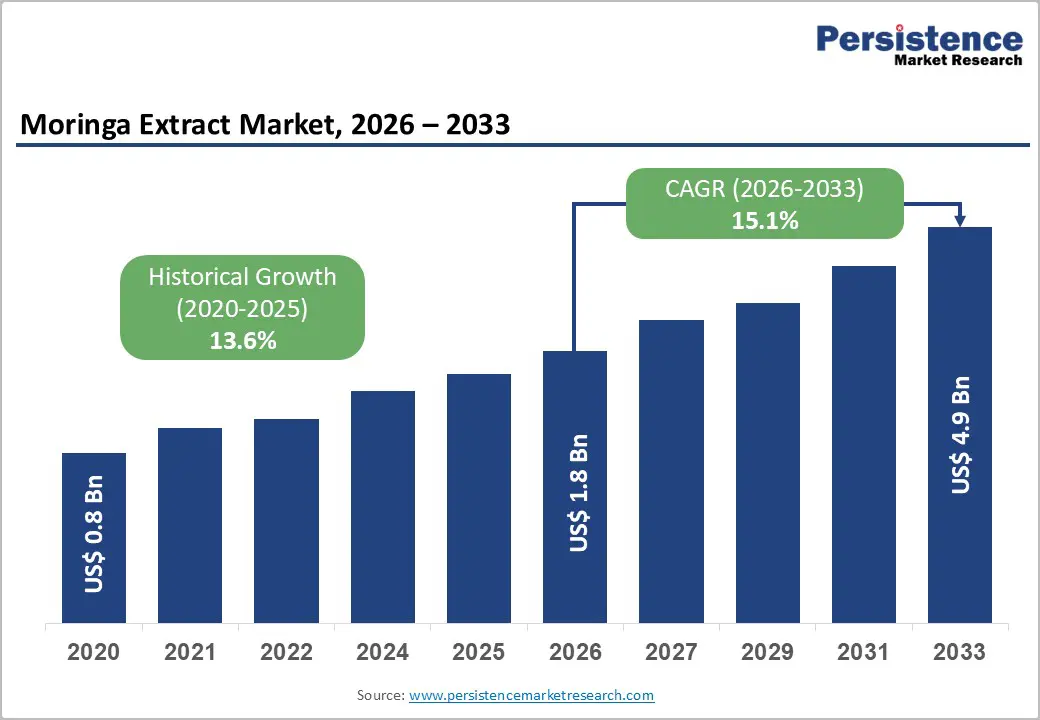
The global moringa extract market is forecast to expand at a CAGR of 15.1% and thereby increase from a value of US$ 1.6 Bn in 2025, to US$ 4.3 Bn by the end of 2032.

Attributes

Key Insights

Moringa Extract Market Size (2025E)

US$ 1.6 Bn

Projected Market Value (2032F)

US$ 4.3 Bn

Global Market Growth Rate (CAGR 2025 to 2032)

15.1%

Historical Market Growth Rate (CAGR 2019 to 2024)

14.4%

Market Introduction and Definition

Moringa extract is derived from the leaves of the moringa oleifera tree. It has become popular in various industries because it is rich in nutrients and has potential health benefits. The extract contains high levels of vitamins, minerals, and antioxidants, making it a valuable supplement for addressing nutritional deficiencies. moringa extract is a sustainable, plant-based solution that aims to improve overall well-being. It caters to a global consumer base that is increasingly conscious of holistic health.

The extract can be used in supplements, herbal medicines, and functional food products, aligning with the growing trend of incorporating natural, nutrient-dense ingredients into daily diets. The moringa extract market is driven by several factors and offers promising opportunities. The increasing awareness of the health benefits of moringa, such as its anti-inflammatory and antioxidant properties, is driving demand in the pharmaceutical and wellness sectors.

The growing interest in plant-based nutrition also creates opportunities for moringa extract in the food and beverage industry, with the potential for innovative product formulations. Additionally, the rising preference for organic and sustainable products positions moringa extract as an attractive choice. As research continues to uncover new health benefits and the market expands its applications, moringa extract is poised for strong growth, providing both industry players and consumers with sustainable and health-conscious options.

Market Growth Drivers

Increasing Trends in Health and Wellness

The growing popularity of health and wellness trends is a major factor driving the increased market growth of moringa extract. As people around the world focus more on preventive healthcare and natural remedies, moringa extract is becoming a preferred choice for holistic well-being. It is rich in nutrients like vitamins, minerals, and antioxidants, making it a valuable supplement for addressing nutritional deficiencies. As individuals look for plant-based alternatives to support their health goals, moringa extract is emerging as a versatile and nutrient-dense option. This has led to its adoption in various industries, including pharmaceuticals, herbal medicines, and functional foods.

In addition, the moringa extract market is experiencing growth due to its increasing use in functional foods. moringa extract is a versatile ingredient that is being incorporated into innovative formulations in food and beverages. This is driven by the growing demand for nutritionally enhanced products. Consumers are now prioritizing foods that offer health benefits beyond basic nutrition, and moringa extract is being used in energy bars, beverages, and snacks to meet this demand. This expansion into functional foods demonstrates the adaptability of moringa extract to changing consumer preferences and its role in driving market growth.

Market Restraints

Effects of Climate Variability on Moringa Farming

One important factor that can significantly impact the market performance of the moringa extract market is the influence of climate variability on moringa cultivation. moringa oleifera, which is the source of moringa extract, is sensitive to environmental conditions. Changes in temperature, precipitation patterns, and other climate variables can directly affect the growth, yield, and quality of moringa crops. Unpredictable weather events like droughts or extreme temperatures can disrupt cultivation, leading to potential supply shortages and fluctuations in moringa extract production.

As climate change becomes a global concern, its implications on agriculture, including moringa cultivation, pose a substantial risk to the stability of the market and the reliable supply of moringa extract. It will be crucial to adapt cultivation practices and implement sustainable farming methods to mitigate the adverse effects of climate variability on the moringa Extract Market.

Challenges in Cultivation, and Ensuring Quality Standards

One of the main challenges in the moringa extract market is the cultivation and quality assurance of moringa oleifera. This plant requires specific agro-climatic conditions for optimal growth, and any variations in these conditions can affect the yield and quality of moringa extracts. Ensuring a consistent and high-quality supply is difficult, especially when faced with unpredictable weather patterns and soil variations. It is also crucial to maintain quality standards during the extraction and processing stages. Adhering to strict quality assurance practices is necessary to overcome the challenges associated with variations in moringa cultivation conditions and ensure a reliable and standardized supply of moringa extract to the market.

Opportunities

Increasing Demand for Natural Ingredients

The moringa extract market has a significant opportunity to capitalize on the increasing demand for natural ingredients in various industries. As consumers continue to seek out wholesome and clean-label products, the health benefits of moringa extract make it a valuable component in supplements, herbal medicines, and functional foods. Market players can boost their revenue by strategically marketing moringa extract as a natural, plant-based solution, aligning with the current trend of conscious and informed consumer choices. Additionally, transparent communication about the sourcing, processing, and sustainable practices related to moringa extract can further enhance its appeal, fostering brand loyalty and driving revenue growth in a market driven by preferences for natural ingredients.

Moreover, an untapped opportunity for revenue expansion in the moringa Extract market is the potential use of moringa extract in the beauty and cosmetic industry. moringa extract contains vitamins and antioxidants that offer promising benefits for skincare and haircare products. With the beauty industry's focus on natural and plant-based ingredients, moringa extract can be positioned as a key component in cosmetics, skincare products, and hair treatments. Companies can innovate and introduce moringa-infused beauty products to take advantage of its nourishing and rejuvenating properties. This expansion into the beauty sector provides a way to increase revenue by tapping into the intersection of wellness, natural beauty, and the growing popularity of moringa extract.

Analyst’s Viewpoint

The increasing global awareness of holistic well-being is bringing moringa extract into the spotlight. This shift towards plant-based remedies is driven by the combination of nutritional benefits and sustainability that moringa extract offers. It not only addresses dietary gaps but also caters to the growing demand for natural cosmetics. From an analyst's perspective, the strategic integration of moringa extract in pharmaceuticals represents a changing paradigm in healthcare. The market for moringa extract is further boosted by the embrace of e-commerce platforms, making it accessible to a global audience. The moringa extract market, with its intersections of agriculture, health, and consumer preferences, is seen as a dynamic terrain full of possibilities and poised for continued expansion.

Supply-side Dynamics

The moringa extract market is influenced by various factors that affect the cultivation, processing, and distribution of this popular botanical extract. moringa oleifera, which thrives in tropical and subtropical regions, is grown in different parts of the world. The extraction process, which mainly involves leaves and seeds, requires careful handling to preserve the bioactive compounds. Sustainable agricultural practices, adherence to quality standards, and ethical sourcing practices all contribute to maintaining a strong supply chain. Additionally, variations in climate and agricultural practices can affect the quantity and quality of moringa extract available in the market. It is important for stakeholders to find a balance between sustainability, quality, and efficiency in navigating the complex supply-side landscape.

China plays a crucial role as a major supplier in the global moringa extract market. This is due to its vast agricultural landscape and expertise in botanical processing. The country's favourable climatic conditions in regions like Yunnan and Guangxi allow for year-round moringa cultivation. Additionally, China's historical use of traditional herbal remedies aligns with the growing global demand for moringa extract in supplements, herbal medicines, and cosmetics. Chinese suppliers, who are often vertically integrated, have the capability to manage various stages of production, from cultivation to extraction and processing. China's significant contribution to the moringa extract market comes not only from its substantial domestic consumption but also from its ability to meet international demands.

Top Regional Markets

Europe's Dominance Upheld by Wellness Renaissance

Europe is becoming a dominant region in the moringa extract market for several reasons. The region's focus on holistic well-being and the increasing demand for natural, plant-based supplements align well with the health-conscious European consumer base. moringa extract, with its rich nutrient profile and versatile applications, including supplements and functional foods, is well-received in the discerning European market.

Europe's strict regulatory standards promote the use of high-quality and ethically sourced ingredients, making moringa extract even more appealing. Europe's openness to innovative health products and sustainable practices positions it at the forefront of the moringa extract market's growth and dominance.

South Asia and the Pacific Thrive on the Back of the Growing Health Consciousness

South Asia, and the Pacific is the fastest-growing region in the moringa extract market. This is due to several factors. Firstly, moringa has a long history of use in traditional medicine in this region, and there is a cultural appreciation for herbal remedies. Additionally, the diverse climates in South Asia, and the Pacific create favourable conditions for moringa cultivation, ensuring a sustainable supply.
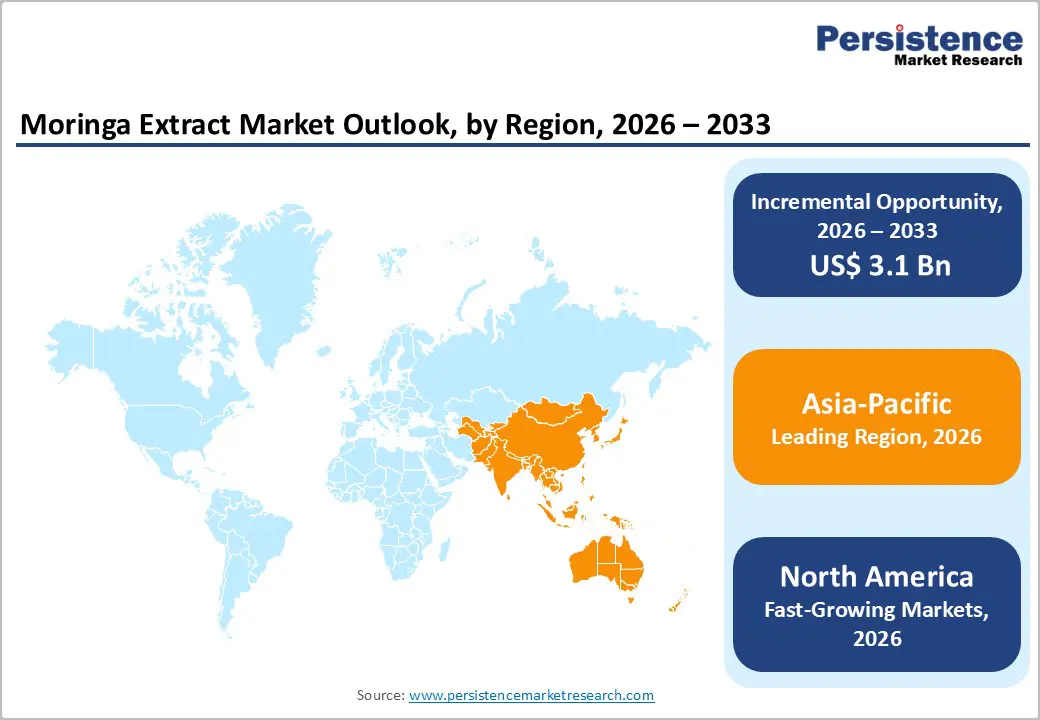
The rising health consciousness, and a shift towards natural wellness solutions also contribute to the popularity of moringa extracts. Furthermore, the prevalence of malnutrition concerns in some areas increases the demand for moringa's nutrient-rich profile. The rapid embrace of moringa extract in South Asia, and the Pacific is a result of a harmonious blend of cultural heritage, health awareness, and favourable agricultural conditions, establishing it as the leader in the market's accelerated growth.

Competitive Intelligence and Business Strategy

Prominent organizations, including Botanic Healthcare, Herbochem, Medikonda Nutrients, Taiyo GmbH, are at the vanguard of this sector, Competitive intelligence in the moringa extract market involves a thorough analysis of market players, their strategies, and the industry landscape to gain a strategic advantage. This includes monitoring competitors' product portfolios, pricing strategies, and distribution channels. Understanding the competitive landscape allows businesses to identify emerging trends, potential collaborations, and areas for innovation. Additionally, gathering intelligence on regulatory changes, consumer preferences, and technological advancements is crucial for staying ahead in this dynamic market. By effectively harnessing competitive intelligence, companies can make informed decisions, mitigate risks, and position themselves strategically to capitalize on evolving market dynamics.

Crafting a strong business strategy in the moringa extract market requires a comprehensive approach that takes into account market trends, consumer demands, and industry regulations. Companies should prioritize sustainable sourcing practices to guarantee a reliable and top-notch supply of moringa extract. Moreover, expanding product offerings by incorporating moringa extract into different applications like pharmaceuticals, cosmetics, and functional foods can help reach a wider market. Building strategic partnerships with local farmers, investing in research and development, and staying updated on global health and wellness trends are crucial elements of a successful business strategy.

Key Recent Developments

New Product Launch

In July 2023, the inclusion of Moringa oleifera to its selection of cosmetic oils has been announced by Naturally Australian Products (NAP). A Ghanaian manufacturer is the source of NAP's moringa seed extract and moringa leaf powder.

Market Impact: This strategic inclusion aligns with the escalating demand for natural ingredients, fostering NAP's commitment to holistic skincare solutions and potentially influencing a broader adoption of Moringa Extract in the beauty industry.

In September 2022, by receiving Informed Ingredient accreditation for its product MorActive, a blend of moringa seeds, extracts, and Sunfiber, Taiyo has continued to advance assurance of quality in the athletic nutrition and lifestyle supplementation sectors.

Market Impact: This development not only amplifies Taiyo's commitment to product excellence but also contributes to the growing credibility of Moringa Extract in the broader wellness and sports nutrition landscape.

In October 2022, The United Kingdom's Government Chemists' Laboratory (LGC) complete global prohibited components testing and certification Scheme for dietary supplement components has officially verified Taiyo's new moringa seed extract.

Market Impact: This accreditation adds a layer of credibility to Taiyo's product, ensuring compliance with stringent global standards. The verified moringa seed extract is poised to gain heightened recognition in the Moringa Extract Market, bolstering consumer trust and affirming its status as a reliable dietary supplement ingredient.

Moringa Extract Market Research Segmentation

By Product Type:

  • Moringa Leaf Extract
  • Moringa Seed Extract
  • Moringa Bark Extract
  • Moringa Root Extract

By Form:

  • Powder
  • Liquid
  • Capsules/ Tablets

By End Use:

  • Food and Beverages
  • Dietary Supplement
  • Cosmetics and Personal Care
  • Pharmaceuticals
  • Animal Feed

By Distribution Channel:

  • Convenience Stores
  • Pharmacy & Health Stores
  • Specialty Stores
  • Independent Small Groceries
  • Online Retailing
  • Others

By Region:

  • North America
  • Europe
  • East Asia
  • South Asia & Oceania
  • Latin America
  • Middle East & Africa

Companies Covered in Moringa Extract Market

  • Botanic Healthcare
  • Herbochem
  • Medikonda Nutrients
  • Taiyo GmbH
  • S.A. Herbal Bioactives LLP
  • Alpspure Lifesciences Private Limited
  • Phyto Life Sciences P. Ltd.
  • Allpure Organics
  • Victoria Foods
  • Himalayan Herbaria Inc.
  • Arizone International
  • VedaOils.us
  • Selleck Chemicals
Frequently Asked Questions

The market is anticipated to grow at a CAGR of 15.1% during the projected period.

The moringa extract market will be valued at US$ 1.6 billion in 2025.

The US will hold the largest market share in 2025.

The prominent players in the market are Botanic Healthcare, Herbochem, Medikonda Nutrients, Taiyo GmbH, and S.A. Herbal Bioactives LLP.

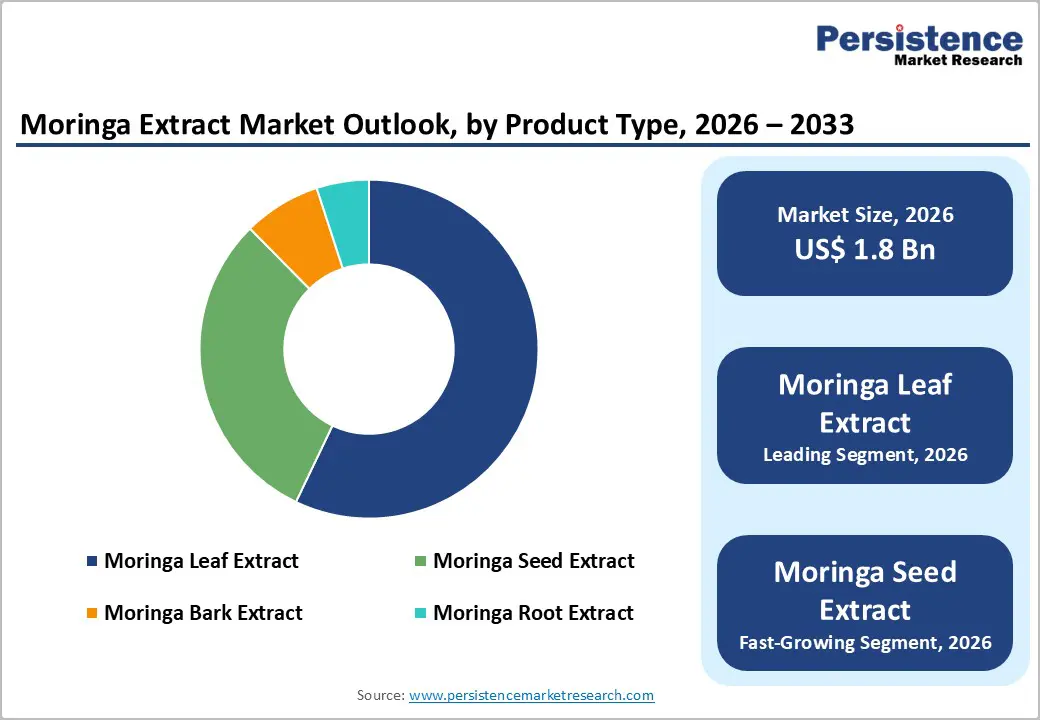
The moringa seed extract segment is expected to grow at the fastest CAGR during the forecast period.

Market Segmentation

Which is the Leading Product Type?

Sales of Moringa Leaf Extract Dominant for its Versatility

The dominant category unquestionably belongs to moringa leaf extract. Renowned for its rich nutrient profile, moringa leaves are a powerhouse of vitamins, minerals, and antioxidants. The extraction process captures this abundance, creating a versatile and sought-after ingredient for various applications. moringa leaf extract is a staple in the nutraceutical and functional food sectors, offering a natural solution for addressing nutritional gaps. Furthermore, the fastest-growing category emerges in the form of moringa seed extract. Acknowledged for its unique composition, Moringa seeds contain beneficial compounds like oleic acid and antioxidants. The extract derived from these seeds holds promise for diverse applications, from cosmetic formulations to oil extraction.

Which Form will Represent the Prominent Segment?

Powder Takes the Lead as Offers Concentrated Nutritional Benefits

Moringa powder emerges as the dominant category, heralding a reign of powdered potency in the market. The popularity of moringa powder is deeply rooted in its convenience, versatility, and concentrated nutritional benefits. Consumers gravitate towards moringa powder for its ease of incorporation into various culinary creations, smoothies, and beverages, making it a staple in health-conscious diets.

The fastest-growing category is capsules/tablets. This form witnesses a swift ascent driven by the increasing demand for convenient and standardized dosage options. moringa capsules/tablets offer consumers a hassle-free and precise way to integrate moringa's nutritional benefits into their daily routines. The appeal lies in the simplicity of consumption, providing a measured dose of moringa extract without the need for intricate preparation.

Which End Use Area is at the Forefront?

Pharmaceuticals Remain the Key Category as Demand for Anti-inflammatory, Antioxidant, and Antimicrobial Products Soars

Pharmaceuticals emerge as the dominant category. The pharmaceutical industry is increasingly recognizing the therapeutic properties of moringa extract. It is being used for its anti-inflammatory, antioxidant, and antimicrobial attributes. The bioactive compounds found in moringa play a crucial role in formulating medicines that address a wide range of health concerns. moringa extract has been found to have anti-inflammatory, antioxidant, and antimicrobial properties. These properties make it a valuable ingredient in the pharmaceutical industry.

The bioactive compounds found in moringa are essential in creating medicines that can effectively treat various health issues. Furthermore, the cosmetics and personal care sector emerges as the fastest-growing category, unveiling the radiance and nourishing properties of moringa. Consumers increasingly seek natural ingredients in skincare and personal care products, driving the swift ascent of moringa extract.

Which Distribution Channel Generates the Highest Revenue?

Online Retail Set to Dominate Sales amid Evolving Purchasing Decisions of Consumers

Online retailing has emerged as the dominant distribution channel; the rise of e-commerce platforms has had a significant impact on consumer buying habits. It has made moringa extract products more accessible, allowing consumers to easily purchase health supplements online. Online retailing provides a wide range of options, allowing consumers to compare different brands, product specifications, and customer reviews before making informed decisions. This convenience and efficiency have revolutionized the way consumers shop for health supplements.

Specialty stores are the fastest-growing category. Specialty stores cater to health-conscious consumers seeking specific products with unique formulations and qualities. These stores often provide a curated selection of health supplements, including moringa extract, coupled with expert advice from knowledgeable staff.

Moringa Extract Market Report Scope

Attribute

Details

Forecast Period

2025 to 2032

Historical Data Available for

2019 to 2024

Market Analysis Units Value: US$ Bn/Mn, Volume: As applicable 

Key Regions Covered

  • North America
  • Latin America
  • Europe
  • South Asia & Pacific
  • East Asia
  • The Middle East & Africa  

Key Countries Covered

  • United States
  • Canada
  • Germany
  • United Kingdom
  • France
  • Italy
  • Spain
  • Russia
  • China
  • Japan
  • South Korea
  • India
  • Thailand
  • Malaysia
  • Indonesia
  • Australia
  • New Zealand
  • GCC Countries
  • South Africa  

Key Market Segments Covered

  • Product Type
  • Form
  • End Use
  • Distribution Channel
  • Region

Key Companies Profiled

  • Botanic Healthcare
  • Herbochem
  • Medikonda Nutrients
  • Taiyo GmbH
  • S.A. Herbal Bioactives LLP
  • Alpspure Lifesciences Private Limited
  • Phyto Life Sciences P. Ltd.
  • Allpure Organics
  • Victoria Foods
  • Himalayan Herbaria Inc.
  • Arizone International
  • VedaOils.us
  • Selleck Chemicals
Report Highlights
  • Market Forecast and Trends
  • Competitive Intelligence & Share Analysis
  • Growth Factors and Challenges
  • Strategic Growth Initiatives
  • Pricing Analysis & Technology Roadmap
  • Future Opportunities and Revenue Pockets
  • Industry Market Analysis Tools

Customization & Pricing

Available upon request

Related Reports

1. Executive Summary

    1.1. Global Moringa Extract Market Snapshot, 2025 and 2032

    1.2. Market Opportunity Assessment, 2025 - 2032, US$ Mn

    1.3. Key Market Trends

    1.4. Future Market Projections

    1.5. Premium Market Insights

    1.6. Industry Developments and Key Market Events   

    1.7. PMR Analysis and Recommendations

2. Market Overview

    2.1. Market Scope and Definition

    2.2. Market Dynamics

        2.2.1. Drivers

        2.2.2. Restraints

        2.2.3. Opportunity

        2.2.4. Challenges

        2.2.5. Key Trends

    2.3. Product Type Lifecycle Analysis

    2.4. Moringa Extract Market: Value Chain

        2.4.1. List of Raw Material Supplier

        2.4.2. List of Manufacturers

        2.4.3. List of Distributors

        2.4.4. List of Applications

        2.4.5. Profitability Analysis

    2.5. Porter Five Force's Analysis

    2.6. Geopolitical Tensions: Market Impact   

    2.7. Macro-Economic Factors

        2.7.1. Global Sectorial Outlook

        2.7.2. Global GDP Growth Outlook

        2.7.3. Global Parent Market Overview

    2.8. Forecast Factors - Relevance and Impact

    2.9. Regulatory and Technology Landscape

3. Global Moringa Extract Market Outlook, 2019-2032

    3.1. Key Highlights

        3.1.1. Market Volume (Units) Projections

        3.1.2. Market Size and Y-o-Y Growth

        3.1.3. Absolute $ Opportunity

    3.2. Market Size (US$ Mn) Analysis and Forecast

        3.2.1. Historical Market Size Analysis, 2019-2023

        3.2.2. Current Market Size Forecast, 2024-2032

    3.3. Global Moringa Extract Market Outlook: Product Type

        3.3.1. Introduction / Key Findings

        3.3.2. Historical Market Size (US$ Mn) and Volume (Units) Analysis By Product Type, 2019 - 2023

        3.3.3. Current Market Size (US$ Mn) and Volume (Units) Forecast By Product Type, 2024 - 2032

            3.3.3.1. Moringa Leaf Extract

            3.3.3.2. Moringa Seed Extract

            3.3.3.3. Moringa Bark Extract

            3.3.3.4. Moringa Root Extract

    3.4. Market Attractiveness Analysis: Product Type

    3.5. Global Moringa Extract Market Outlook: Form

        3.5.1. Introduction / Key Findings

        3.5.2. Historical Market Size (US$ Mn) and Volume (Units) Analysis By Form, 2019 - 2023

        3.5.3. Current Market Size (US$ Mn) and Volume (Units) Forecast By Form, 2024 - 2032

            3.5.3.1. Powder

            3.5.3.2. Liquid

            3.5.3.3. Capsules

    3.6. Market Attractiveness Analysis: Form

    3.7. Global Moringa Extract Market Outlook: End Use

        3.7.1. Introduction / Key Findings

        3.7.2. Historical Market Size (US$ Mn) and Volume (Units) Analysis By End Use, 2019 - 2023

        3.7.3. Current Market Size (US$ Mn) and Volume (Units) Forecast By End Use, 2024 - 2032

            3.7.3.1. Food and Beverages

            3.7.3.2. Dietary Supplement

            3.7.3.3. Cosmetics and Personal Care

            3.7.3.4. Pharmaceuticals

            3.7.3.5. Animal Feed

    3.8. Market Attractiveness Analysis: End Use

    3.9. Global Moringa Extract Market Outlook: Distribution Channel

        3.9.1. Introduction / Key Findings

        3.9.2. Historical Market Size (US$ Mn) and Volume (Units) Analysis By End-use, 2019 - 2023

        3.9.3. Current Market Size (US$ Mn) and Volume (Units) Forecast By End-use, 2024 - 2032

            3.9.3.1. Convenience Stores

            3.9.3.2. Pharmacy & health stores

            3.9.3.3. Specialty stores

            3.9.3.4. Independent Small Groceries

            3.9.3.5. Online Retailing

            3.9.3.6. Others

    3.10. Market Attractiveness Analysis: End-use

4. Global Moringa Extract Market Outlook: Region

    4.1. Key Highlights

    4.2. Historical Market Size (US$ Mn) and Volume (Units) Analysis By Region, 2019 - 2023

    4.3. Current Market Size (US$ Mn) and Volume (Units) Forecast By Region, 2024 - 2032

        4.3.1. North America

        4.3.2. Europe

        4.3.3. East Asia

        4.3.4. South Asia and Oceania

        4.3.5. Latin America

        4.3.6. Middle East & Africa (MEA)

    4.4. Market Attractiveness Analysis: Region

5. North America Moringa Extract Market Outlook, 2019 - 2032

    5.1. Key Highlights

    5.2. Pricing Analysis

    5.3. Historical Market Size (US$ Mn) and Volume (Units) Analysis By Market, 2019 - 2023

        5.3.1. By Country

        5.3.2. By Product Type

        5.3.3. By Form

        5.3.4. By End Use 

        5.3.5. By Distribution Channel

    5.4. Current Market Size (US$ Mn) and Volume (Units) Forecast By Country, 2024 - 2032

        5.4.1. U.S.

        5.4.2. Canada

    5.5. Current Market Size (US$ Mn) and Volume (Units) Forecast By Product Type, 2024 - 2032

        5.5.1. Moringa Leaf Extract

        5.5.2. Moringa Seed Extract

        5.5.3. Moringa Bark Extract

        5.5.4. Moringa Root Extract

    5.6. Current Market Size (US$ Mn) and Volume (Units) Forecast By Form, 2024 - 2032

        5.6.1. Powder

        5.6.2. Liquid

        5.6.3. Capsules

    5.7. Current Market Size (US$ Mn) and Volume (Units) Forecast By End Use, 2024 - 2032

        5.7.1. Food and Beverages

        5.7.2. Dietary Supplement

        5.7.3. Cosmetics and Personal Care

        5.7.4. Pharmaceuticals

        5.7.5. Animal Feed

    5.8. Current Market Size (US$ Mn) and Volume (Units) Forecast By End-use, 2024 - 2032

        5.8.1. Convenience Stores

        5.8.2. Pharmacy & health stores

        5.8.3. Specialty stores 

        5.8.4. Independent Small Groceries

        5.8.5. Online Retailing

        5.8.6. Others

    5.9. Market Attractiveness Analysis

6. Europe Moringa Extract Market Outlook, 2019 - 2032

    6.1. Key Highlights

    6.2. Pricing Analysis

    6.3. Historical Market Size (US$ Mn) and Volume (Units) Analysis By Market, 2019 - 2023

        6.3.1. By Country

        6.3.2. By Product Type

        6.3.3. By Form

        6.3.4. By End Use 

        6.3.5. By Distribution Channel

    6.4. Current Market Size (US$ Mn) and Volume (Units) Forecast By Country, 2024 - 2032

        6.4.1. Germany

        6.4.2. France

        6.4.3. U.K.

        6.4.4. Italy

        6.4.5. Spain

        6.4.6. Russia

        6.4.7. Turkey

        6.4.8. Rest of Europe

    6.5. Current Market Size (US$ Mn) and Volume (Units) Forecast By Product Type, 2024 - 2032

        6.5.1. Moringa Leaf Extract

        6.5.2. Moringa Seed Extract

        6.5.3. Moringa Bark Extract

        6.5.4. Moringa Root Extract

    6.6. Current Market Size (US$ Mn) and Volume (Units) Forecast By Form, 2024 - 2032

        6.6.1. Powder

        6.6.2. Liquid

        6.6.3. Capsules

    6.7. Current Market Size (US$ Mn) and Volume (Units) Forecast By End Use, 2024 - 2032

        6.7.1. Food and Beverages

        6.7.2. Dietary Supplement

        6.7.3. Cosmetics and Personal Care

        6.7.4. Pharmaceuticals 

        6.7.5. Animal Feed

    6.8. Current Market Size (US$ Mn) and Volume (Units) Forecast By End-use, 2024 - 2032

        6.8.1. Convenience Stores

        6.8.2. Pharmacy & health stores

        6.8.3. Specialty stores 

        6.8.4. Independent Small Groceries

        6.8.5. Online Retailing

        6.8.6. Others

    6.9. Market Attractiveness Analysis

7. East Asia Moringa Extract Market Outlook, 2019 - 2032

    7.1. Key Highlights

    7.2. Pricing Analysis

    7.3. Historical Market Size (US$ Mn) and Volume (Units) Analysis By Market, 2019 - 2023

        7.3.1. By Country

        7.3.2. By Product Type

        7.3.3. By Form

        7.3.4. By End Use 

        7.3.5. By Distribution Channel

    7.4. Current Market Size (US$ Mn) and Volume (Units) Forecast By Country, 2024 - 2032

        7.4.1. China

        7.4.2. Japan

        7.4.3. South Korea

    7.5. Current Market Size (US$ Mn) and Volume (Units) Forecast By Product Type, 2024 - 2032

        7.5.1. Moringa Leaf Extract

        7.5.2. Moringa Seed Extract

        7.5.3. Moringa Bark Extract

        7.5.4. Moringa Root Extract

    7.6. Current Market Size (US$ Mn) and Volume (Units) Forecast By Form, 2024 - 2032

        7.6.1. Powder

        7.6.2. Liquid

        7.6.3. Capsules

    7.7. Current Market Size (US$ Mn) and Volume (Units) Forecast By End Use, 2024 - 2032

        7.7.1. Food and Beverages

        7.7.2. Dietary Supplement

        7.7.3. Cosmetics and Personal Care

        7.7.4. Pharmaceuticals 

        7.7.5. Animal Feed

    7.8. Current Market Size (US$ Mn) and Volume (Units) Forecast By End-use, 2024 - 2032

        7.8.1. Convenience Stores

        7.8.2. Pharmacy & health stores

        7.8.3. Specialty stores

        7.8.4. Independent Small Groceries

        7.8.5. Online Retailing

        7.8.6. Others

    7.9. Market Attractiveness Analysis

8. South Asia & Oceania Moringa Extract Market Outlook, 2019 - 2032

    8.1. Key Highlights

    8.2. Pricing Analysis

    8.3. Historical Market Size (US$ Mn) and Volume (Units) Analysis By Market, 2019 - 2023

        8.3.1. By Country

        8.3.2. By Product Type

        8.3.3. By Form

        8.3.4. By End Use 

        8.3.5. By Distribution Channel

    8.4. Current Market Size (US$ Mn) and Volume (Units) Forecast By Country, 2024 - 2032

        8.4.1. India

        8.4.2. Southeast Asia

        8.4.3. ANZ

        8.4.4. Rest of South Asia & Oceania

    8.5. Current Market Size (US$ Mn) and Volume (Units) Forecast By Product Type, 2024 - 2032

        8.5.1. Moringa Leaf Extract

        8.5.2. Moringa Seed Extract

        8.5.3. Moringa Bark Extract

        8.5.4. Moringa Root Extract

    8.6. Current Market Size (US$ Mn) and Volume (Units) Forecast By Form, 2024 - 2032

        8.6.1. Powder

        8.6.2. Liquid

        8.6.3. Capsules

    8.7. Current Market Size (US$ Mn) and Volume (Units) Forecast By End Use, 2024 - 2032

        8.7.1. Food and Beverages

        8.7.2. Dietary Supplement

        8.7.3. Cosmetics and Personal Care

        8.7.4. Pharmaceuticals 

        8.7.5. Animal Feed

    8.8. Current Market Size (US$ Mn) and Volume (Units) Forecast By End-use, 2024 - 2032

        8.8.1. Convenience Stores

        8.8.2. Pharmacy & health stores

        8.8.3. Specialty stores 

        8.8.4. Independent Small Groceries

        8.8.5. Online Retailing

        8.8.6. Others

    8.9. Market Attractiveness Analysis

9. Latin America Moringa Extract Market Outlook, 2019 - 2032

    9.1. Key Highlights

    9.2. Pricing Analysis

    9.3. Historical Market Size (US$ Mn) and Volume (Units) Analysis By Market, 2019 - 2023

        9.3.1. By Country

        9.3.2. By Product Type

        9.3.3. By Form

        9.3.4. By End Use 

        9.3.5. By Distribution Channel

    9.4. Current Market Size (US$ Mn) and Volume (Units) Forecast By Country, 2024 - 2032

        9.4.1. Brazil

        9.4.2. Mexico

        9.4.3. Rest of Latin America

    9.5. Current Market Size (US$ Mn) and Volume (Units) Forecast By Product Type, 2024 - 2032

        9.5.1. Moringa Leaf Extract

        9.5.2. Moringa Seed Extract

        9.5.3. Moringa Bark Extract

        9.5.4. Moringa Root Extract

    9.6. Current Market Size (US$ Mn) and Volume (Units) Forecast By Form, 2024 - 2032

        9.6.1. Powder

        9.6.2. Liquid

        9.6.3. Capsules

    9.7. Current Market Size (US$ Mn) and Volume (Units) Forecast By End Use, 2024 - 2032

        9.7.1. Food and Beverages

        9.7.2. Dietary Supplement

        9.7.3. Cosmetics and Personal Care

        9.7.4. Pharmaceuticals

        9.7.5. Animal Feed

    9.8. Current Market Size (US$ Mn) and Volume (Units) Forecast By End-use, 2024 - 2032

        9.8.1. Convenience Stores

        9.8.2. Pharmacy & health stores

        9.8.3. Specialty stores

        9.8.4. Independent Small Groceries

        9.8.5. Online Retailing

        9.8.6. Others

    9.9. Market Attractiveness Analysis

10. Middle East & Africa Moringa Extract Market Outlook, 2019 - 2032

    10.1. Key Highlights

    10.2. Pricing Analysis

    10.3. Historical Market Size (US$ Mn) and Volume (Units) Analysis By Market, 2019 - 2023

        10.3.1. By Country

        10.3.2. By Product Type

        10.3.3. By Form

        10.3.4. By End Use 

        10.3.5. By Distribution Channel

    10.4. Current Market Size (US$ Mn) and Volume (Units) Forecast By Country, 2024 - 2032

        10.4.1. GCC

        10.4.2. Egypt

        10.4.3. South Africa

        10.4.4. Northern Africa

        10.4.5. Rest of Middle East & Africa

    10.5. Current Market Size (US$ Mn) and Volume (Units) Forecast By Product Type, 2024 - 2032

        10.5.1. Moringa Leaf Extract

        10.5.2. Moringa Seed Extract

        10.5.3. Moringa Bark Extract

        10.5.4. Moringa Root Extract

    10.6. Current Market Size (US$ Mn) and Volume (Units) Forecast By Form, 2024 - 2032

        10.6.1. Powder

        10.6.2. Liquid

        10.6.3. Capsules

    10.7. Current Market Size (US$ Mn) and Volume (Units) Forecast By End Use, 2024 - 2032

        10.7.1. Food and Beverages

        10.7.2. Dietary Supplement

        10.7.3. Cosmetics and Personal Care

        10.7.4. Pharmaceuticals 

        10.7.5. Animal Feed

    10.8. Current Market Size (US$ Mn) and Volume (Units) Forecast By End-use, 2024 - 2032

        10.8.1. Convenience Stores

        10.8.2. Pharmacy & health stores

        10.8.3. Specialty stores

        10.8.4. Independent Small Groceries

        10.8.5. Online Retailing

        10.8.6. Others

    10.9. Market Attractiveness Analysis

11. Competition Landscape

    11.1. Market Share Analysis, 2024

    11.2. Market Structure

        11.2.1. Competition Intensity Mapping By Market  

        11.2.2. Competition Moringa Seed Extract

        11.2.3. Apparent Product Capacity

    11.3. Company Profiles (Details - Overview, Financials, Strategy, Recent Developments)

        11.3.1. Botanic Healthcare

            11.3.1.1. Overview

            11.3.1.2. Segments and Product

            11.3.1.3. Key Financials

            11.3.1.4. Market Developments

            11.3.1.5. Market Strategy

        11.3.2. Herbochem

            11.3.2.1. Overview

            11.3.2.2. Segments and Product

            11.3.2.3. Key Financials

            11.3.2.4. Market Developments

            11.3.2.5. Market Strategy

        11.3.3. Medikonda Nutrients

            11.3.3.1. Overview

            11.3.3.2. Segments and Product

            11.3.3.3. Key Financials

            11.3.3.4. Market Developments

            11.3.3.5. Market Strategy

        11.3.4. Taiyo GmbH

            11.3.4.1. Overview

            11.3.4.2. Segments and Product

            11.3.4.3. Key Financials

            11.3.4.4. Market Developments

            11.3.4.5. Market Strategy

        11.3.5. S.A. Herbal Bioactives LLP

            11.3.5.1. Overview

            11.3.5.2. Segments and Product

            11.3.5.3. Key Financials

            11.3.5.4. Market Developments

            11.3.5.5. Market Strategy

        11.3.6. Alpspure Lifesciences Private Limited

            11.3.6.1. Overview

            11.3.6.2. Segments and Product

            11.3.6.3. Key Financials

            11.3.6.4. Market Developments

            11.3.6.5. Market Strategy

        11.3.7. Phyto Life Sciences P. Ltd.

            11.3.7.1. Overview

            11.3.7.2. Segments and Product

            11.3.7.3. Key Financials

            11.3.7.4. Market Developments

            11.3.7.5. Market Strategy

        11.3.8. Allpure Organics

            11.3.8.1. Overview

            11.3.8.2. Segments and Product

            11.3.8.3. Key Financials

            11.3.8.4. Market Developments

            11.3.8.5. Market Strategy

        11.3.9. Victoria Foods

            11.3.9.1. Overview

            11.3.9.2. Segments and Product

            11.3.9.3. Key Financials

            11.3.9.4. Market Developments

            11.3.9.5. Market Strategy

        11.3.10. Himalayan Herbaria Inc.

            11.3.10.1. Overview

            11.3.10.2. Segments and Product

            11.3.10.3. Key Financials

            11.3.10.4. Market Developments

            11.3.10.5. Market Strategy

        11.3.11. Arizone International

            11.3.11.1. Overview

            11.3.11.2. Segments and Product

            11.3.11.3. Key Financials

            11.3.11.4. Market Developments

            11.3.11.5. Market Strategy

        11.3.12. VedaOils.usl

            11.3.12.1. Overview

            11.3.12.2. Segments and Product

            11.3.12.3. Key Financials

            11.3.12.4. Market Developments

            11.3.12.5. Market Strategy

        11.3.13. Selleck Chemicals

            11.3.13.1. Overview

            11.3.13.2. Segments and Product

            11.3.13.3. Key Financials

            11.3.13.4. Market Developments

            11.3.13.5. Market Strategy

12. Appendix

    12.1. Research Methodology

    12.2. Research Assumptions

    12.3. Acronyms and Abbreviations

Research Methodology Framework for Market Research Excellence

At Persistence Market Research, we implement a comprehensive, validated, and multi-dimensional approachto market analysis that delivers actionable insights across complex market landscapes. Our methodology combines the analytical rigor of leading consulting firms with innovative research techniques, ensuring robust market assessments that guide strategic decision-making with confidence.

Core Research Philosophy

Our methodology is built on four foundational pillars:

Research Philosophy Image

At Persistence Market Research, our methodology is designed to transcend conventional market studies by combining analytical rigor, multi-source validation, and future-focused insights.

We integrate advanced research frameworks, robust data collection strategies, cutting-edge analytics, and innovative technologies to deliver a 360-degree view of complex markets.

We integrate advanced research frameworks, robust data collection strategies, cutting-edge analytics, and innovative technologies to deliver a 360-degree view of complex markets.

Each stage spanning from strategic scoping and hypothesis-building to competitive intelligence, quality validation, and actionable recommendations is engineered to provide clients with unmatched clarity, precision, and confidence in decision-making.

By embedding innovation and technology at the core, our approach ensures that insights are not only comprehensive but also predictive, empowering businesses to seize opportunities, mitigate risks, and achieve sustainable growth

Research Philosophy Image

Capturing Key Information and Events

During this phase, key research objectives focus on essential information and data points for assessing the market, including:

Research Philosophy Image

TAM-SAM-SOM Framework Implementation

We employ both top-down and bottom-up approaches to ensure accurate market sizing.

Top-Down Market SizingBottom-Up Market Sizing
Universe Definition: Total global/regional market identificationUnit Economics: Average transaction values, purchase frequencies, customer lifecycle
Segmentation Filters: Geographic, demographic, and behavioral constraintsCustomer Segmentation: Detailed buyer persona development and sizing
Market Share Analysis: Competitive landscape assessment and share allocationPenetration Analysis: Market penetration rates by segment and geography
Growth Rate Application: Historical trends and forward-looking growth assumptionsScaling Methodology: Extrapolation techniques with confidence intervals

Validation & Cross-Verification

  • Triangulation: Comparing top-down and bottom-up results for consistency
  • Sensitivity Analysis: Testing key assumptions and parameter variations
  • Peer Benchmarking: Comparison with analogous markets and industry benchmarks
  • Expert Review: External validation through industry specialist consultation

Research Philosophy Image

Forecasting & Projection Modeling

Our proprietary forecasting models incorporate multiple variables and scenarios.

Forecasting Components

  • Historical Trend Analysis: 10-year historical growth patterns and cyclical variations
  • Driver-Based Modeling: Economic indicators, demographic shifts, technology adoption
  • Scenario Planning: Base case, optimistic, and conservative projections
  • Monte Carlo Simulations: Probability-weighted outcomes and risk assessments

Model Validation

  • Back-Testing: Historical accuracy assessment over 3–5-year periods
  • Cross-Validation: Multiple modeling approaches for result comparison
  • External Benchmarking: Comparison with established market forecasts
  • Continuous Calibration: Quarterly model updates based on new data

Comprehensive Data Collection Strategy

Our secondary research phase establishes a robust knowledge base utilizing diverse, credible sources.

Secondary Data Sourcess

  • Industry Publications & Reports
  • Government & Regulatory Data
  • Financial Intelligence (filings & reports)
  • Academic Research & Digital Intelligence

Quality Assurance Protocol

  • Source credibility assessment and publication date validation
  • Data consistency checks across multiple sources
  • Bias identification and neutralization techniques
  • Information gap tracking for primary research prioritization

Research Philosophy Image

Primary Research Excellence

Our primary research methodology employs best-in-class techniques to capture unique market insights.

Quantitative Research Methods

  • Large-Scale Surveys: Statistically representative samples with 95% confidence intervals
  • Survey Methodology: Multi-channel deployment (online, telephone, in-person)
  • Question Architecture and Response Optimization

Qualitative Research Methods

  • Executive Interviews
  • Focus Groups
  • Expert Consultations

Quality Assurance & Validation Framework

Multi-Stage Validation Process

  • Source Verification and Consistency Testing
  • Outlier Detection and Bias Assessment
  • Peer Review Process and External Validation
  • Sensitivity Analysis and Confidence Intervals

Research Philosophy Image

Methodology Validation & Credibility

Our research methodology has been extensively validated through:

  • Academic Partnerships: Collaborations with top-tier business schools and research institutions
  • Client Success Stories: Documented case studies demonstrating research impact and ROI
  • Continuous Benchmarking: Performance comparison with leading global research firms

This comprehensive methodology framework positions Persistence Market Research at the forefront of market intelligence, combining the analytical sophistication of top-tier consulting firms with innovative research techniques. Our approach ensures that every market assessment delivers precise, actionable, and strategically valuable insights that drive business success in competitive market environments.

Ready to unlock your market potential? Contact our research experts to discuss how our validated methodology can transform your strategic decision-making with data-driven market intelligence.

Copyright © 2026 Persistence Market Research. All Rights Reserved

Connect With Us -