




- Healthcare Services
- Eyelid Scrub Market
Eyelid Scrub Market Size, Share, and Growth Forecast, 2026 - 2033
Eyelid Scrub Market by Product Type (Pre-moistened Scrubs, Spray Scrubs, Dry Pad Scrubs), Application (Dry Eye Disease, Blepharitis, Others), Distribution Channel (Hospital Pharmacies, Online Pharmacies, Retail Pharmacies), and Regional Analysis for 2026 - 2033

Eyelid Scrub Market Size and Trends Analysis
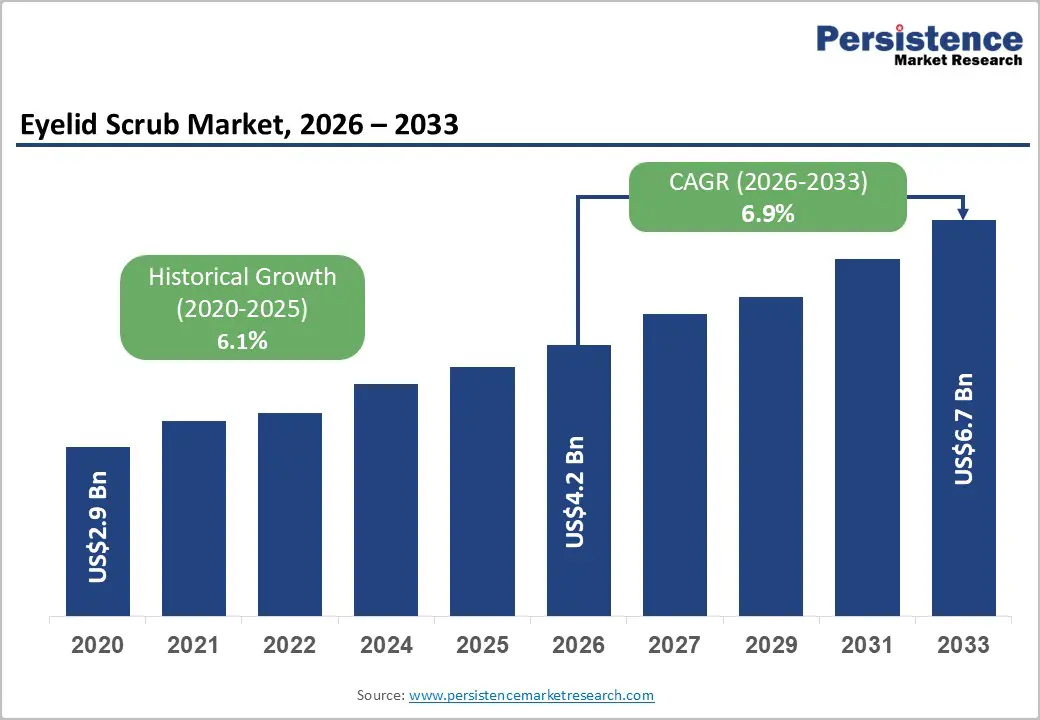
The global eyelid scrub market size is likely to be valued at US$4.2 billion in 2026 and is expected to reach US$6.7 billion by 2033, growing at a CAGR of 6.9% during the forecast period from 2026 to 2033.
The eyelid scrub market is driven by the escalating global prevalence of blepharitis and dry eye disease, growing awareness of lid hygiene as an essential component of ocular surface health management, and the expanding recommendation of eyelid scrub products by ophthalmologists and optometrists as first-line conservative management within dry eye and blepharitis treatment protocols.
Key Industry Highlights:
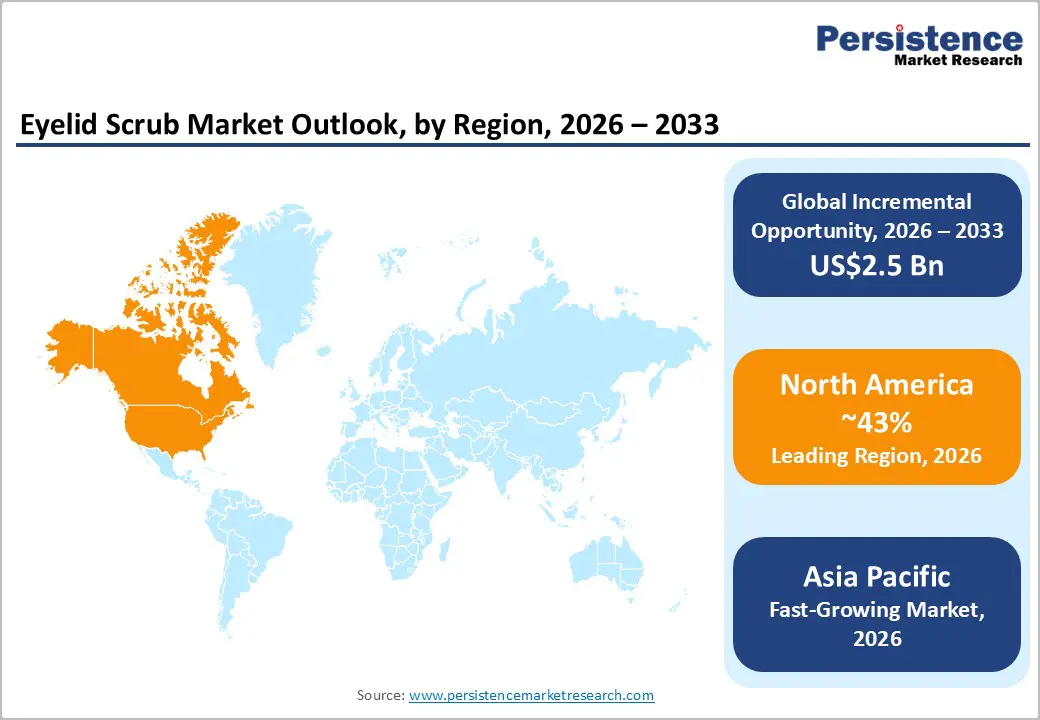
- Dominant Region: North America is expected to lead the eyelid scrub market with approximately 40% revenue share in 2026, driven by the high prevalence of dry eye disease and blepharitis in the aging U.S. population, strong ophthalmologist and optometrist recommendation culture for lid hygiene products, and the established U.S. retail and online pharmacy distribution infrastructure for OTC ophthalmic hygiene products.
- Fastest-growing Region: Asia Pacific is projected to be the fastest-growing regional market, driven by rising digital device use, increasing dry eye and blepharitis prevalence, growing ophthalmic healthcare awareness, and expanding retail pharmacy and e-commerce distribution of eyelid hygiene products across China, India, South Korea, and Japan.
- Dominant Product Type: Pre-moistened scrubs are expected to lead with approximately 55% share in 2026, reflecting their established convenience-first market position as ready-to-use single-application eyelid cleansing pads recommended by eye care professionals for blepharitis management and dry eye-related eyelid hygiene.
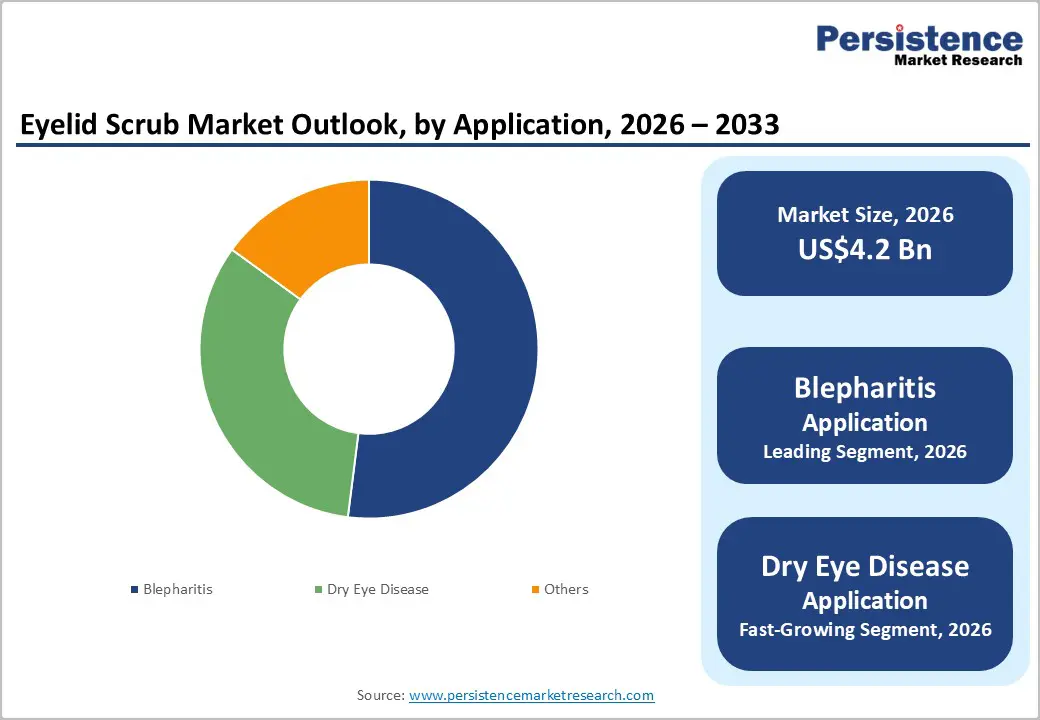
- Leading Application: Blepharitis commands approximately 48% of market revenue in 2026, as the primary clinical indication driving ophthalmologist and optometrist recommendations of eyelid scrub products within standardized anterior blepharitis and meibomian gland dysfunction management protocols.
- According to a 2024 survey published by The Journal of Cornea and External Disease, it was reported that about 21.6% of people amongst 2495 participants are suffering from dry eye disease in Germany. Thus, the growing prevalence of eye conditions is further supporting the rising demand for eyelid scrubs in the market.
DRO Analysis
Driver - Rising Global Prevalence of Blepharitis, Dry Eye Disease, and Demodex Infestation
The escalating global burden of blepharitis and dry eye disease, two of the most prevalent conditions in ophthalmic clinical practice, is the foundational demand driver for eyelid scrub products, as both conditions require regular lid margin cleansing as a core management component. Dry eye disease affects an estimated 5-50% of the global population depending on geographic region and diagnostic criteria applied, with higher prevalence in elderly populations, contact lens wearers, digital device users with reduced blink rates, post-refractive surgery patients, and individuals with systemic autoimmune conditions including Sjögren's syndrome and rheumatoid arthritis.
The growing clinical recognition of Demodex blepharitis as a common and frequently underdiagnosed eyelid disease, with Demodex mite infestation estimated to be present in a substantial proportion of blepharitis patients presenting to ophthalmology and optometry clinics, is creating growing specific product demand for tea tree oil-based eyelid scrub formulations with demonstrated Demodex eradicating activity.
Restraint - Market Fragmentation and Consumer Awareness Challenges
The eyelid scrub market is characterized by significant product proliferation encompassing branded clinical products from established ophthalmic companies, private label pharmacy products, and generic formulations competing across overlapping product formats and active ingredient claims that create consumer navigation complexity and dilute brand loyalty across the market.
The clinical nature of eyelid hygiene products places them in an intermediate market position between pharmaceutical-adjacent eye drops dispensed through prescription channels and general consumer hygiene products purchased through mass retail, a positioning ambiguity that makes consumer discovery, product differentiation, and pharmacy shelf visibility challenging for eyelid scrub brands competing in this clinically important but commercially fragmented category.
Opportunity - Tea Tree Oil and Hypochlorous Acid Formulation Innovation for Demodex Management
The expanding clinical recognition of Demodex blepharitis, accelerated by the FDA approval of lotilaner ophthalmic solution for Demodex treatment and growing ophthalmology community awareness of Demodex prevalence in blepharitis patients is creating a significant commercial opportunity for eyelid scrub products specifically formulated with Demodex-targeting active ingredients including tea tree oil (terpinen-4-ol) and hypochlorous acid (HOCl) that can position themselves within the Demodex blepharitis management protocol as complementary lid hygiene adjuncts to prescription anti-Demodex therapy.
Hypochlorous acid (HOCl) eyelid spray and scrub formulations, including Avenova's hypochlorous acid-based spray, are experiencing growing clinical adoption for their broad-spectrum antimicrobial activity against Staphylococcal and Demodex-associated blepharitis pathogens, anti-inflammatory properties, and excellent tolerability profile that makes them suitable for daily long-term lid hygiene maintenance in sensitive eye patients and contact lens wearers.
Category-wise Analysis
Product Type Insights
Pre-moistened scrubs are expected to dominate the market by product type, commanding approximately 55% of global revenue in 2026. Their market leadership reflects the pre-moistened pad format's established position as the most widely recommended and adopted eyelid hygiene product format, combining clinical-grade lid margin cleansing efficacy with convenient ready-to-use application that eliminates the need for water dilution, application tool preparation, or technique complexity that can reduce patient compliance with daily lid hygiene routines.
Spray scrubs represent the fastest-growing product type, gaining significant clinical and consumer adoption for their gentle, closed-eye spray application format that offers distinct advantages over pad-based application for patients with eyelid sensitivity, corneal involvement, contact lens wear, and severe blepharitis where direct pad contact with the lid margin may cause discomfort.
Application Insights
Blepharitis is expected to dominate the application, commanding approximately 48% of global market revenue in 2026. Blepharitis's market leadership reflects its position as the primary clinical indication driving ophthalmologist and optometrist recommendations of eyelid scrub products within standardized lid disease management protocols, the chronic recurrent nature of the condition generating consistent long-term eyelid scrub purchasing, and the broad prevalence of anterior and posterior blepharitis across adult populations globally that creates a large and expanding patient base actively seeking effective lid hygiene management solutions.
Dry eye disease represents the fastest-growing application segment, driven by the exponentially expanding global dry eye disease population estimated to affect hundreds of millions of people globally with above-average prevalence among digital device users, aging populations, contact lens wearers, and post-refractive surgery patients and the growing clinical integration of lid hygiene within comprehensive dry eye disease management protocols addressing the evaporative dry eye component attributable to Meibomian gland dysfunction and anterior lid margin disease.
Distribution Channel Insights
Retail pharmacies are anticipated to dominate the distribution channel, capturing approximately 44% of market revenue in 2026. Their market leadership reflects the established consumer purchasing behavior for OTC ophthalmic hygiene products through traditional pharmacy retail channels, including major chains such as CVS, Walgreens, Rite Aid (U.S.), Boots (U.K.), and dm-drogerie markt (Germany), where eyelid scrub products are available for immediate self-purchase following eye care professional recommendation.
Online pharmacies and e-commerce represent the fastest-growing distribution channel, driven by the significant expansion of ophthalmic health product e-commerce purchasing across all major markets, the convenience advantages of home delivery for chronic-use daily lid hygiene products, and the superior product discovery and information accessibility of online platforms that enable health-informed consumers to self-select evidence-based eyelid scrub products.
Regional Insights
North America Eyelid Scrub Market Trends
North America is projected to dominate the eyelid scrub market, holding approximately 40% of total revenue in 2026, representing the largest regional market globally. The region's market leadership reflects the high prevalence of dry eye disease and blepharitis in the U.S. aging population, strong ophthalmologist and optometrist clinical recommendation culture for lid hygiene products, the established OTC ophthalmic product retail and online distribution infrastructure, and the concentrated presence of leading eyelid scrub brands including OCuSOFT, Heyedrate, Avenova, and Bausch + Lomb.
U.S Eyelid Scrub Market Insights
The U.S. is expected to dominate with approximately 80% of the regional share in 2026, anchored by the country's large aging population with high blepharitis and meibomian gland dysfunction prevalence, the strong dry eye disease management clinical community encompassing board-certified ophthalmologists, optometrists, and dry eye specialists who routinely recommend eyelid scrub products within standardized treatment protocols, and the sophisticated U.S. ophthalmic hygiene consumer market served through comprehensive retail pharmacy, ophthalmology office dispensing, and e-commerce distribution channels.
Canada Eyelid Scrub Market Insights
Canada is projected to account for approximately 20% of the North America eyelid scrub market in 2026, supported by its advanced optometry and ophthalmology care infrastructure, stringent regulatory oversight by Health Canada for ophthalmic OTC products, and increasing consumer awareness of dry eye disease and blepharitis as important ocular health conditions that require regular eyelid hygiene and preventive care.
Europe Eyelid Scrub Market Trends
Europe is expected to represent the second-largest regional eyelid scrub market, accounting for approximately 27% of the global revenue in 2026, supported by Europe's well-developed ophthalmology and optometry infrastructure, growing dry eye and blepharitis awareness among European eye care professionals and patients, and the strong European eyelid hygiene product heritage represented by established brands including Théa Pharma's Blephasol and Bausch + Lomb's SteriLid eyelid cleansing products.
Germany Eyelid Scrub Market Trends
Germany is anticipated to lead the Europe market, holding 38% of the share in 2026, driven by the country's large aging population with high blepharitis and meibomian gland dysfunction prevalence, the well-developed German ophthalmology specialist and Augenoptiker (optical retailer/optician) professional recommendation network, and the comprehensive German pharmacy distribution infrastructure including dm-drogerie markt, Rossmann, and traditional Apotheke networks providing accessible OTC eyelid scrub product availability.
U.K. Eyelid Scrub Market Trends
The U.K. market is expected to hold 17% of the regional share in 2026, shaped by the NHS ophthalmology and optometry service provision framework, with NHS opticians providing primary eye care services and recommending eyelid hygiene products within dry eye and blepharitis patient management and the strong U.K. consumer health product retail market through Boots, Lloyds Pharmacy, and online health retailers including Amazon UK.
Asia Pacific Eyelid Scrub Market Trends
Asia Pacific is projected to be the fastest-growing region, propelled by the rapidly expanding digital device use generating dry eye and blepharitis prevalence growth across young and working-age populations, growing ophthalmic healthcare awareness and specialist consultation rates, expanding retail pharmacy and e-commerce distribution infrastructure, and the increasing adoption of dry eye disease management protocols incorporating eyelid hygiene recommendations across major Asia Pacific markets.
Japan Eyelid Scrub Market Trends
Japan is projected to be a mature and clinically sophisticated country in Asia Pacific, commanding approximately 40% of the total share in 2026, reflecting the country's advanced ophthalmic healthcare system, high contact lens usage rates creating elevated blepharitis and dry eye risk, and the Japanese medical community's comprehensive clinical guidelines for dry eye disease management that include lid hygiene recommendations.
China Eyelid Scrub Market Trends
China is projected to account for approximately 30% of the Asia Pacific eyelid scrub market in 2026, supported by the country's large and expanding population, rising digital device usage that is contributing to increased rates of dry eye disease and blepharitis among urban and working-age consumers, continued expansion of ophthalmology specialty care infrastructure, and the rapid growth of e-commerce platforms such as Tmall, JD.com, and Douyin that enhance consumer access to eyelid hygiene products across the country.
Competitive Landscape
The global eyelid scrub market is characterized by a competitive landscape encompassing established ophthalmic pharmaceutical and consumer health companies with comprehensive eye care product portfolios, specialized eyelid hygiene brand companies with focused lid care product innovation, and emerging direct-to-consumer ophthalmic health brands leveraging e-commerce and social media marketing to build clinical and consumer brand positions in the growing dry eye and blepharitis management market.
Competitive dynamics are shaped by clinical evidence strength and ophthalmologist recommendation penetration, product formulation innovation and active ingredient differentiation, distribution channel breadth across clinical and consumer retail environments, brand equity within the ophthalmic professional community, and digital marketing and e-commerce execution capability. OCuSOFT maintains a leading global position in the eyelid scrub market through its comprehensive Lid Scrub product family encompassing original, plus, and specialized formulations for varying blepharitis severity and Demodex indications, backed by strong ophthalmologist and optometrist recommendation penetration built through decades of professional sample distribution, clinical education programs, and professional society engagement.
Key Industry Developments:
- In October 2024, myze, a digital health platform, launched The Daily Lid Wipe as part of daily self-care among the general population with an aim to increase its brand presence in the market.
- In April 2022, Théa Pharma Inc. launched iVIZIA OTC eye care products, including eyelid cleansing wipes, among others, in the U.S. This helped the company to strengthen its product offerings.
Companies Covered in Eyelid Scrub Market
- Heyedrate
- OCuSOFT
- Bausch + Lomb
- Prestige Consumer Healthcare Inc.
- Avenova Eyecare
- Alcon Inc.
- Théa Pharma Inc.
Frequently Asked Questions
The global eyelid scrub market is projected to reach US$4.2 billion in 2026.
Rising cases of blepharitis, dry eye disease, and Demodex infestation are increasing demand for daily eyelid hygiene products, especially tea tree oil-based eyelid scrubs.
The market is poised to witness a CAGR of 6.9% from 2026 to 2033.
Growing awareness of Demodex blepharitis is driving demand for tea tree oil and hypochlorous acid-based eyelid scrubs that support antimicrobial, anti-inflammatory, and long-term lid hygiene management.
Key players include Heyedrate, OCuSOFT, Bausch + Lomb, Prestige Consumer Healthcare Inc., Avenova Eyecare, Alcon Inc., and Théa Pharma Inc.


