




- Medical Devices
- Embryo Incubator Market
Embryo Incubator Market Size, Share, and Growth Forecast 2026 - 2033
Embryo Incubator Market by Product Type (Tri-gas Incubators, Tri-gas Incubators with Camera), by Application (In-Vitro Fertilization, Assisted Reproductive Technology, Embryo Research), by End User (Fertility Clinics, Hospitals, Research Laboratories), by Regional Analysis, 2026-2033

Embryo Incubator Market Share and Trends Analysis
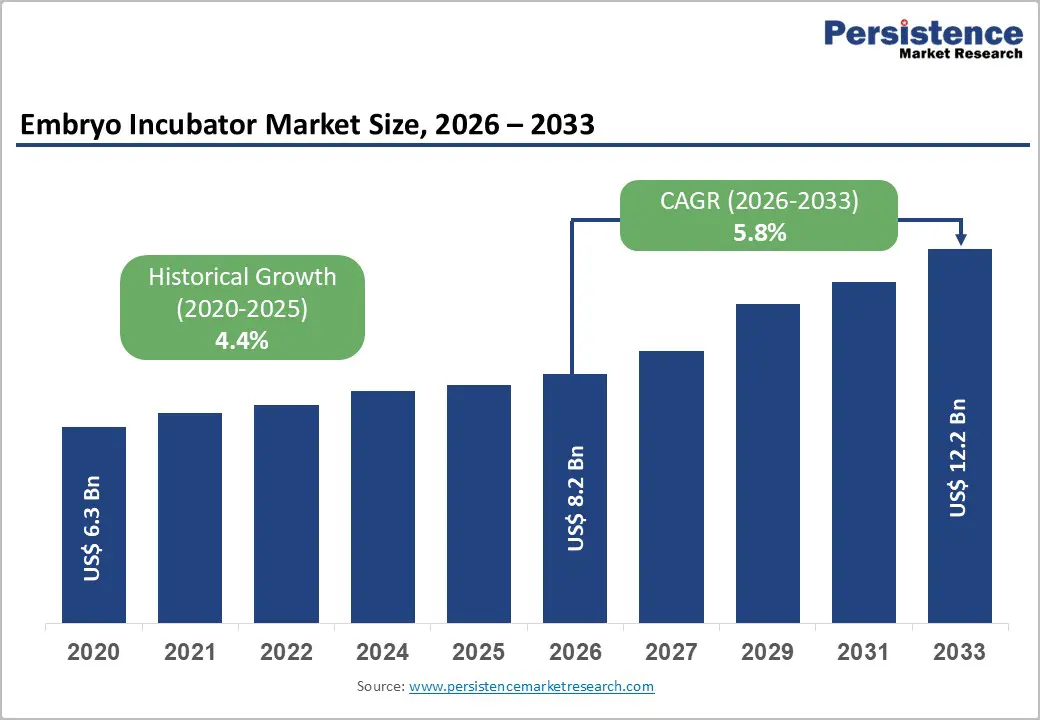
The global embryo incubator market size is expected to be valued at US$ 8.2 billion in 2026 and projected to reach US$ 12.2 billion by 2033, growing at a CAGR of 5.8% between 2026 and 2033.
The market expansion is primarily driven by the escalating global infertility prevalence affecting approximately 1 in 6 people worldwide according to World Health Organization (WHO) reports, increasing adoption of advanced assisted reproductive technology procedures, and rapid technological innovations, including time-lapse imaging and artificial intelligence integration for improved embryo selection. These convergent factors create substantial demand for sophisticated embryo incubation systems across fertility clinics, hospitals, and research institutions, particularly as government healthcare systems increasingly recognize infertility as a medical priority requiring specialized treatment infrastructure.
Key Highlights:
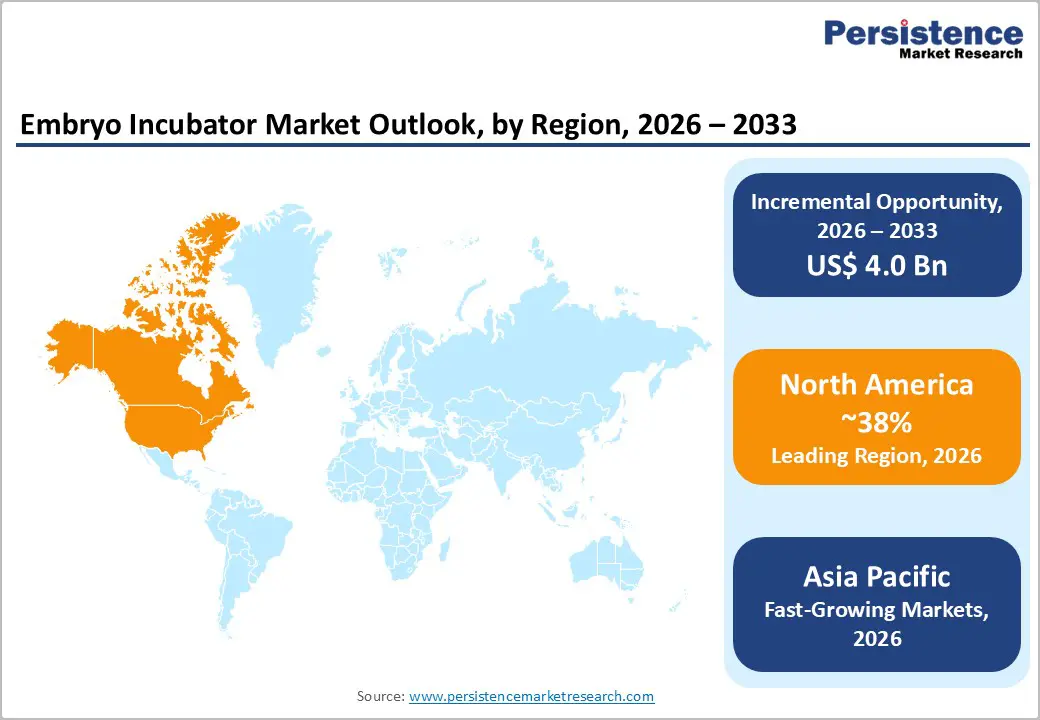
- North America leads with 38% market share, supported by advanced healthcare infrastructure, established fertility clinics, favorable insurance policies, strong regulations, and continuous innovation in embryo incubator technology.
- Asia-Pacific is the fastest-growing region, driven by healthcare policy reforms, expanding clinic infrastructure, skilled professionals, medical tourism growth, and rising awareness of reproductive healthcare.
- Tri-Gas Incubators with Camera dominate the product category (55% share), offering time-lapse imaging, precise environmental control, and data analytics to improve embryo selection and IVF success rates.
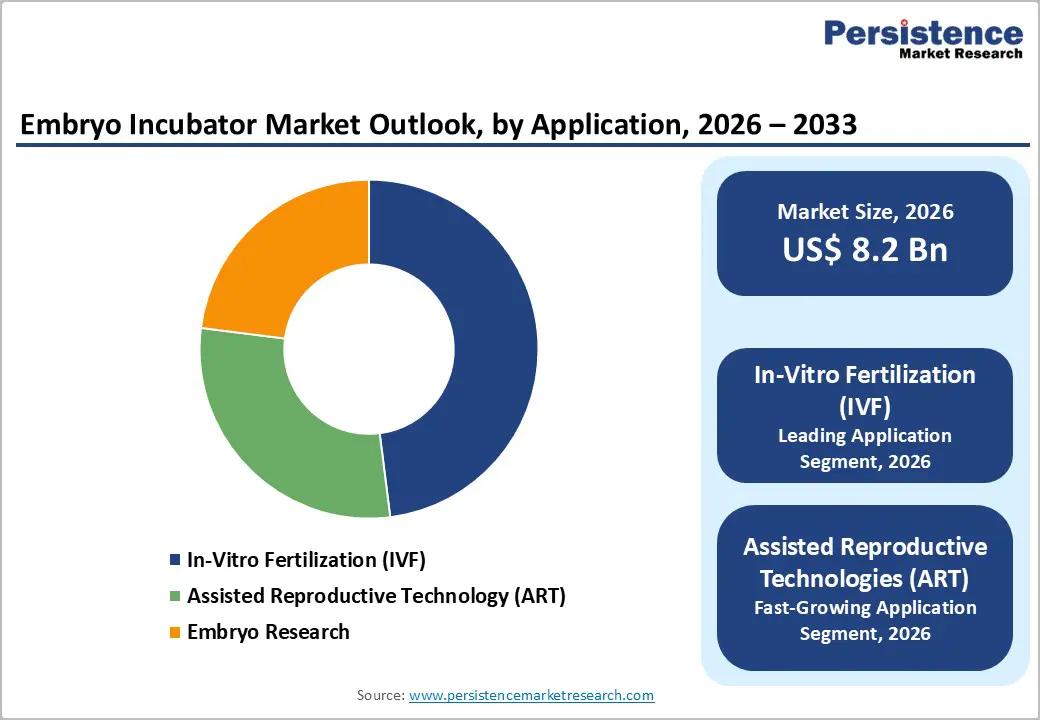
- IVF applications lead with 48% share, fueled by high IVF cycles, expanding adoption, better insurance coverage, and growing cultural acceptance of assisted reproductive technologies.
- AI and cloud-based analytics present opportunities for automated embryo assessment, improved selection accuracy, predictable outcomes, and competitive differentiation for clinics.
| Key Insights | Details |
|---|---|
|
Embryo Incubator Market Size (2026E) |
US$ 8.2 billion |
|
Market Value Forecast (2033F) |
US$ 12.2 billion |
|
Projected Growth CAGR (2026-2033) |
5.8% |
|
Historical Market Growth (2020-2025) |
4.4% |
Market Dynamics
Drivers - Rising Global Infertility Prevalence and Increasing Adoption of Assisted Reproductive Technologies
The rising prevalence of infertility worldwide has emerged as a significant driver for the embryo incubator market. According to the World Health Organization, infertility affects approximately 10–15% of couples globally, with higher incidence in regions experiencing delayed parenthood and lifestyle-related health issues. This growing need for fertility solutions has led to increased adoption of assisted reproductive technologies (ART), including in-vitro fertilization (IVF), intracytoplasmic sperm injection (ICSI), and other advanced procedures. Embryo incubators play a critical role in these treatments by providing a stable and controlled environment for embryo culture, ensuring higher survival and implantation rates. As more couples seek fertility treatment, especially in emerging markets with rising awareness and accessibility of ART services, the demand for high-performance embryo incubators is expected to grow significantly, further driving technological innovations and market expansion.
Technological Advancements in Time-Lapse Imaging and Artificial Intelligence Integration
Modern embryo incubators have evolved significantly from conventional systems, with tri-gas incubators with integrated camera systems commanding 54.6% of the market share in 2025. Time-lapse imaging technology enables continuous, non-invasive embryo monitoring without removing embryos from their optimal culture environment, maintaining stable temperature, gas composition, and humidity conditions throughout development. This advancement directly translates to improved embryo viability and higher implantation success rates. The integration of artificial intelligence and machine learning algorithms for automated embryo quality assessment represents the fastest-growing segment, allowing embryologists to make objective, data-driven decisions about embryo selection for transfer. These technological innovations significantly enhance in-vitro fertilization (IVF) success rates, reduce clinical miscarriage rates, and improve overall treatment outcomes, compelling fertility clinics and research institutions to invest in next-generation incubation systems.
Restraints - High Capital Equipment Costs and Operational Complexity
Sophisticated embryo incubators with integrated camera systems and automated monitoring capabilities require substantial capital investments, typically ranging from hundreds of thousands to several million dollars depending on specifications and capacity. Beyond initial acquisition costs, organizations must budget for regular maintenance, calibration, personnel training, and compliance certifications. This financial barrier significantly limits adoption among smaller fertility clinics, non-profit organizations, academic research institutions with constrained budgets, and healthcare providers in low-to-middle income countries. In developing regions, where the median infertility treatment cost represents a substantial portion of annual household income, the accessibility challenge remains severe, creating geographic disparities in technology adoption and patient access to advanced fertility care services.
Regulatory Variations and Specialized Training Requirements
Embryo incubators operate under stringent regulatory frameworks that vary significantly across jurisdictions. The European Union, United States Food and Drug Administration (FDA), and national regulatory bodies in China, Japan, India, and other markets establish distinct compliance requirements, validation protocols, and quality standards. These varying regulatory landscapes create operational complexity for manufacturers and healthcare providers operating across multiple regions. Additionally, effective utilization of advanced incubator systems requires specialized embryology training, quality assurance expertise, and technical proficiency that remains scarce in many markets. The shortage of qualified personnel capable of properly operating, maintaining, and interpreting data from sophisticated incubation systems creates operational bottlenecks and limits market penetration, particularly in emerging economies with developing reproductive healthcare infrastructure.
Opportunities - Integration of Artificial Intelligence and Cloud-Based Data Analytics for Embryo Assessment
The integration of artificial intelligence (AI) and machine learning technologies into embryo incubation systems represents a transformative market opportunity. Advanced algorithms can analyze time-lapse imaging data to identify morphokinetic markers predictive of embryo developmental competence, enabling objective, standardized embryo selection without subjective embryologist interpretation. Cloud-based data management systems allow fertility clinics to store, analyze, and compare embryo development patterns across thousands of cycles, generating insights that continuously improve selection accuracy and treatment protocols. This technology integration reduces the clinical expertise required for effective incubator operation, partially addressing the global shortage of qualified embryologists. Furthermore, AI-driven embryo assessment improves implantation rates and reduces miscarriage risks, justifying premium equipment pricing while enhancing patient satisfaction and clinic reputation. Early adopters of AI-integrated incubators are reporting significantly improved clinical outcomes, creating competitive differentiation and market demand that will accelerate technology adoption throughout the forecast period.
Category-wise Analysis
Product Type Insights
Tri-Gas Incubators with Camera represents the dominant product segment, commanding approximately 55% of the embryo incubator market in 2025. These advanced systems integrate multiple critical components including precise environmental control mechanisms for carbon dioxide, oxygen, and nitrogen gas mixtures, integrated high-resolution camera systems with microscopic imaging capabilities, and sophisticated temperature and humidity regulation systems. The primary advantage of tri-gas incubators with cameras is their ability to maintain optimal embryo culture conditions while enabling continuous, non-invasive monitoring through time-lapse imaging. This technology eliminates the embryo stress associated with removing samples from incubators for periodic microscopic evaluation, which exposes embryos to temperature fluctuations, altered gas concentrations, and physical handling. The resulting improvement in embryo viability, implantation rates, and pregnancy success rates justifies the premium pricing of these systems. Leading manufacturers, including Esco Micro Pte. Ltd. with their MIRI Time-Lapse Incubator, Genea Biomedx with their Geri system, and Vitrolife with Embryoscope technology have established strong market positions through continuous innovation in imaging resolution, data analytics capabilities, and user interface design that simplifies workflow integration in busy fertility laboratory settings.
End-user Insights
Fertility clinics dominate the embryo incubator market due to their central role in assisted reproductive treatments. These clinics perform the highest volume of in-vitro fertilization (IVF) and related procedures, where precise embryo culture and monitoring are critical for successful implantation. Embryo incubators provide a controlled environment for temperature, humidity, and gas composition, directly impacting embryo viability and patient outcomes. As demand for fertility services rises globally, fueled by increasing infertility rates, delayed parenthood, and greater social acceptance of reproductive technologies, fertility clinics are expanding their infrastructure and investing in advanced incubator systems. Additionally, clinics prioritize technologies like time-lapse imaging and tri-gas incubators to improve success rates and attract patients. Their continuous operational need for high-quality embryo culture positions fertility clinics as the largest and most consistent users of embryo incubators worldwide.
Regional Insights
North America Embryo Incubator Market Trends
North America leads the global embryo incubator market, driven by advanced healthcare infrastructure, high awareness of fertility treatments, and strong adoption of assisted reproductive technologies (ART). The region benefits from a well-established network of fertility clinics and hospitals offering in-vitro fertilization (IVF), intracytoplasmic sperm injection (ICSI), and other ART procedures, creating sustained demand for high-performance incubators. Technological innovation is a key trend, with clinics increasingly deploying time-lapse imaging systems and tri-gas incubators to enhance embryo monitoring and improve success rates. Additionally, supportive government policies, insurance coverage for infertility treatments in select areas, and a growing focus on research and personalized fertility solutions contribute to market growth. North America also witnesses early adoption of portable and compact incubators, catering to smaller clinics and research labs. These factors collectively maintain the region’s leading position while driving continuous technological advancement.
Asia Pacific Embryo Incubator Market Trends
The Asia Pacific embryo incubator market is witnessing rapid growth, emerging as a key region in the global landscape due to rising infertility rates, increasing awareness of assisted reproductive technologies (ART), and expanding healthcare infrastructure. Countries like India, China, Japan, and Australia are experiencing growing demand for in-vitro fertilization (IVF) and related procedures, driving the adoption of advanced embryo incubators. Fertility clinics and hospitals are investing in time-lapse imaging systems, tri-gas incubators, and compact units to improve embryo monitoring and success rates. Government initiatives promoting reproductive healthcare, coupled with increasing disposable income and social acceptance of ART, are further supporting market expansion. Additionally, the proliferation of fertility research centers and collaborations with global technology providers is accelerating the availability of cutting-edge incubator systems. Collectively, these factors position the Asia Pacific as the fastest-growing region in the embryo incubator market.
Competitive Landscape
The embryo incubator market is highly competitive, characterized by continuous technological innovation and product differentiation. Key players focus on developing advanced features such as time-lapse imaging, tri-gas control, and compact designs to enhance embryo culture and improve clinical outcomes. Companies invest heavily in research and development, strategic collaborations, and geographic expansion to strengthen their market presence. Competitive strategies also include offering customized solutions for fertility clinics, hospitals, and research laboratories, alongside after-sales support and training services. The combination of innovation, quality, and customer-centric approaches drives intense rivalry, positioning the market as dynamic and technology-driven with evolving adoption patterns globally.
Key Developments:
- In December 2025, Hanahealth, the authorized partner of Sydney-based Genea Biomedx, launched the advanced GERI Time-Lapse Incubator across India. GERI, the next-generation time-lapse embryo culture system from Genea Biomedx, was designed for IVF clinics, laboratories embracing digital transformation, centers pursuing accreditation, and research-focused fertility groups. The system enabled these facilities to modernize their processes and enhance IVF outcomes, offering a more efficient and technologically advanced approach to embryo monitoring and culture.
Companies Covered in Embryo Incubator Market
- Esco Micro Pte. Ltd.
- Vitrolife
- Genea Biomedx
- Cook Medical Inc.
- Thermo Fisher Scientific Inc.
- Genea Limited
- EMD Sereno Inc.
- IVFtech ApS
- The Baker Company
Frequently Asked Questions
The global embryo incubator market is projected to reach US$ 8.2 billion in 2026.
Increasing prevalence of infertility among couples is driving demand for assisted reproductive technologies (ART), such as IVF, where embryo incubators are essential.
North America maintains the dominant regional position, capturing approximately 38% of global embryo incubator market share in 2025.
Remote monitoring, data storage, and analytics can enhance clinical decision-making, support multi-center collaborations, and attract tech-savvy fertility clinics.
Esco Micro Pte. Ltd., Vitrolife, Genea Biomedx, Cook Medical Inc., and Thermo Fisher Scientific Inc.


