




- Home Care & Utilities
- Countertop Spray Market
Countertop Spray Market Size, Share, and Growth Forecast 2026 - 2033
Countertop Spray Market by Product Type (All-Purpose Countertop Sprays, Disinfectant Spray, Degreasing Countertop Sprays, Surface-Specific Sprays (Stone & Granite, Quartz, Marble, Stainless-steel safe), Others), Application (Household, Commercial, Industrial), Distribution Channel (Offline Channels, Online Channels), and Regional Analysis, 2026 - 2033

Countertop Spray Market Size and Trend Analysis
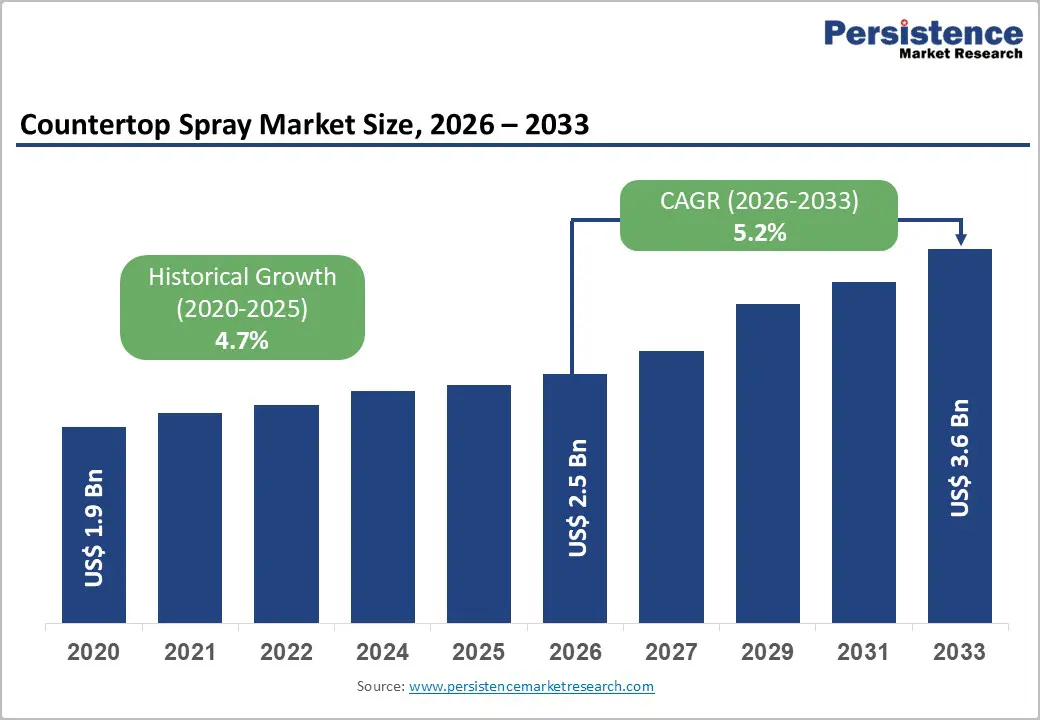
The global Countertop Spray Market size is expected to be valued at US$ 2.5 billion in 2026 and projected to reach US$ 3.6 billion by 2033, growing at a CAGR of 5.2% between 2026 and 2033.
Rising hygiene awareness continues to be a major growth driver, as health authorities such as the World Health Organization (WHO) and Centers for Disease Control and Prevention (CDC) emphasize regular surface disinfection to reduce pathogen transmission. Rapid urbanization and increasing dual-income households are fueling demand for convenient, ready-to-use cleaning solutions. Additionally, expanding e-commerce penetration improves product accessibility, enabling sustained market growth across residential and commercial sectors globally.
Key Industry Highlights:
- Leading Region: North America leads the Countertop Spray Market with a 34% share in 2025, supported by strong hygiene awareness, advanced retail infrastructure, and high adoption of disinfectant sprays.
- Fastest Growing Region: Asia Pacific is the fastest-growing region, holding a 30% share in 2025, fueled by rapid urbanization and expanding middle-class consumer adoption.
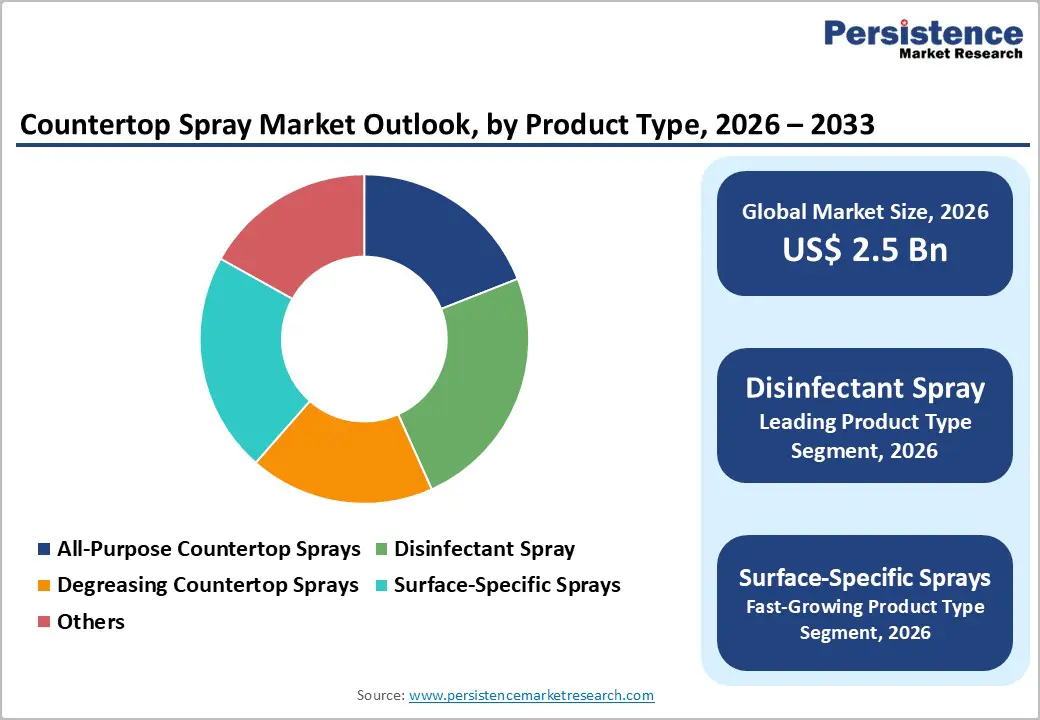
- Leading Category: Disinfectant Spray dominates the product segment with a 32% share in 2025, driven by sustained demand for antibacterial and antiviral surface protection.
- Fastest Growing Category: Online Channels are the fastest-growing distribution segment, accelerating due to rising e-commerce penetration and subscription-based purchasing trends.
- Key Opportunity: Eco-friendly and plant-based antibacterial countertop sprays present a strong opportunity, aligned with increasing consumer preference for sustainable and surface-safe cleaning solutions.
| Key Insights | Details |
|---|---|
|
Countertop Spray Size (2026E) |
US$ 2.5 billion |
|
Market Value Forecast (2033F) |
US$ 3.6 billion |
|
Projected Growth CAGR(2026-2033) |
5.2% |
|
Historical Market Growth (2020-2025) |
4.7% |
Market Dynamics
Drivers - Heightened Hygiene Awareness and Sustained Sanitization Practices Driving Countertop Spray Adoption
The heightened focus on hygiene following the COVID-19 pandemic continues to significantly influence consumer cleaning habits. Households and commercial establishments alike have adopted more frequent surface-cleaning routines to minimize the risk of pathogen transmission. Kitchens and bathrooms, being high-contact areas, are witnessing increased usage of disinfectant countertop sprays designed to eliminate bacteria and viruses effectively.
Consumers now prioritize products that offer visible cleanliness along with antimicrobial protection. This behavioral shift has led to sustained demand for disinfectant and multi-surface sprays across residential and commercial spaces. The perception of safer, sanitized environments supports repeat purchases, reinforcing steady market expansion as hygiene remains a long-term priority rather than a temporary trend.
Rapid Urbanization and Growing Preference for Convenient, Time-Saving Cleaning Solutions
Rapid urbanization and evolving lifestyles are reshaping cleaning preferences worldwide. As urban populations grow, living spaces become more compact, and fast-paced routines leave limited time for extensive cleaning. Consumers increasingly prefer ready-to-use countertop sprays that provide quick and efficient cleaning without the need for additional preparation or dilution.
The rise in dual-income households further strengthens demand for convenient solutions that simplify daily chores. Multi-surface sprays capable of handling grease, stains, and general dirt in one application are particularly attractive to busy professionals. This demand for efficiency, combined with modern retail accessibility, continues to accelerate the adoption of countertop spray products globally.
Restraints - Stringent Chemical Regulations and Compliance Requirements Increasing Reformulation Costs
Increasing regulatory scrutiny on chemical ingredients used in cleaning products poses a significant challenge for countertop spray manufacturers. Governments across major markets have tightened safety standards regarding volatile organic compounds, preservatives, and antimicrobial agents. Compliance with evolving environmental and health regulations often requires reformulation, additional testing, and updated labeling, which increases operational complexity and production costs.
These regulatory procedures can also delay product approvals and market launches, limiting innovation speed. Smaller manufacturers may struggle with compliance expenses, while larger players must invest heavily in research and safer ingredient alternatives. Such constraints can impact profit margins and slow the introduction of new synthetic or disinfectant spray variants in competitive markets.
Rising Consumer Shift Toward Natural and Plant-Based Cleaning Alternatives
Growing consumer awareness regarding indoor air quality and chemical exposure is shifting demand toward natural and plant-based cleaning solutions. Many buyers now prefer products perceived as non-toxic, biodegradable, and free from harsh synthetic additives. This trend is particularly strong among health-conscious households seeking safer cleaning options for kitchens and food-contact surfaces.
As a result, conventional chemical-based countertop sprays face increasing competition from eco-friendly and organic alternatives. Brands that fail to adapt to clean-label preferences risk losing market share. The shift toward sustainable and plant-derived formulations may restrain growth for traditional products while encouraging manufacturers to redesign offerings to align with evolving consumer expectations.
Opportunity - Expanding Demand for Eco-Friendly and Sustainable Countertop Spray Innovations
Rising environmental awareness is creating strong opportunities for eco-friendly countertop spray formulations. Consumers increasingly seek plant-based, biodegradable, and low-VOC products that ensure effective cleaning while minimizing environmental impact. Demand is particularly strong for stone-safe and non-corrosive solutions that combine sustainability with surface protection, appealing to premium and health-conscious buyers.
Manufacturers investing in green chemistry, refill packaging, and certified sustainable ingredients can capture higher-value segments. Willingness among consumers to pay a premium for safer and environmentally responsible products strengthens revenue potential. Continuous innovation in natural disinfectant technologies and sustainable packaging formats presents long-term growth prospects across residential and commercial markets.
Growth in Hospitality and Professional Cleaning Sectors Driving Commercial Demand
The expansion of the global hospitality industry presents significant opportunities for countertop spray manufacturers. Hotels, resorts, restaurants, and serviced apartments require consistent and efficient surface cleaning solutions to maintain hygiene standards and enhance guest confidence. Increased travel activity directly supports higher procurement of industrial-grade and bulk cleaning sprays.
Additionally, the growth of professional cleaning and facility management services strengthens demand for commercial and institutional countertop sprays. These service providers prioritize high-performance, quick-drying, and multi-surface formulations suitable for large-scale operations. As tourism and organized cleaning services expand globally, commercial adoption of countertop sprays is expected to rise steadily.
Category-wise Analysis
Product Type Insights
Disinfectant sprays lead the countertop spray market, accounting for 32% share in 2025, primarily driven by sustained hygiene awareness and demand for germ-eliminating solutions. Consumers increasingly prefer products that provide antibacterial and antiviral protection, particularly for kitchen and bathroom countertops. The strong focus on surface sanitization in households, food preparation areas, and commercial settings continues to reinforce the dominance of disinfectant formulations over standard cleaning sprays.
Meanwhile, eco-friendly and surface-specific sprays are emerging as the fastest-growing categories. Rising preference for plant-based ingredients and stone-safe formulations is encouraging manufacturers to introduce specialized products for granite, quartz, and marble surfaces. Consumers seeking safer, non-corrosive, and multi-benefit solutions are accelerating innovation in natural and premium countertop spray segments.
Application Insights
The household segment dominates the market, holding 58% share in 2025, supported by consistent daily cleaning routines in residential spaces. Urban households increasingly rely on ready-to-use countertop sprays for quick removal of grease, spills, and bacteria from kitchen and bathroom surfaces. The growing number of urban homes and compact living environments further strengthens demand for convenient and effective home cleaning solutions.
The commercial segment is witnessing the fastest growth due to expanding hospitality, foodservice, and office infrastructure worldwide. Restaurants, hotels, and shared workspaces require frequent surface sanitization to maintain hygiene standards. The increasing outsourcing of cleaning services and higher sanitation expectations in public spaces are driving strong demand for professional-grade countertop spray products.
Distribution Channel Insights
Offline channels lead the market with a 52% share in 2025, primarily driven by supermarket and hypermarket sales. Consumers prefer in-store purchases for cleaning products, as they allow product comparison, brand familiarity, and immediate availability. Strong retail shelf presence and promotional activities continue to support the dominance of brick-and-mortar distribution networks.
Online channels are emerging as the fastest-growing distribution segment. Expanding e-commerce platforms, subscription models, and direct-to-consumer brand websites are improving accessibility and convenience. Digital promotions, customer reviews, and doorstep delivery are influencing purchasing decisions, particularly among younger and urban consumers, accelerating the shift toward online countertop spray sales.
Regional Insights
North America Countertop Spray Market Trends
North America leads the global countertop spray market, accounting for approximately 34% share in 2025, driven by strong consumer awareness regarding hygiene and well-established retail infrastructure. The United States remains the key contributor, supported by stringent hygiene standards in residential and commercial environments. High penetration of branded disinfectant sprays and continuous product innovation focused on safer formulations further strengthen regional dominance.
The region is also witnessing steady growth due to rising e-commerce adoption and increasing home renovation activities. Consumers are upgrading kitchens and countertops, encouraging demand for surface-specific and premium sprays. Expansion of private-label brands and sustainable product lines continues to enhance competition and product accessibility across urban and suburban markets.
Europe Countertop Spray Market Trends
Europe represents a mature yet steadily expanding market, supported by strict regulatory frameworks and harmonized biocidal product standards. Germany and the United Kingdom lead regional consumption due to high hygiene awareness and strong household spending on cleaning products. Growing demand for environmentally compliant and low-chemical formulations aligns with the region’s sustainability focus.
The market is projected to grow at a CAGR of around 5.0% during the forecast period, supported by rising tourism and hospitality activities across France, Spain, and Southern Europe. Increased sanitation requirements in public facilities and commercial establishments are driving consistent demand for disinfectants and multi-surface countertop sprays throughout the region.
Asia Pacific Countertop Spray Market Trends
Asia Pacific accounts for approximately 30% share in 2025 and is emerging as the fastest-growing regional market. Rapid urbanization in countries such as China and India, along with expanding middle-class populations, is driving higher adoption of modern household cleaning products. Growing awareness about hygiene and rising disposable incomes are encouraging consumers to shift from traditional cleaning methods to convenient spray formats. The region also benefits from strong manufacturing capabilities and expanding retail networks, including online marketplaces. Increasing investments in hospitality, foodservice, and commercial infrastructure across Southeast Asia further stimulate demand for disinfectant and industrial-grade countertop sprays, supporting sustained long-term market growth.
Competitive Landscape
The countertop spray market is moderately consolidated, with leading manufacturers maintaining a strong presence through broad product portfolios and established distribution networks. Competition is driven by continuous research and development focused on safer, plant-based, and surface-specific formulations. Companies are investing in innovation to enhance antimicrobial performance, improve fragrance profiles, and develop refillable or concentrated formats that address both convenience and sustainability expectations.
Differentiation increasingly depends on patented formulations, eco-certifications, and packaging innovation. Subscription-based sales models and direct-to-consumer strategies are gaining traction, strengthening customer retention. Sustainability commitments, transparent labeling, and multi-surface compatibility are becoming critical competitive factors shaping long-term positioning in the market.
Key Developments:
- In March 2024, SC Johnson introduced a Green Seal-certified Windex granite spray designed specifically for stone surfaces, strengthening its sustainable product portfolio and expanding its presence in premium, eco-conscious countertop cleaning solutions across retail markets.
- In July 2025, Reckitt expanded its Lysol portfolio with a no-rinse stone disinfectant spray, enhancing convenience for consumers and commercial users while targeting growing demand for surface-safe, antimicrobial cleaning solutions in kitchens and hospitality environments.
- In November 2023, Clorox launched a plant-based countertop spray that achieved USDA BioPreferred certification, reinforcing its commitment to sustainable innovation and meeting increasing consumer demand for environmentally responsible, bio-based household cleaning products.
Companies Covered in Countertop Spray Market
- The Clorox Company
- Reckitt (Reckitt Benckiser Group plc)
- S. C. Johnson & Son, Inc.
- Procter & Gamble Co.
- Unilever PLC
- Henkel AG & Co. KGaA
- Colgate‑Palmolive Company
- Ecolab Inc.
- Zep Inc.
- Method Products, PBC
- Seventh Generation, Inc.
- Mrs. Meyer’s Clean Day
- Betco Corporation
- GOJO Industries, Inc.
- Werner & Mertz Company
Frequently Asked Questions
US$ 2.5 billion globally, supported by strong household demand holding 58% share in 2025.
Post-COVID hygiene focus drives demand, with Disinfectant Spray leading at 32% share in 2025.
North America leads with a 34% share in 2025, driven by strong U.S. hygiene standards and retail presence.
Eco-friendly disinfectant sprays present key opportunities, especially across fast-growing Asia Pacific holding 30% share in 2025.
Major players include Reckitt, S. C. Johnson & Son, Inc., and The Clorox Company.


